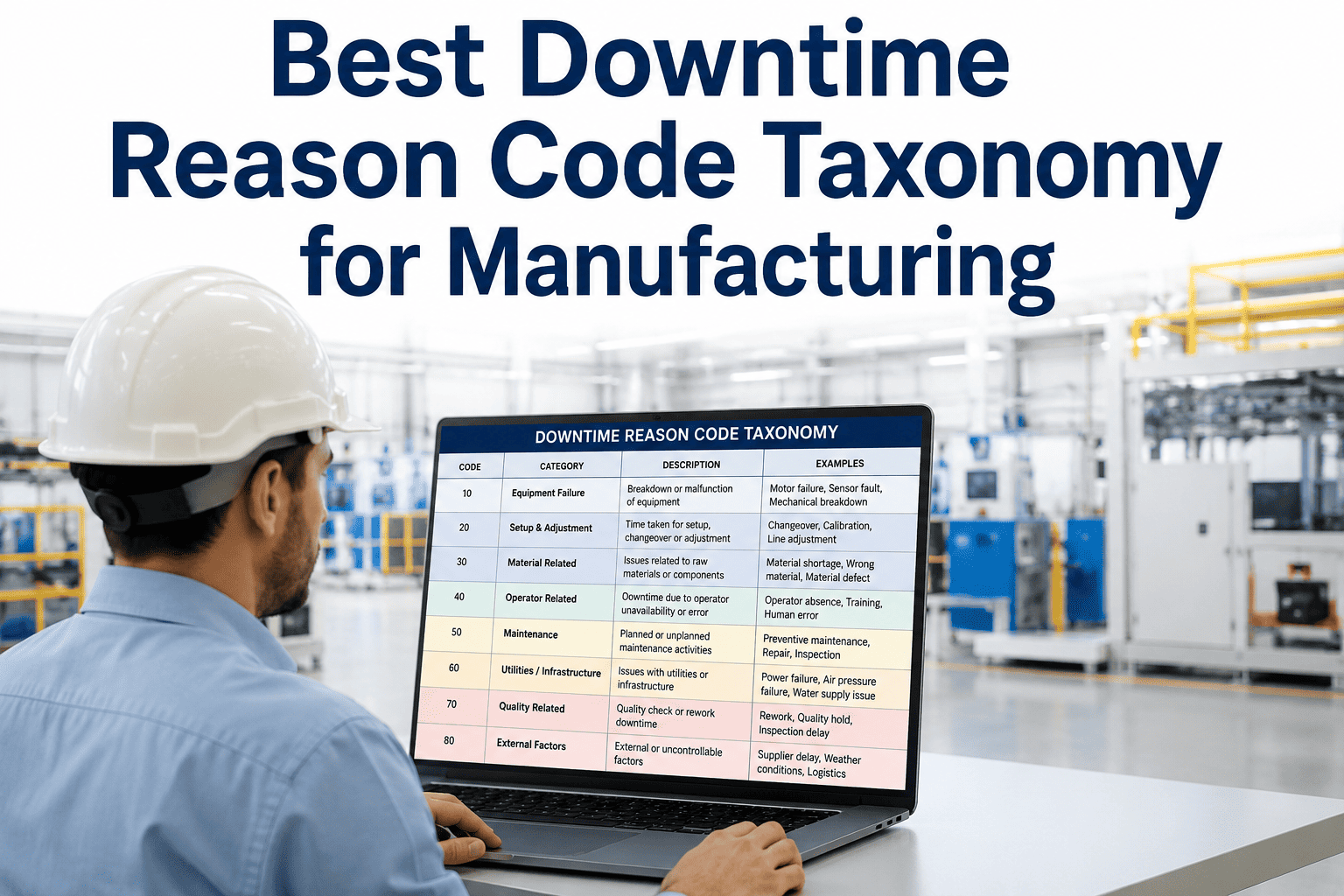
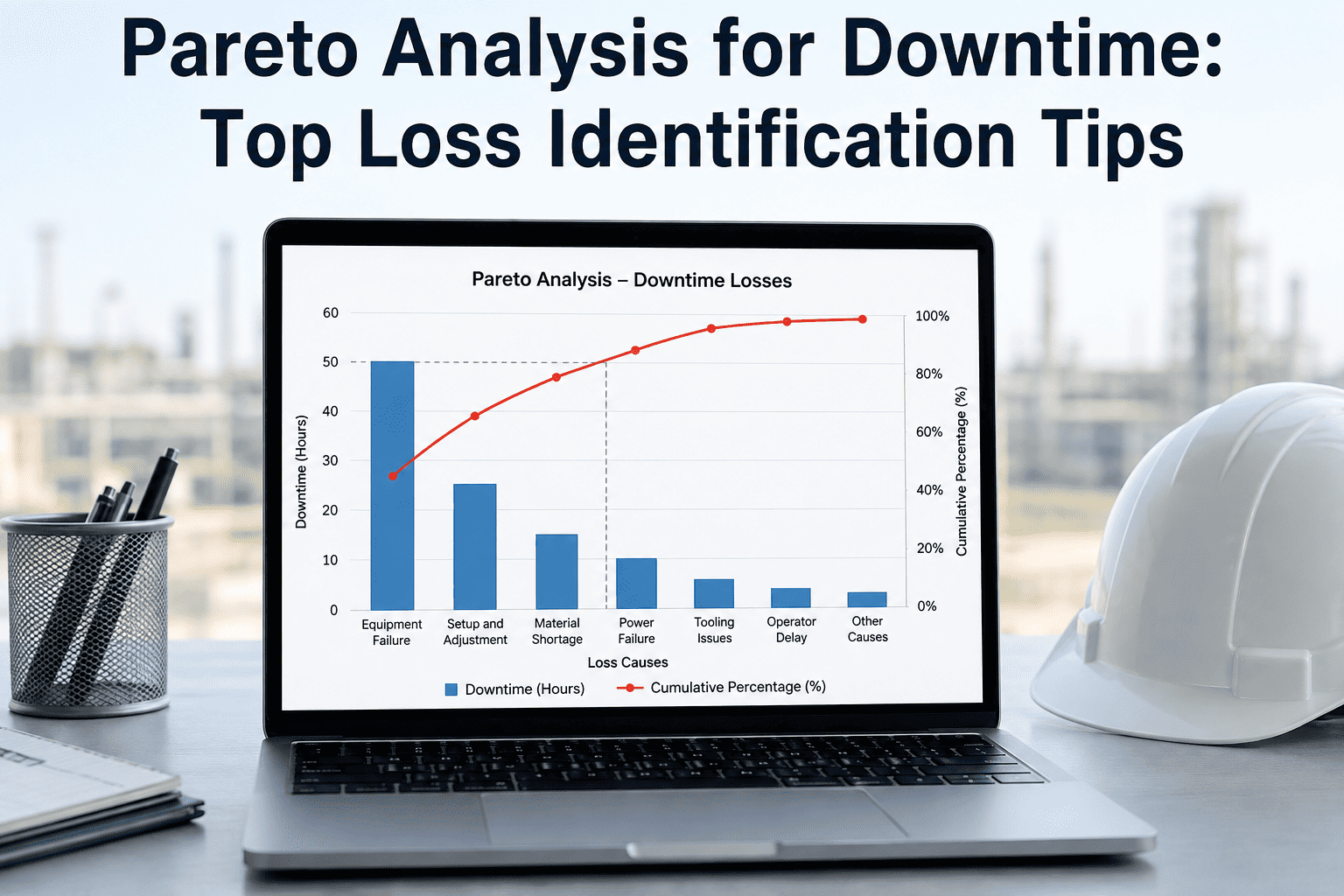
A downtime log full of entries like "machine issue" or "material problem" looks like data but functions like noise, because nobody can run a meaningful Pareto analysis or root cause investigation on categories that vague. A proper reason code taxonomy separates equipment causes, process causes, and external causes into a hierarchical structure specific enough that two different operators logging the same stoppage would pick the same code. Plants that build this structure once tend to find that months of previously uninterpretable downtime history suddenly becomes usable the moment new stops are logged consistently. Book a demo to see a reason code taxonomy built for your equipment.
Three Top-Level Cause Categories
Every downtime taxonomy should start by separating stoppages into a small number of top-level categories before subdividing further.
Equipment Cause
Stoppages originating from the machine itself, including mechanical failure, electrical fault, tooling wear, or a component reaching end of life, distinct from anything upstream or external to the equipment.
Process Cause
Stoppages tied to how the process is being run rather than a hardware failure, including changeovers, setup adjustments, quality holds, and planned parameter changes between production runs.
External Cause
Stoppages originating outside the equipment and process entirely, such as material shortage, power interruption, staffing gaps, or upstream supply delay that leaves the machine idle through no fault of the equipment or operator.
Building the Hierarchy: From Category to Specific Code
A useful taxonomy typically nests two or three levels deep, specific enough to support analysis without becoming so granular that logging becomes a burden.
Level 2
Mechanical Failure
Level 3
Bearing Failure — Main Drive
Level 3
Style Change — Tooling Swap
Level 2
Material Shortage
Level 3
Raw Material — Delayed Delivery
Get a Taxonomy Built Around Your Actual Equipment
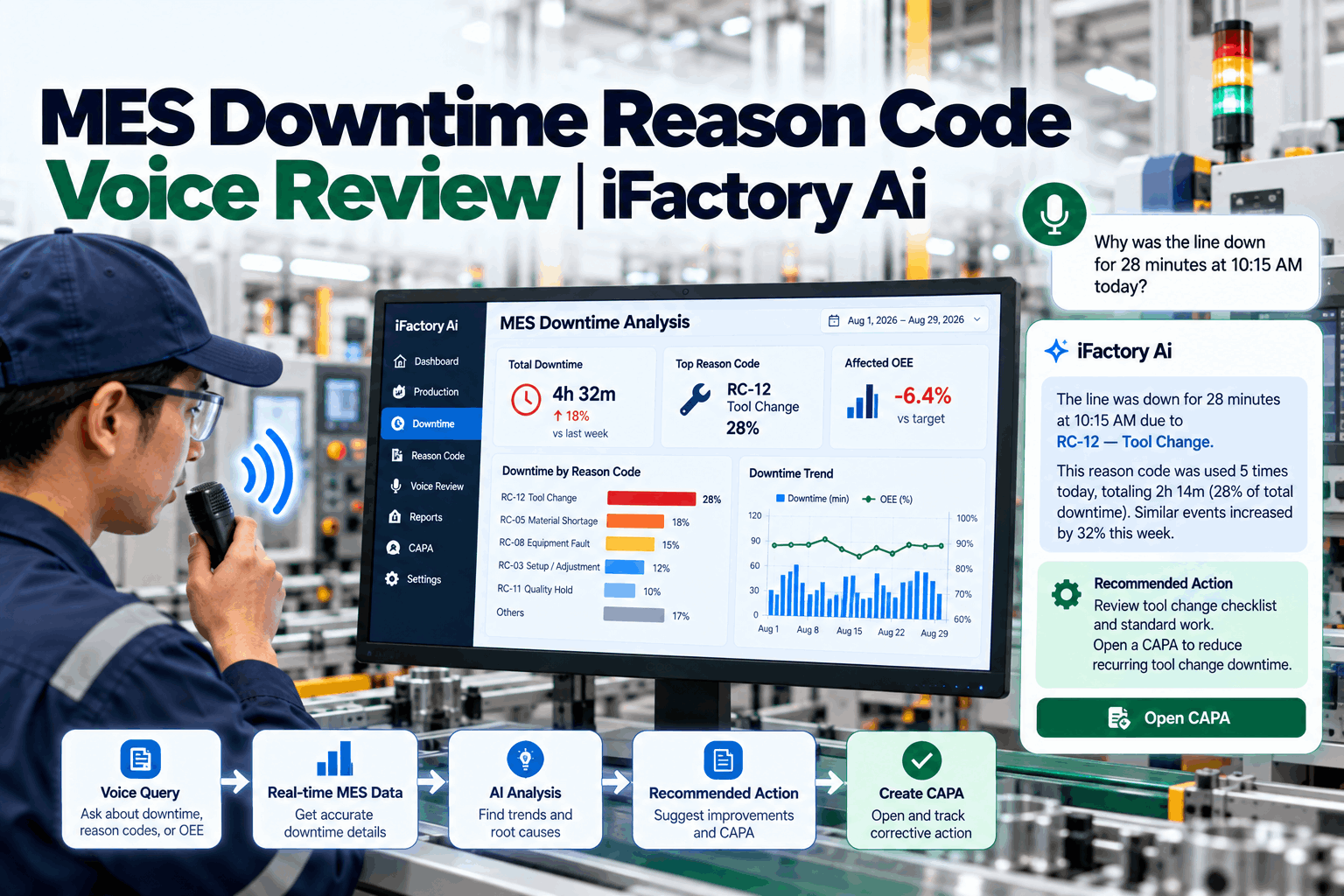
iFactory helps structure a hierarchical reason code taxonomy specific to your machines and process, so downtime data supports real Pareto and root cause analysis from day one.
Design Principles for a Usable Taxonomy
1
Keep the top level small and mutually exclusiveThree to five top-level categories, with each stoppage belonging clearly to one and only one, prevents ambiguity at the point of logging and keeps Pareto summaries interpretable at a glance.
2
Limit hierarchy depth to what operators can navigate quicklyA taxonomy nested five or six levels deep becomes a burden to log accurately in the moment, so two or three levels is generally the practical ceiling for shop-floor logging speed.
3
Build codes around your actual failure history, not a generic templateA taxonomy copied from a generic industry template often includes categories your equipment never experiences and misses the specific failure modes that actually recur on your floor.
4
Separate planned from unplanned stoppages at the top levelMixing a scheduled changeover with an unplanned breakdown under the same broad code distorts both the availability calculation and the Pareto ranking of true reliability losses.
5
Review and refine the taxonomy periodicallyAs new failure modes emerge or old categories go unused, revisiting the taxonomy every few months keeps it aligned with what is actually happening on the floor rather than freezing it at initial design.
Turn Vague Downtime Logs Into Analyzable Data
iFactory applies a structured, hierarchical reason code taxonomy consistently across every stoppage, making Pareto analysis and root cause work possible on data you already collect.
What a Well-Built Taxonomy Delivers
3
Top-Level Cause Categories
2–3
Hierarchy Levels, Practical Depth
Pareto-Ready
Data Structured for Real Analysis
Our downtime log had over a year of entries, almost all logged as either "breakdown" or "other." When we tried to run a Pareto analysis to justify a maintenance investment, we had nothing usable to show. Rebuilding the taxonomy around our actual failure history took less time than we expected, and within a month the new data was specific enough to actually rank our top loss categories.
Reliability Engineer
Process Manufacturing Plant — Pune
Frequently Asked Questions
QHow many reason codes should a taxonomy include in total?
There is no universal number, since it depends on how many distinct failure modes and process stoppages your specific equipment actually experiences, but a taxonomy with a few dozen specific codes organized under three to five top-level categories is a common practical range for a single production line. Far fewer risks vagueness, while far more risks slowing down consistent logging at the point of stoppage.
QCan an existing informal downtime log be converted into a proper taxonomy retroactively?
Historical entries logged under vague categories generally cannot be reliably reclassified after the fact unless there was enough free-text detail recorded alongside the code to reconstruct the actual cause, which is why the practical starting point is usually building the taxonomy correctly going forward rather than attempting a full retroactive cleanup of ambiguous historical data.
Talk to an expert about transitioning from your current log.
QShould changeover time be counted as downtime at all?
Whether changeover time counts toward availability loss depends on your specific OEE definition and reporting convention, but regardless of that classification decision, changeover should still carry its own distinct reason code separate from unplanned equipment failure, since conflating the two makes it impossible to see how much of total stoppage time is planned versus unplanned.
QHow do we get operators to log codes consistently rather than defaulting to a catch-all category?
Keeping the code selection interface simple and fast at the point of logging, limiting hierarchy depth to what can be navigated in a few seconds, and reviewing logged data regularly to flag overuse of catch-all or "other" categories back to operators all contribute to consistent logging, since a taxonomy that is technically well-designed but slow to use in practice tends to get bypassed under production pressure.
QHow often should the taxonomy be revised once it is in use?
A periodic review, commonly every few months, checking for codes that are never used, new failure modes that lack a specific code, or an "other" category accumulating an unexpectedly large share of entries keeps the taxonomy aligned with what is actually happening on the floor rather than becoming stale relative to evolving equipment and processes.
Book a demo to see taxonomy usage tracked and reviewed over time.
Make Every Stoppage Traceable to a Specific, Actionable Cause
iFactory helps you design and apply a hierarchical reason code taxonomy built around your actual equipment, turning downtime logs into data you can act on.