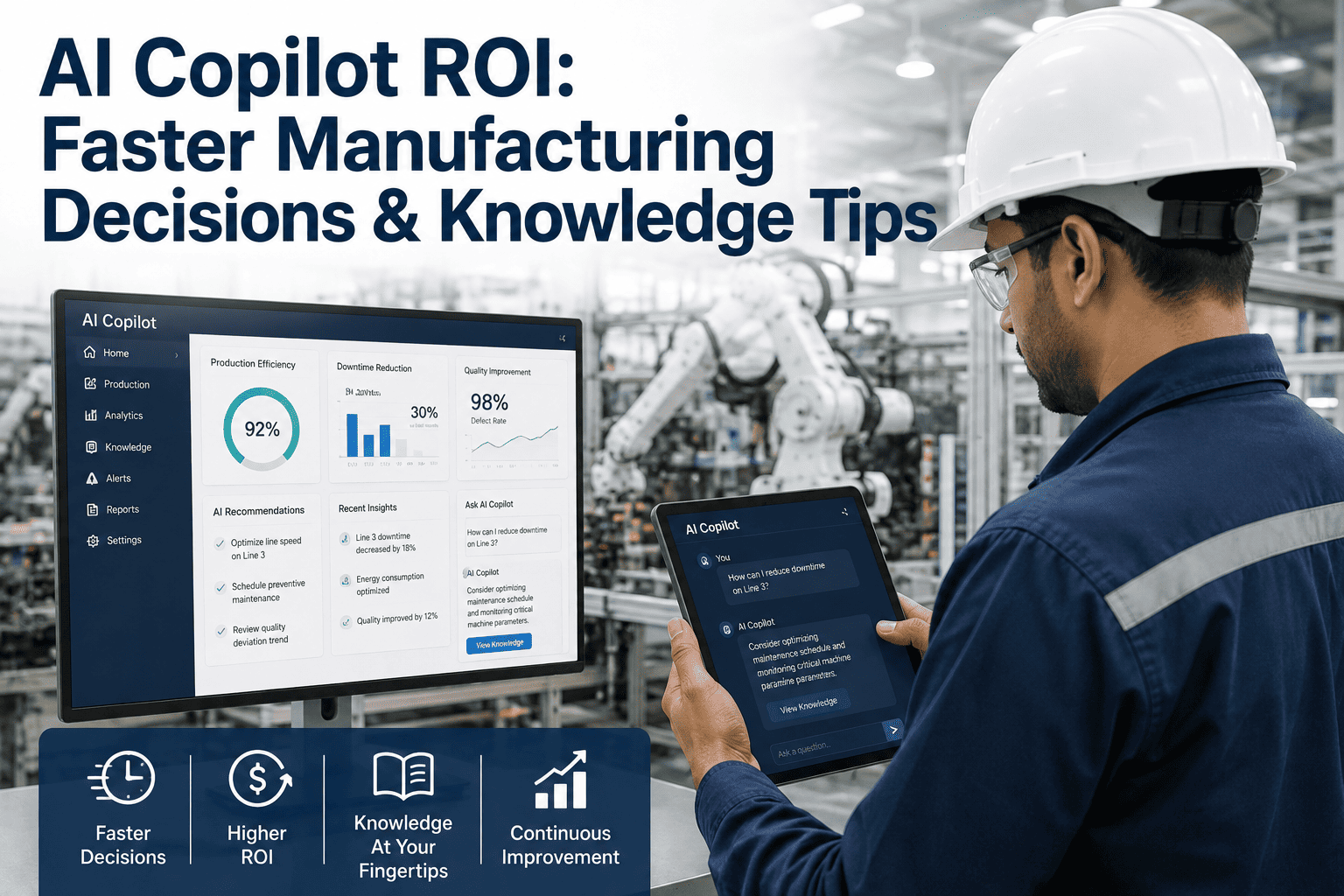
A veteran maintenance technician retires after thirty years, taking with him the exact sequence of checks he ran whenever a specific press started making an unusual sound, knowledge that was never written down because he simply knew it. A shift supervisor spends twenty minutes digging through binders and old email threads trying to find the root cause analysis from a similar downtime event eighteen months ago, only to eventually give up and start troubleshooting from scratch. These moments happen constantly across manufacturing plants, and each one has a real, measurable cost in lost time, repeated mistakes, and knowledge that walks out the door with every retirement or departure, yet almost none of it shows up as a clean line item on a monthly cost report. An AI copilot addresses this directly by putting your plant's own documented knowledge, historical incident data, and standard procedures into a conversational interface that any operator, technician, or engineer can query in seconds instead of searching through binders, shared drives, or a colleague's memory. If knowledge gaps and slow decisions are costing your plant real money, you can book a demo to see how an AI copilot pays for itself.
Turn Scattered Plant Knowledge Into Instant Answers Your Team Can Trust
iFactory's AI copilot puts your documented procedures, historical incident data, and institutional knowledge into a conversational tool that cuts troubleshooting time and preserves expertise that would otherwise walk out the door.
Three Sources of Return That Make Up AI Copilot ROI
Copilot value is not a single number but the sum of three distinct benefits that show up in different parts of the operation. Understanding each source separately makes it possible to estimate the value for your specific plant rather than relying on a generic industry average. Different plants tend to weight these three sources differently depending on their specific pain points, and building a credible business case usually starts by identifying which of the three is causing the most visible frustration today rather than trying to quantify all three with equal precision from day one.
Plants approaching retirement waves in their skilled trades workforce often find knowledge retention is the most urgent driver, while plants with high new-hire turnover or frequent product changeovers tend to see faster decisions and error reduction as the more immediate, measurable benefits. Neither weighting is wrong, and most successful deployments eventually realize value from all three sources as the copilot's knowledge base matures and usage spreads across more roles within the plant.
Faster Decisions
Time saved when an operator or engineer gets an immediate, accurate answer instead of searching documentation, calling a colleague, or waiting for an expert to become available.
Knowledge Retention
Value preserved when the expertise of experienced staff is captured in a queryable form before retirement or turnover removes it from the organization entirely.
Error Reduction
Cost avoided when consistent, correct procedural guidance reduces the mistakes that happen when someone works from memory or an outdated printed document.
How Much Time a Copilot Actually Saves on Common Plant Floor Questions
The table below compares the typical time required to resolve common information-seeking tasks using traditional methods versus querying an AI copilot with access to plant documentation and historical data. These figures are drawn from observed patterns across manufacturing plants of varying size and complexity, and while the exact minutes will differ at your facility depending on how well organized your existing documentation already is, the relative gap between the two methods tends to hold consistently across most environments.
| Task | Traditional Method | With AI Copilot |
|---|---|---|
| Find the SOP for an infrequent changeover | 8-15 minutes searching shared drives or binders | Under 30 seconds via direct query |
| Locate root cause from a similar past incident | 20-40 minutes searching email and reports, or none found | 1-2 minutes, with source incident referenced |
| Confirm a torque spec or setting for a variant | 5-10 minutes checking multiple documents | Under 30 seconds with the specific variant confirmed |
| Onboard a new operator to a station's procedures | Several shifts of shadowing an experienced operator | Immediate access to documented procedure plus shadowing |
| Escalate an unfamiliar fault code correctly | Call supervisor, wait for callback, guess in the meantime | Immediate guidance on the documented escalation path |
Why Knowledge Retention Is Becoming an Urgent Priority, Not a Nice-to-Have
Manufacturing is facing a demographic shift that makes institutional knowledge capture more urgent than it has ever been. A large share of experienced maintenance technicians, process engineers, and floor supervisors are approaching retirement age, and much of what they know was never formally documented because it accumulated gradually through years of hands-on experience rather than a structured training program. When that person leaves, the plant does not just lose a headcount, it loses a working mental model of exactly how the equipment behaves under conditions that never made it into any manual.
An AI copilot addresses this gap by making it far easier to capture what an experienced employee knows before they leave. Rather than a formal knowledge transfer project that competes for time with normal daily responsibilities, capturing knowledge into the copilot's reference material can happen incrementally, through natural conversations, documented troubleshooting sessions, and structured interviews conducted over the weeks leading up to a departure. The goal is not to capture everything at once but to prioritize the highest-risk knowledge first, typically the undocumented troubleshooting steps for the equipment most critical to production, before moving on to lower-priority institutional knowledge as time allows.
A Simple Framework for Estimating Copilot Value at Your Plant
Building a credible ROI estimate does not require perfect data, just a reasonable approximation of how often information-seeking delays and errors occur today. The framework below walks through the calculation most plants use to build an internal business case. It is worth resisting the temptation to wait for perfect data before building this estimate, since a directionally reasonable calculation based on informed estimates from supervisors and technicians is almost always sufficient to justify a focused pilot, and the pilot itself will generate the precise usage data needed to refine the estimate for a broader rollout decision.
Count Daily Information Queries
Estimate how many times per shift an operator or technician needs to look something up, ask a colleague, or wait for an expert across your target area.
Estimate Average Time Cost
Assign a realistic average time for how long each of those queries currently takes to resolve, including any downtime while the line waits on an answer.
Apply a Fully Loaded Labor Rate
Multiply the time saved across all queries by your plant's fully loaded labor cost to translate time savings into a dollar figure.
Add Error and Downtime Avoidance
Layer in the estimated cost of errors or extended downtime avoided when correct guidance is available immediately instead of through trial and error.