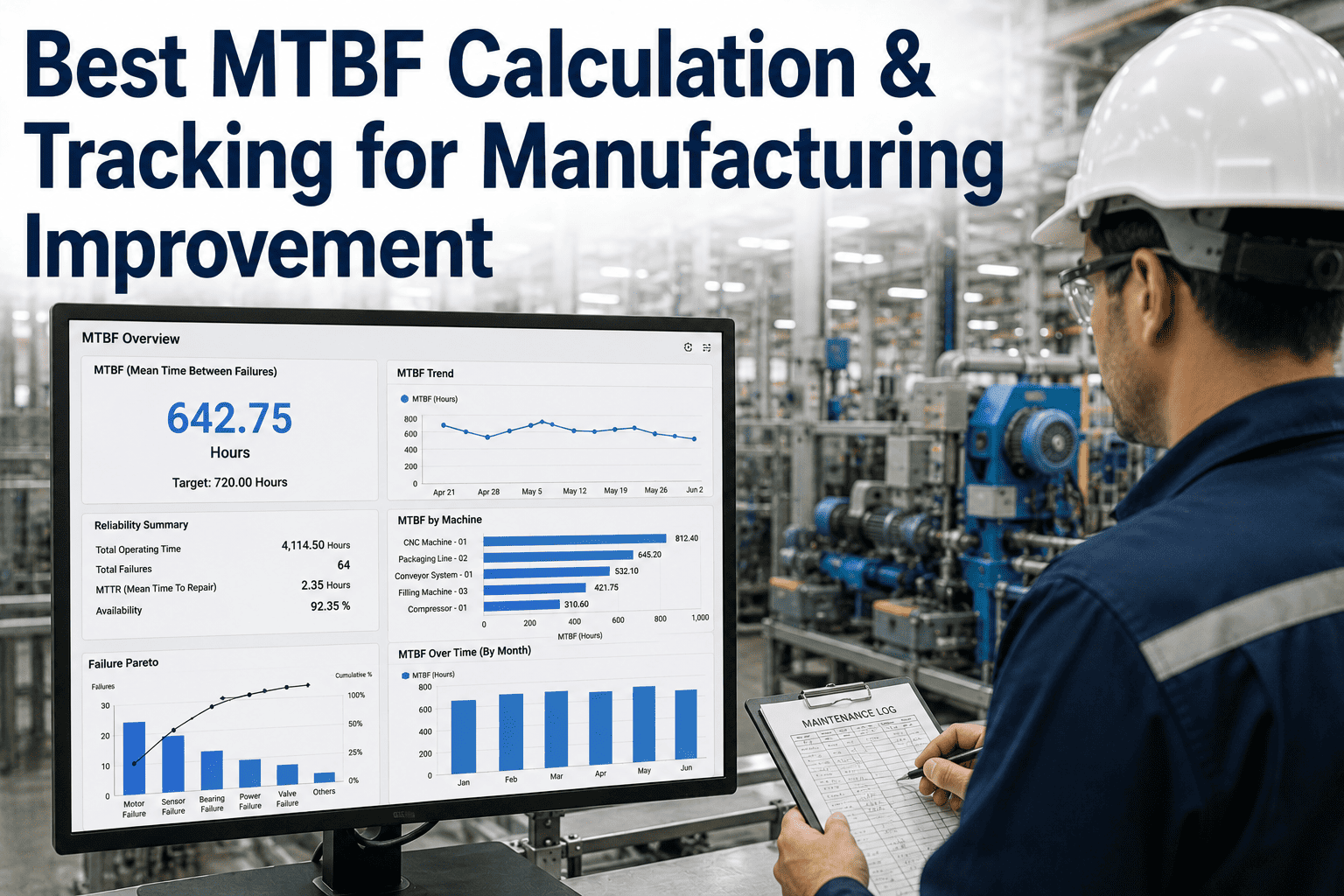
A maintenance team that can't state its MTBF with confidence usually can't say whether reliability is actually improving or just feels better because the last few weeks happened to be quiet. Mean Time Between Failures turns a string of anecdotal "things have been running well lately" into a number that can be trended, compared across equipment, and tied to specific reliability investments — but only if the failure counting and operating hours behind it are tracked consistently, which is where most plants' MTBF numbers quietly fall apart. A working session with our team can review whether your current MTBF calculation is actually measuring what you think it is.
MTBF Calculation, Tracking, and Improvement for Manufacturing Equipment
Mean Time Between Failures is one of the most referenced reliability metrics in manufacturing — and one of the most inconsistently calculated. This is how to define it correctly, track it reliably, and use the trend to guide maintenance investment.
The Calculation
MTBF in Its Simplest Form
MTBF = Total Operating Hours ÷ Number of Failures
The formula is simple. Getting a trustworthy number depends entirely on what counts as "operating hours" and what counts as a "failure" — the two places most plants' MTBF numbers actually break down.
Where Accuracy Usually Fails
Two Definitional Questions Every Plant Needs to Answer Consistently
What Counts as a Failure?
A minor stop cleared by the operator in under a minute and a bearing failure requiring a four-hour repair are very different events, but both often get logged as a single "failure" if the criteria aren't defined — inflating the failure count and understating true MTBF.
What Counts as Operating Hours?
Calendar time, scheduled production time, and actual run time after breaks and changeovers all produce different denominators — mixing them across different equipment or time periods makes MTBF comparisons meaningless.
Confirm Your MTBF Numbers Are Actually Comparable
A short review checks whether your failure counting and operating hours definitions are consistent across equipment and time periods, before drawing conclusions from the trend.
Failure Classification
A Practical Severity Threshold for Failure Counting
| Event Type | Typical Duration | Counts Toward MTBF? |
|---|---|---|
| Minor stop, operator-cleared | Under 5 minutes | Usually excluded, tracked separately |
| Component replacement, unplanned | 30 minutes to several hours | Included |
| Major breakdown requiring parts order | Several hours to days | Included |
| Planned maintenance stop | Scheduled duration | Excluded — not a failure |
Using the Trend
What a Rising or Falling MTBF Actually Tells You
A single MTBF number for one piece of equipment in one month is close to meaningless on its own — reliability metrics only become useful as a trend, tracked consistently over enough time to separate a real shift from normal statistical noise. A rising MTBF trend, sustained over several months, is reasonable evidence that a reliability investment — a new PM strategy, an operator training program, a component upgrade — is actually working. A falling trend on a specific asset is often the earliest available warning that something has changed in that equipment's condition, sometimes weeks before it would show up in any other metric, giving a reliability team time to investigate before the failures accelerate further. What MTBF can't do on its own is explain why it moved — that requires pairing the trend with failure mode data, which is why MTBF works best as a summary indicator that tells you where to look, not a diagnostic tool that tells you what to fix.
Track MTBF Trends Across Your Whole Asset List, Not Just One Machine
See which assets are trending up, which are quietly degrading, and where a reliability investment is actually paying off.
Known Limitations
Where MTBF Can Mislead If Used on Its Own
Averages hide bimodal failure patterns
An asset that fails predictably at eighteen months and one that fails randomly can show the same MTBF, despite needing completely different maintenance strategies.
Small sample sizes produce unstable numbers
An asset with only two or three recorded failures can show wildly different MTBF values from month to month simply due to timing, not any real reliability change.
It says nothing about repair speed
An asset can have excellent MTBF and still cause serious downtime if each failure, though rare, takes days to repair — MTTR fills that gap.
The single most common issue I find when auditing a plant's reliability metrics is that MTBF is being calculated with a different failure definition on different lines, sometimes even by different shift supervisors on the same line, which means the trend everyone's been reviewing in monthly meetings was never actually comparable month to month. Fixing the definition first, before trying to improve the number, is almost always the highest-leverage first step.
Kwame Osei-Villanueva
Reliability Engineering Consultant · 15 years in industrial asset management
Frequently Asked
MTBF Calculation and Tracking — Common Questions
What's a good MTBF for manufacturing equipment?
There's no universal target since it varies enormously by equipment type, duty cycle, and industry, which is why tracking each asset's own MTBF trend over time is far more useful than comparing against a generic industry benchmark. Book a review to establish a meaningful baseline for your own equipment.
Should minor stops be included in MTBF calculations?
Most plants exclude very short, operator-cleared minor stops from the core MTBF calculation and track them as a separate metric, since including them tends to bury the more significant failures that actually drive maintenance planning decisions underneath a much larger count of trivial events.
How does MTBF differ across similar assets doing the same job?
Even identical equipment models can show meaningfully different MTBF depending on installation age, maintenance history, and local operating conditions, which is why comparing MTBF across seemingly similar assets is still useful for spotting outliers worth investigating. Ask our team how to set up that kind of cross-asset comparison.
How much historical failure data is needed before MTBF is meaningful?
A handful of failures produces a statistically unstable number, so most reliability teams treat MTBF cautiously until at least several failure events have been recorded for a given asset, using broader equipment-class data in the meantime for lower-frequency assets. Book a session to discuss how to handle low-failure-count assets in your fleet.
Can MTBF be automatically calculated from existing maintenance records?
Yes, provided failure events and operating hours are logged consistently in a CMMS or similar system — the calculation itself is straightforward once the underlying data is clean, which is usually the larger and more valuable part of the work. Contact support to see how this connects to your existing maintenance data.
Get an MTBF Number You Can Actually Trust and Trend
iFactory standardizes failure counting and operating hours across your fleet, so MTBF trends reflect real reliability changes rather than inconsistent definitions.