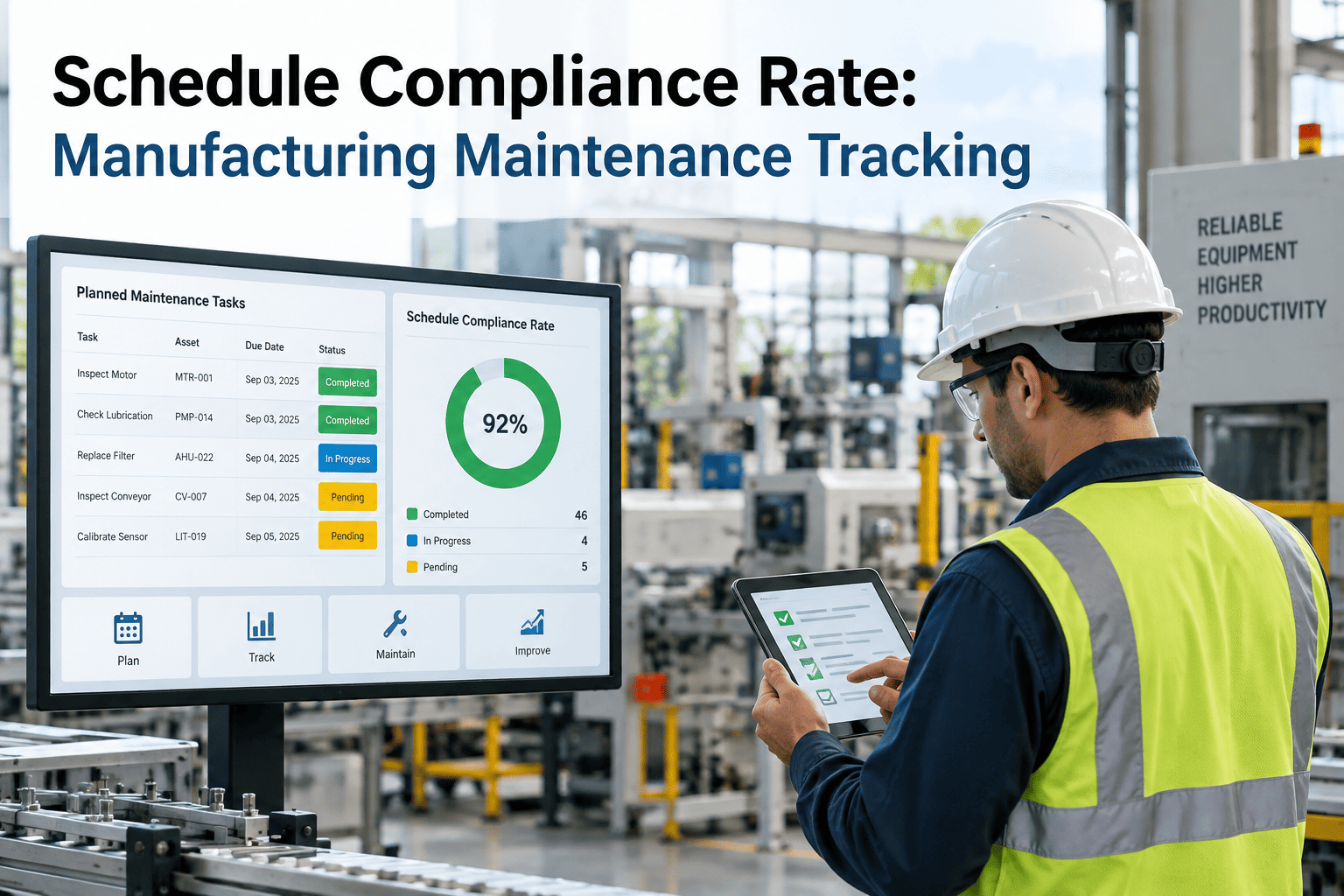
A maintenance schedule that gets rewritten every single day isn't really a schedule, it's a wish list that production and maintenance both quietly know will change before the shift is over. Schedule compliance rate, the share of planned work orders actually executed on the day and in the sequence they were scheduled, is what separates a plant with real planning discipline from one where planning is more of a formality than an operating practice. A low schedule compliance rate rarely stays contained to maintenance either, since a maintenance team constantly reshuffling its day is a maintenance team that can't reliably promise production a specific downtime window, which erodes trust between the two departments over time. Teams ready to build real schedule compliance tracking and fix the barriers behind a low number can start that conversation with iFactory's support team.
The Schedule Says One Thing. The Floor Does Another. Every Single Day.
iFactory tracks planned versus executed maintenance work order by order, so schedule compliance becomes a real, measured number instead of a plan everyone quietly expects to be rewritten by lunchtime.
Why Planned Work Keeps Losing to Emergency Work
Schedule compliance erodes for predictable reasons, and almost all of them trace back to a mismatch between what the schedule assumes and what the floor can actually deliver on a given day. Fixing the number durably means addressing the specific barrier, not just asking the team to try harder to stick to the plan.
Emergency Work Always Wins the Argument
A breakdown feels urgent in a way a scheduled inspection never does, so planned tasks get bumped by default whenever anything reactive comes up.
Parts Aren't Staged Before the Task Is Due
A technician arriving at a scheduled job only to discover a missing part turns a planned task into an unplanned delay through no fault of the schedule itself.
The Schedule Assumes More Hours Than Exist
A plan built without checking it against actual available labor capacity will chronically underperform regardless of team effort or intent.
Nobody Tracks Why a Task Actually Slipped
Without a documented reason code for every missed task, the same barrier keeps causing the same slippage month after month, unaddressed.
What Counts as a Compliant Work Order
A defensible schedule compliance number depends on a clear, consistent definition of what "on schedule" actually means, since a loose definition can flatter a number that doesn't reflect genuine planning discipline.
| Compliance Definition | What It Requires | Common Pitfall |
|---|---|---|
| Completed on the Scheduled Day | Work order closed within the same shift or day it was planned | Allows a task moved a day later to still count as compliant |
| Completed Within the Scheduled Window | Work order closed within a defined tolerance, often plus or minus one day | A wide tolerance window can mask real slippage |
| Completed in Planned Sequence | Tasks executed in the order the plan intended, not just eventually done | Harder to track without a proper scheduling system |
Improving Schedule Compliance Without Just Demanding It
A number that's chronically low usually reflects a structural gap between the plan and reality, and closing that gap takes a specific sequence rather than a general push for better discipline.
Track Every Slip With a Reason Code
Recording exactly why each planned task didn't happen as scheduled, whether emergency work, missing parts, or labor shortage.
Find the Single Largest Recurring Barrier
Most plants find one or two causes account for the majority of slippage once reason codes are actually reviewed.
Right-Size the Schedule to Real Capacity
A schedule built against actual available labor hours, rather than an aspirational number, is far more likely to actually be executed.
Protect Planned Work From Casual Displacement
A clear policy for what actually qualifies as urgent enough to bump a scheduled task keeps emergency work from becoming the default excuse.
Turn Your Maintenance Schedule Into a Plan the Floor Actually Follows
iFactory tracks planned versus executed work order by order with reason codes for every slip, so schedule compliance improvement targets the real barrier, not just the symptom.
A Composite Scenario: The Schedule That Was Rewritten Every Morning
A composite discrete manufacturing plant's maintenance schedule had become something of a running joke on the floor, with technicians openly acknowledging that whatever was planned for the day rarely survived past the first hour once production called in an urgent issue. Formal schedule compliance had never actually been measured, but informal estimates from the team put it somewhere well under fifty percent.
Once reason-code tracking was introduced, the data revealed that a single asset area, an aging conveyor system prone to frequent minor jams, was generating the majority of the emergency work orders that kept bumping the planned schedule. Rather than continuing to reschedule around it indefinitely, the team dedicated a focused two-week reliability improvement project specifically to that conveyor system. Emergency call volume from that area dropped by more than half afterward, and overall schedule compliance climbed from an estimated forty percent to a sustained eighty-two percent within the following quarter.
Common Mistakes in Schedule Compliance Improvement
Treating Every Slip as Equally Unavoidable
Without reason codes, a genuine emergency and a routine, avoidable delay look identical in the data, hiding the real improvement opportunity.
Building the Schedule Around Aspirational Capacity
A plan that assumes more labor hours than the team genuinely has available guarantees chronic non-compliance no matter how disciplined the team is.
Letting Any Interruption Qualify as an Emergency
Without a clear policy on what actually justifies bumping planned work, minor issues get treated with the same urgency as genuine failures.
Measuring Compliance Without Ever Acting on the Pattern
A tracked but unreviewed compliance number provides visibility without the follow-through needed to actually improve it.
Is Your Plant Ready to Track Real Schedule Compliance
Your maintenance schedule is built in a system, not a shared spreadsheet
A proper scheduling system is what makes planned-versus-executed tracking possible without heavy manual reconciliation.
Technicians record why a task slipped, not just that it did
Reason codes are what turn a compliance number into an actionable diagnostic rather than a static score.
The schedule has been checked against real available labor hours
An honest capacity check prevents the plan itself from being the reason compliance stays chronically low.
There's a clear policy for what qualifies as truly urgent work
A defined threshold protects planned tasks from being displaced by issues that could reasonably wait.
Frequently Asked Questions
What schedule compliance rate should a manufacturing plant be aiming for?
Ninety percent or higher is commonly cited as the world-class benchmark across maintenance and operations literature, though many plants realistically start well below that and improve gradually as scheduling discipline and capacity planning mature. A more useful early target for a plant just beginning to track this metric is steady month-over-month improvement rather than an immediate jump to the world-class number, since chasing the benchmark too aggressively before fixing root causes tends to produce gamed rather than genuine compliance. Plants wanting help setting a realistic improvement trajectory can talk to iFactory support.
How is schedule compliance different from PM compliance?
PM compliance specifically measures whether preventive maintenance tasks were completed on schedule, while schedule compliance is the broader metric covering all planned work orders, preventive and otherwise, executed as originally scheduled. The two overlap significantly in practice, since missed PMs are usually a major contributor to a low overall schedule compliance rate, but tracking both separately reveals whether a compliance problem is specifically preventive-maintenance-related or a wider planning issue.
How do we stop emergency work from automatically bumping every planned task?
The most effective approach is defining a clear internal standard for what actually qualifies as urgent enough to displace scheduled work, distinguishing a genuine safety or production-stopping issue from a task that feels urgent but could reasonably wait a shift or a day. Reviewing reason codes regularly also reveals when the same "emergency" keeps recurring from the same asset, which usually signals a reliability problem worth solving directly rather than continuing to reschedule around indefinitely.
Can schedule compliance improve without adding more maintenance staff?
Often, yes, since a significant share of schedule slippage traces back to planning and parts-staging gaps rather than a genuine lack of labor hours. Right-sizing the schedule against real capacity, pre-staging parts before a task is due, and fixing the specific asset generating the most disruptive emergency work frequently improves compliance meaningfully before headcount ever needs to be addressed. Book a demo to see how a compliance improvement plan gets built around your existing team.
Why does production trust matter for a maintenance schedule compliance metric?
A maintenance team that consistently delivers on its planned schedule can offer production a reliable downtime window with real confidence, while a team with chronically low compliance tends to see production push back on even reasonable maintenance requests, since past experience has taught them the schedule will likely change anyway. Improving schedule compliance often repairs this cross-department trust as a direct side effect, well beyond the maintenance metrics themselves.
Make Your Maintenance Schedule a Plan the Floor Can Actually Trust
iFactory tracks planned versus executed work with reason codes for every slip, turning schedule compliance into a real, improvable discipline instead of a daily guessing game.