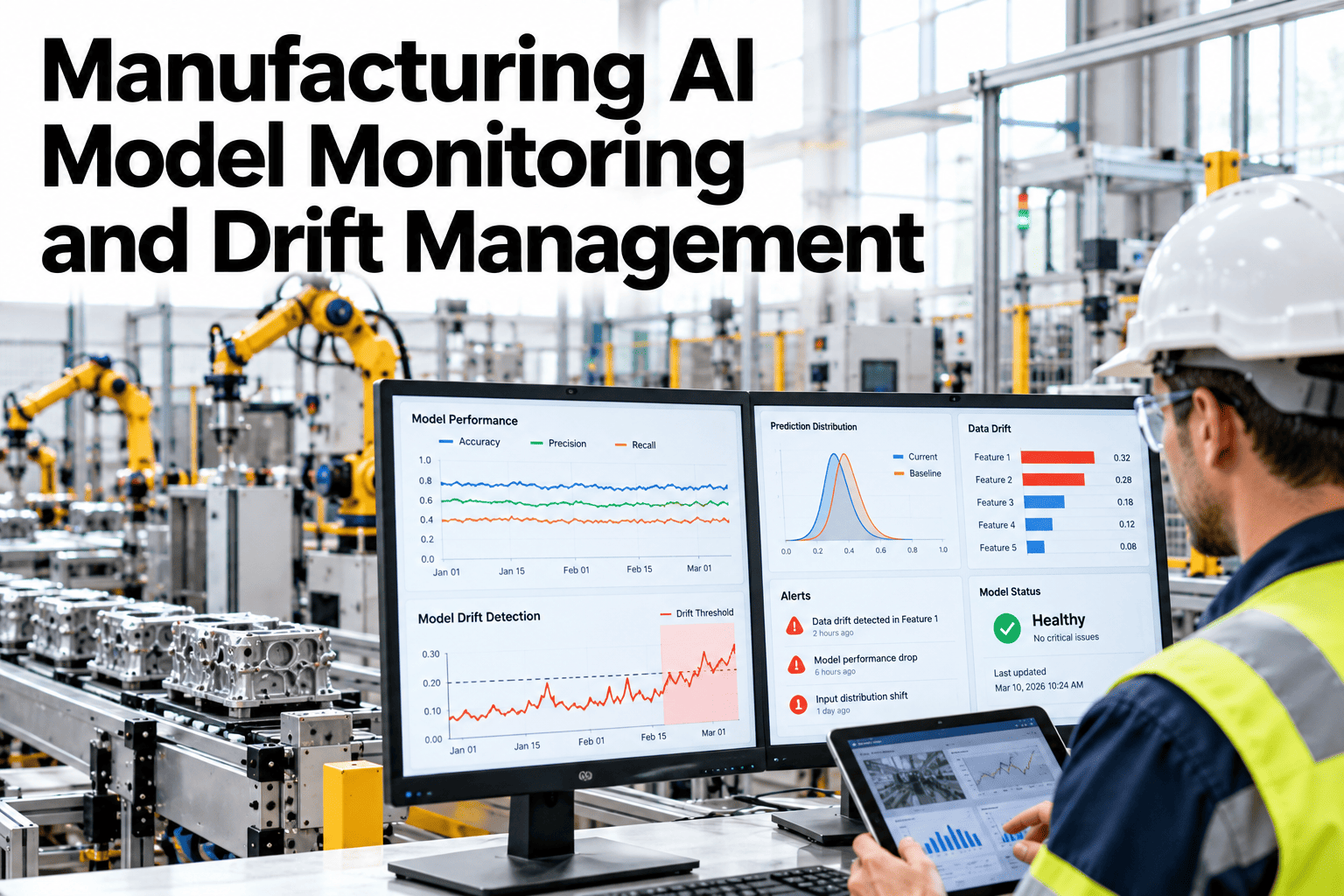
A model that was ninety-five percent accurate at launch does not announce the day it drops to eighty. It slides quietly, a point here and a point there, as the product mix shifts, a new supplier's material behaves slightly differently, or a camera lens gathers a film of dust nobody noticed. Without active monitoring, the first sign of drift is often a downstream problem the model should have caught, not a dashboard telling anyone accuracy has slipped. Model monitoring and drift management close that gap by watching the model's own performance as closely as the model watches the line. AI and plant engineering leaders can see drift detection running against a live model on iFactory AI before accuracy becomes a visible problem.
A Model That Isn't Monitored Is Already Drifting
iFactory AI tracks model accuracy continuously, catching drift before it becomes a downstream problem nobody saw coming.
Where Drift Actually Comes From
A new product variant the model wasn't trained to recognize well.
A new supplier's component behaves or looks slightly different.
A camera lens, light source or sensor drifting out of calibration.
Temperature or humidity changes affecting process or material behavior.
What a Monitoring System Actually Tracks
| Metric | What It Reveals |
|---|---|
| Prediction accuracy | Direct measure of model performance against known outcomes |
| Confidence distribution | Whether the model is becoming less certain over time |
| Input data distribution | Whether the data coming in still resembles the training data |
| Override rate | How often operators are correcting the model's output |
| Edge case frequency | How often the model sees situations outside its trained range |
Check Whether Your Own Models Are Drifting Now
Bring a model that's been running for a few months to a 30-minute session and check its drift signals.
From Detection to Response
Monitoring flags accuracy or confidence moving outside bounds.
Determine whether the cause is data, process or sensor drift.
Update the model with recent data, or fix the underlying cause.
Confirm accuracy recovers before returning to full trust.
A Composite Scenario: The Vision Model That Quietly Lost Accuracy
Picture a defect detection model running for six months with no monitoring. A new supplier's component, visually similar but not identical to the trained parts, starts causing more missed detections each week.
By the time the increase in downstream complaints traces back to the model, months of reduced accuracy have passed. Continuous monitoring would have flagged the confidence shift within days of the new component entering the line.
Where iFactory AI Fits
Tracks accuracy continuously
Compares model predictions against known outcomes on an ongoing basis.
Watches input distribution
Flags when incoming data starts to diverge from what the model was trained on.
Alerts before impact
Surfaces drift while it's still small, before a downstream symptom appears.
Supports retraining
Feeds recent data back into the model update process when drift is confirmed.
Expert Review
An industrial AI implementation consultant's perspective, reviewed for accuracy before publication: the plants that get burned by AI aren't usually the ones whose models were wrong at launch. They're the ones whose models were right at launch and nobody kept watching. Drift is slow and undramatic by nature, which is exactly why it needs a system watching for it rather than relying on someone noticing. Checking a model that's been running untouched for months is often the fastest way to see whether this is already happening.
Frequently Asked Questions
How quickly can model drift be detected with monitoring in place?
It depends on how quickly ground truth or confirming data becomes available and how sensitive the monitoring thresholds are set. For processes where outcomes are confirmed quickly, drift can often be flagged within days; for slower feedback loops, it may take longer, but still far faster than waiting for a visible downstream symptom. See how quickly drift would surface for your specific use case in a short session.
What's the difference between data drift and concept drift?
Data drift means the incoming data looks statistically different from what the model trained on, such as a new product variant's visual characteristics. Concept drift means the underlying relationship the model learned has changed, such as what actually counts as a defect shifting due to a new quality standard. Both require monitoring, but they often need different fixes. Ask for an explanation of which type of drift applies to your model.
How often should a model be retrained?
Rather than a fixed schedule, retraining is generally best triggered by detected drift crossing a defined threshold, since retraining too often wastes effort and too rarely leaves the model stale. Some organizations also set a maximum interval as a backstop even if drift hasn't been detected, to catch slow degradation monitoring might miss. Explore a retraining trigger policy suited to your model.
Can operator overrides be used as a drift signal?
Yes, a rising rate of operators correcting or overriding the model's output is often one of the earliest practical signals that something has changed, since it reflects real-world disagreement before formal accuracy metrics may catch up. Tracking override rate alongside statistical drift measures gives a fuller picture. Try a review of how override data could feed your drift monitoring.
Who should be responsible for responding to a drift alert?
A named owner, ideally someone with both data science understanding and plant floor context, should be responsible for investigating a drift alert, diagnosing the cause and deciding whether retraining or a process fix is needed. Without a named owner, drift alerts risk sitting unaddressed the same way the original problem would have. Join a session on assigning drift response ownership in your organization.
Catch Drift While It's Still Small
iFactory AI watches your models as closely as your models watch the line. Book a walkthrough on your own deployed models.