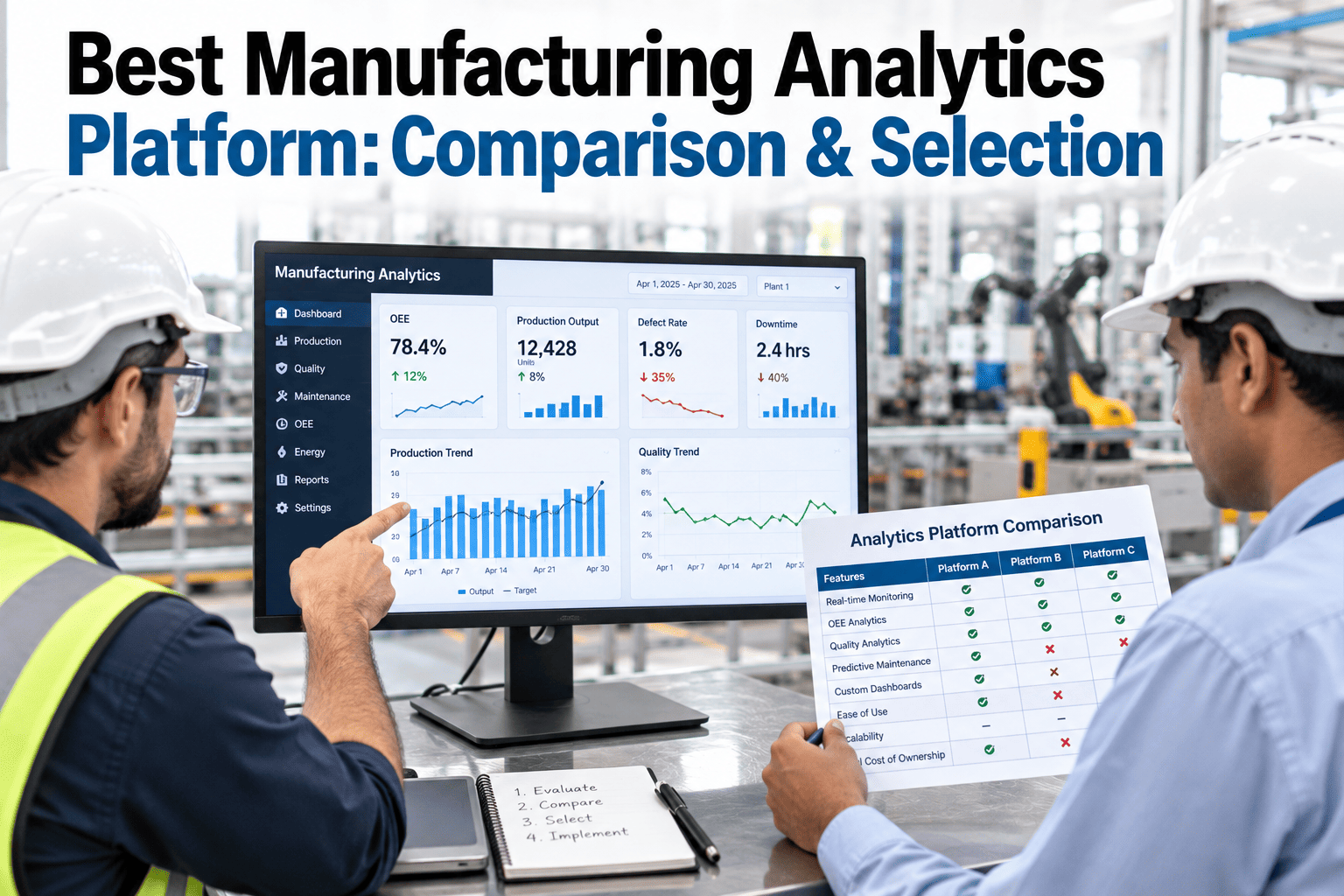
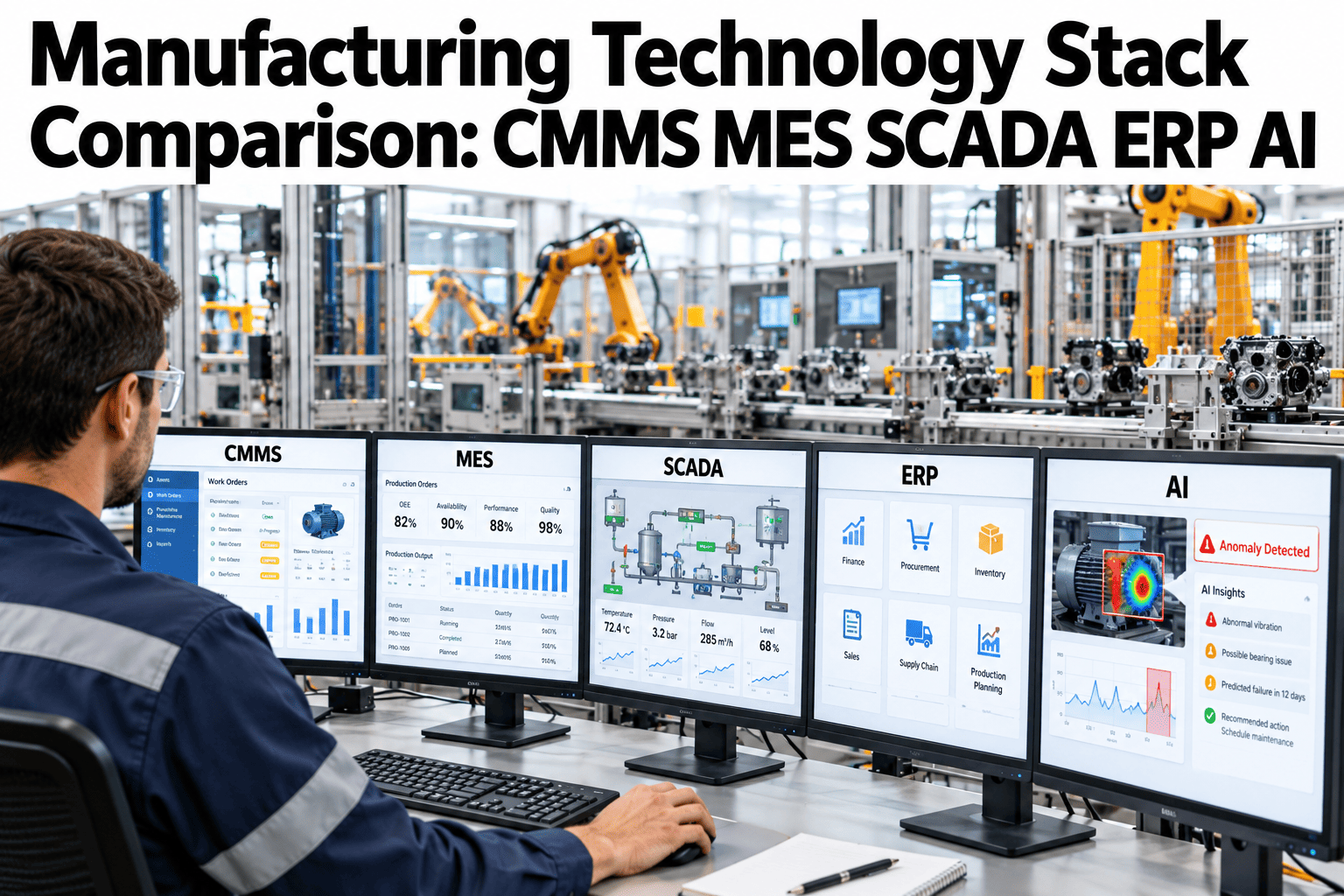
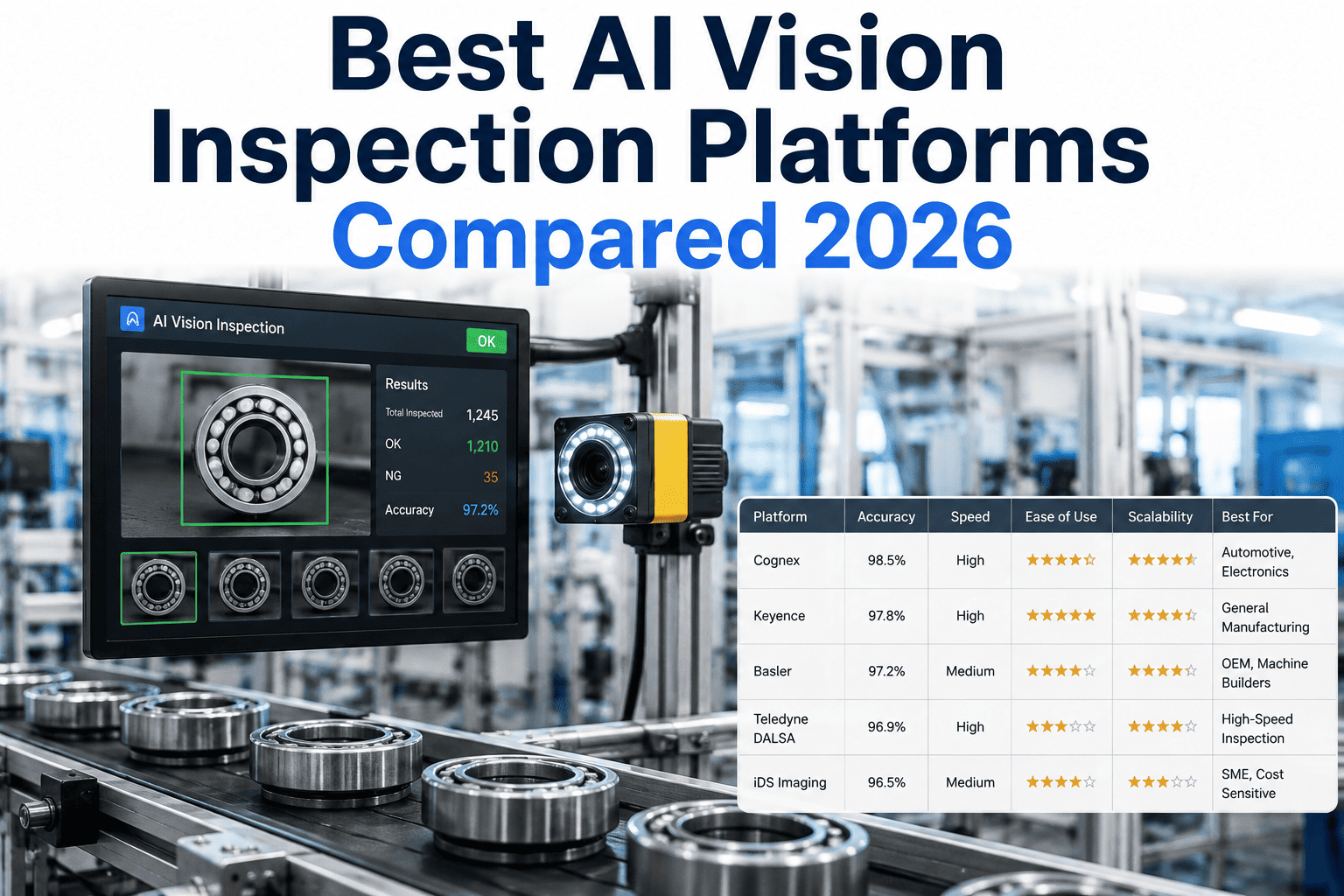
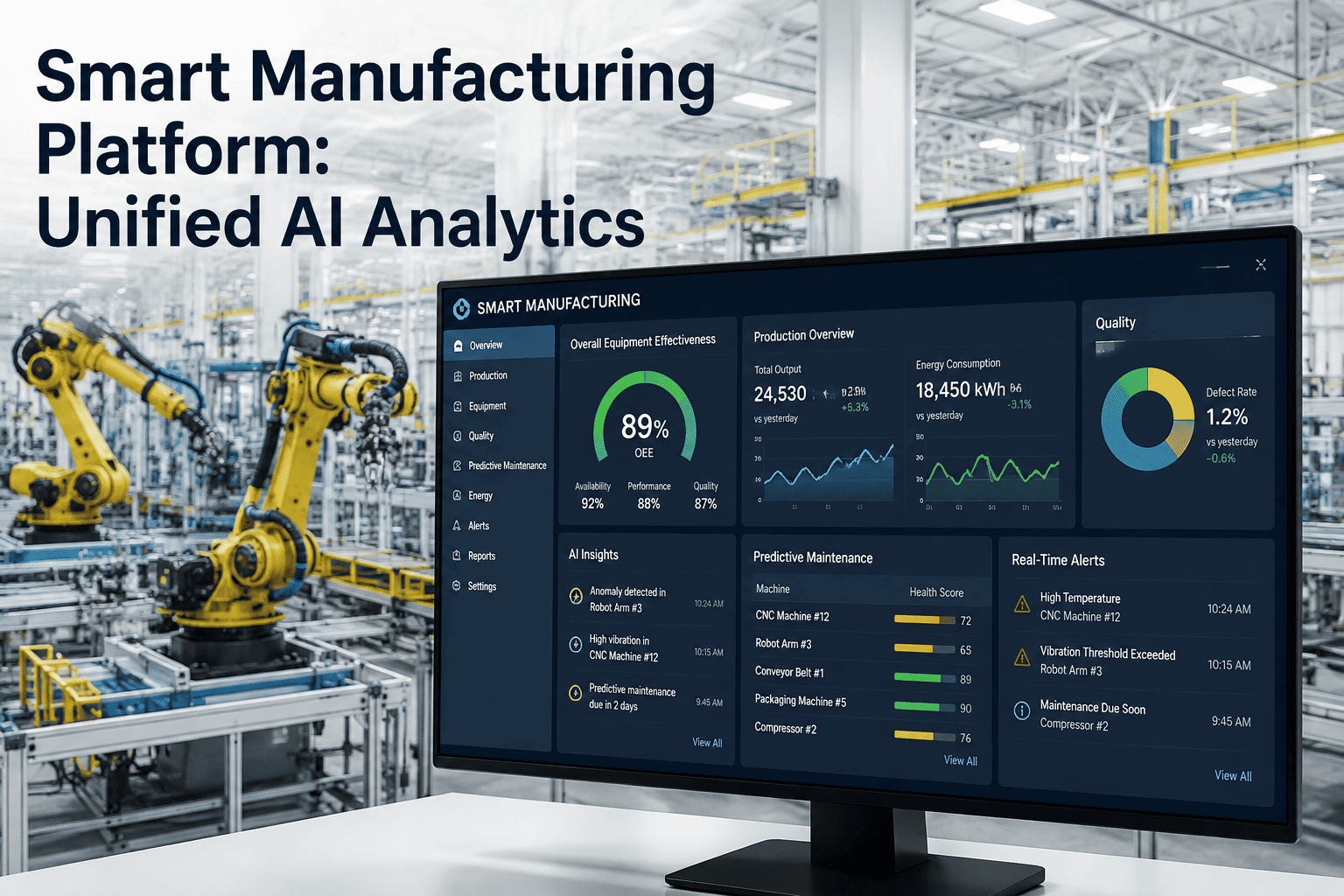
Picking a manufacturing analytics platform off a feature checklist is how most plants end up re-platforming eighteen months later. Every vendor demo looks impressive when it's running on clean sample data against a curated set of use cases, and the questions that actually determine whether a platform survives contact with your real plant, can it scale past a pilot line, can it integrate with the PLCs and CMMS you already run, how long until it produces a decision anyone trusts, rarely get answered honestly in a sales conversation. The plants that pick well are the ones that evaluate against a weighted set of criteria before they ever sit through a demo, not after. If you're in the middle of a platform evaluation right now, book a demo to see how iFactory holds up against that same weighted criteria.
MANUFACTURING ANALYTICS · PLATFORM SELECTION 2026
The Criteria That Actually Predict a Successful Rollout
iFactory helps manufacturing teams evaluate analytics platforms against the factors that actually determine long-term success, not just what looks impressive in a sales demo.
Integration Capability30%
Total Cost of Ownership15%
WHY THESE FIVE, IN THIS ORDER
What Each Criterion Is Actually Protecting You From
A weighted evaluation isn't just a scoring exercise, it forces the conversation toward the failure modes that actually kill analytics rollouts, most of which have nothing to do with dashboard aesthetics.
Integration Capability
The single biggest predictor of rollout success or failure. A platform that can't cleanly pull data from your PLCs, MES, and CMMS forces manual workarounds that quietly poison data quality from day one.
Scalability
A platform that performs beautifully on a single pilot line but buckles once connected to twenty lines across three plants isn't a platform, it's a proof of concept wearing a production label.
Time-to-Value
How long before the platform produces a decision someone actually trusts and acts on, not how long before a dashboard exists.
Total Cost of Ownership
The licensing fee is rarely the real number. Integration labor, ongoing maintenance, and the cost of a failed rollout all belong in the comparison.
Vendor Support Model
Whether the vendor shows up after the contract is signed, or leaves you to figure out configuration and troubleshooting alone.
THE QUESTIONS DEMOS DON'T ANSWER
What to Ask Beyond the Feature List
1What happens to data quality when a sensor drops offline mid-shift, does the platform flag the gap or silently interpolate?
2How many hours of integration labor were required for a reference customer with a PLC and MES environment comparable to ours?
3What's the actual time from contract signature to a working dashboard someone on the floor trusts and uses daily?
4How does pricing change as we add lines, plants, or users, and where are the hidden cost cliffs?
5What does support actually look like ninety days after go-live, not during the sales process?
Score your current shortlist against these criteria
iFactory can walk through this weighted evaluation against your actual environment and current vendor shortlist.
THREE PLATFORM ARCHETYPES
Knowing What Kind of Platform You're Actually Looking At
Most manufacturing analytics platforms fall into one of three broad archetypes, and understanding which one you're evaluating clarifies what trade-offs you're actually accepting.
Point Solutions
Deep on one specific problem, OEE, quality, or energy, but often leave you to integrate the results into a broader operational picture yourself.
Enterprise Suites
Broad coverage across many use cases, typically at the cost of a longer time-to-value and a heavier integration lift to get fully operational.
Unified Intelligence Platforms
Built to connect analytics, maintenance, and quality data in one place from the start, trading some point-solution depth for faster cross-functional value.
PILOT-STAGE VS PRODUCTION-SCALE
What Changes Once You're Past the Pilot
| Factor |
Pilot-Stage Performance |
Production-Scale Reality |
| Data volume |
One line, curated data, low load |
Dozens of lines, real-world noise, high load |
| Integration complexity |
A single, often modern, data source |
A mix of legacy PLCs, MES, and CMMS systems |
| User adoption |
A small, motivated pilot team |
Hundreds of users with varying digital comfort |
| Support demand |
Vendor's best team, high attention |
Standard support tier, real response times |
| True cost |
Often subsidized or discounted |
Full licensing, integration, and support costs |
TURNKEY DEPLOYMENT
How iFactory Supports Your Evaluation and Rollout
What Gets Delivered
A weighted evaluation scorecard built against your specific environment
Reference architecture review against your PLC, MES, and CMMS mix
A realistic total cost of ownership model across a 3-year horizon
A pilot-to-production scaling plan defined before rollout starts
Ongoing support benchmarked against your actual response time needs
Evaluation Timeline
Week 1: Environment audit and weighted criteria scoring
Week 2: Reference architecture and TCO modeling
Week 3: Final recommendation and rollout plan
FREQUENTLY ASKED QUESTIONS
What Teams Ask During Platform Evaluation
Why does integration capability outweigh raw analytics features in this scoring model?
Analytics features are only ever as good as the data feeding them, and a platform with impressive dashboards but weak integration against your actual PLC, MES, and CMMS environment will produce unreliable analytics regardless of how sophisticated the underlying algorithms are. Weak integration also tends to create hidden manual workarounds, someone exporting a spreadsheet by hand every week, that quietly become a single point of failure and a data quality risk long after the initial rollout excitement fades.
Book a demo to see how integration capability is actually assessed against your specific systems.
How do we actually verify a vendor's scalability claims before committing?
The most reliable verification is asking for and speaking directly with a reference customer running the platform at a scale comparable to your intended production footprint, not just a case study logo on a website, since a platform's pilot-stage demo performance tells you very little about how it behaves once connected to dozens of lines with real-world data noise and hundreds of concurrent users. Specific technical questions about data ingestion limits, concurrent user performance benchmarks, and infrastructure requirements at scale are also worth pushing for directly rather than accepting a general assurance that "it scales."
Contact our support team to review scalability verification questions specific to your intended rollout size.
What's typically hidden in total cost of ownership that a licensing quote doesn't show?
Integration labor is the most commonly underestimated cost, since connecting a platform to a real, messy plant environment with legacy PLCs almost always takes more engineering time than a vendor's initial estimate suggests, and ongoing maintenance of that integration as systems change over time is a recurring cost that's easy to overlook when only comparing sticker prices. The cost of a failed or stalled rollout, wasted implementation time, lost organizational momentum, and the eventual cost of re-platforming, is the least visible cost of all and the one a weighted evaluation upfront is specifically designed to help you avoid.
Book a demo to build a realistic three-year TCO model against your specific environment.
Should we always choose a unified platform over a point solution?
Not necessarily, since a unified platform genuinely trades some depth in any single use case for breadth and cross-functional connectivity, and a plant with one very specific, well-defined problem, say, a single quality inspection bottleneck, might actually be better served by a deep point solution focused entirely on that problem rather than a broader platform that handles it adequately but not exceptionally. The right choice depends on whether your priority is solving one problem as well as possible or building a connected operational picture across maintenance, quality, and analytics from the start.
Contact our support team to discuss which archetype fits your specific priorities.
How much weight should a slick sales demo actually carry in our decision?
Relatively little on its own, since every demo is built to showcase a platform under ideal conditions with curated data and a narrow set of use cases specifically chosen to look impressive, which tells you very little about how the platform performs against your actual, messier plant environment. A demo is most useful as a starting point for asking harder follow-up questions, requesting to see the platform handle a genuinely difficult scenario from your own environment, a sensor dropout, a legacy PLC data format, rather than as the primary basis for the decision itself.
Book a demo to see how iFactory performs against a genuinely difficult scenario from your own plant.
EVALUATE ON WHAT ACTUALLY MATTERS
Choose a Platform That Survives Contact With Your Real Plant
iFactory helps you evaluate analytics platforms against integration capability, scalability, time-to-value, and true total cost, the factors that actually predict a successful rollout.