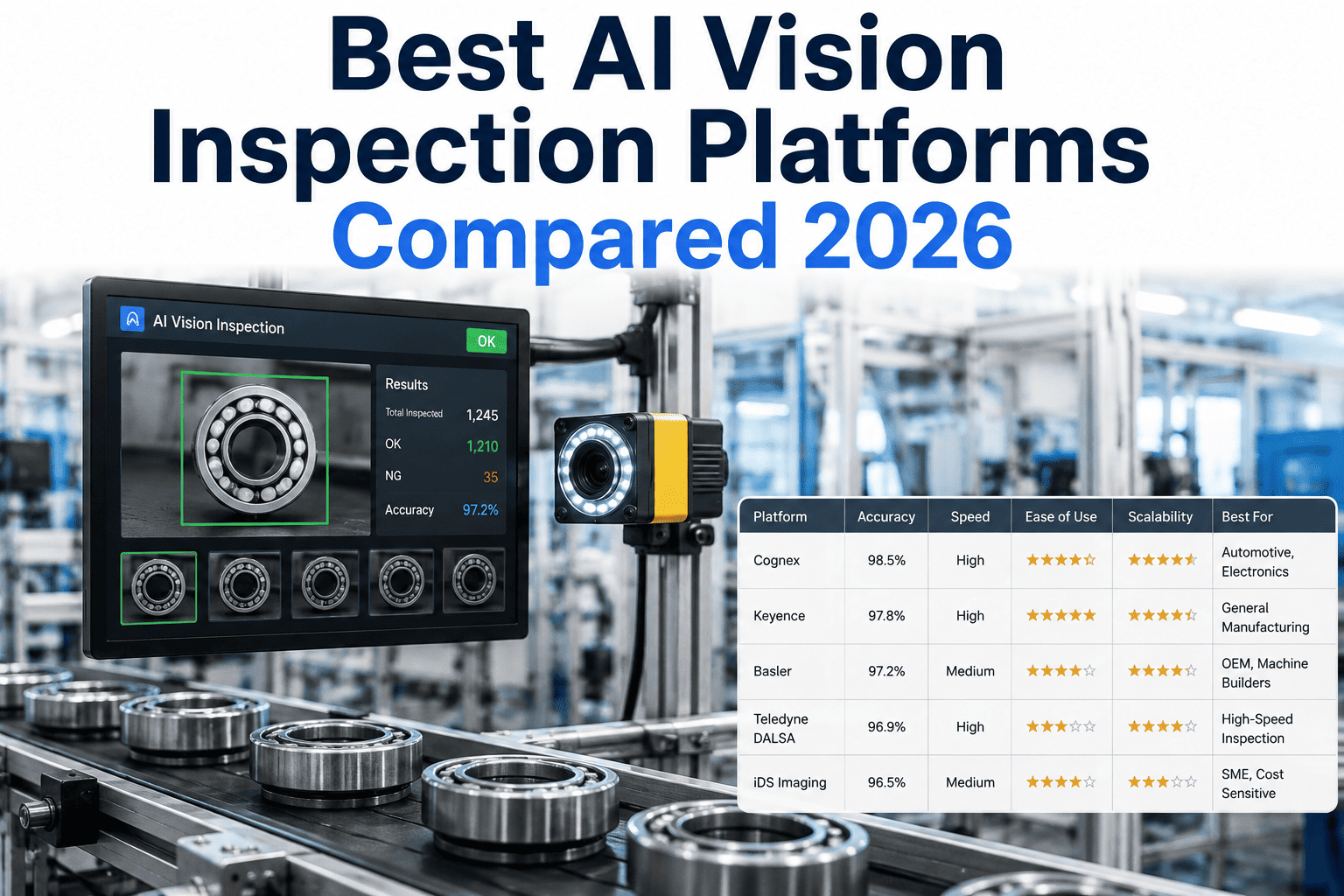
Choosing an AI vision vendor looks straightforward from a distance: request a few demos, compare accuracy claims, pick the lowest bid or the flashiest presentation, and move on. Manufacturing teams that follow that process usually regret it within a year, because the demo environment never resembles the actual production floor, the accuracy number in the sales deck was measured on a curated dataset that has nothing to do with your parts, and the support commitment that sounded reassuring during the pitch turns into a ticket queue with no defined response time once the contract is signed. Selecting the right platform requires evaluating criteria that rarely show up in a glossy comparison chart: how the vendor handles model retraining after go-live, what actually happens when a line goes down at two in the morning, and whether the company has real, verifiable experience in your specific industry rather than a single case study reused across every vertical. This guide walks through the evaluation framework that separates a platform that performs in a demo from one that performs on your line for years. When you want to compare a real evaluation against the framework below, you can book a demo with iFactory.
Evaluate AI Vision Vendors on What Actually Matters After the Contract Is Signed
iFactory's platform is built around the criteria that predict long-term performance: retraining discipline, response commitments, and verifiable industry experience, not just a demo-day accuracy number.
Six Criteria That Predict Long-Term Platform Performance
Accuracy on demo day tells you almost nothing about how a platform will behave six months into a real deployment. The scorecard below reflects the criteria that consistently separate vendors who deliver sustained results from those who deliver an impressive pilot and then stall. Most evaluation teams naturally focus on accuracy and price because those are the easiest numbers to compare across vendors on a spreadsheet, but the criteria that actually predict a difficult or smooth relationship two years into the deployment rarely appear in a standard proposal document at all.
Weighting these six criteria evenly is a reasonable starting point, but the right weighting genuinely depends on your plant's specific constraints. A facility with strict cybersecurity requirements from an automotive OEM customer should weight on-premise architecture heavily regardless of how it affects the other scores, while a facility that has been burned by slow vendor support in the past should weight response commitments accordingly. Building this weighting explicitly, before vendor conversations begin, keeps the evaluation objective rather than drifting toward whichever vendor made the best impression in the room.
Model Retraining Process
Does the vendor have a documented, repeatable process for retraining models as production conditions change, or is retraining an unplanned, billable emergency each time accuracy drifts?
On-Premise vs Cloud Architecture
Can the platform run inference entirely on-premise where your IT security policy requires it, or does it depend on a cloud connection that becomes a liability and a latency risk?
Support Response Commitments
Is there a contractually defined response time for a line-down issue, or a vague promise of "responsive support" with no enforceable service level behind it?
Industry-Specific Experience
Has the vendor deployed successfully in your specific manufacturing vertical, with defect types and materials similar to yours, or is their experience concentrated in an unrelated industry?
Integration With Existing Systems
Does the platform connect to your existing PLC, MES, and SCADA infrastructure using standard protocols, or does it require replacing systems that already work?
Hardware Durability Ratings
Is the physical hardware rated for your actual plant environment, including dust, moisture, vibration, and temperature extremes, or built for a clean lab setting?
Warning Signs That Predict a Difficult Vendor Relationship
Certain patterns during the sales and evaluation process reliably predict problems after the contract is signed. Watching for these signals during vendor conversations can save a plant from a costly deployment that underperforms or stalls entirely. None of these red flags are necessarily disqualifying on their own, but a vendor showing two or more of them at once is worth scrutinizing far more carefully before moving forward with a purchase decision.
It is worth noting that these warning signs are often more visible in how a vendor responds to pushback than in their initial pitch. Any sales team can present a polished demo, but asking pointed questions about dataset methodology, requesting a shadow mode pilot, or asking for references from year-two customers will quickly separate a vendor confident in their platform's real-world performance from one relying primarily on presentation quality to close the deal.
On-Premise Edge Processing Versus Cloud-Dependent Inspection Platforms
One of the most consequential and least understood decisions in platform selection is whether inference happens on-premise or depends on a cloud connection. The table below compares the two architectures across the factors that matter most on a real production line. This decision is frequently made by default rather than deliberately, since many vendors built their platform around a cloud-first architecture because it was simpler to develop, not because it was the right fit for a manufacturing environment with strict data policies and line-speed latency requirements.
For plants supplying automotive, aerospace, or defense customers, the on-premise question is often not a preference but a hard requirement written directly into the customer's supplier IT security agreement. Confirming this requirement with your own IT and quality teams before evaluating vendors saves significant time, since a cloud-dependent platform that looks attractive on price may simply be disqualified before a shadow mode pilot is even considered.
| Factor | Cloud-Dependent Platform | On-Premise Edge Platform |
|---|---|---|
| Network Dependency | Inspection stops or degrades if the internet connection drops | Runs independently of any external network connection |
| Data Security | Production images leave the plant network, requiring vendor trust and data handling agreements | Images never leave the plant, satisfying strict OEM and IT security policies |
| Latency at Line Speed | Round-trip network latency can bottleneck high-speed inspection stations | Local processing delivers consistent low-latency inference regardless of network conditions |
| Ongoing Cost Structure | Often billed per inference or per image, scaling unpredictably with production volume | Fixed hardware cost with predictable ongoing licensing, independent of inspection volume |
| IT Approval Complexity | Requires extensive security review for external data transmission at most manufacturers | Aligns with standard on-premise IT policy with minimal additional review |
A Structured Four-Step Process for Comparing Shortlisted Vendors
A disciplined evaluation process protects against the common failure of selecting a vendor based on presentation quality rather than substantive fit for the plant's actual needs. The steps below outline a practical approach that manufacturing teams can run internally regardless of which vendors are on the shortlist.
Define the Specific Defect and Success Metric
Before any vendor conversation, document the exact defect type, current detection rate, and target accuracy so every vendor is evaluated against the same concrete benchmark.
Request a Shadow Mode Pilot, Not a Demo
A demo on the vendor's curated dataset proves nothing about your line; insist on a validation period using your actual parts before evaluating accuracy claims.
Verify Support Commitments in Writing
Response time guarantees, retraining cadence, and escalation paths should be documented in the contract, not described verbally during the sales process.
Check References in Your Industry
Speak directly with a reference plant running the platform on similar parts and materials to understand real-world performance beyond the vendor's own case studies.