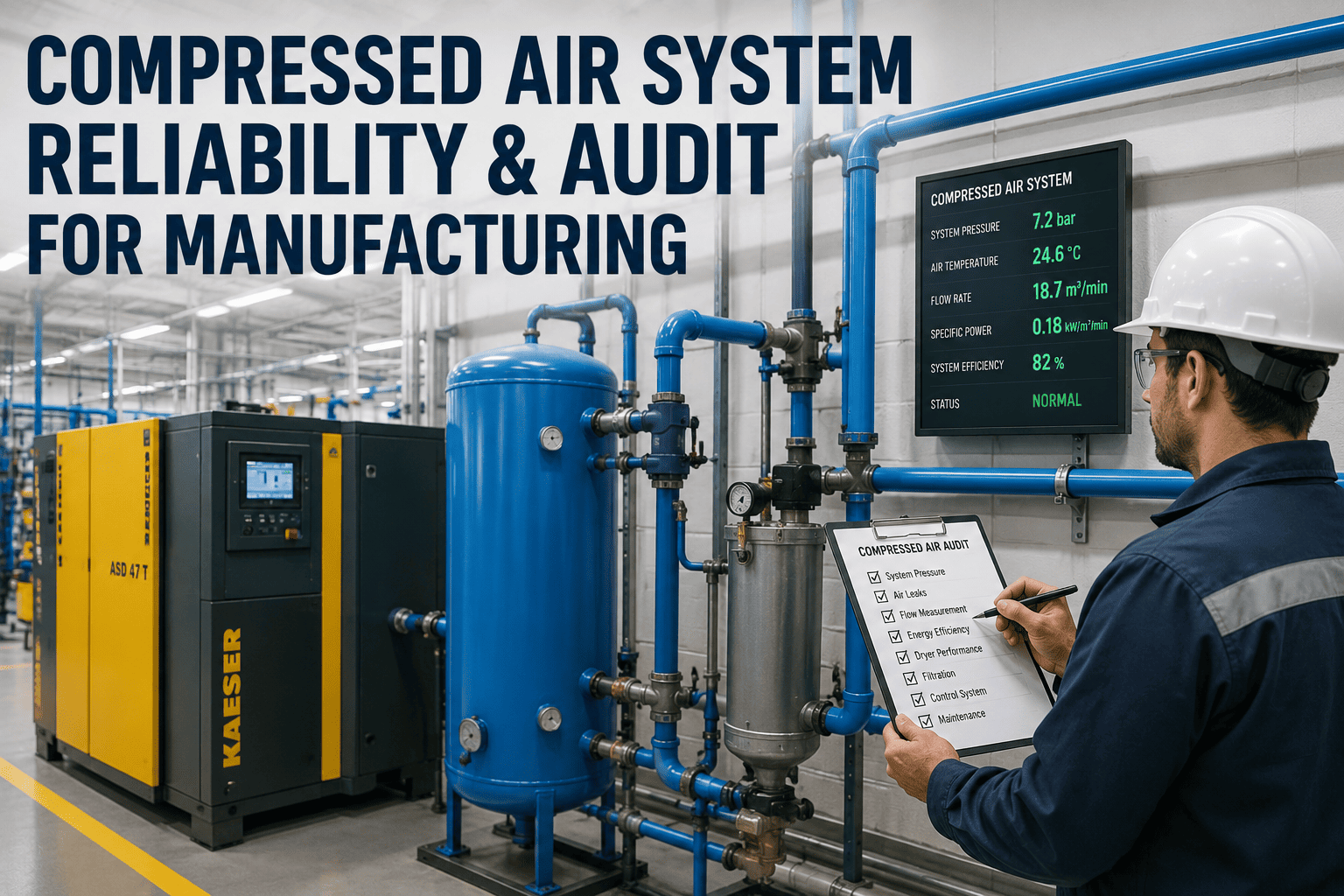
An eighth of the electrical energy that goes into a typical compressor comes out the other end as usable compressed air — the rest is lost as heat before it ever reaches a single pneumatic tool. That inefficiency is baked into the physics and can't be engineered away. What can be engineered away is the 20–35% of that already-expensive air that most plants lose to leaks, worn seals, and drains that fail silently, on top of unplanned downtime when a saturated dryer sends wet air downstream into equipment that was never built to handle it. iFactory's equipment reliability platform tracks compressor health, dryer dew point trends, and leak-driven demand creep as connected signals instead of three separate maintenance tickets.
Compressed air rarely gets the same operational attention as electricity, water, or gas, even though most manufacturing plants spend a comparable share of their energy budget generating it. Electricity has a meter and a monthly bill someone reviews line by line. Compressed air has a compressor humming in a mechanical room that nobody visits unless something breaks — and by the time something breaks, the leak rate, dew point drift, or bearing wear that caused it has usually been building for months, quietly, without a single alert firing anywhere on the plant floor.
Compressed Air Is Your Fourth Utility. Most Plants Manage It Like an Afterthought.
Leak losses, drifting dew points, and undiagnosed compressor wear rarely trigger an alarm until a production line goes down. A structured reliability audit catches all three before they become an outage — and turns a utility that's currently invisible on every dashboard into one that's tracked, trended, and budgeted like any other critical asset.
The Physics That Make Every Leak Expensive
Compressed air is inherently costly to produce — roughly eight units of electrical energy go in for every one unit of usable compressed air that comes out, a ratio that hasn't changed meaningfully in decades regardless of compressor technology. That means every leak isn't just losing "air," it's losing air that already cost eight times as much to make as the electricity that produced it. A single 1/8-inch leak running continuously at typical system pressure can waste well over a thousand dollars a year in electricity alone, and most industrial sites have dozens to hundreds of leak points scattered across fittings, hose connections, quick-couplers, and threaded joints that loosen gradually from vibration.
The scale compounds fast. Department of Energy-cited studies put average system leakage at around 25% of total compressor output, with some poorly maintained systems losing significantly more. On a compressed air system that represents 20–30% of total plant electricity consumption — which is typical — a quarter of that spend is being generated purely to feed leaks that produce nothing. None of this shows up as a distinct line item anywhere. It's absorbed into the electricity bill, and because compressed air has historically been treated as "free" background infrastructure rather than a metered utility, most plants have never actually quantified what their leak rate is costing them.
| Leak Size | Estimated CFM Loss | Approx. Annual Cost (single shift) | Approx. Annual Cost (24/7 operation) |
|---|---|---|---|
| 1/16 inch | ~6 CFM | $200–$470 | $850–$2,000 |
| 1/8 inch | ~26 CFM | $900–$1,900 | $3,800–$8,000 |
| 1/4 inch | ~100+ CFM | $3,500–$7,500 | $14,500–$31,000 |
Illustrative ranges based on published industry leak-cost benchmarks; actual cost depends on system pressure, electricity rate, and compressor efficiency.
What makes these numbers easy to underestimate is that no single leak feels significant on its own. A hiss at one fitting sounds like background noise, not a budget line item. But leak counts on unmanaged systems routinely run into the dozens or hundreds across a mid-size plant, and the cost table above applies to every single one of them simultaneously — a facility with forty small-to-medium leaks scattered across its distribution network can easily be carrying tens of thousands of dollars in annual waste before anyone runs a formal survey to add it all up.
Air Quality Classification — Why "Dry Enough" Depends on the Application
Not every point of use on a plant floor needs the same air quality, and treating the whole system to the strictest standard wastes energy while treating it to the loosest standard risks product damage in sensitive processes. ISO 8573-1 defines air purity in classes covering particulates, water content, and oil content, and matching the right class to each application — rather than defaulting to one blanket spec for the entire plant — is one of the most overlooked reliability and cost levers in a compressed air system.
| Application | Typical Dew Point Requirement | Dryer Type | Consequence of Under-Spec Air |
|---|---|---|---|
| General pneumatic tools | 37–50°F | Refrigerated | Accelerated cylinder and valve wear |
| Paint & finishing | Below freezing | Desiccant | Bubbling, poor adhesion, rework |
| Food & pharma contact | Below freezing, oil-free | Desiccant + coalescing filtration | Contamination risk, compliance failure |
| Outdoor / cold environment lines | -40°F or lower | Desiccant | Freeze-ups, line blockages |
Over-drying air the whole plant doesn't need is a quiet energy cost of its own — desiccant drying consumes more energy than refrigerated drying, and running the entire distribution system at the strictest dew point required anywhere in the plant means paying that premium everywhere, not just where it's actually needed. A segmented approach, with point-of-use drying for the small number of applications that genuinely require it, is usually both cheaper to operate and more reliable, because it isolates the failure risk of a desiccant system to a smaller, more manageable footprint.
Three Failure Domains, One System — Why Compressed Air Audits Get Split Up Wrong
Compressed air reliability problems get diagnosed piecemeal because they show up in different places: a maintenance tech hears a hiss near a fitting, a quality engineer notices moisture in a paint line, an energy manager sees a utility bill creep upward. Treated separately, none of these look urgent. Treated as one system, they're the same underlying discipline gap — nobody owns compressed air end-to-end, so each symptom gets its own ticket, its own technician, and its own investigation, when a single connected view of the system would have shown the same root cause driving all three.
Compressor Health
Bearing wear, valve degradation, and worn intercoolers reduce a compressor's actual output well below its rated capacity long before a hard failure occurs. Most plants only discover this when a second compressor has to run to make up the shortfall — doubling the energy cost of a problem that was fixable for a fraction of that price.
Dryer & Dew Point Drift
A refrigerated dryer with a failing condensate drain or a desiccant dryer past its regeneration cycle can send moisture-laden air downstream for hours before anyone notices — because the dryer keeps running, it just stops working. Wet air corrodes piping, washes lubricant out of pneumatic cylinders and valves, and ruins product in any process where air contacts material directly.
Leak Accumulation
Most leaks are inaudible on an active production floor and invisible to the naked eye — they're found with ultrasonic detection, not a walkthrough. Left unmanaged, leak count only grows: every fitting that loosens from vibration adds to the total, and the system never self-corrects without a structured tagging and repair program.
A Compressed Air Audit Should Cover the Whole System, Not Just the Compressor Room
iFactory tracks compressor performance trends, dryer dew point history, and leak tag-and-repair status in one asset record — so a pressure drop gets traced to its actual cause instead of triggering a guess.
Running a Structured Compressed Air Reliability Audit
A compressed air audit isn't a one-time energy project — it's a repeatable inspection cycle that, done properly, pays for itself within the first pass and keeps paying every quarter after. The sequence below reflects how experienced reliability teams structure the work, moving from measurement to repair to a maintained baseline rather than a single sweep that's never repeated.
The most common mistake in how plants approach this work is treating it as an event rather than a program. A contractor comes in, runs an ultrasonic survey, hands over a report with a leak count and a dollar estimate, and the plant fixes the top few items on the list. Six months later, half of those repaired fittings have loosened again from the same vibration that caused the original leak, and three new leaks have appeared elsewhere. Without a mechanism to re-survey and re-tag on a fixed schedule, the entire exercise becomes a recurring, unpredictable expense instead of a managed reliability discipline with a known, shrinking cost curve.
Baseline the system
Measure total generated CFM against actual production demand during a period with no scheduled air-consuming activity. The gap between what's being generated and what's plausibly being used is your starting leak estimate, and it's worth documenting carefully since it becomes the number every future audit gets measured against.
Conduct an ultrasonic leak survey
Walk the full distribution system — including areas that are quiet during off-shifts — with ultrasonic detection equipment. Tag every leak found with location, estimated size, and priority; most surveys uncover leak counts far higher than plant staff expect.
Check dew point at multiple points, not just the dryer outlet
A dryer reading correctly at its own outlet can still deliver wet air to a distant point of use if there's a failed drain, an undersized line, or a bypass valve left open somewhere in between. Spot-check dew point at several downstream locations, not only where it's most convenient to measure.
Rank repairs by cost impact, not just leak size
A moderate leak in a high-pressure line running 24/7 often costs more annually than a larger leak on an intermittently used branch. Prioritize the repair list by dollar impact so the highest-value fixes happen first.
Re-baseline on a recurring schedule
Leaks accumulate continuously from vibration and thermal cycling — a system audited once and never revisited will drift back toward its original leak rate within a year or two. Build the survey into a standing PM schedule, not a one-time project.
What Compressed Air Problems Actually Cost — Beyond the Utility Bill
The energy line item is the easiest cost to calculate, which is exactly why it's the one most audits stop at. It's also usually the smaller half of the total cost. Every leak also forces the compressor to cycle more frequently to hold system pressure, which accelerates wear on valves, unloaders, and bearings — shortening compressor life and pulling maintenance forward. Falling system pressure from accumulated leaks gets misdiagnosed as undersized equipment more often than plants realize, leading to capital spend on a second compressor when the actual fix was a leak repair program costing a fraction as much.
Moisture-related failures carry their own downstream cost profile. Wet air doesn't just corrode piping — it washes lubricant out of pneumatic cylinders and valves, causing intermittent sticking that looks like a random equipment fault rather than a root-caused air quality issue. In processes where compressed air contacts product directly — spray finishing, food-contact blow-off, pharmaceutical processing — a dew point excursion that goes unnoticed for even a few hours can produce a quality event large enough to erase any energy savings the plant thought it was capturing elsewhere.
There's also a scheduling cost that rarely makes it into an ROI calculation: unplanned compressed air outages are disproportionately disruptive because so much equipment depends on air simultaneously. A single compressor failure or a dryer that trips offline doesn't take down one machine — it can take down an entire production line or an entire building, all at once, with no warning beyond a pressure alarm that fires after the disruption has already started. Treating compressor and dryer health as a scheduled reliability program rather than a reactive break-fix category converts that risk into a predictable maintenance line item instead of an unplanned production loss.
Common Mistakes That Undermine Compressed Air Reliability Programs
Compressed air is the utility every plant manager assumes someone else is watching. It's not on the energy dashboard the way electricity or natural gas is, so a leak rate can climb for years without anyone noticing — until a second compressor gets purchased to cover a shortfall that a leak repair program could have solved for a tenth of the cost. The plants that get this right treat it exactly like any other reliability asset: baseline it, inspect it on a schedule, and track the trend, not just the snapshot.
Frequently Asked Questions
How do I know if my compressed air leak rate is actually a problem?
A simple baseline test reveals it quickly: run the system with all production equipment off, ideally during a shift change or off-hours, and measure how often the compressor still cycles to maintain pressure. Any cycling under those conditions is leak demand, since nothing should be consuming air. Compare that against your total generated CFM — a result above roughly 10% suggests a leak rate worth investigating with a proper ultrasonic survey, and above 20–25% is common enough in unmanaged systems that it should prompt immediate action. The test costs nothing but a bit of scheduling and gives a far more reliable number than guessing based on how loud the compressor room sounds. Book a demo to see how iFactory tracks this baseline automatically over time rather than as a one-off test.
What's the difference between a refrigerated dryer and a desiccant dryer, and does it matter for reliability?
Refrigerated dryers cool air to condense out moisture and typically reach dew points in the high-30s to 50°F range — sufficient for most general manufacturing uses. Desiccant dryers use a moisture-absorbing media to reach far lower dew points, often well below freezing, which matters for applications like paint finishing, pharmaceutical production, or any process where a frozen line in cold conditions would cause a failure. The reliability risk differs by type too: refrigerated dryers commonly fail through a clogged or stuck condensate drain, while desiccant dryers fail through saturated or degraded desiccant media that stops absorbing moisture effectively.
Why did my compressor pressure drop even though I haven't added any new equipment?
The most common explanation is leak accumulation — fittings loosen gradually from vibration and thermal cycling, and a system that had a healthy leak rate a few years ago can drift well past it without any single dramatic failure. It's also worth checking whether a dryer or filter is developing excessive pressure drop as it becomes contaminated, since that reduces usable pressure downstream even if the compressor itself is generating normally. iFactory's support team can walk through a diagnostic sequence that rules out compressor wear before assuming new equipment is required.
How often should a compressed air system be audited for leaks?
An annual full-system ultrasonic survey is a reasonable minimum for most plants, with a more frequent quarterly spot-check on high-vibration areas and critical production lines where a leak has outsized cost impact. Facilities with aggressive vibration exposure, frequent hose changes, or seasonal humidity swings that stress fittings differently across the year often benefit from a semi-annual cadence instead. The key discipline is recurrence — leaks accumulate continuously, so any fixed cadence beats an irregular or one-time approach.
Can moisture in compressed air actually cause equipment failures, or is it just a quality issue?
Both, and the equipment failures are often misdiagnosed as something else entirely. Moisture washes lubricant out of pneumatic cylinders, valves, and actuators, causing intermittent sticking and premature wear that looks like a random mechanical fault rather than an air quality root cause. It also corrodes internal piping over time, gradually reducing pipe diameter and increasing pressure drop throughout the distribution system — a slow-moving problem that eventually presents as a capacity issue rather than a moisture issue, which is exactly what makes it hard to trace back to the actual cause without dew point trend data. Talk to iFactory about correlating dew point trends with downstream equipment fault history to catch this connection early.
Stop Treating Compressed Air Like It's Free
iFactory connects compressor performance, dryer dew point trends, and leak repair tracking into one reliability view — so pressure problems get traced to their actual cause instead of triggering a guess or an unnecessary capital purchase.