A belt or chain drive rarely fails without warning. It glazes, cracks, elongates, or drifts out of alignment for weeks before it finally snaps or jumps a tooth — and by the time that happens, the actual root cause is almost always tension or alignment that was never checked, not a defective part. iFactory's asset health monitoring turns those slow warning signs into scheduled work orders before a drive failure takes down a line.
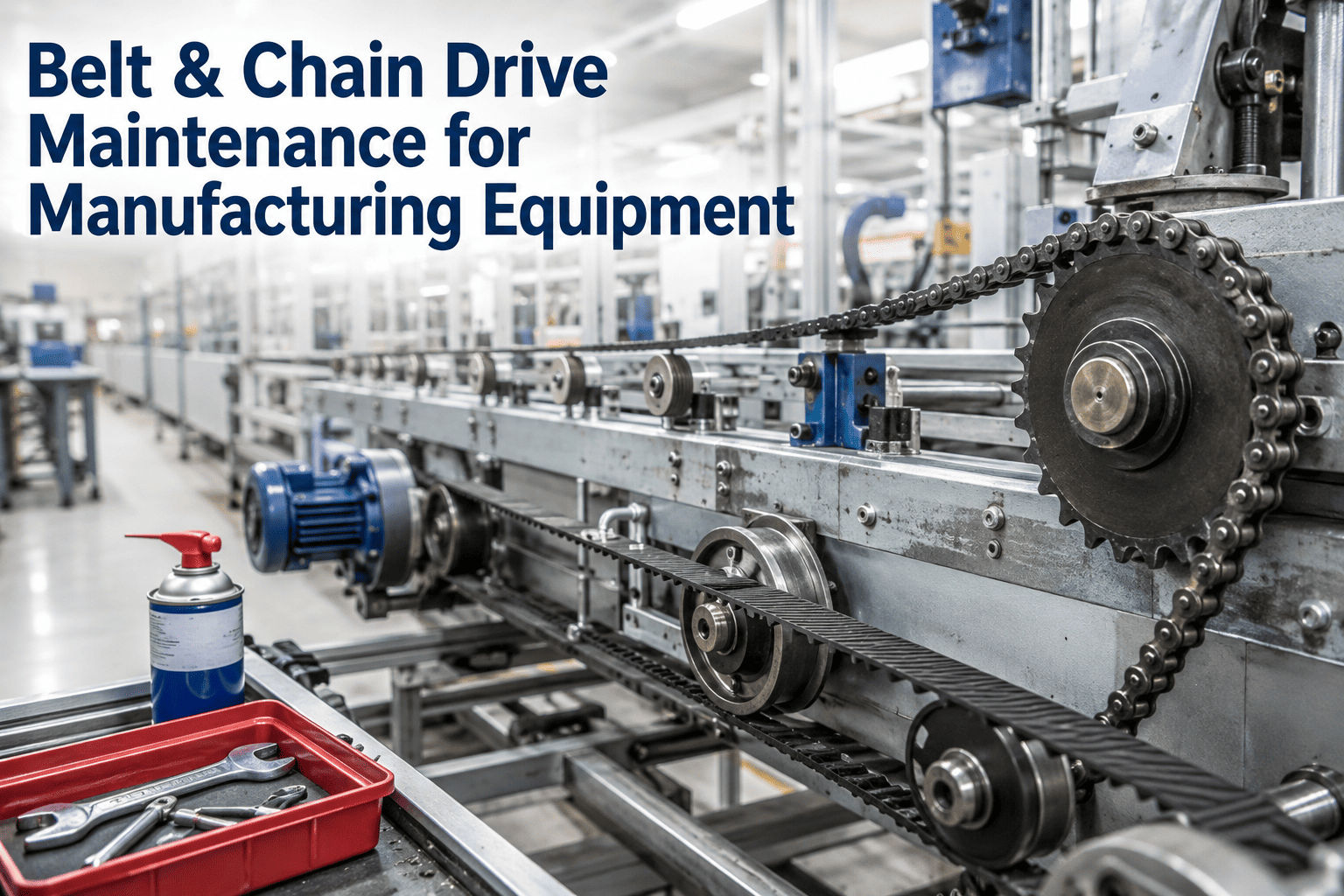
Belt & Chain Drive Maintenance for Manufacturing Equipment
Tension, alignment, and wear are the three variables that determine whether a drive lasts years or fails in months. This guide covers how to inspect, measure, and correct each one — for both belt drives and chain drives — before they cause unplanned downtime.
Why These Two Drive Types Fail Differently
Belt drives and chain drives both transmit rotational power between shafts, but they fail through different mechanisms, so they need different inspection routines. A belt drive relies on friction (V-belts) or tooth engagement (synchronous belts) and degrades through heat, flex fatigue, and tension loss. A chain drive relies on mechanical engagement between rollers and sprocket teeth, and it degrades through metal-on-metal wear at the pin-and-bushing interface, which shows up as elongation rather than surface cracking.
That distinction matters for how a maintenance team should actually inspect each type. Belt condition is judged largely by visual and tactile signs — cracking, glazing, fraying — combined with a tension measurement. Chain condition is judged almost entirely by a single dimensional measurement: how much has the chain elongated relative to its original pitch. Treating both drive types with the same generic "check it and listen for noise" inspection misses the specific failure signature each one produces.
Environment plays a larger role in drive selection and maintenance frequency than most equipment specifications acknowledge. Belt drives generally handle dust and moderate contamination reasonably well because they operate through friction or tooth engagement rather than close metal-to-metal tolerances, but they are far more sensitive to heat than chains — sustained high ambient temperatures accelerate the rubber or polymer degradation that leads to cracking and glazing. Chain drives tolerate heat well by comparison, since they are steel-on-steel, but they are far less forgiving of inadequate lubrication, and dusty or abrasive environments turn lubricant into a grinding paste if relubrication intervals are not tightened to match. A drive that was correctly specified for a clean, moderate-temperature environment can fail well ahead of its rated life if it gets relocated or repurposed into a harsher application without a corresponding review of tension, lubrication, or inspection frequency.
Stop Diagnosing Drive Failures After They Happen
iFactory logs tension readings, alignment checks, and chain elongation measurements against each asset, so a technician's next PM visit already knows what trend line they're watching.
Belt Drive Maintenance: Tension, Alignment, and Wear
Belt drives are the most common power transmission method in manufacturing because they are inexpensive, tolerant of minor misalignment compared to rigid couplings, and simple to service. That tolerance for minor misalignment is also what makes belts easy to neglect — a slightly misaligned drive will often keep running for months while quietly shortening the belt's service life and increasing bearing load.
Correct belt tension is the single most important factor in belt life. Too little tension causes slip, heat buildup, and glazing on V-belts, or tooth jumping and eventual snapping on synchronous belts. Too much tension overloads the bearings and shafts and shortens belt life just as effectively as under-tension, only through a different mechanism. Tension should be set using the force-deflection method: deflect the belt 1/64 inch for every inch of span length, and check the deflection force against the belt manufacturer's tension chart for that belt profile and speed — not by feel or by how it sounds. After any adjustment, re-check tension again after the first 24 hours of operation, since a new belt seats into its grooves and tension typically drops slightly during that initial run period.
Misalignment is either parallel (shafts not level with each other) or angular (sheaves not perpendicular to the shaft centerline), and both accelerate belt edge wear, cause uneven pulley wear, and create the audible noise most technicians associate with "a belt going bad." V-belt drives should be aligned within 0.5 degrees or 1/10 inch per foot of center-distance span; synchronous and poly-V drives need tighter alignment, within 0.25 degrees or 1/16 inch per foot. Use a straight edge and string for a fast check, or a laser alignment tool for a precise one, and always re-check alignment any time tension is adjusted — the two variables interact, and correcting one can shift the other.
Belt degradation is visible before it is catastrophic. Cracking across the belt ribs signals flex fatigue from age or excessive bending around undersized pulleys. Glazing — a shiny, hardened belt surface — signals chronic slip from under-tension. Fraying at the edges signals misalignment or a damaged pulley groove. A belt that has worn down to where it rides in the bottom of the pulley groove instead of near the top will slip regardless of how much additional tension is applied, because the wear itself has changed the effective pulley diameter. Any of these signs during a routine inspection should trigger a scheduled replacement, not a wait-and-see approach — a belt showing glazing or cracking rarely improves.
Chain Drive Maintenance: Elongation, Lubrication, and Sprocket Condition
Chain drives handle higher torque and harsher environments than belts, which is why they show up on conveyors, heavy indexing equipment, and drives running in dust, heat, or contamination that would destroy a belt quickly. But chains fail through a mechanism belts do not experience the same way: elongation. As the chain articulates around each sprocket, friction wears material away from the pins and bushings. The chain does not stretch in the sense of the metal deforming — it elongates because material is being removed from the wear surfaces, millions of cycles at a time.
Elongation is the primary indicator of chain wear and the measurement that determines replacement timing. Measure a taut span of chain — never a slack section, which will give a false reading — from the center of one pin to the center of another, across as many pitches as practical for accuracy. Most industrial chain drives should be replaced once elongation reaches 2 to 3% of original pitch length. Precision or synchronized drives, and drives using large sprockets above roughly 67 teeth, need a tighter threshold of around 1.5%, because even small elongation translates into a larger positional error once it's multiplied across a large sprocket's circumference.
Chain and sprocket wear are linked in both directions, which is why they should always be inspected — and usually replaced — together. Worn sprocket teeth lose their proper involute profile and develop a "hooked" shape. Installing a new chain onto a hooked sprocket does not fix anything; the hooked teeth act like a file against the new chain and can wear it out in a fraction of its normal service life. The reverse is also true: running a stretched chain on a good sprocket accelerates wear on that sprocket's teeth. Inspect tooth profile visually at every elongation check, looking for the square profile of a healthy tooth versus the pointed or "shark fin" shape of a worn one.
Lubrication is the single largest controllable factor in how fast a chain elongates, because it reduces the metal-on-metal friction at the pin-and-bushing interface that causes wear in the first place. Lubrication interval depends heavily on drive speed and environment: high-speed drives often need daily lubrication, while slow-moving conveyor chains may only need weekly or monthly attention. A dry, unlubricated chain in a dusty environment can reach its elongation replacement threshold dramatically faster than the same chain properly lubricated on schedule, which makes lubrication compliance one of the highest-leverage, lowest-cost interventions available for chain drive reliability.
Chain tension deserves its own note, separate from elongation, because the two are related but not identical. Elongation is a wear measurement; tension is an installation and adjustment setting, typically expressed as a small amount of sag or vertical movement between sprocket centers rather than a tight, rigid span. An over-tightened chain adds unnecessary load to the chain itself, the sprockets, and the connected bearings, which accelerates the very elongation the tension check is meant to prevent — the two problems compound each other rather than existing independently. A chain drive inspection should always check both together: tension as an installation setting, and elongation as the cumulative wear indicator that tension alone cannot substitute for.
Belt vs. Chain Drive: Inspection Reference
| Inspection Point | Belt Drive | Chain Drive | Frequency |
|---|---|---|---|
| Primary failure mode | Slip, glazing, cracking, tooth jump | Pin/bushing wear and elongation | Ongoing awareness |
| Key measurement | Deflection force vs. tension chart | Elongation % across a taut span | Monthly to quarterly |
| Alignment check | Straight edge or laser, 0.25-0.5° tolerance | Sprocket-to-sprocket parallel and planar check | Every PM cycle |
| Replacement trigger | Cracking, glazing, fraying, wear into groove | 2-3% elongation (1.5% precision drives) | Condition-based |
| Paired component | Pulley/sheave groove condition | Sprocket tooth profile | Inspect together |
| Lubrication need | None — lubricant damages most belts | Critical — interval depends on speed and environment | Daily to monthly |
Turn Tension Charts and Elongation Limits Into Standard Work
iFactory builds the tolerance thresholds for each drive directly into the inspection checklist, so a technician always knows the number that triggers a work order — not just a general sense that "it looked worn."
Common Mistakes That Shorten Drive Life
Most premature belt and chain failures trace back to a small, repeating set of process gaps rather than defective parts. The equipment specification is rarely the problem — the way it's tensioned, aligned, lubricated, and re-checked over time is where drives actually lose their rated service life.
Tensioning a belt by feel instead of by measurement. A hand-tightened belt is a guess, and guessing is one of the fastest ways to create recurring belt failures. Use a tension gauge and the manufacturer's deflection chart every time, not just at initial installation.
Replacing a chain without inspecting the sprockets. A new chain on worn, hooked sprocket teeth will fail far faster than its rated service life. Chain and sprocket condition should always be evaluated together, and both replaced together when either shows significant wear.
Measuring chain elongation on a slack span. An unloaded, sagging chain will give a shorter and falsely reassuring measurement. Always measure under tension — either while running under normal load or with the specified measuring load applied if the chain is off the sprockets.
Applying belt dressing to a slipping belt. Dressing masks a tension problem temporarily and damages the belt material in the process. A slipping belt needs a tension correction, not a chemical treatment.
Adjusting tension and never re-checking alignment. Tension and alignment interact mechanically — correcting one frequently shifts the other. Always re-verify both after adjusting either, and repeat until neither needs further correction.
Drive Maintenance KPIs to Track
Tracking the right leading indicators turns drive maintenance from a reactive "replace it when it breaks" activity into a measurable, improvable program. The four metrics below cover both drive types and give a plant a way to see whether tension, alignment, and lubrication discipline are actually improving over time — not just whether the current week was quiet.
Unplanned Drive Failures
Belt or chain failures that were not caught during a scheduled inspection. Every occurrence is a signal that inspection frequency or measurement discipline needs review.
Chain Elongation at Inspection
Average elongation reading across monitored chain drives at time of inspection. A rising trend across the asset base signals a lubrication or load problem worth investigating plant-wide.
Tension Check Compliance
Percentage of scheduled belt tension checks completed within their PM window. Directly correlates with belt service life and slip-related downtime.
Mean Time Between Drive Replacements
Average operating time between belt or chain replacements on a given asset class. Should trend upward as tension, alignment, and lubrication discipline improve.
Almost every emergency belt or chain replacement I've investigated traces back to something that was measurable weeks in advance. A belt doesn't glaze overnight — it glazes after months of chronic slip that a tension gauge would have caught on the first check. A chain doesn't jump a sprocket without warning — it elongates gradually, and the elongation is a number you can write down and watch trend upward. The plants that stop having drive-related downtime are not the ones with better belts or chains. They're the ones that measure instead of guess, on a schedule, every time.
Repair, Adjust, or Replace: Making the Call
Not every drive issue found during inspection needs an immediate replacement, and treating every finding as an emergency wastes maintenance hours that could go toward actual bad actors. A simple decision framework helps technicians and planners apply consistent judgment across the plant instead of relying on individual experience alone.
If a belt shows correct tension and alignment but visible early-stage glazing, schedule replacement at the next planned maintenance window rather than an emergency stop — glazing progresses over weeks, not hours, once tension is corrected. If a belt shows both glazing and misalignment together, treat it as higher priority, because the two problems compound each other and the belt is likely closer to failure than the glazing alone would suggest. A chain reading below 1.5% elongation on a standard drive needs no action beyond continued monitoring; a chain between 1.5% and the 2-3% replacement threshold should be scheduled for replacement at the next convenient window, with sprocket teeth inspected at the same time. A chain already at or above the threshold, or a sprocket showing visible hooking, should not wait for the next scheduled PM — both are close enough to secondary damage that a planned but prompt intervention is worth the schedule disruption.
The underlying principle is the same for both drive types: a measured reading, tracked against a known threshold, turns a subjective judgment call into an objective scheduling decision. That is also what separates a plant that reacts to drive failures from one that prevents them — the difference is rarely better parts, and almost always better measurement discipline applied consistently over time.
Frequently Asked Questions
Check tension at every scheduled PM cycle, and always re-check it 24 hours after installing a new belt, since new belts typically lose some tension as they seat into the pulley grooves during initial operation. High-cycle or high-criticality drives often warrant a more frequent check — monthly rather than quarterly — because slip-related heat damage accumulates faster under continuous duty. Book a demo to see how iFactory schedules tension checks automatically based on each drive's duty cycle rather than a single plant-wide interval.
Belt slip is the immediate symptom of insufficient tension — the belt loses grip on the pulley under load, which reduces power transmission efficiency and generates friction heat. Glazing is the longer-term consequence of repeated or chronic slip: the belt surface hardens and develops a shiny, smooth appearance that further reduces the belt's coefficient of friction, making the slip worse in a self-reinforcing cycle. A glazed belt cannot usually be corrected with a tension adjustment alone and typically needs replacement. Book a demo to see how tension-trend alerts in iFactory catch chronic slip before it reaches the glazing stage.
In most cases, chain and sprockets should be evaluated and replaced together once either shows significant wear. Installing a new chain on worn, hooked sprocket teeth causes the new chain to wear out far faster than its rated life, because the deformed tooth profile no longer engages the chain correctly. Similarly, running an elongated chain on good sprockets accelerates wear on those sprocket teeth. The only exception is when sprocket wear is measured and confirmed to be within tolerance during a routine inspection — in that case, a chain-only replacement is reasonable. Book a demo to see how iFactory links chain and sprocket service history on the same asset record.
Chain elongation is a gradual, cumulative wear process that is very difficult to judge accurately by eye, especially in the low single-digit percentages that actually matter for replacement timing. A chain that has elongated 2% looks nearly identical to a new chain during a casual visual inspection, but that 2% is enough to cause improper sprocket engagement, increased noise, and accelerated sprocket tooth wear. A measured elongation check using a taut span and a wear gauge is the only reliable way to catch the problem before it produces secondary damage to expensive sprockets and shafts. Book a demo to see how iFactory logs elongation readings over time so the trend — not a single snapshot — drives the replacement decision.
Tension alone does not guarantee drive life if alignment, lubrication, or load conditions are wrong. A belt can be perfectly tensioned and still fail quickly if the pulleys are misaligned, since misalignment causes edge wear and instability that tension cannot correct. A chain can be well-lubricated and still elongate rapidly if the load or duty cycle changed after the drive was originally sized — for example, a line speed increase that was never reflected in a re-evaluation of the drive design. Any drive failing faster than expected despite correct tension is a signal to check alignment, lubrication history, and whether the application has changed since the drive was specified. Book a demo to walk through a root-cause review of a recurring drive failure on your equipment.
Give Every Belt and Chain Drive a Measured, Documented Inspection History
iFactory tracks tension readings, alignment checks, and elongation trends against every drive asset — so replacement decisions are based on measured wear, not guesswork or a missed noise on the shop floor.