SAP S/4HANA & MES Integration: Real-Time Data Without the Mess
By Daniel Brooks on May 26, 2026
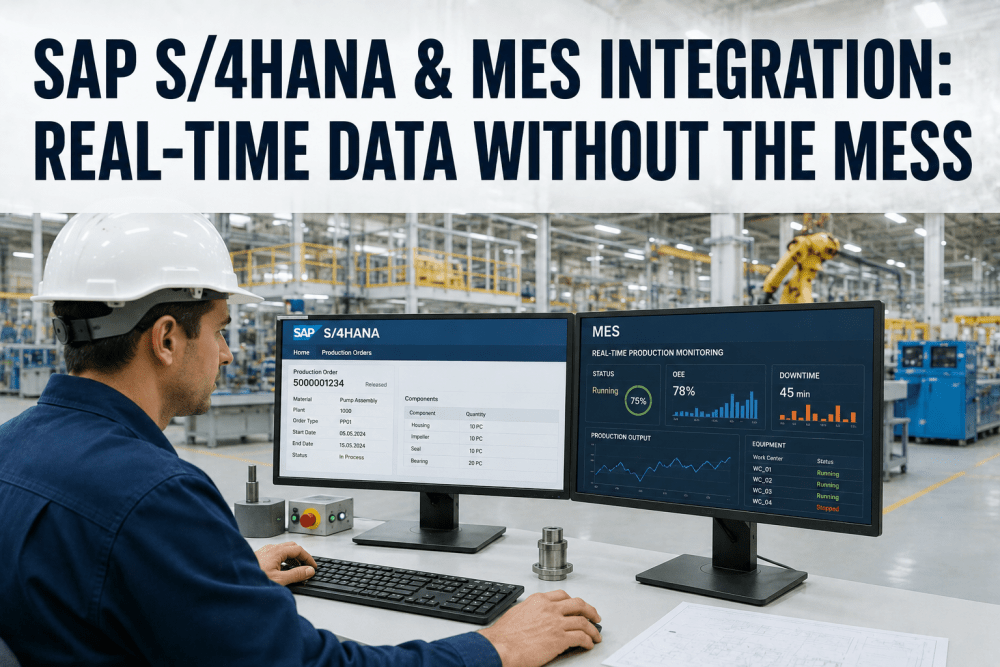
Manufacturing leaders in 2026 face an uncomfortable truth: most plants still run two parallel realities. Finance and planning teams live inside SAP S/4HANA with monthly closes, MRP runs, and inventory ledgers. The shop floor lives inside an MES — sometimes SAP-native, sometimes a third-party platform, sometimes a patchwork of Excel sheets and PLC dashboards stitched together by tribal knowledge. Between these two realities sits a daily mess: production confirmations entered manually hours after the shift ends, BOMs that drift out of sync across systems, scrap and yield numbers reconciled by spreadsheet, batch genealogy reconstructed by a process engineer with three browser tabs open. SAP S/4HANA & MES integration is what closes this gap — not as a one-time IT project, but as a continuously running data fabric where production orders, master data, confirmations, goods movements, and quality results flow bidirectionally in near real time. Done right, the integration eliminates the reconciliation tax, gives operations a single source of truth, and lets finance and supply chain make decisions on data that is minutes old, not days old. Done badly, it creates new failure modes: IDoc backlogs, duplicated postings, master data drift, and shop floor teams who learn to distrust the ERP all over again. This page walks through how iFactory architects SAP S/4HANA to MES integration for U.S. manufacturers — the data objects that must flow, the integration patterns SAP supports, the architecture choices that determine whether you build a clean pipeline or another mess.
SAP Integration · MES Connectivity · Real-Time Manufacturing
SAP S/4HANA & MES Integration: Real-Time Data Without the Mess
Architect a bidirectional, near real-time data fabric between SAP S/4HANA and your manufacturing execution system. Production orders flow down. Confirmations, goods movements, and quality results flow up. Master data stays in sync. Operations and finance finally agree on the numbers.
Why ERP-MES Integration Breaks Down in the First Place
Before walking through the architecture, it helps to be honest about why so many SAP-to-MES integrations end up as the mess they were supposed to solve. The problems are rarely technical at root — the protocols and connectors have existed for two decades. The breakdowns are almost always architectural, organizational, or both. iFactory has seen the same five failure patterns repeat across U.S. plants from automotive to pharma to food and beverage. Knowing them up front is the cheapest way to avoid them.
01
Manual confirmations
Shop floor confirms production hours or days late, often through SAP GUI directly. Inventory, WIP, and cost figures lag reality. Finance closes the month on stale data.
02
Master data drift
BOMs, routings, and work centers exist separately in S/4HANA and the MES. Updates are made in one and forgotten in the other. Operators trust neither.
03
Point-to-point sprawl
Each new plant, line, or MES variant gets its own custom interface. The landscape becomes a maze of bespoke RFCs no one wants to touch when SAP is upgraded.
04
No error recovery
When an IDoc fails or a BAPI returns an error, nobody is paged. Messages stack in queues for weeks. Reconciliation becomes a quarterly project.
05
Shop floor disconnect
PLCs, SCADA, and machine data never reach the MES, let alone S/4HANA. Real-time visibility ends at the operator HMI. ERP receives a daily summary at best.
The Reference Architecture — How Data Should Actually Flow
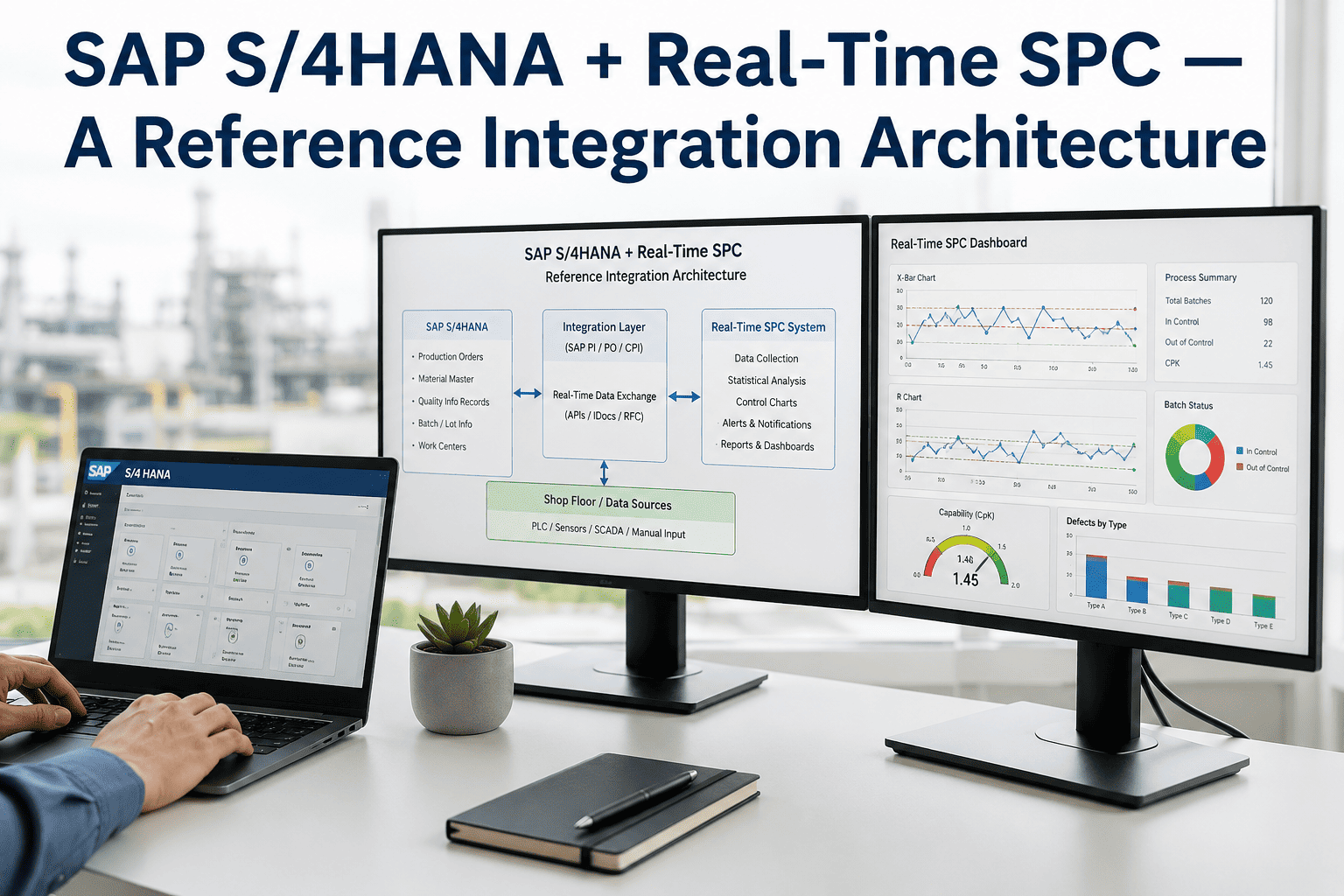
iFactory's reference architecture for SAP S/4HANA and MES integration follows the ANSI/ISA-95 functional hierarchy strictly. S/4HANA owns Level 4 (enterprise planning, financials, supply chain). The MES owns Level 3 (production execution, dispatching, detailed scheduling, performance). SCADA and PLCs own Levels 1 and 2. Each layer has clear ownership, defined data contracts, and a documented integration pattern across the boundary. Below is the data flow we deploy — bidirectional, asynchronous where appropriate, synchronous where required, and instrumented end-to-end so failures are caught in minutes, not weeks.
Bidirectional Data Flow · SAP S/4HANA ↔ MES ↔ Shop Floor
ISA-95 L4 ↔ L3 ↔ L2/L1 · SAP Cloud Integration (CPI) as the integration backbone
Downstream: S/4HANA pushes production orders, BOMs, routings, work centers, materials, and batches to the MES via IDocs over CPI or direct OData calls.
Upstream: MES posts confirmations, goods receipts/issues, scrap, yield, and quality results back to S/4HANA via BAPI calls through the SAP Cloud Connector.
Shop floor: MES dispatches setpoints to PLCs and ingests telemetry via OPC-UA and MQTT. Only summarized, contextualized data crosses up to ERP.
Want a walkthrough of this architecture mapped onto your current SAP landscape? Book a Demo and we will review the data objects, integration patterns, and gaps live.
The 12 Data Objects That Must Flow Between S/4HANA and MES
A clean SAP-to-MES integration is not a single pipe. It is a defined set of data contracts, each with its own direction, frequency, and trigger. Get any of these wrong and the integration starts leaking — operators stop trusting it, planners override it, and finance reconciles around it. Below are the twelve data objects iFactory mandates in every SAP S/4HANA to MES integration design, with the SAP-recommended pattern for each.
#
Data Object
Direction
Pattern
Frequency
01
Material Master
S/4HANA → MES
IDoc (MATMAS) via CPI
On change
02
Bill of Materials (BOM)
S/4HANA → MES
IDoc (BOMMAT) via CPI
On change
03
Routing / Recipe
S/4HANA → MES
IDoc (LOIROU) via CPI
On change
04
Work Center / Resource
S/4HANA → MES
IDoc (LOIWCS) via CPI
On change
05
Production / Process Order
S/4HANA → MES
IDoc (LOIPRO) via CPI
On release
06
Batch / Inspection Lot
S/4HANA → MES
IDoc (BATMAS) via CPI
On creation
07
Order Confirmation
MES → S/4HANA
BAPI (CO_CREATE_TT)
Per operation
08
Goods Issue (Component)
MES → S/4HANA
BAPI (GOODSMVT_CREATE)
Per consumption
09
Goods Receipt (FG)
MES → S/4HANA
BAPI (GOODSMVT_CREATE)
Per completion
10
Scrap / Yield Variance
MES → S/4HANA
BAPI confirmation extension
Per operation
11
Quality Inspection Result
MES → S/4HANA
BAPI (QPRS_RESULT)
Per inspection
12
Equipment / Functional Loc
S/4HANA ↔ MES
IDoc + OData
On change
The 4 Integration Patterns SAP Officially Supports
SAP offers four well-defined integration patterns for connecting S/4HANA to a manufacturing execution layer. Each has a place — and a place where it does not belong. A common architectural mistake is to pick one pattern and force every data object through it. The right answer is almost always a combination: IDocs for asynchronous master data, BAPIs for transactional postings that need transactional integrity, OData for synchronous lookups, and event-driven messaging for high-volume telemetry signals.
Pattern 1
IDocs via SAP Cloud Integration (CPI)
Asynchronous, document-based messaging. Standard SAP message types (MATMAS, LOIPRO, BOMMAT) routed through CPI for transformation and delivery. Reliable for master data and order release.
Best for · Master data, order release, large-batch sync
Watch · Latency, IDoc backlog, error monitoring
Pattern 2
BAPI / RFC via Cloud Connector
Synchronous function module calls. MES invokes SAP BAPIs (GOODSMVT_CREATE, CO_CREATE_TT) through the SAP Cloud Connector. Transactional integrity, immediate response.
Best for · Confirmations, goods movements, quality results
Watch · Network reliability, BAPI return handling
Pattern 3
OData / REST Services
Modern RESTful APIs exposed by S/4HANA. MES queries OData services for real-time lookups (stock, batch, classification). Lower setup overhead than BAPI, higher granularity than IDocs.
Best for · Synchronous queries, dashboards, ad hoc lookups
Watch · Rate limits, payload size
Pattern 4
Event-Driven (SAP Event Mesh / Kafka)
Publish-subscribe event streaming. S/4HANA emits business events; MES subscribes and reacts. Decoupled, scalable, ideal for high-volume telemetry, status changes, and cross-plant choreography.
Best for · Telemetry, real-time choreography, multi-plant
How iFactory Delivers the Integration — A 6-Phase Workflow
iFactory's delivery model for SAP S/4HANA to MES integration is structured as a six-phase workflow with defined entry-exit criteria at each gate. We do not begin coding interfaces until the data contracts are signed off jointly by your SAP team, MES owner, and operations leadership. This sequencing is what separates a clean integration from another patchwork that breaks the next time SAP is patched.
01
Discovery & Data Contract Definition
Inventory all master and transactional data objects flowing between S/4HANA and the shop floor. Define ownership, direction, latency tolerance, and error-handling expectations for each. Sign off jointly across IT, OT, and finance.
Map each data object to the right SAP integration pattern — IDocs, BAPIs, OData, or event-driven. Validate against SAP recommended practices and existing landscape constraints (ECC vs S/4HANA, on-prem vs RISE, single-tenant vs multi-plant).
Deploy SAP Cloud Integration content for ERP-to-MES messaging. Configure plant mapping, value mapping, certificates, and the S4H_INTEGRATION_OAUTH destination. Set up SAP Cloud Connector for inbound BAPI calls from MES to S/4HANA.
Output · CPI iFlows live · Cloud Connector validated
04
MES Configuration & Plant Mapping
Configure the MES side — production order rules, dispatching logic, confirmation triggers, BAPI payload mapping. Ensure plant codes, work center IDs, material numbers, and batch numbers map cleanly across systems. Reconcile differences before go-live, not after.
Output · MES configured · master data reconciled
05
End-to-End Testing & Shadow Run
Test every data object end-to-end against test SAP and MES instances. Run a shadow period where the integration runs alongside existing manual processes — comparing every posting, every confirmation, every variance. Fix every discrepancy before cutover.
Output · Reconciled shadow run · validated cutover plan
06
Cutover, Monitoring & Continuous Ops
Go-live with end-to-end monitoring instrumented from day one. Message queues, BAPI response times, IDoc statuses, exception alerts, and reconciliation dashboards all live before first production shift. Operations team owns the monitoring runbook.
Output · Live integration · monitoring dashboards · ops runbook
Ready to map your data objects?
Bring your current landscape — S/4HANA version, MES platform, plant count, integration backlog — and we will walk through the architecture, gaps, and quick wins in 30 minutes.
Traditional Integration vs Modern Real-Time Integration
The biggest difference between a legacy SAP-to-MES integration and a modern one is not the protocols — it is the operating model. Legacy integrations were built as batch handoffs with reconciliation as a planned process. Modern integrations are built as continuous data fabrics with reconciliation as an exception. Below is the side-by-side that helps stakeholders understand what they are actually buying when they sponsor a modernization.
Traditional Batch Integration
1
Production confirmations entered manually into SAP GUI hours after the shift ends
2
Master data updated in S/4HANA, manually re-keyed into MES days later
3
Goods movements posted in nightly batch jobs, inventory always stale
4
Quality results recorded on paper, transcribed into QM module weekly
5
Scrap and yield reconciled by spreadsheet at month-end close
Result · Stale data · trust erosion · reconciliation tax
Modern Real-Time Integration
1
Confirmations posted automatically by MES on operation completion via BAPI
2
Master data flows via IDoc through CPI on every S/4HANA change, MES updates in minutes
3
Goods issues and receipts posted per operation, inventory reflects reality
4
Quality results captured at the source, posted to QM via BAPI within seconds
5
Scrap and yield reconcile continuously — no month-end surprises
Result · Single source of truth · faster decisions · no surprises
What iFactory Brings to a SAP S/4HANA Integration
iFactory's MES platform is designed to integrate with SAP S/4HANA out of the box — not as a marketing claim, but as a working set of pre-built CPI iFlows, BAPI handlers, IDoc parsers, and monitoring dashboards we deploy at every U.S. customer site. The platform also covers everything below the integration layer: predictive maintenance, AI vision quality inspection, OEE analytics, digital twin, work order management, and the smart document management that keeps SOPs in step with production. The integration is one workstream of a broader operational data layer.
Pre-built SAP CPI iFlows
Reusable integration content for the standard data objects — MATMAS, BOMMAT, LOIROU, LOIPRO — with mapping, error handling, and retry logic ready to deploy.
MES Workflow Engine
Production order routing, dispatching, operator instructions, and confirmation triggers all driven by configurable workflows aligned to S/4HANA process orders.
Real-Time Production Monitoring
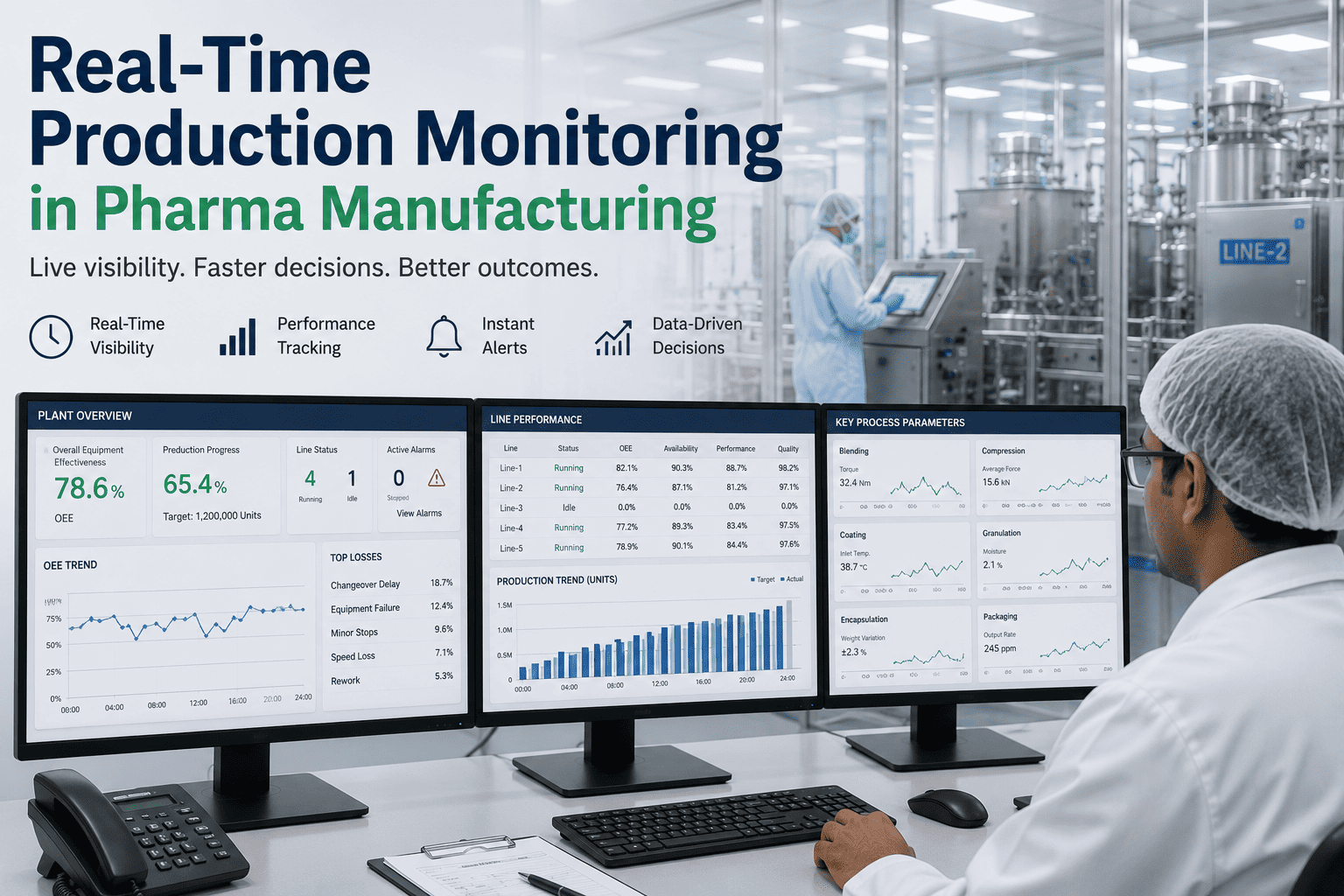
Live OEE, throughput, and downtime data captured at the line, contextualized against the active SAP production order, and surfaced on shop floor and management dashboards.
AI Vision & Quality
Vision-camera defect detection and SPC tied to SAP QM inspection lots, with results posted back automatically through QPRS_RESULT BAPI calls.
Predictive Maintenance & CMMS
Equipment health from PLC and sensor telemetry feeds the CMMS, which synchronizes work orders and functional locations with SAP Plant Maintenance.
End-to-End Monitoring
Integration health dashboards covering IDoc status, BAPI response times, queue depth, reconciliation gaps, and exception alerts wired to your operations channels.
Expert Review — A Practical Take from the Field
We asked iFactory's lead SAP integration architect to summarize what U.S. manufacturers consistently get wrong on these projects, and what separates a healthy ERP-MES integration from one that becomes the next problem to solve. The answer was direct.
The teams that succeed treat ERP-MES integration as an operating capability, not a one-time project. They define data contracts before they touch CPI. They monitor every IDoc and BAPI call from day one. They build a small reconciliation dashboard that operations actually opens every morning. And they put one person — not a committee — in charge of the data fabric between S/4HANA and the shop floor. The teams that fail buy a tool, throw it over the wall to a systems integrator, and discover at the next month-end that nothing reconciles.
iFactory Integration Architecture Team
SAP S/4HANA & MES Integration Practice
Industries Where We See This Pattern Working
iFactory's SAP S/4HANA to MES integration practice spans every regulated and high-mix discrete and process manufacturing sector across the U.S. The patterns are consistent — what changes is the dominant data object. Pharma cares about batch genealogy and electronic batch records. Automotive cares about confirmations and serial-number traceability. Food and beverage cares about lot recall and shelf-life dating. Each industry weights the twelve data objects differently, and each gets a tuned integration design.
Pharmaceuticals
Batch genealogy, electronic batch records, 21 CFR Part 11 audit trail synchronized between S/4HANA QM and MES.
Automotive
High-volume confirmations, serial-number traceability, just-in-sequence dispatching tied to SAP production orders.
Food & Beverage
Lot-level traceability, shelf-life dating, allergen segregation, and recall scenarios driven from SAP batches.
Chemicals & Process
Process orders, recipe execution, batch yield variance posted to S/4HANA per phase, not per shift.
Steel & Cement
Heavy-asset OEE, energy consumption, and shutdown management tied to SAP PM functional locations.
FMCG & Consumer Goods
High-volume confirmations, packaging traceability, multi-plant choreography across S/4HANA instances.
Conclusion — The Integration Is the Product
For most U.S. manufacturers, the question is no longer whether to integrate SAP S/4HANA with the MES. The question is whether the integration you build will be a continuously running data fabric or another batch handoff dressed up in new protocols. The deciding factors are architectural and organizational. Pick the right pattern per data object. Sign off the contracts before writing code. Monitor every message from day one. Put one accountable owner over the integration. The result is a plant where operations and finance finally see the same numbers — and where every downstream investment in AI, predictive maintenance, digital twin, and Industry 4.0 starts from a foundation of trusted data, not reconciled spreadsheets. Book a Demo to see how iFactory builds this on top of your existing SAP landscape.
Frequently Asked Questions
What is SAP S/4HANA and MES integration in plain terms?
It is the bidirectional data connection between SAP S/4HANA (your ERP, which handles production orders, inventory, costing, and financials) and your Manufacturing Execution System (the platform that runs the shop floor — dispatching, confirmations, quality, OEE). Done well, production orders flow down from S/4HANA into the MES automatically, and confirmations, goods movements, scrap, yield, and quality results flow back up in near real time. The two systems agree on what is happening, when, and at what cost.
Which SAP integration patterns should we use for which data objects?
Use IDocs through SAP Cloud Integration (CPI) for asynchronous master data — material master, BOM, routing, work center, production order release. Use BAPI calls through the SAP Cloud Connector for transactional postings that need synchronous integrity — confirmations, goods issues, goods receipts, quality results. Use OData services for synchronous queries and dashboards. Use event-driven messaging (SAP Event Mesh or Kafka) for high-volume telemetry and cross-plant choreography. A real integration combines all four — not just one. Book a Demo for a walkthrough on your stack.
Do we need SAP Digital Manufacturing Cloud (DMC) or can we use a third-party MES?
Both work. SAP Digital Manufacturing (formerly DMC) is SAP's native MES, runs on Business Technology Platform, and has the tightest pre-built integration with S/4HANA via SAP Cloud Integration. Third-party MES platforms — including iFactory — integrate using the same CPI, BAPI, IDoc, and OData mechanisms SAP exposes. The choice usually comes down to feature fit, deployment model preference, total cost of ownership, and what you already run. iFactory integrates with S/4HANA using SAP's standard patterns plus pre-built iFlows that compress deployment time significantly.
How long does a SAP S/4HANA to MES integration typically take to deploy?
For a single plant with a well-scoped data contract and clean master data, a focused integration covering the twelve core objects can be live in roughly eight to sixteen weeks. Multi-plant rollouts add proportional time per site plus governance overhead. The biggest variable is almost never the integration tooling — it is master data quality and organizational alignment. Plants where the data contract is signed off early and master data is cleaned before iFlows are built consistently land on the faster end of that range.
What happens to the integration if SAP S/4HANA is upgraded or we migrate to RISE with SAP?
A standards-based integration — IDocs, BAPIs, OData, all routed through SAP Cloud Integration — survives upgrades and RISE migration with minimal rework, because the SAP-exposed interfaces are versioned and stable. Custom point-to-point RFCs are the integrations that break on upgrade. This is why iFactory mandates the SAP-recommended patterns and CPI as the backbone. Plants that built their integration the standards-based way move to RISE smoothly. Plants that did not, rebuild.
Stop Reconciling Spreadsheets · Start Running on Real-Time Data
Book a SAP S/4HANA & MES Integration Session
Whether you are designing a new integration, modernizing a legacy batch interface, or preparing for a S/4HANA migration, we will walk through your current landscape, identify the highest-leverage data objects to integrate first, and map a delivery plan that fits your timeline.