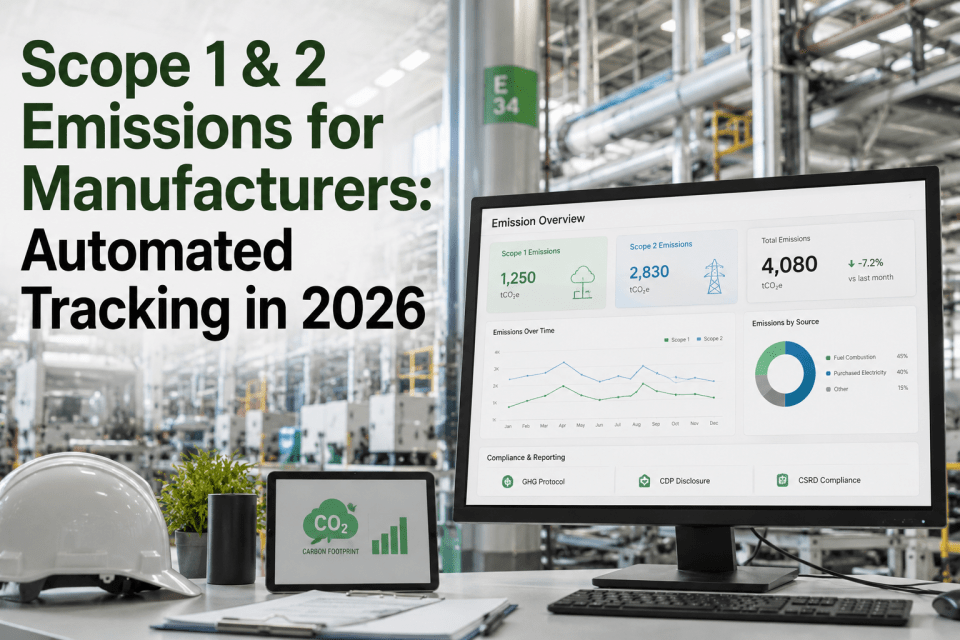
For U.S. manufacturers, 2026 is the year carbon accounting stopped being a sustainability team project and became a finance, operations, and compliance mandate all at once. California's SB 253 — now firmly enforced after CARB's February 2026 rulemaking — requires every U.S. company with more than $1 billion in revenue doing business in the state to publicly disclose Scope 1 and Scope 2 greenhouse gas emissions by August 10, 2026, with administrative penalties of up to $500,000 per entity per year for non-compliance. The EU's CSRD, IFRS S2, CDP, and SBTi Net-Zero Standard all now require GHG Protocol-aligned disclosure. And yet most manufacturing plants still calculate emissions on spreadsheets fed by utility bills that arrive 30 days late, with no traceability back to meters, no audit trail and no way to reconcile billed energy with what production lines actually consumed. Scope 1 and 2 emissions manufacturing tracking is now a software problem — and iFactory AI's Energy Monitoring platform was built to solve it. Plants ready to move from spreadsheet-based accounting to audit-ready, sensor-driven ESG reporting can Book a Demo to see automated emissions tracking integrated directly into the shop floor.
Automate Scope 1 & 2 Emissions Tracking Across Every Plant in Your Network
iFactory's Energy Monitoring platform connects directly to PLCs, sub-meters, and utility data feeds to produce audit-ready GHG inventories aligned with SB 253, CSRD, and CDP — without spreadsheets, without delay.
Why Scope 1 & 2 Emissions Tracking Is a 2026 Imperative for U.S. Manufacturers
The compliance landscape has shifted permanently. Manufacturers selling into California, the EU, or to OEM customers with verified supply chain emissions targets now face overlapping disclosure requirements that demand consistent, verifiable carbon data. SB 253 alone is expected to cover more than 5,400 large companies, with penalties up to $500,000 per year for missed filings. The EU's CSRD layers on top of that with limited assurance requirements, and CDP, SBTi, and most large procurement contracts now expect GHG Protocol-aligned Scope 1 and 2 inventories as a baseline.
For plants still aggregating utility bills into a quarterly spreadsheet, this is a structural problem — not a documentation problem. Manual workflows can't scale to multi-site, multi-meter, multi-fuel emission accounting under third-party assurance. iFactory's Energy Monitoring solution closes that gap by pulling real-time data from PLCs, sub-meters, and utility APIs into a single carbon ledger that maps every kWh and every cubic meter of natural gas to a verified emission factor. Manufacturing leaders evaluating this shift can Book a Demo to see what audit-ready emissions reporting looks like for a multi-plant operation.
SB 253 (California)
Scope 1 & 2 disclosure required by August 10, 2026 for U.S. companies with $1B+ revenue doing business in California. Limited assurance becomes mandatory from 2027.
EU CSRD
U.S. manufacturers with EU subsidiaries or significant EU turnover must report GHG Protocol-aligned Scope 1 and 2 emissions with third-party limited assurance.
CDP & SBTi
Voluntary frameworks adopted by most Fortune 500 buyers. Tier 1 and Tier 2 suppliers face contract pressure to disclose verified Scope 1 and 2 emissions.
IFRS S2 & ISSB
Global baseline for climate-related financial disclosure now adopted by 20+ jurisdictions. Aligns Scope 1, 2 disclosure with financial reporting cycles.
What Scope 1 and Scope 2 Actually Mean Inside a Manufacturing Plant
The GHG Protocol — the international standard underpinning every major emissions regulation — divides corporate greenhouse gas emissions into three scopes. For manufacturers, getting Scope 1 and Scope 2 inventories right is the foundation that every other ESG metric, reduction target, and disclosure depends on. Misclassifying a fuel source or applying the wrong emission factor invalidates the entire downstream reporting chain.
Scope 1 — Direct Emissions From Plant Operations
Scope 1 covers everything your facility directly burns, leaks, or emits from owned or controlled sources. For a typical manufacturing plant, this means stationary combustion (natural gas in boilers, furnaces, kilns, ovens, and dryers), mobile combustion (forklifts, plant vehicles, on-site logistics fleet), process emissions (chemical reactions like CO₂ release during cement calcination or steel production), and fugitive emissions (refrigerant leaks from HVAC and chillers, SF₆ from electrical switchgear, methane from compressed gas systems). Every one of these sources requires its own activity data and emission factor — and missing any of them creates a material gap in the inventory.
Scope 2 — Indirect Emissions From Purchased Energy
Scope 2 covers indirect emissions from purchased electricity, steam, heat, and cooling consumed at the facility. The GHG Protocol's Scope 2 Guidance requires dual reporting under two methods: the location-based method (using the average emission factor for the regional grid where the electricity was consumed) and the market-based method (which reflects the contractual instruments — renewable energy certificates, power purchase agreements, green tariffs — the facility has acquired). Most manufacturers underestimate the complexity here: a single plant drawing from multiple meters across different rate schedules, with on-site solar feeding the grid, requires careful boundary management to avoid double counting.
Why Automation Is No Longer Optional
A mid-size manufacturing site can have 40 to 200 individual emissions sources across Scope 1 and 2 — every boiler, every dryer, every meter, every refrigeration unit. Tracking these manually across multiple plants is the leading cause of disclosure errors and assurance failures. iFactory's Energy Monitoring platform automates this entire data layer, pulling activity data directly from PLCs, building management systems, sub-meters, and utility APIs in real time. Manufacturers wrestling with this data scope can Book a Demo to see how the platform maps every source against GHG Protocol categories automatically.
The Automated Scope 1 & 2 Emissions Tracking Workflow
Audit-ready emissions reporting depends on a clean, repeatable data flow from the meter or sensor all the way to the disclosure submission. iFactory's Energy Monitoring solution structures this workflow into five connected stages — each one removing a category of manual work that has historically caused assurance failures.
Source Data Capture
PLC tags, sub-meters, BMS, utility APIs, and fuel delivery records feed directly into the platform. No manual entry, no monthly spreadsheet pulls.
Activity Data Normalization
Raw kWh, therms, cubic meters, and liters are validated, deduplicated, and mapped to standardized emission source categories per GHG Protocol.
Emission Factor Application
EPA, IPCC, IEA, and regional grid emission factors applied automatically. Dual location-based and market-based Scope 2 calculations handled in parallel.
GHG Inventory Aggregation
Site-level, business-unit, and consolidated corporate inventories generated in real time. Drill-down from total tCO₂e to the originating meter reading.
Disclosure-Ready Reports
SB 253, CSRD, CDP, and SBTi-formatted outputs auto-generated with full audit trail. Assurance-ready evidence package included for each disclosure.
Manual Carbon Accounting vs. Automated Emissions Tracking
The operational gap between manual GHG accounting and automated tracking is significant — and it widens with every additional plant, meter, or disclosure framework added to the program. Teams planning a transition can Book a Demo with iFactory for a workflow walk-through against their current process.
| Workflow Stage | Spreadsheet-Based Approach | iFactory Automated Tracking | Time / Quality Impact |
|---|---|---|---|
| Data Collection | Monthly utility bill copy-paste, manual meter reads | Real-time PLC, sub-meter, and utility API ingestion | 30+ days → Continuous |
| Emission Factor Application | Hand-keyed factors from EPA or IEA PDFs | Versioned factor library with automated regional mapping | No transcription errors |
| Scope 2 Dual Reporting | Often skipped or done incorrectly | Location-based and market-based calculated in parallel | Full GHG Protocol compliance |
| Multi-Plant Consolidation | Email-based collection across site coordinators | Centralized dashboard with site, region, and corporate roll-ups | Weeks → Real time |
| Audit Trail | Embedded formulas, lost version history | Immutable activity log with source-to-disclosure traceability | Assurance-ready |
| Disclosure Generation | Manual report assembly per framework | SB 253, CSRD, CDP, SBTi templates auto-generated | Days → Minutes |
How iFactory's Energy Monitoring Powers Scope 1 & 2 Compliance
iFactory's Energy Monitoring solution is built specifically for the multi-meter, multi-plant operational reality of modern manufacturing. The platform consolidates the full Scope 1 and Scope 2 data layer — from raw sensor readings to disclosure-ready GHG inventories — into a single connected environment that integrates with existing CMMS, MES, and ERP systems.
Sensor & Sub-Meter Integration
For: Plant Engineering & Energy Managers
- PLC tag integration for fuel and power consumption
- Sub-meter network for line-level visibility
- BMS and chiller plant data integration
- Utility API and billing data reconciliation
GHG Inventory & ESG Dashboards
For: Sustainability & ESG Reporting Teams
- Automated Scope 1 and 2 calculation engine
- Dual location-based / market-based Scope 2
- Site, region, and corporate consolidation
- Real-time emissions dashboards by source
Audit-Ready Reporting
For: ESG, Legal, & Finance Leaders
- SB 253 reporting template auto-generation
- CSRD and CDP-aligned output formats
- SBTi target tracking and progress reports
- Limited assurance evidence package
Operational Impact of Automated Emissions Tracking
The benefits of moving from manual to automated emissions tracking are measurable across compliance, cost, and operational efficiency. The results below reflect benchmarks observed across iFactory-supported manufacturing deployments during the first reporting cycle.
Industry Perspective on Automated GHG Tracking in Manufacturing
"We spent the first half of 2025 trying to build our SB 253 inventory in spreadsheets across eleven U.S. plants. By June, we had 19 versions of the same workbook, three different ways of calculating market-based Scope 2, and an external auditor who refused to sign off. Switching to iFactory's Energy Monitoring platform took eight weeks to deploy across our largest sites — and the moment we did, every meter, every fuel delivery, and every emission factor was traceable end to end. We filed our August 2026 disclosure with assurance evidence already attached. The platform paid for itself in saved audit hours alone, and we've since identified roughly 11% in energy cost reduction opportunities the data was hiding from us."
90-Day Path to Audit-Ready Scope 1 & 2 Reporting
A structured 90-day deployment sequence gets a multi-plant manufacturer from spreadsheet-based accounting to audit-ready, sensor-driven emissions reporting before the next disclosure cycle.
Emission Source Mapping
Inventory every Scope 1 source (boilers, furnaces, fleet, refrigerants, process emissions) and every Scope 2 meter across each plant. Define organizational and operational boundaries per GHG Protocol.
Data Pipeline Activation
Connect PLCs, sub-meters, BMS, utility APIs, and fuel delivery records to the iFactory data layer. Validate baseline activity data against prior 12 months of utility billing.
Carbon Engine Calibration
Apply EPA, IPCC, and regional grid emission factors. Run dual location-based and market-based Scope 2 calculations. Reconcile site-level and corporate inventories with finance and procurement records.
Disclosure Preparation & Assurance
Generate SB 253, CSRD, and CDP-formatted disclosures. Compile assurance evidence package for third-party verifier. Set up continuous monitoring for the next reporting cycle.
Automated Scope 1 & 2 Tracking Is Now the Manufacturing Standard
The era of building a corporate GHG inventory from monthly utility bills and shared spreadsheets is over. With SB 253 enforcement now confirmed for August 2026, CSRD assurance requirements taking hold across U.S.-EU operations, and procurement contracts increasingly tying preferred-supplier status to verified emissions data, manufacturers face a binary choice: automate the Scope 1 and 2 data layer or accept compliance risk, audit failures, and lost contracts.
iFactory's Energy Monitoring solution delivers the connected, sensor-driven, GHG Protocol-aligned tracking infrastructure that modern manufacturing operations require. From real-time data capture across PLCs and sub-meters to auto-generated SB 253 and CSRD reports with full audit traceability, the platform replaces spreadsheet workflows with disclosure-ready intelligence. Manufacturers preparing for the 2026 reporting cycle and beyond can Book a Demo to see how iFactory maps to their specific multi-plant emissions profile.
Scope 1 & 2 Emissions Tracking — Frequently Asked Questions
Does SB 253 apply to manufacturers that aren't headquartered in California?
Yes. SB 253 applies to any U.S. company with annual global revenue above $1 billion that "does business" in California, regardless of headquarters location. Manufacturers selling, operating, or distributing into California typically fall under scope and must disclose Scope 1 and 2 emissions by August 10, 2026.
What's the difference between location-based and market-based Scope 2 reporting?
Location-based Scope 2 uses the average emission factor of the regional grid where electricity is consumed. Market-based Scope 2 reflects contractual instruments — renewable energy certificates, power purchase agreements, green tariffs — that the company has acquired. GHG Protocol requires both to be reported in parallel, and iFactory's platform calculates them simultaneously to ensure compliance.
How does iFactory's Energy Monitoring integrate with existing plant systems?
The platform connects directly to PLCs via standard industrial protocols (OPC UA, Modbus, MQTT), to building management systems, to sub-meter networks, and to utility APIs. It also exchanges data with CMMS, MES, and ERP systems already deployed in the plant — no rip-and-replace required.
What data is needed to generate an audit-ready Scope 1 and 2 inventory?
Activity data for every Scope 1 emission source (fuel consumption by type, refrigerant usage, process inputs) and every Scope 2 source (purchased electricity, steam, heat, cooling by meter). iFactory captures this data continuously from plant systems and pairs it with verified emission factors, producing a complete, traceable inventory for third-party assurance.
Does the platform support both SB 253 and EU CSRD reporting from the same data set?
Yes. iFactory maintains a single source-of-truth GHG inventory and generates framework-specific outputs — SB 253, CSRD, CDP, SBTi, IFRS S2 — without re-collecting data. The same activity records and emission factors flow into every required disclosure format with full audit traceability preserved.
Build an Audit-Ready Scope 1 & 2 Reporting Program with iFactory AI
iFactory connects your plant sensors, sub-meters, utility data, and ERP records into a single carbon ledger — producing SB 253, CSRD, and CDP-ready disclosures with full traceability and assurance evidence built in.