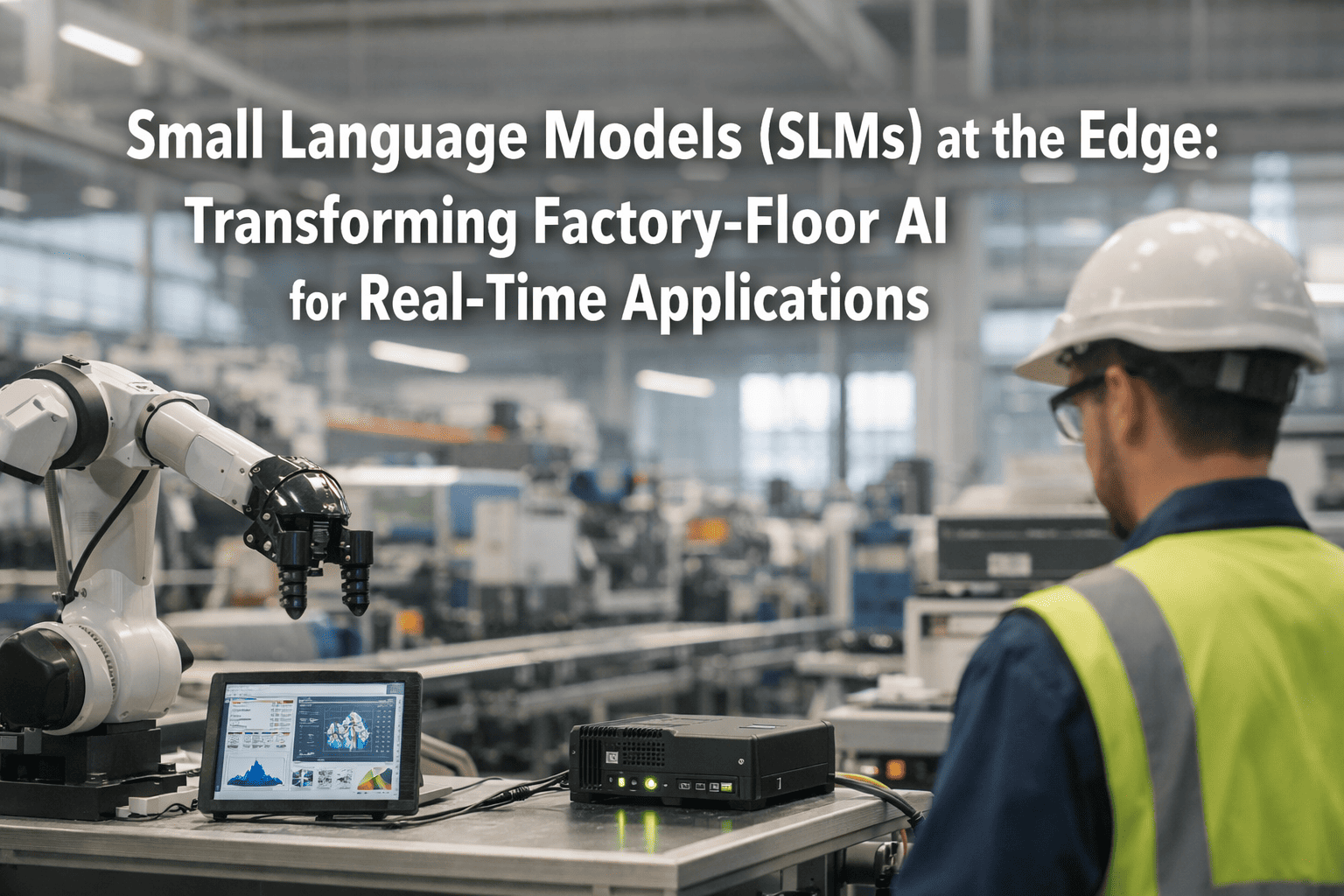
Your factory floor doesn't need GPT-5. It needs a 3-billion parameter model that identifies bearing wear from vibration patterns in 8 milliseconds — running on a $2,000 edge device with no internet connection. That's the shift happening right now: small, task-specific language models (SLMs) deployed at the edge are replacing cloud-dependent LLMs for real-time manufacturing AI. Gartner predicts that by 2027, organizations will use small, task-specific AI models 3x more than general-purpose LLMs. Dell calls 2026 "the year of the SLM." The reason is simple — on a factory floor where milliseconds matter, data sovereignty is non-negotiable, and internet connectivity is unreliable, small beats big every time. This guide shows how iFactory deploys SLMs on edge hardware for real-time quality control, predictive maintenance, and operator assistance — without sending a single byte to the cloud. Book a free consultation to explore SLM deployment for your plant.
AI-Native Digital Transformation for Smart Manufacturing
Expert session covering SLM deployment, edge AI architecture, and local model strategies — with live Q&A.
Register Now — Free Session →The Big Problem With Big Models on the Factory Floor
Cloud-based LLMs like GPT-4 are extraordinary for general tasks. But on a factory floor, they fail in three critical ways that iFactory's SLM approach solves.
Latency Kills
Cloud round-trip: 200ms–2s. A quality defect on a line running 100+ units/minute passes 3-5 units before the cloud even responds. SLMs on edge: <10ms. Defect caught on the same unit.
Data Leaves Your Building
Every API call sends production data — process parameters, defect images, maintenance logs — to a third-party cloud. For defense, pharma, and export-controlled manufacturing, this is a compliance violation. SLMs on edge: zero data egress.
Costs Explode at Scale
At $0.01-0.06 per 1K tokens, running an LLM across 500 sensors generating data every second becomes a budget nightmare. Per-token costs don't exist with SLMs — you own the hardware, the model runs free forever.
SLM vs. LLM: The Factory-Floor Comparison
This isn't a competition for who writes the best essay. It's about which model architecture survives on a factory floor where power is limited, latency is fatal, and connectivity is unreliable.
4 SLM Use Cases iFactory Deploys Today
Each SLM is fine-tuned on your plant's data — maintenance logs, process parameters, quality records, SOPs. They speak your factory's language, not the internet's.
Real-Time Quality Inspector
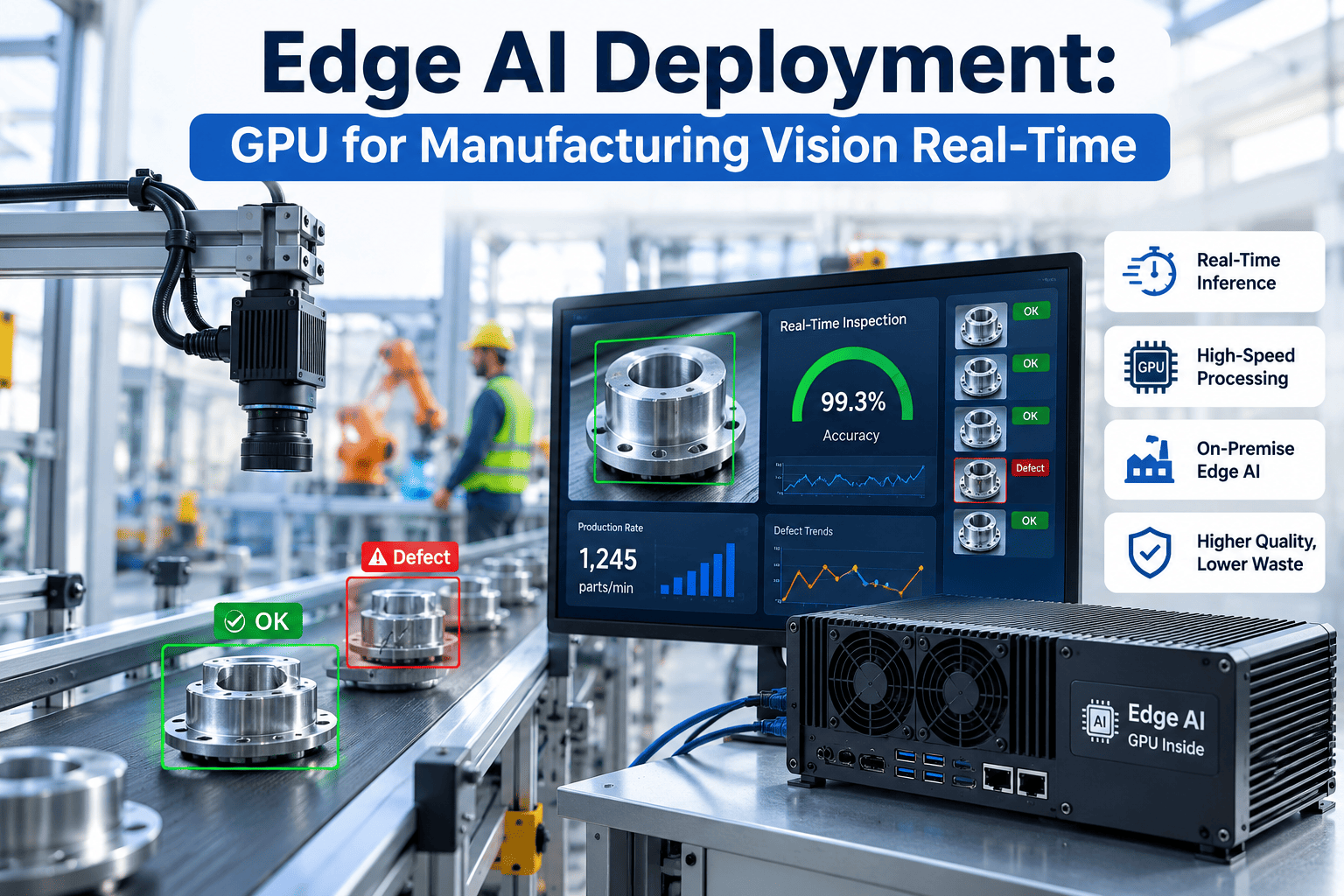
A 3B-parameter vision+language model analyzes every unit on the line. Detects surface defects, dimensional drift, and assembly errors — then explains the defect type in natural language for the operator. All in <10ms, on edge hardware.
Predictive Maintenance Analyst
A vibration + thermal + acoustic SLM correlates multi-sensor patterns to predict failures 48-72 hours ahead. Generates natural-language repair plans with parts lists — directly into your CMMS without cloud dependency.
Operator AI Assistant
An on-device SLM trained on your SOPs, maintenance manuals, and tribal knowledge. Operators ask questions in natural language — "Why is press 7 running hot?" — and get plant-specific answers in seconds, offline.
Process Optimization Agent
Continuously analyzes process parameters — temperature, pressure, speed, feed rates — and micro-adjusts setpoints to maintain optimal quality while minimizing energy use. Learns your specific equipment behavior over time.
The iFactory Edge Stack: How SLMs Run on Your Floor
Deploying an SLM isn't just about the model — it's about the full stack from sensor to inference to action. Here's what iFactory provisions at the edge.
Expert Perspective
Small, task-specific models provide quicker responses and use less computational power, reducing operational and maintenance costs.
Micro LLMs — compact, task-specific models optimized for efficiency — are moving from research curiosity to production reality in 2026.
Manufacturing facilities can deploy local SLMs for real-time quality control and predictive maintenance — without the latency of connectivity to a cloud.
The future of factory-floor AI isn't bigger models. It's smaller, smarter, domain-specific models that run where the data lives — at the edge, in real-time, with zero cloud dependency. iFactory's Local LLM Deployment makes this real: fine-tuned SLMs on edge hardware, connected through the Unified Namespace, governed by your policies, owned by you.
Deploy SLMs on Your Factory Floor
iFactory's Local LLM Deployment fine-tunes task-specific models on your plant data and runs them on edge hardware — sub-10ms inference, zero cloud cost, full data sovereignty.
Frequently Asked Questions
Small Models. Big Impact. Zero Cloud.
The factory of 2026 runs AI at the edge — fast, private, and free from per-token pricing. iFactory makes it real.