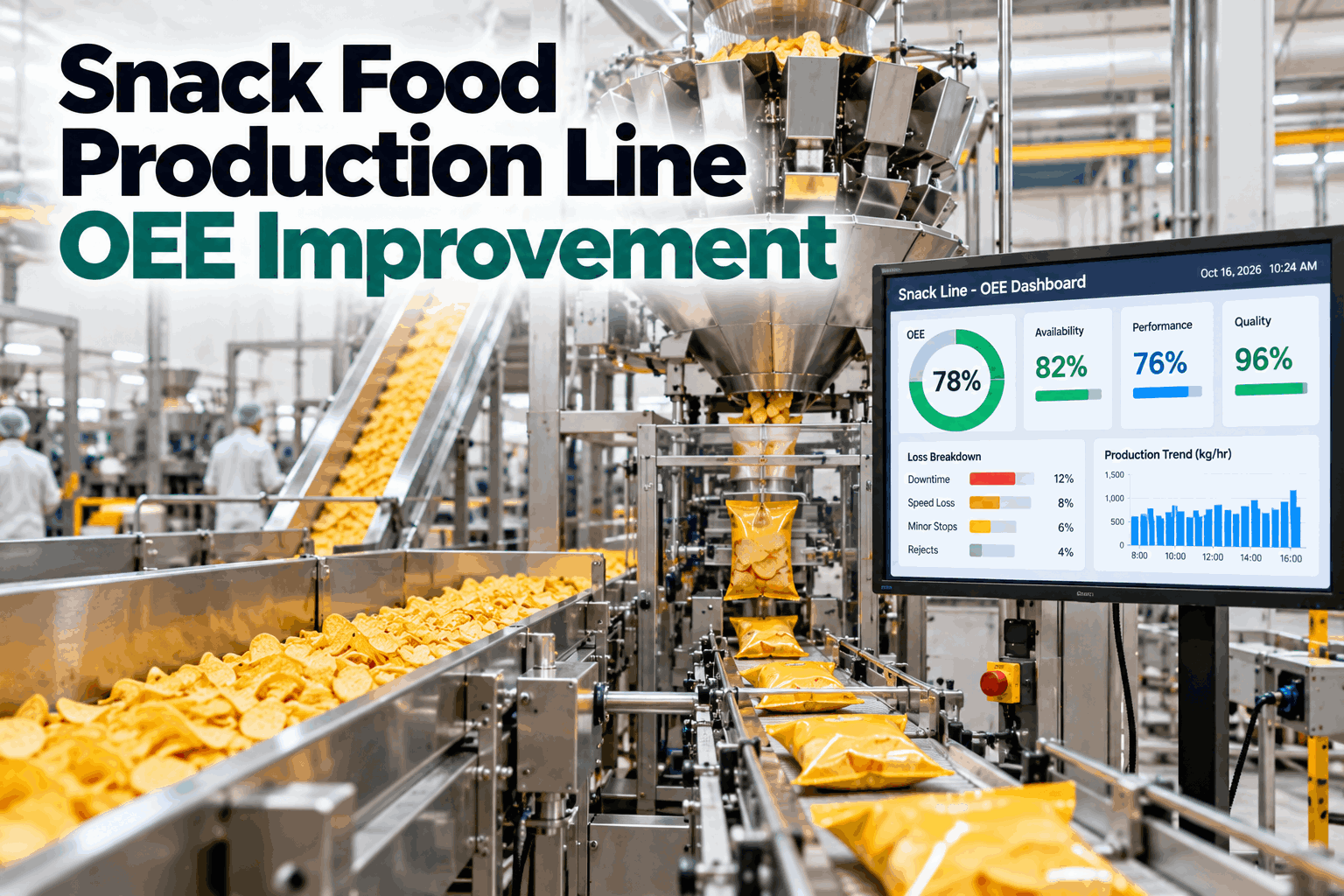
A snack line rarely loses a shift to one big breakdown. It loses it in small pieces. The seasoning runs light for twenty minutes. The weigher misses a cycle because the feed surged. A crumb lands in the seal and the bag leaks. Each one looks minor. Together they are the difference between a good shift and an average one, and most of them never reach the shift report. This guide shows where a snack line really loses tonnage, how to measure it so the numbers can be trusted, and what to fix first. To see the same view on your own line, book a line review.
Snack Food Production Line OEE Improvement
Find the kilos lost to seasoning drift, weigher rejects and bag seal fails, and win them back in the right order.
- One shift followed in kilos, loss by loss
- The three snack losses: what causes each and how to fix it
- Six KPIs and a 10-point line audit
One 40 g bagger rated at 100 bags a minute, over 440 planned minutes. A worked example, not a benchmark.
Where a Snack Line Loses Tonnage
Five places, and only some of them show up as downtime.
Follow the product from the fryer or oven to the case. At each step a little is lost, and each loss lands in a different part of OEE. Some do not land in OEE at all. That is why a line can report a fair OEE and still miss its tonnage plan. Our support team can map these five on your line.
OEE compares good bags made with good bags possible. A bag that is two grams heavy still counts as one good bag. So overfill, often called giveaway, never appears in the score. Track it next to OEE, in kilos, or the most quietly expensive loss on the line stays invisible.
The Three Losses, One at a Time
Seasoning drift, weigher rejects and bag seal fails. What each looks like, and what fixes it.
These three are specific to snack lines, and they share a habit. Each starts small, builds slowly and is usually found by a person, late. Each also has a signal the machines already give off. To go through them on your own equipment, book a working session.
Seasoning drift
QualityProduct that is pale, patchy or too salty. It is often caught by a taste panel or lab check an hour after it began.
The seasoning feeder runs at one rate while product flow rises and falls. Powder also clumps in damp air and builds up in the drum.
Log seasoning fed against product weight passing through, minute by minute. The ratio shows drift long before the lab does.
Tie the feeder rate to product flow. Keep the feed to the drum even. Clean the drum and feeder on a set interval.
Weigher rejects
Speed + QualityBags pushed off by the checkweigher, bagger cycles with no product, and average weights that creep above the target.
A multihead weigher builds each bag from a few hoppers. Starve it or flood it and it cannot find a good mix. Oil and seasoning on the hoppers add error.
Count cycles with no valid combination. Trend average weight and its spread for each pack size. Count checkweigher rejects by cause.
Steady the feed first. Clean and zero the hoppers on a clock. Save the best settings for each product and pack, and reload them every time.
Bag seal fails
Stops + QualitySoft bags that have lost their air, crumbs visible in the seal, and operators stopping to wipe the jaws.
Product is still falling when the jaws close. Seasoning dust coats the seal area. Jaw temperature or film position wanders.
Log seal rejects by bagger and by jaw. Trend jaw temperature. Count every stop for jaw cleaning, however short.
Tighten each charge so it clears the jaws. Clean jaws on an interval, not on failure. Check settings when a new film reel goes on.
A packaging white paper from Key Technology says a gap of about 100 milliseconds between one product charge and the next is typically enough for the jaws to seal cleanly, and that a weigher usually combines three to five hoppers for each bag.
One Shift as Arithmetic
OEE is three simple fractions multiplied together. Here is the shift from the top of the page, worked through so anyone on the line can check it.
Expose It: Measure the Line the Right Way
A loss you cannot see is a loss you will not fix.
Most snack plants already report OEE. Fewer report one that the floor believes. The six rules below are what make the number honest, and they cost little to follow. If a rule is broken, the score looks better than the line really is. Ask our line specialists to check yours against them.
Count at the bagger
The bagger sets how much leaves the line. Measure there, not at the fryer.
One rated speed per pack
A 25 g bag and a 150 g bag run at different speeds. Each needs its own.
Let the machine log stops
People forget short stops. The bagger does not. Ask the operator only for the reason.
Keep the short stops
Thirty stops of twenty seconds are ten minutes. On a snack line they add up fast.
Take good bags from the checks
Use checkweigher and seal-check counts, not a tally written at the end of the shift.
Report kilos beside OEE
Overfill and waste are measured in weight. Show them on the same screen.
The three snack losses inside the example shift
Illustrative. The three named losses come to about 170 kg of the 481 kg lost in this shift, roughly a third. In this example the flavour change and slow running were larger, which is the point of measuring before fixing.
Recover It: What to Fix, in What Order
Steady the flow first. Speed comes last.
It is tempting to chase each loss with its own project. On a snack line that often wastes effort, because the three losses share one upstream cause. Work in the order below and each step makes the next one easier. To plan this for your line, book a recovery plan.
Steady the flow
Even product from the fryer to the drum to the weigher. No surges, no gaps.
Clean on a clock
Drum, hoppers and jaws cleaned at set intervals, before they cause a reject.
Tune each pack
Saved settings for every product and bag size, loaded at each change.
Then raise speed
Only once rejects and stops are low. Speed on a rough line just makes more waste.
When product reaches the seasoning drum in surges, a fixed feeder over-seasons the thin patches and under-seasons the thick ones. The same surge then starves and floods the weigher, which misses cycles and overfills. Long, ragged charges then trail into the bagger jaws and spoil the seal. Fix the surge and all three improve together.
Usually costs little
- Cleaning intervals for drum, hoppers and jaws
- Saved settings for each product and pack
- A check each time a new film reel is loaded
- Stop reasons entered during the shift
- Flavour changes timed and reviewed
Usually needs investment
- Feed control that meters product to the weigher
- A seasoning feeder that follows product flow
- Automatic seal checking on every bag
- Camera checks on seasoning coverage
- A new weigher for very light products
Measure first. The figures will show which of these would pay back.
Six Snack Line KPIs and a 10-Point Audit
Six numbers to watch each shift, and ten checks to run once a quarter.
We could not find an independent, published OEE benchmark for snack lines. The 85% figure comes from 1970s Japanese car plants, and OEE.com itself warns that it may not fit every industry. A snack line's best benchmark is its own best shift on the same product and pack. iFactory tracks the six KPIs below for each line and pack size. Our integration team can confirm which signals your machines already give.
The 10-point line audit
- OEE is counted at the bagger, not at the cooker
- Every pack size has its own rated speed
- Stops are logged by the machine, with a reason given in-shift
- Stops under five minutes are counted
- Good bags come from checkweigher and seal-check counts
- Giveaway is reported in kilos next to OEE
- Seasoning feed follows product flow, and the ratio is logged
- Weigher hoppers are cleaned and zeroed on a set interval
- Seal rejects are logged by bagger and by jaw
- Flavour changes are timed from last good bag to first good bag
Score one point for each line that is true today. Under six, fix the measurement before the machines.
One set of data, three views
- Operator. The top loss right now, and which machine it is on.
- Shift lead. OEE and kilos for each line, with losses ranked.
- Plant manager. Lines compared by pack, week on week.
iFactory shows and ranks the losses. Your team decides the fix.
Turnkey AI: Delivered, Connected and Live in 6–12 Weeks
You do not build this. It arrives ready.
iFactory ships as a pre-configured NVIDIA AI server, racked and ready, with the software pre-loaded. Rack it, plug in power and Ethernet, and the AI is live on your network.
Our team handles cabling, network setup, PLC and SCADA integration, operator training and 24×7 remote monitoring. The server sits inside your own network, so line and recipe data stay on site. For a scope matched to your lines, request a turnkey quote.
Ship, network and data
Server installed. Weigher, bagger, checkweigher and seasoning signals connected. Rated speeds agreed for each pack.
Model training and pilot
One line live. Stops, rejects and giveaway counted automatically and checked against the shift's own records.
Go-live and training
Remaining lines added. Operators and shift leads trained. 24×7 remote monitoring begins.
Frequently Asked Questions
What is a good OEE for a snack food line?
There is no trusted public figure for snack lines. 85% is often called world-class, and OEE.com says most manufacturers are nearer 60%. Neither was measured on snack lines. The most useful target is your own best shift on the same product and pack size, repeated every shift.
Why measure OEE at the bagger and not the fryer?
Because the bagger decides how much sellable product leaves the line. A fryer can run flat out while bags are lost to the weigher or the seal. Counting at the bagger captures every loss upstream of it, in units the business sells.
Is giveaway part of OEE?
No. OEE counts good bags, and an overfilled bag is still a good bag. Giveaway is a yield loss that sits outside the score. Report it in kilos on the same screen as OEE, or a line can look healthy while handing product away in every bag.
How does seasoning drift lower OEE?
Through quality. Product that is too light or too heavy on seasoning is held, reworked or scrapped, and those bags are not good bags. Heavy seasoning also wastes an expensive ingredient, and that cost does not show in OEE at all.
What causes most weigher rejects?
Uneven feed is the usual cause. A multihead weigher needs a steady supply to find a good mix of hoppers. When it is starved or flooded, it misses cycles or releases off-weight bags. Product build-up on the hoppers is the second common cause.
How do we cut bag seal failures?
Start by logging rejects by bagger and jaw, so you know where they come from. Then look at three things: product still falling as the jaws close, dust and oil on the jaws, and jaw temperature or film position wandering over the shift.
Do we need new sensors, and how long does it take?
Often not. Most weighers, baggers and checkweighers already report counts, weights and stops, and we connect to those first. Going live takes six to twelve weeks from delivery. To check what your machines can provide, contact our team.
Bring One Shift From One Line
In thirty minutes we turn one shift of your own figures into the kilo view at the top of this page, and show which loss is largest. You keep the breakdown whether or not you go further with iFactory.
- 1Bag counts for one shift, by bagger
- 2The stop log for the same shift
- 3A checkweigher report with average weight and rejects
- 4Seal or leak reject counts
- 5Your pack sizes and the rated speed for each