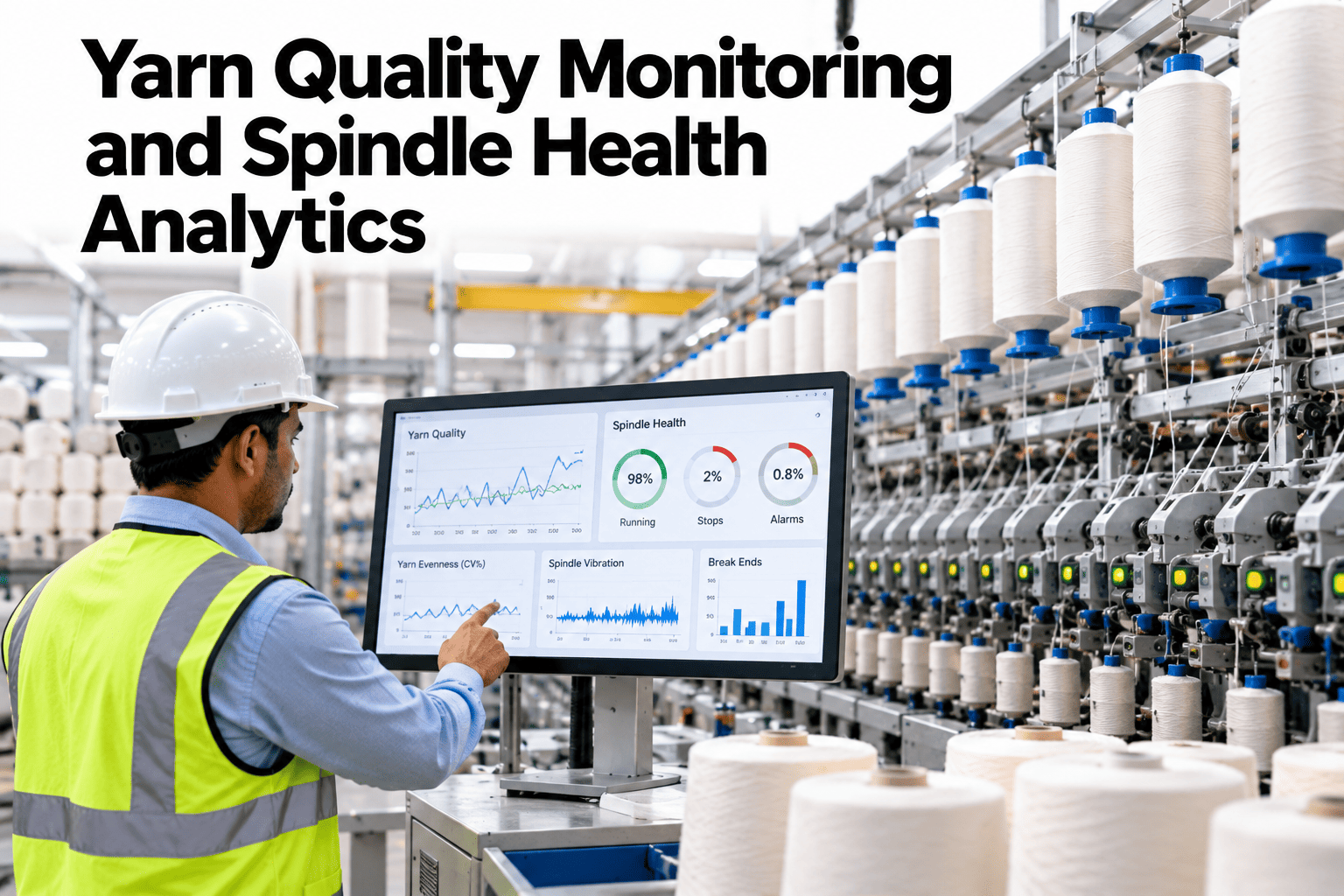
A single underperforming spindle on a ring frame rarely gets noticed on its own, since a spinning floor can have thousands of spindles running at once and a quality issue traced to just one of them tends to hide inside the overall yarn quality average. By the time a batch of yarn shows up with inconsistent twist or strength at the next stage, the specific spindle responsible has often been running that way for days or weeks already. Spindle-level health analytics flips this by tracking each spindle's own performance pattern continuously, so a single underperforming spindle gets flagged on its own rather than waiting to show up as a quality problem downstream. If you want to see this kind of spindle-level tracking applied to your own spinning floor data, you can review a sample spindle health report with our team.
Catch a Failing Spindle Before It Shows Up as a Yarn Quality Problem
Spindle-level health tracking that flags an underperforming spindle on its own, instead of waiting for inconsistent twist or strength to surface days later in a finished yarn batch.
Why a Single Bad Spindle Hides Inside the Average
With thousands of spindles contributing to a single frame's output, one underperforming spindle has only a tiny statistical effect on the overall batch quality figure, which is exactly why it goes unnoticed.
The Signals Behind Spindle Health Tracking
A handful of continuously monitored signals, tracked per spindle rather than per frame, are what make early detection possible.
| Signal tracked | What it reveals | Common cause if flagged |
|---|---|---|
| Spindle speed consistency | Whether the spindle is maintaining its target RPM steadily | Bearing wear or belt tension issue |
| Yarn tension variation | Consistency of tension applied during winding | Traveler wear or ring condition |
| Twist consistency | Whether twist per inch stays within the target range | Drafting or spindle drive irregularity |
| Breakage frequency | How often the yarn breaks at that specific spindle | Multiple possible mechanical causes worth isolating |
Tracking these signals per spindle, rather than only at the frame level, is what turns a vague quality complaint into a specific, fixable maintenance task.
How a Flagged Spindle Gets Investigated
A flag is only useful if it leads to a clear next step, so the investigation process follows the same short path every time.
Check Your Own Spinning Floor for Hidden Underperformers
Share a recent period of spindle-level data and we will show which spindles are drifting from their baseline.
What Catching It Early Actually Prevents
Catching a failing spindle while it is still a maintenance issue, rather than after it becomes a yarn quality problem, avoids a specific chain of downstream cost.
What iFactory Textile Specialists See Across Spinning Floors
iFactory textile specialists who review spindle-level data across multiple mills find that yarn tension variation is usually the earliest reliable signal of a developing spindle issue, often appearing well before breakage frequency increases noticeably.
They recommend starting spindle health tracking on the frames producing your highest-value or most quality-sensitive yarn first, since that is where catching an issue early delivers the clearest return before expanding coverage to the rest of the floor.
What Spinning Floor Teams Ask About Spindle Health Tracking
Bring Spindle Health Analytics to Your Spinning Floor
Book a session with iFactory AI to see spindle-level tracking applied to your own ring frame data.