In 2026, the gap between maintenance organizations that lead on operational performance and those that perpetually fight fires comes down to one capability: what they can see, measure, and predict from their own maintenance data. Advanced analytics and reporting in a Computerized Maintenance Management System (CMMS) have evolved far beyond monthly downtime summaries and work order completion rates. Today's top-tier CMMS platforms deliver real-time predictive failure scoring, AI-generated maintenance recommendations, equipment health trend modeling, and automated compliance reporting — all built on the operational data that every instrumented facility is already generating but rarely exploiting to its full potential. For maintenance leaders navigating the demands of Industry 4.0, cloud-connected asset fleets, and tighter OEE accountability, the analytics layer of a CMMS is no longer a reporting add-on — it is the engine that converts raw data into measurable cost reduction and uptime improvement. Book a Demo to see how iFactory AI's analytics platform transforms your maintenance data into operational intelligence.
Why Advanced Analytics Are Now Central to CMMS Value
The original value proposition of a CMMS was straightforward: replace paper-based maintenance records with a searchable digital system. That baseline value was captured by most industrial organizations in the 1990s and 2000s. What remains on the table — and what separates world-class maintenance operations from average ones — is the analytics value sitting inside those systems, unrealized. A CMMS holding five years of work order records, equipment failure logs, parts consumption history, and sensor readings is not a maintenance record; it is a predictive model waiting to be built. Advanced analytics capabilities in a modern CMMS activate that latent value by applying machine learning, statistical process control, and AI reasoning to the data that already exists — transforming historical records into forward-looking failure predictions, and operational reports into decision-support tools that change what maintenance teams do before a failure occurs, not after.
iFactory AI's platform is purpose-built for this analytics layer — connecting to existing CMMS platforms, DCS historians, and IoT sensor networks to deliver predictive intelligence that standard CMMS reporting cannot provide. The result is a maintenance organization that operates from data-driven certainty rather than experience-based intuition, with measurable downtime and cost outcomes to prove it.
The Six Advanced Analytics Capabilities That Define CMMS Excellence in 2026
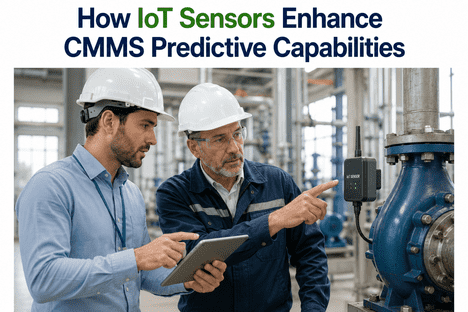
The most commercially valuable analytics capability in a CMMS is the ability to assign each monitored asset a continuously updated failure probability score — and a projected remaining useful life — based on real-time sensor data, historical failure patterns, and maintenance records. iFactory AI's predictive engine trains asset-specific models using vibration signatures, motor current trends, temperature profiles, and process historian data, producing failure predictions 14 to 28 days ahead of breakdown with accuracy rates above 90% on instrumented rotating equipment. Unlike rule-based threshold alarms that trigger only when a value exceeds a fixed limit, predictive scoring detects subtle multi-variable patterns that precede failure weeks earlier than any single-sensor alarm. Each prediction is delivered as a ranked, actionable alert with estimated failure date, confidence interval, and recommended intervention — enabling the maintenance planner to schedule work before the failure window rather than scrambling after it.
Overall Equipment Effectiveness, Mean Time Between Failures, and Mean Time To Repair are the three maintenance KPIs that most directly connect maintenance performance to production outcomes — yet most CMMS platforms calculate them from manually entered records with reporting lags measured in days or weeks. Advanced CMMS analytics computes these metrics continuously from live machine data: OEE from actual production counts, speeds, and quality sensor outputs; MTBF from failure event timestamps correlated to sensor baselines; MTTR from work order open-to-close timestamps linked to asset status signals. iFactory AI's dashboard layer delivers these KPIs at shift-level granularity, enabling supervisors to see OEE degradation developing in real time and dispatch response before the shift ends rather than reading about it in tomorrow's report. Trend modeling projects MTBF trajectory forward, identifying assets whose failure rate is accelerating before they enter the failure zone.
The integration of AI Vision cameras into CMMS analytics workflows is one of the most impactful advances in maintenance intelligence available in 2026. iFactory AI's Vision Camera system applies computer vision models to continuous or scheduled visual feeds, automatically detecting corrosion progression, seal degradation, structural crack initiation, insulation failure, belt misalignment, and thermal anomalies — conditions that traditional sensor arrays cannot detect but that represent a significant portion of real-world maintenance failures. When the Vision system detects an anomaly, it generates a structured analytics record: anomaly classification, severity score, confidence level, progression rate if historical images are available, and an automatically created CMMS work order with photographic evidence attached. This closes the visual inspection analytics gap that leaves most CMMS systems blind to the failure modes they cannot instrument with point sensors. Learn more at the iFactory AI Vision Camera product page.
Advanced CMMS analytics transforms cost management from a backward-looking accounting function into a forward-looking optimization tool. Cost analytics in a mature CMMS deployment tracks total cost of ownership per asset (labor, parts, energy, downtime, contractor), compares actual maintenance spend against planned budget by asset class and work type, and — critically — models the cost tradeoff between preventive intervention and continued operation. iFactory AI's cost analytics module calculates the daily energy penalty of a degrading motor, the production revenue at risk from a predicted bearing failure, and the parts and labor cost of the recommended intervention — presenting the maintenance planner with a financial case for each predictive alert that makes scheduling decisions straightforward. Over a 12-month deployment, cost analytics typically identifies 15 to 25 percent of maintenance spend that is either premature, duplicative, or applied to the wrong failure mode — direct savings that pay back the analytics platform multiple times over. Book a Demo to see a cost analytics walkthrough for your asset class.
Regulatory compliance reporting — ISO 55001 asset management, ISO 14001 environmental management, OSHA maintenance records, food safety HACCP documentation, and industry-specific standards — consumes significant supervisor and reliability engineer time in most maintenance organizations. Manual compliance reporting introduces transcription errors, documentation gaps, and audit risk that automated CMMS reporting eliminates entirely. iFactory AI's compliance module captures all required process parameters, maintenance event records, and inspection outcomes directly from sensor data and work order completions — assembling audit-ready reports in the required format automatically on a scheduled basis. Compliance reporting that previously required two to three days of manual data reconciliation is produced overnight, with complete traceability to source sensor readings and work order records that satisfies third-party auditors.
Every equipment failure contains information — about the operating conditions that contributed, the maintenance gaps that allowed it to develop, and the detection opportunities that were missed. Root cause analytics in an advanced CMMS extracts this information systematically, correlating failure events with preceding sensor trends, work order history, parts consumed, and operating parameter deviations to identify the causal pattern. iFactory AI's root cause module presents a ranked list of contributing factors for each failure event, models their relative contribution to failure probability, and uses this learning to improve the predictive models for similar assets across the fleet. Over time, this creates a continuously improving analytics engine that becomes increasingly accurate as failure data accumulates — turning each failure not just into a repair event, but into a predictive model improvement that prevents the next one.
iFactory connects to your existing CMMS, historian, and sensor infrastructure and delivers your first predictive failure alert within 30 days — with full OEE, cost, and compliance analytics live in weeks, not months.
Reporting Maturity Model: From Basic Records to Predictive Intelligence
Not all CMMS analytics are created equal. The maturity of a maintenance analytics deployment can be mapped across four levels, from basic record-keeping through descriptive reporting to diagnostic analysis and finally to predictive and prescriptive intelligence. Most CMMS implementations stall at Level 2 — descriptive reporting — because the gap between historical summaries and genuine predictive capability requires an AI analytics layer that standard CMMS platforms do not include. iFactory AI is designed to close this gap, moving organizations from Level 2 to Level 4 by applying machine learning to the data their existing CMMS and sensor infrastructure is already collecting.
Key Analytics Metrics and What They Actually Measure
iFactory AI: Advanced Analytics Built for Industry 4.0 CMMS Deployments
A Predictive Intelligence Engine for Your Entire Asset Fleet
iFactory AI integrates with your existing CMMS (SAP PM, Maximo, Infor EAM, eMaint), historian, and IoT sensor network to deliver the advanced analytics layer that standard CMMS platforms lack — without replacing what already works. Pre-built analytics templates for rotating equipment, conveyors, heat exchangers, compressors, and 40+ asset classes are live within 2 to 4 weeks.
Industry Applications: Analytics Delivering Measurable Impact
Expert Perspective: The Analytics Transformation in Maintenance Management
Frequently Asked Questions: Advanced CMMS Analytics and Reporting
Every sensor reading, work order, and failure event in your CMMS is a signal. iFactory AI connects those signals into predictive intelligence — delivering failure warnings 14 to 28 days ahead, real-time OEE dashboards, and automated compliance reports from the data you are already collecting.
The transition from reactive maintenance to analytics-driven operational excellence is available to every instrumented facility — the data is already there. Book a Demo with iFactory AI and see how advanced CMMS analytics transforms your maintenance records into a predictive intelligence system that protects uptime, reduces cost, and delivers the reporting confidence that modern compliance and ESG obligations demand.