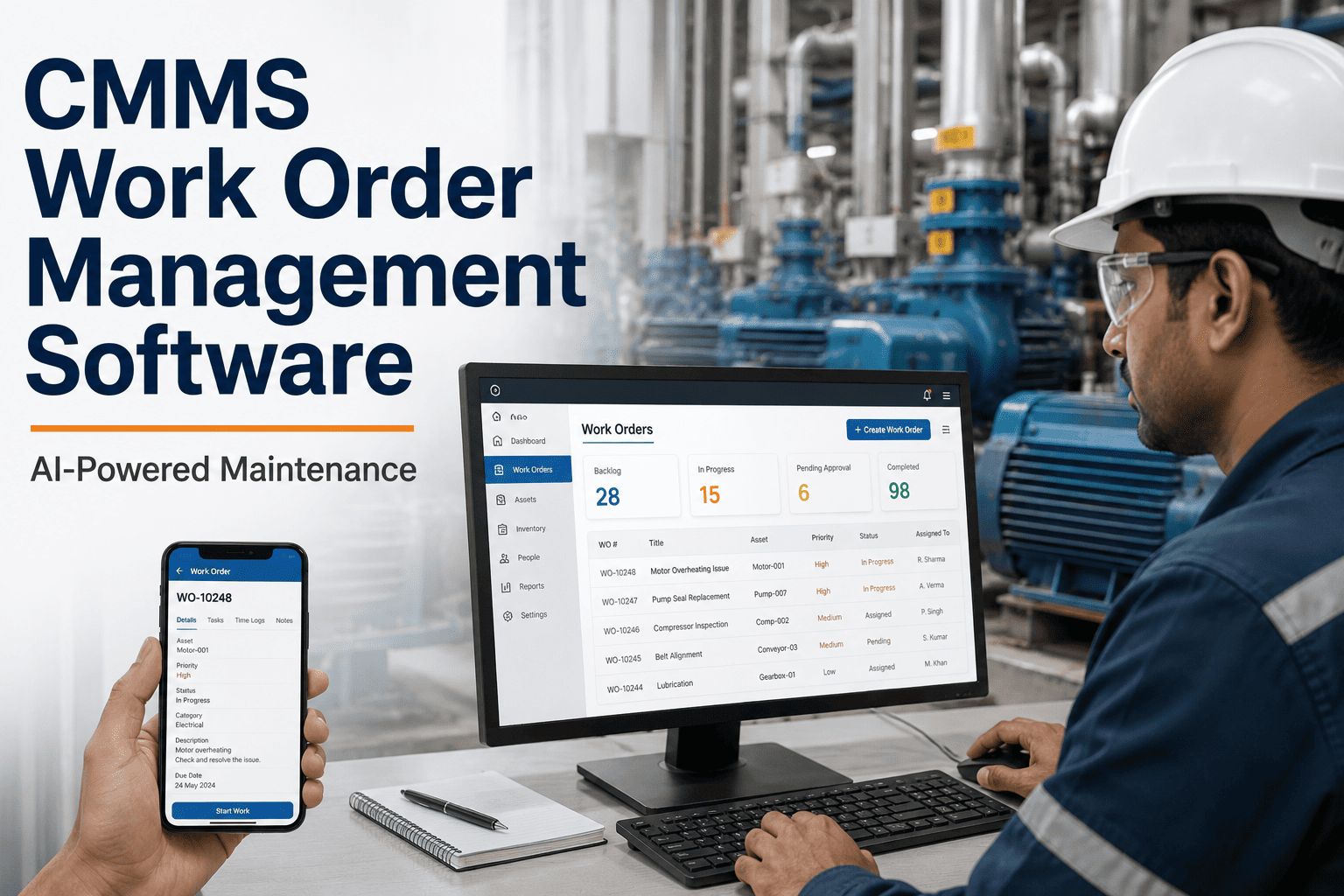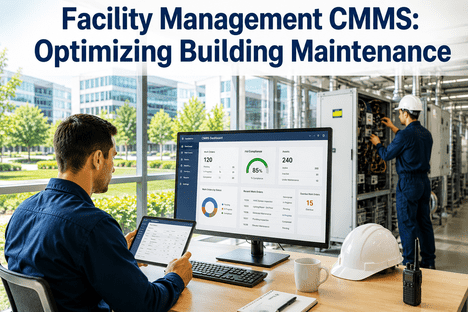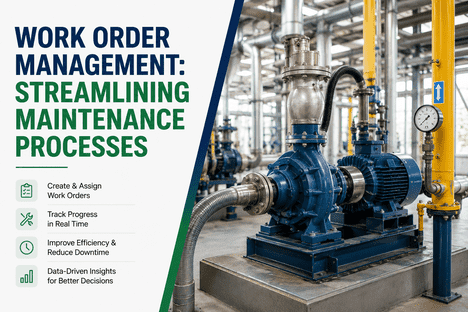
Maintenance and reliability engineers trust their CMMS (Computerized Maintenance Management System) to log work orders, schedule preventive tasks, and manage spare parts. Yet despite these investments, most plants still suffer from unexpected breakdowns, reactive firefighting, and hidden asset degradation. Why? Because traditional CMMS platforms operate in the dark — they lack real-time, streaming data from the equipment they're supposed to protect. IoT sensors fundamentally reshape this reality: vibration, temperature, pressure, current, and flow sensors feed live asset health metrics directly into CMMS workflows, transforming static schedules into predictive intelligence. Without IoT, a CMMS is simply a historical ledger; with it, maintenance becomes a closed-loop, AI-driven discipline that anticipates failures before they trigger downtime. iFactory bridges this critical gap, turning silent sensor signals into automated work orders and actionable reliability insights.
Stats strip – IoT & CMMS impactThe Maintenance Blind Spot: Why Traditional CMMS Lacks True Prediction
From Reactive Work Orders to Sensor-Driven Proactive Care
A conventional CMMS relies on human-entered data, time-based intervals, and lagging indicators (failure reports, operator rounds). IoT sensors completely reverse this paradigm: they stream vibration spectra, thermal profiles, harmonic currents, and lubricant debris counts at millisecond resolution. When integrated with a CMMS, these data streams enable machine learning models to detect subtle precursors of bearing wear, misalignment, or cavitation. Instead of discovering a failed pump during a manual inspection, your maintenance team receives a work order automatically generated by a sensor anomaly — with recommended parts, priority level, and estimated time-to-failure. The gap between "scheduled preventive maintenance" and genuine predictive capability is the absence of live asset intelligence. iFactory closes that gap by embedding IoT fusion directly into CMMS ecosystems.
5 Critical Failure Points IoT Sensors Resolve in CMMS Environments
5-Step Framework: Deploying IoT Sensors to Elevate CMMS Predictive Power
Financial & Operational Impact: IoT-Enhanced CMMS vs. Traditional Approaches
| Failure Scenario | Traditional CMMS Detection | IoT-Enabled CMMS Prediction | Annual Cost Avoidance |
|---|---|---|---|
| Electric Motor Bearing Failure | After breakdown or monthly vibration route | 2-4 weeks advance notice via continuous envelope analysis | $85K – $210K |
| Centrifugal Pump Cavitation | Impeller damage discovered during failure | High-frequency pressure harmonics trigger work order | $60K – $180K |
| Conveyor Gearbox Lubrication Loss | Manual thermography every 30 days | Real-time oil debris & temperature fusion alert | $45K – $120K |
| Cooling Tower Fan Imbalance | Vibration threshold alarm (already severe) | Trend analysis of 0.1 mm/s increments → scheduled balancing | $30K – $90K |
| Electrical Cabinet Overheating | Infrared audit quarterly / component meltdown | Wireless thermal sensors + current harmonics AI | $70K – $160K |
Key Industry 4.0 Capabilities: What Genuine IoT + CMMS Integration Requires
Beyond Basic Telemetry – AI, Digital Twins, and Closed-Loop Workflows
True predictive maintenance is not about merely visualizing sensor data on a dashboard; it requires four essential pillars: 1) Edge computing that preprocesses high-frequency signals, 2) Machine learning models trained on specific asset failure modes, 3) Seamless CMMS sync (bidirectional work order, asset hierarchy, and parts inventory), and 4) Prescriptive analytics that recommend corrective actions. iFactory’s platform delivers these pillars out of the box, reducing false positives and enabling reliability teams to focus on strategic improvements rather than data interpretation. Additionally, our AI Vision Camera ( iFactory AI Vision Camera ) complements IoT sensors with visual anomaly detection for asset inspections.
Frequently Asked Questions: IoT Sensors & CMMS Predictive Capabilities
How do IoT sensors improve CMMS work order accuracy?
IoT sensors provide continuous, objective asset data instead of subjective operator logs. When a sensor detects vibration exceeding dynamic thresholds, the CMMS auto-generates a work order with precise fault codes, severity levels, and recommended actions. This reduces misdiagnosis and eliminates data entry errors.
Can iFactory integrate with our existing CMMS platform?
Yes. iFactory offers native APIs and middleware for leading CMMS/EAM solutions including SAP, IBM Maximo, UpKeep, Maintenance Connection, Fiix, and many others. Our team ensures seamless bidirectional data flow (sensor → CMMS → work order closure).
What types of IoT sensors are most valuable for predictive maintenance?
Accelerometers (vibration), thermocouples/IR sensors, current transducers, pressure transmitters, ultrasonic sensors, and oil debris monitors are critical. iFactory’s platform fuses these signals to detect bearing wear, misalignment, cavitation, electrical faults, and lubrication degradation.
What is the typical ROI after implementing IoT-enhanced CMMS?
Plants typically see payback within 6–9 months, driven by 25–40% reduction in unplanned downtime, 15–25% lower maintenance spend, extended asset life, and optimized spare parts inventory. Book a Demo to request a custom ROI analysis.
Does IoT data overload maintenance teams with false alarms?
iFactory’s AI applies adaptive thresholding and machine learning models trained on your equipment’s normal behavior. This minimizes nuisance alarms and only escalates actionable anomalies to the CMMS, ensuring maintenance teams focus on real failure modes.
How does iFactory handle connectivity in harsh industrial environments?
iFactory supports industrial wireless protocols (LoRaWAN, Wi-Fi, 5G, wired Ethernet) and edge gateways that buffer data during connectivity loss. Sensors are rated IP67/IP69K for dust, water, and high-temperature zones. Data synchronization resumes automatically when connectivity is restored.
Can iFactory predict failures across rotating and fixed assets?
Absolutely. Our AI models cover motors, pumps, fans, compressors, conveyors, turbines, gearboxes, and heat exchangers. Fixed assets like structural mounts or piping systems benefit from strain and corrosion sensors integrated with CMMS workflows.
Is predictive maintenance compatible with small to mid-sized plants?
Yes. iFactory offers scalable sensor packages and edge analytics that fit any budget. Starting with critical assets (top 10 failure-prone machines) delivers immediate cost savings and forms a blueprint for plant-wide predictive maintenance.