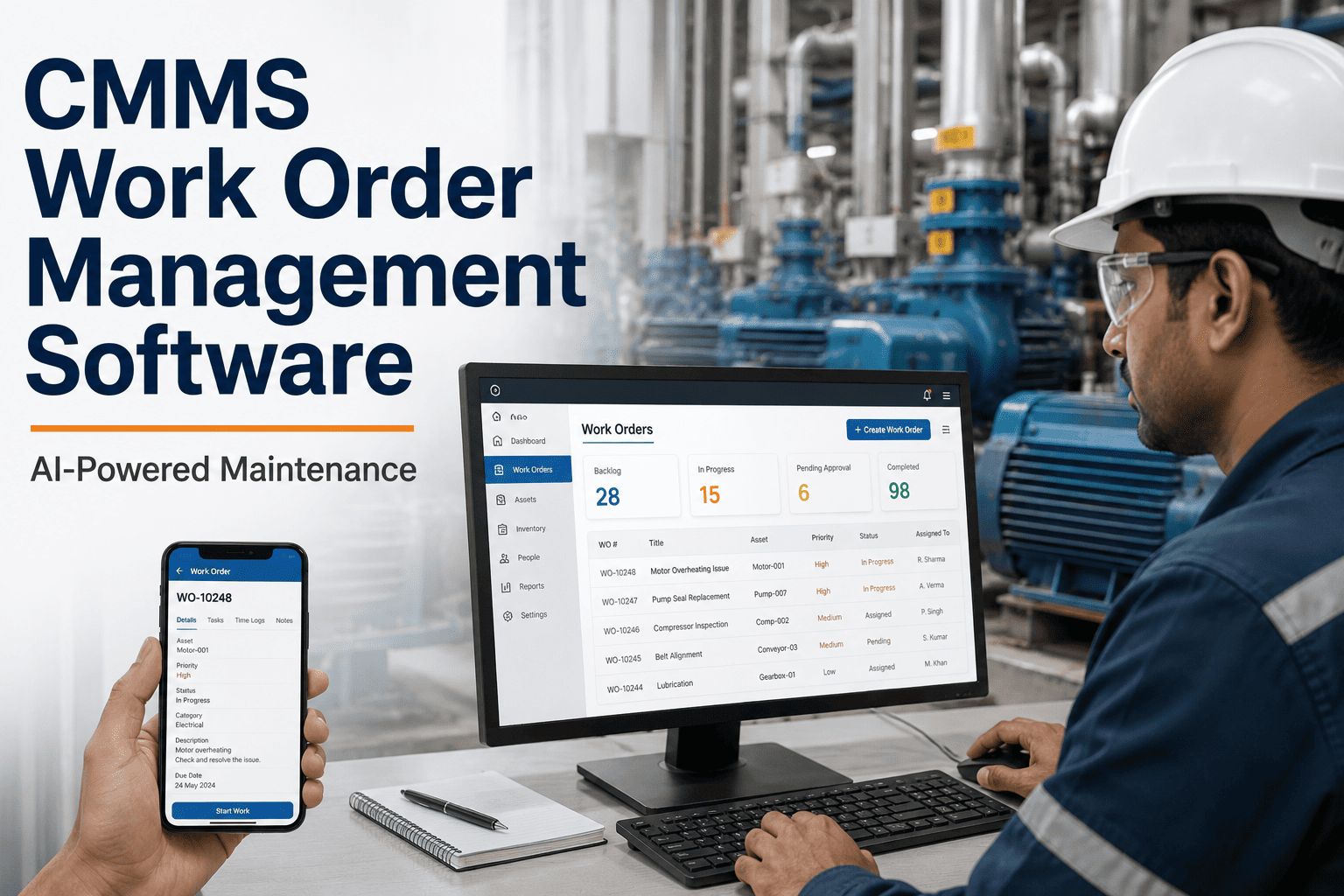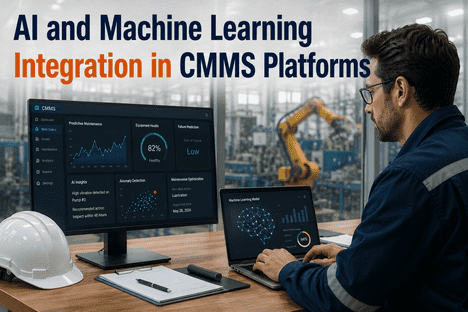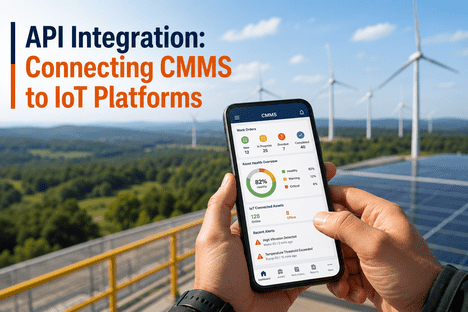
API integration connecting a Computerized Maintenance Management System to IoT platforms is the foundational architecture that separates reactive maintenance organizations from those operating true predictive maintenance programs in 2026. In most industrial facilities today, IoT sensors generate continuous streams of vibration, temperature, pressure, and energy consumption data — but that data lives in isolation inside the IoT platform, disconnected from the CMMS where work orders are created, parts are managed, and maintenance history is recorded. The result is a structural gap: maintenance teams receive no automated signal when sensor data crosses a failure threshold, procurement gets no advance warning to stage replacement parts, and finance sees no real-time cost impact from equipment degradation events until they escalate to unplanned downtime. Connecting CMMS to IoT platforms via REST API, MQTT, OPC-UA, or Modbus protocol bridges eliminates this gap — enabling sensor-triggered work orders, condition-based maintenance scheduling, and asset health dashboards that give operations leadership real-time visibility into equipment status across the entire facility floor. iFactory's AI vision camera platform extends this connected architecture by contributing production quality inspection data as an additional asset condition signal — detecting surface degradation, dimensional drift, and output quality decline that indicate equipment wear before traditional vibration and temperature sensors register a fault condition. If you want to see how iFactory's AI vision platform integrates with your CMMS and IoT infrastructure to deliver predictive maintenance signals from the production line, you can Book a Demo with iFactory's integration team today.
Why CMMS-IoT API Integration Is the Core Infrastructure of Industry 4.0 Maintenance
Industry 4.0 has produced an abundance of sensor hardware and IoT platforms capable of monitoring equipment condition in extraordinary detail — but sensor data alone does not prevent equipment failures. The maintenance action that prevents a failure only occurs when the sensor signal reaches the CMMS, triggers a work order, prompts parts staging from inventory, and schedules a technician before the threshold condition becomes a failure event. Without API integration connecting the IoT platform to the CMMS, every one of those steps requires human observation and manual execution — reintroducing the delays and omission risks that the sensor network was deployed to eliminate. REST API connectivity between IoT platforms and CMMS systems automates this entire chain: the sensor detects the anomaly, the API call creates the work order, the CMMS checks parts availability, and the scheduler assigns the task — all within seconds of the sensor event, without any human in the loop between detection and dispatch.
The scale of value this architecture unlocks is significant. Machine learning models running on accumulated IoT and CMMS data have demonstrated the ability to predict bearing failures 14 or more days before occurrence — giving maintenance teams time to schedule corrective work during planned downtime rather than responding to emergency shutdowns that disrupt production. Facilities that have completed CMMS-IoT integration report emergency maintenance event reductions of 40–55% in the first year of operation, alongside measurable improvements in mean time between failures and reductions in total maintenance cost per asset. iFactory's AI vision cameras contribute an additional predictive signal layer to this architecture — detecting production output quality degradation caused by tooling wear, alignment drift, or mechanical fatigue before those conditions reach the threshold that triggers a traditional vibration or temperature alert. Manufacturers ready to extend their CMMS-IoT integration to include AI vision quality data can Book a Demo to see this capability in a live integration context.
Five Structural Problems That CMMS-IoT API Integration Solves in 2026
The operational problems that CMMS-IoT API integration addresses are not theoretical — they are the daily friction points that maintenance managers, reliability engineers, and plant directors experience in facilities where sensor networks and CMMS systems operate in parallel but not in connection. iFactory's integration work across industrial manufacturing environments has consistently identified the following five structural problems as the highest-priority targets for CMMS-IoT API integration value generation.
Sensor Alerts That Disappear Without Triggering Maintenance Action
IoT platforms generate alerts when sensor readings cross configured thresholds — but in facilities without CMMS integration, those alerts arrive in a dashboard that maintenance personnel may or may not be actively monitoring. Alerts that are not seen are not acted on. Alerts that are seen manually trigger a work order creation process that takes hours and introduces transcription errors about asset identity, fault type, and urgency. CMMS-IoT API integration eliminates this gap by converting sensor alerts directly into structured CMMS work orders — with asset ID, fault category, sensor reading, and priority level populated automatically from the IoT platform data without any manual intermediary step between alert and dispatch. Book a Demo to see how iFactory's AI vision data integrates with CMMS work order automation in a live production environment.
Maintenance Decisions Made Without Real-Time Asset Condition Context
Calendar-based preventive maintenance schedules perform maintenance activities at fixed time or meter intervals regardless of actual equipment condition — a strategy that simultaneously over-maintains assets in good condition and under-maintains assets degrading faster than the schedule anticipates. When the CMMS has no access to real-time IoT sensor data, it cannot adjust maintenance frequency based on actual condition — so planners operate on historical averages rather than current asset health. API integration that surfaces IoT condition data within the CMMS asset record gives planners the real-time context they need to extend intervals on assets performing within healthy parameters and accelerate maintenance on assets showing degradation signals — optimizing the maintenance schedule against actual need rather than assumed need.
Parts Stockouts at the Moment of Maintenance Execution
Unplanned maintenance events fail most often not because technicians are unavailable, but because the required replacement parts are not in stock at the time the work order is executed. When IoT-triggered predictive maintenance work orders are generated days or weeks before the actual maintenance window, the CMMS can check parts availability at work order creation and trigger procurement automatically if the required component falls below reorder point. This predictive procurement signal — possible only when the IoT platform and CMMS are connected via API — ensures that parts arrive before the scheduled maintenance window, converting what would have been an emergency stockout into a planned, first-visit-complete maintenance event.
Asset Mapping Failures That Destroy Integration Credibility
The most common reason CMMS-IoT integration projects fail is not a protocol problem — it is an asset identity mismatch problem. When the IoT platform identifies an asset as one identifier and the CMMS stores it under a different asset ID, alerts from the IoT platform land on the wrong asset record in the CMMS, technicians reject the ticket, and the integration loses operational credibility within weeks of deployment. A successful API integration requires a verified asset mapping layer that reconciles IoT platform asset references with CMMS asset IDs before any work order automation is activated — a step that must be completed manually across a representative sample of assets before the integration goes live in production.
Production Quality Degradation Invisible to Condition Monitoring Systems
Vibration, temperature, and pressure sensors detect mechanical and thermal anomalies — but they cannot detect the production quality consequences of equipment degradation that occurs before any physical parameter crosses a sensor threshold. A worn tooling surface, a misaligned feed mechanism, or a coating system losing uniformity will manifest in production output quality before it registers on a vibration sensor. iFactory's AI vision cameras close this detection gap by inspecting every production unit and generating structured quality data records that flow into the CMMS as condition-based maintenance signals — triggering tooling inspection work orders, alignment check tasks, and calibration events based on what the production output reveals about equipment health, not what the vibration sensor has or has not yet detected.
API Integration Protocols: Connecting CMMS to IoT Platforms in 2026
The technical protocol that connects a CMMS to an IoT platform determines the integration's latency, reliability, data volume capacity, and compatibility with existing industrial infrastructure. No single protocol is optimal for every environment — the right choice depends on the CMMS platform, the IoT sensor network architecture, network topology, and the latency requirements of the maintenance use cases the integration must support. The following protocol profiles reflect the most common CMMS-IoT integration patterns deployed in industrial manufacturing environments in 2026.
HTTP-Based Integration for CMMS Work Order Automation
REST API integration is the most widely supported connection method between modern CMMS platforms and IoT gateways — because virtually every cloud-based CMMS platform exposes a REST API for work order creation, asset record update, and parts request submission. When an IoT platform detects a threshold breach, it fires a REST POST request to the CMMS API endpoint, creating a structured work order with asset ID, fault type, sensor reading, and priority level without any human intermediary. REST API integration is ideal for alert-to-work-order automation use cases where latency of seconds to minutes is acceptable and where the IoT platform and CMMS are both cloud-connected. iFactory's AI vision platform uses REST API integration to push inspection quality events and condition-based maintenance triggers into connected CMMS systems in real time.
Lightweight Pub/Sub Protocol for High-Frequency Sensor Data
MQTT (Message Queuing Telemetry Transport) is the dominant protocol for high-frequency sensor data streams in industrial IoT environments — designed for low-bandwidth, high-reliability message delivery between sensors, IoT gateways, and subscriber applications including CMMS platforms. MQTT's publish/subscribe architecture enables hundreds of sensors to stream data continuously to a broker that routes specific topic subscriptions to the CMMS — so the maintenance system receives only the sensor events relevant to work order generation without processing the full sensor data volume. MQTT integration is optimal for facilities with dense sensor networks where individual sensor readings must be monitored in real time and threshold-breach events must trigger CMMS work orders within seconds of occurrence.
Industrial Automation Standard for PLC and SCADA Connectivity
OPC-UA (Open Platform Communications Unified Architecture) is the industrial automation standard for connecting PLCs, SCADA systems, and factory automation equipment to higher-level applications including CMMS platforms. In manufacturing environments where equipment condition data is generated by Allen-Bradley, Siemens, or other PLC systems, OPC-UA integration provides the standardized data model and security architecture that allows CMMS platforms to read equipment parameters directly from the automation layer without requiring additional IoT sensor hardware. OPC-UA integration is particularly valuable in brownfield manufacturing environments where significant PLC infrastructure already exists and extending IoT monitoring requires connectivity to the existing automation network rather than deployment of additional sensor hardware.
Legacy Equipment Connectivity for Brownfield IoT Integration
Modbus RTU and TCP protocols provide connectivity to the large installed base of industrial equipment that predates modern IoT communication standards — enabling CMMS-IoT integration in brownfield manufacturing environments without requiring equipment replacement or firmware upgrades. Protocol adapter layers in modern IoT gateways translate Modbus register data from legacy equipment into REST API or MQTT messages that modern CMMS platforms can consume — making equipment installed decades ago a viable source of condition monitoring data for predictive maintenance programs. This protocol compatibility is critical for manufacturers seeking to deploy CMMS-IoT integration across mixed equipment fleets where asset ages and communication capabilities vary significantly across the production environment.
Event-Driven Notification for Alert-to-Ticket Integration Patterns
Webhook integration enables IoT platforms to push event notifications to CMMS systems in real time when specific conditions occur — without the CMMS needing to continuously poll the IoT platform for new data. When a sensor breach event or predictive model alert fires in the IoT platform, the webhook delivers a structured payload to the CMMS endpoint containing the event details, asset reference, and priority classification. Webhook integration is the simplest implementation pattern for alert-to-ticket automation in environments where the IoT platform supports outbound webhook configuration and the CMMS exposes an inbound webhook receiver — making it the recommended starting point for organizations beginning their CMMS-IoT integration journey before expanding to more complex bidirectional API architectures.
Closed-Loop Integration with Work Order Feedback to IoT Platform
Bidirectional CMMS-IoT integration adds a feedback loop that returns work order resolution data from the CMMS back to the IoT platform when maintenance tasks are completed. This closed loop enables the IoT platform's predictive models to learn from technician feedback — understanding which sensor signatures preceded which failure modes, and which maintenance actions resolved which alert conditions. Over time, bidirectional integration produces predictive models that are substantially more accurate than those trained on sensor data alone, because they incorporate the maintenance outcome data that only the CMMS holds. This is the most complex integration pattern but delivers the highest long-term value for facilities committed to continuous improvement in predictive maintenance accuracy.
iFactory AI Vision Platform: Extending CMMS-IoT Integration to Production Quality Data
Traditional IoT sensor networks — vibration monitors, temperature probes, pressure transducers, flow meters — detect mechanical and thermal asset condition changes. They cannot detect the quality consequences of equipment degradation that appear in production output before any physical sensor registers a fault. iFactory's AI vision camera platform fills this detection gap by inspecting every production unit and generating structured quality data records that connect directly to CMMS maintenance workflows — adding a third data source to the connected maintenance architecture alongside IoT sensor data and CMMS work order history.
iFactory's edge-deployed AI vision cameras process every production unit inspection in 8 to 22 milliseconds, generating timestamped quality records that identify defect type, severity, and production batch linkage. When inspection data reveals a pattern — increasing surface defect rate, dimensional drift toward the specification boundary, coating uniformity decline — the platform sends a condition-based maintenance trigger to the connected CMMS via REST API, creating a tooling inspection or equipment alignment work order before the degradation produces a batch rejection event. This AI vision quality signal extends the predictive maintenance program to detect equipment problems that mechanical sensors miss — because the production output is the most sensitive indicator of equipment health available in a manufacturing environment. Manufacturers operating CMMS-IoT integrated environments can add iFactory's AI vision data stream to their connected maintenance architecture without replacing or disrupting existing sensor infrastructure or CMMS configuration.
| Integration Data Source | What It Detects | CMMS Trigger Type | iFactory Advantage |
|---|---|---|---|
| Vibration Sensors | Bearing wear, imbalance, misalignment at threshold | Alert-triggered work order at fault threshold | iFactory detects earlier — via output quality decline |
| Temperature Sensors | Thermal anomaly, friction events, cooling failure | Alert-triggered work order at threshold breach | iFactory detects coating and surface effects first |
| Pressure Transducers | Flow restriction, seal degradation, pump wear | Condition-based maintenance scheduling | iFactory adds fill/seal quality signal to maintenance trigger |
| Energy Meters | Motor efficiency decline, drive degradation | Trend-based PM schedule adjustment | iFactory correlates output quality with energy trend data |
| iFactory AI Vision Cameras | Output quality drift, tooling wear, dimensional deviation, surface defects | Condition-based work order before sensor threshold reached | Earlier detection — from production output, not equipment parameters |
CMMS-IoT Integration Implementation Roadmap: A Phased Approach That Delivers ROI in 30 Days
Most CMMS-IoT integration projects fail not because the technology is inadequate, but because the implementation sequence is wrong. Teams that start with the most complex integration — bidirectional ERP sync or full predictive model deployment — spend months on configuration and validation before any operational benefit is realized, creating stakeholder fatigue that often ends projects before they deliver value. The following phased roadmap prioritizes the highest-value, fastest-to-deploy integration patterns first — delivering measurable ROI within 30 days of starting integration work while building toward the full connected maintenance architecture over a 6 to 12 month horizon.
Phase 1 — Asset Mapping and Integration Specification (Weeks 1–2)
Before any API connection is established, complete a manual verification of the asset mapping between the IoT platform and the CMMS across a representative sample of 10 to 20 assets. Confirm that asset identifiers in both systems refer to the same physical equipment and document the field mappings between IoT alert data fields and CMMS work order fields — asset ID, fault category, priority level, required parts, and assigned maintenance group. This mapping exercise is the most important step in the integration project: asset mapping failures are the leading cause of integration credibility loss in deployed environments and must be resolved before automation is activated. Define the alert-to-work-order logic that will govern which sensor events create which work order types, with what priority, and assigned to which technician group.
Phase 2 — Pilot IoT-to-Work-Order Automation on Highest-Priority Asset Group (Weeks 3–6)
Deploy the alert-to-work-order API integration on the five to ten assets with the highest historical emergency maintenance frequency or the highest downtime cost per event — the asset group where the integration will deliver the fastest and most visible ROI. Run the automated work order generation in parallel with existing manual processes for two weeks, comparing automated work order content against what technicians would have created manually to validate accuracy and completeness. Configure exception handling for alerts that do not produce valid work orders — typically caused by unmapped assets or out-of-range sensor readings — and establish a review process for integration exceptions that prevents silent failures from going undetected. Measure work order response time before and after automation to establish the baseline ROI metric for Phase 3 expansion.
Phase 3 — Full Asset Fleet Integration and Predictive Model Activation (Weeks 7–20)
Expand the validated integration configuration to the full asset fleet, completing asset mapping verification for all remaining equipment groups. Activate CMMS inventory integration so that IoT-triggered work orders automatically check parts availability at creation and initiate procurement requests when required components fall below reorder point. Deploy predictive maintenance models on assets where sufficient sensor history has accumulated — typically assets that have been connected to the IoT platform for six or more months — and configure predictive work order generation that schedules maintenance during planned downtime windows rather than emergency response. Include iFactory AI vision data streams in the integration where production lines are in scope, connecting output quality inspection events to CMMS maintenance triggers for condition-based tooling and equipment maintenance scheduling.
Phase 4 — Bidirectional Sync and Continuous Improvement Loop (Weeks 21–32)
Activate bidirectional data flow that returns work order resolution data from the CMMS back to the IoT platform and predictive model training pipeline — enabling the predictive algorithms to incorporate maintenance outcome data alongside sensor readings for progressively more accurate failure prediction. Establish continuous improvement dashboards that track predictive model accuracy, work order first-visit completion rate, mean time between failures by asset group, and total maintenance cost per production unit. Conduct a quarterly review of integration performance against the operational baselines established in Phase 2 and adjust alert threshold configurations, predictive model parameters, and asset mapping based on the first full quarter of integrated operation data.
Frequently Asked Questions: API Integration Connecting CMMS to IoT Platforms
What is the difference between CMMS-IoT integration via REST API versus MQTT, and which should we use?
REST API integration is the right choice for alert-to-work-order automation use cases where the IoT platform triggers discrete events that need to create structured CMMS records — because REST's request-response model maps naturally to work order creation workflows and is supported by virtually every modern CMMS platform. MQTT is the right choice for high-frequency sensor data streaming where hundreds of readings per second need to be monitored continuously and threshold breaches need to trigger CMMS actions within seconds — because MQTT's publish-subscribe architecture handles high data volumes with lower overhead than repeated REST calls. Most industrial facilities ultimately use both: MQTT for continuous sensor monitoring and REST API for the CMMS work order creation that threshold events trigger.
How does iFactory's AI vision platform send condition-based maintenance signals to a CMMS via API?
iFactory's AI vision cameras generate structured inspection records for every production unit — including defect type, severity, frequency trend, and production batch linkage. When the inspection data analysis layer identifies a quality degradation pattern that indicates equipment wear or process drift, the platform generates a condition-based maintenance trigger via REST API POST to the connected CMMS, creating a work order with the asset reference, fault description, supporting quality data, and priority classification pre-populated. This integration requires no middleware layer — iFactory's platform connects directly to the CMMS API using the same REST interface that other IoT data sources use, and the AI vision data stream appears as another condition monitoring input within the existing CMMS-IoT integration architecture. Book a Demo to see iFactory's CMMS API integration in a live production configuration.
Can CMMS-IoT integration work with legacy equipment that does not have modern IoT sensor outputs?
Yes — through protocol adapter layers built into modern IoT gateways that translate legacy Modbus RTU/TCP register data into REST API or MQTT messages that CMMS platforms can consume. Equipment installed decades ago that communicates via Modbus can be connected to the CMMS-IoT integration architecture without firmware upgrades, PLC replacement, or hardware modification — by placing an IoT gateway at the equipment network level that reads Modbus registers and converts the data to modern protocols. For equipment with no electronic output at all, iFactory's AI vision cameras provide condition monitoring capability through production output quality inspection — detecting degradation in the product being made without requiring any connectivity to the equipment itself.
What data security considerations apply to CMMS-IoT API integration in manufacturing environments?
CMMS-IoT API integration introduces additional network connectivity that must be designed to prevent unauthorized access to both the operational technology network where sensors reside and the IT network where the CMMS operates. API authentication using OAuth 2.0 or API key management should be implemented on all CMMS API endpoints, with role-based access controls limiting which systems can create, modify, or close work orders via API. Network segmentation between OT and IT layers should be maintained with integration traffic passing through a defined integration middleware or gateway layer rather than direct OT-to-CMMS connectivity. iFactory's edge-deployed AI vision platform processes inspection decisions on local hardware, minimizing the network surface area required for CMMS integration — only compressed structured data records travel from the production network to the CMMS, not raw image data.
How long does CMMS-IoT API integration take to deploy and when should ROI be expected?
The alert-to-work-order automation integration on a priority asset group — the highest-value quick-win phase — typically completes in three to six weeks from project start, including asset mapping verification, API configuration, parallel validation, and live deployment. ROI from this first phase is typically measurable within 30 days of go-live through reduced work order response time, eliminated alert-to-dispatch delays, and improved first-visit completion rates. Full facility integration including predictive model deployment and bidirectional sync takes six to twelve months depending on asset fleet size, sensor network complexity, and the CMMS platform's API capability. Adding iFactory AI vision data streams to an existing CMMS-IoT integration typically takes two to four weeks from hardware installation to live API data flow, following the same integration pattern as other IoT data sources already connected to the CMMS.
What metrics should manufacturers track to measure CMMS-IoT integration performance?
The primary operational metrics for CMMS-IoT integration performance are: mean time between failures by asset group (improving as predictive maintenance accuracy increases), emergency-versus-planned maintenance ratio (improving as IoT-triggered predictive work orders replace reactive responses), work order first-visit completion rate (improving as predictive procurement ensures parts availability before scheduled maintenance), and alert-to-work-order creation time (from hours to seconds with automation active). Financial metrics include total maintenance cost per production unit, avoided downtime cost per quarter, and labor productivity in the maintenance department. iFactory adds production quality metrics — defect rate per million opportunities, tooling-related rejection frequency, and equipment-linked quality event trend — as additional integration performance indicators that connect maintenance program effectiveness directly to production output quality.