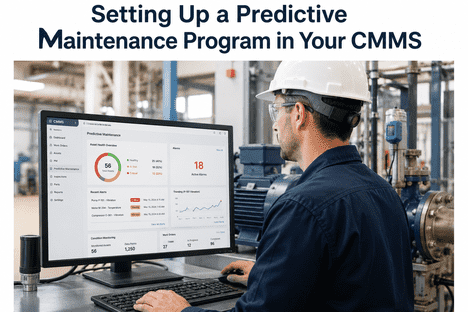
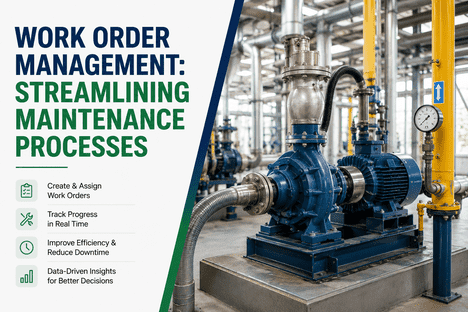
Cloud-Based CMMS (Computerized Maintenance Management System) solutions have transformed how industrial facilities approach equipment reliability, work order management, and maintenance planning. Unlike legacy on-premise systems that require dedicated IT infrastructure, periodic manual upgrades, and limited remote access, modern cloud-based CMMS platforms deliver maintenance management capabilities through a browser or mobile application with centralized data storage, automatic updates, and role-based access from any location with internet connectivity. For steel plants, lime operations, and other heavy industrial facilities where equipment downtime directly impacts production throughput and profitability, the shift from on-premise to cloud-based maintenance management represents not merely a technology upgrade but a fundamental change in how maintenance intelligence is generated, shared, and acted upon across shifts, departments, and geographic locations.
Core Benefits of Cloud-Based CMMS in Industrial Operations
The measurable advantages of cloud-based maintenance management extend across accessibility, cost structure, data integrity, and analytics capability — each of which translates into specific operational and financial outcomes for industrial facilities managing complex equipment fleets.
Book a Demo to see how leading steel and heavy industrial facilities are deploying cloud CMMS with integrated predictive analytics to reduce unplanned downtime and optimize maintenance spend across their equipment fleet.
Critical Considerations for Cloud CMMS Selection and Deployment
Selecting a cloud-based CMMS platform requires evaluating factors beyond feature checklists. Integration compatibility with existing industrial control systems, data security architecture, offline functionality during network interruptions, and the vendor's approach to data portability all determine whether the platform delivers sustainable value or becomes an additional tool that maintenance teams circumvent rather than adopt.
- OPC-UA and Modbus TCP connectivity for PLC and DCS data ingestion
- Historian integration for long-term trend analysis and model training
- API-first architecture enabling connection with ERP, procurement, and inventory systems
- Mobile application support for frontline technician workflow capture
- SCADA integration for real-time equipment status in work order context
- SOC 2 Type II certification or equivalent third-party security audit
- Data encryption at rest and in transit with role-based access control
- Multi-tenant isolation architecture preventing cross-customer data exposure
- Regular automated backups with defined recovery point and time objectives
- Compliance with regional data residency requirements for industrial operators
- Local data buffering during network outages with automatic sync on reconnection
- Edge processing for time-critical condition monitoring alerts below cloud latency threshold
- Mobile work order execution with offline attachment and photo capture
- Hybrid deployment option for sensitive data remaining on-premise
- Standardized data export formats for asset registry, work order history, and maintenance records
- Published API documentation enabling custom integrations by facility IT teams
- Contractual data ownership terms specifying customer retention rights upon termination
- Scheduled data extraction capability at defined intervals for independent backup
Cloud CMMS Architecture: How Modern Platforms Deliver Maintenance Intelligence
A cloud-based CMMS architecture consists of three interconnected layers — the data ingestion and integration layer connecting to plant-floor equipment and sensors, the analytics and work order management layer that converts raw data into actionable maintenance tasks, and the presentation layer delivering role-appropriate views to operators, planners, engineers, and management. iFactory's platform extends this standard architecture with AI-powered condition monitoring that continuously evaluates equipment health against learned behavioral baselines and generates work orders automatically when predictive models identify developing failure patterns. This integration of AI vision and sensor analytics with traditional CMMS work flow creates a closed loop from condition detection to maintenance execution that rule-based systems cannot replicate.
| Capability | Legacy On-Premise CMMS | Cloud-Based CMMS | iFactory AI-Enhanced Cloud CMMS |
|---|---|---|---|
| Deployment timeline | 3 to 9 months | 2 to 6 weeks | 2 to 4 weeks with pre-built templates |
| IT infrastructure required | Servers, database, network, backup, IT staff | Internet-connected devices only | Internet-connected devices plus existing sensor infrastructure |
| Remote access capability | VPN or virtual desktop required | Native browser and mobile access | Mobile with offline work order execution |
| Condition monitoring integration | Separate system with manual data transfer | API-based integration | Native AI analytics with automatic work order generation |
| Predictive maintenance | Calendar-based or usage-based only | Rule-based from integrated sensor data | Machine learning models trained on historical failure patterns |
| Cross-site benchmarking | Manual consolidation of separate databases | Real-time across all sites in platform | Automated fleet-wide pattern recognition and anomaly detection |
| Update and upgrade frequency | Annual or biannual with downtime | Continuous with zero downtime | Continuous with model retraining and improvement |
| Total cost of ownership (3-year) | Baseline | 40 to 55 percent reduction | Comparable to cloud CMMS with measurable downtime reduction ROI |
Work Order Management in the Cloud: From Reactive to Predictive Workflows
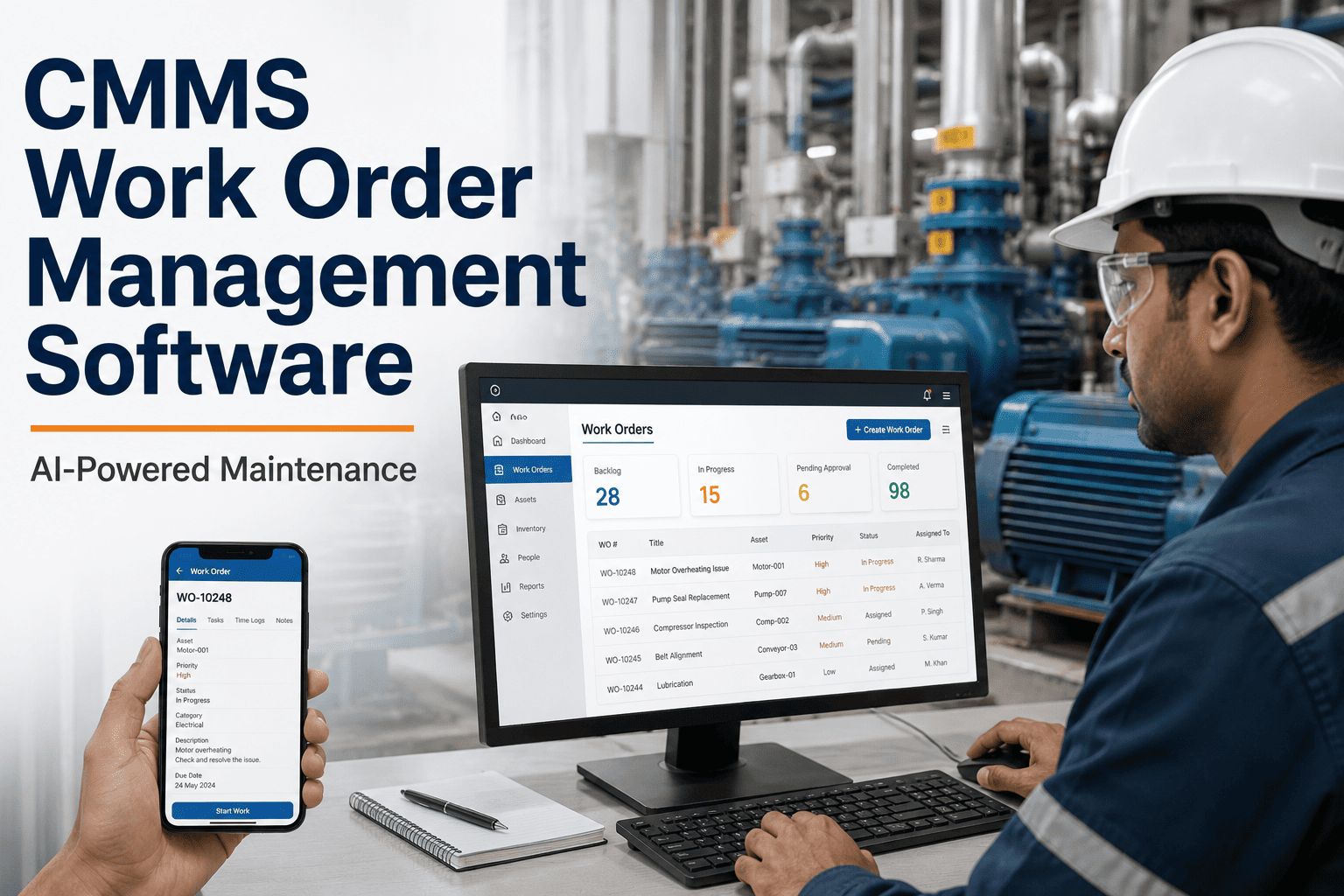
Work order management remains the operational core of any CMMS platform, and cloud delivery transforms how work orders are created, assigned, executed, and analyzed. In traditional on-premise systems, work orders are typically generated through scheduled preventive maintenance calendars or technician-reported breakdowns — both reactive triggers that address problems after they have already affected production. Cloud-based platforms with integrated condition monitoring shift this paradigm by enabling work order creation from predictive model outputs, equipment health scores, and real-time sensor deviations that precede failure by days or weeks.
Preventive and Predictive Maintenance Scheduling in Cloud CMMS
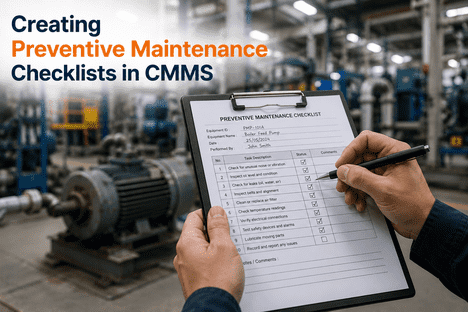
Cloud CMMS platforms transform maintenance scheduling from static calendar-based triggers to dynamic, condition-informed recommendations that optimize the balance between maintenance cost and failure risk. Preventive maintenance schedules generated from OEM recommendations, historical failure data, and equipment criticality ratings are managed centrally and adjusted automatically as operating conditions, utilization patterns, and equipment age evolve. Predictive maintenance models operating in the cloud ingest real-time sensor streams — including AI vision camera feeds for visual equipment inspection — and generate maintenance triggers when model confidence exceeds configurable thresholds.
Asset Management and Lifecycle Tracking in the Cloud
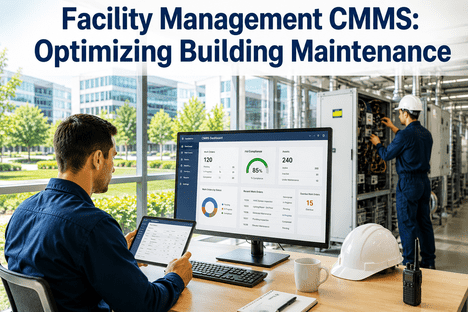
Cloud-based asset management provides a single source of truth for every piece of equipment in the facility — from rotary kilns and vibrating screens to conveyor drives and crusher assemblies. Each asset record captures installation date, manufacturer specifications, maintenance history, cost of repairs, spare parts linked, and documentation including drawings, procedure manuals, and inspection records. The cloud platform enables maintenance teams to track asset lifecycle costs, calculate mean time between failure and mean time to repair by asset type and manufacturer, and identify underperforming equipment that may require replacement or redesign. Multi-site operators compare identical asset classes across facilities to identify best practices and standardize maintenance strategies.
Work Order History and Failure Pattern Analysis
Cloud CMMS platforms aggregate work order data across all assets and sites, enabling failure pattern recognition that is invisible when maintenance records are siloed in spreadsheets or disconnected databases. Repeated failures on the same component across multiple similar assets trigger a root cause analysis workflow rather than repeated repair cycles. iFactory's analytics layer extends this capability by correlating work order history with real-time condition data to identify which sensor patterns precede specific failure modes — converting tribal knowledge into documented, transferable predictive rules.
Inventory and Spare Parts Optimization
Cloud-connected spare parts inventory management tracks stock levels, reorder points, supplier lead times, and parts consumption rates across all maintained assets. When predictive models identify a developing failure, the platform automatically checks parts availability and generates procurement requests for components below minimum stock — eliminating the scenario where a planned repair is delayed by missing parts. Multi-site organizations consolidate inventory visibility to reduce duplicate stock and optimize parts allocation across facilities.
Compliance and Audit Readiness
Cloud CMMS platforms automatically maintain audit-ready records of all maintenance activities, calibration certifications, safety inspections, and regulatory compliance tasks. Role-based access controls ensure that only authorized personnel can modify critical records, and all changes are logged with timestamps and user identification. For ISO 55000, OSHA, and environmental compliance reporting, the platform generates required documentation directly from live data without manual compilation effort.
Mobile Workforce Enablement
Cloud CMMS mobile applications provide technicians with work order details, asset history, procedure documents, and parts information at the point of maintenance — eliminating trips to the maintenance office for information retrieval. Technicians capture completion data, measurements, and photo evidence on site, syncing to the cloud for immediate visibility by planners and engineers. Offline mode ensures productivity continues during network interruptions with automatic synchronization when connectivity resumes.
Book a Demo to learn how iFactory's cloud CMMS platform combines asset management, work order automation, and AI-driven predictive maintenance in a single unified system purpose-built for heavy industrial operations.
Expert Perspective: Cloud CMMS in Heavy Industrial Operations
We moved our maintenance management from an on-premise system that required a full-time database administrator and a server room refresh every four years to iFactory's cloud platform in six weeks from purchase to live operation. The difference was immediate — maintenance planners worked from home during a plant outage, technicians captured work orders on tablets in the field, and our reliability engineers accessed fleet-wide failure patterns without waiting for IT to run database queries. The predictive maintenance integration was the deciding factor. Our previous system could tell us what broke last week. iFactory tells us what is failing now and how long we have to intervene. That shift from historical reporting to forward-looking intelligence is what justifies the cloud investment for any plant manager who has absorbed an unplanned kiln shutdown and knows the cost of finding out about a failure after production has already stopped.
Frequently Asked Questions About Cloud-Based CMMS
Cloud CMMS platforms achieve data security through encryption at rest AES-256 and in transit TLS 1.3, role-based access controls with granular permission levels, multi-factor authentication, SOC 2 Type II certification, regular penetration testing, and data residency options that maintain records within specified geographic boundaries. For facilities with additional security requirements, hybrid deployment options allow sensitive asset data to remain on-premise while work order and scheduling functionality operates from the cloud. iFactory's platform architecture includes all of these security layers as standard, not as add-on features.
Enterprise cloud CMMS platforms include offline functionality that buffers work order updates, technician observations, and sensor data locally during network interruptions. When connectivity is restored, the platform automatically synchronizes all offline activity with the cloud database, resolving conflicts through timestamp and role-based priority rules. iFactory's platform extends this with edge processing capability that continues predictive analytics locally during cloud connectivity loss, ensuring that condition monitoring and failure detection remain operational regardless of network status.
Cloud CMMS platforms provide REST API access and pre-built connectors for major ERP systems including SAP, Oracle, Microsoft Dynamics, and Infor. Common integration points include work order cost transfer to accounting, purchase order generation for spare parts procurement, inventory synchronization for stock level accuracy, and asset master data alignment between CMMS and ERP. iFactory's integration layer also connects to industrial data systems — OPC-UA servers, historians, SCADA platforms — that standard CMMS platforms do not typically support, enabling the AI analytics capability that distinguishes iFactory from generic maintenance management tools.
Organizations migrating from on-premise to cloud CMMS typically recover the full migration investment within 6 to 12 months through eliminated IT infrastructure costs, reduced software maintenance fees, and productivity gains from improved maintenance workflow efficiency. Facilities that deploy AI-enhanced cloud CMMS with predictive maintenance capability — like iFactory's platform — achieve ROI within 3 to 6 months because unplanned downtime reduction delivers savings that dwarf CMMS software costs. A single avoided kiln or crusher failure in a steel plant or heavy industrial facility can justify the entire platform investment for multiple years.
Cloud CMMS platforms provide a unified asset registry, work order template library, and maintenance procedure repository accessible across all sites. Corporate reliability engineers define standard maintenance strategies for each asset class, and site teams execute those standards with local customization where justified by equipment differences or operating conditions. Cross-site dashboards display maintenance KPIs — mean time between failure, mean time to repair, schedule compliance, maintenance cost per asset — for identical equipment classes across all locations, enabling identification of top-performing sites and transfer of best practices to underperforming facilities.
Conclusion: Cloud CMMS as the Foundation for Intelligent Maintenance Operations
Cloud-based CMMS solutions have evolved from convenience-oriented software tools into the operational backbone of modern industrial maintenance organizations. The combination of reduced infrastructure cost, universal data accessibility, automatic updates, and scalable architecture makes cloud deployment the standard approach for new CMMS implementations and migrations alike. What distinguishes leading platforms from basic cloud CMMS tools is the integration of AI-powered predictive analytics — the capability to convert the sensor data that industrial facilities already generate into forward-looking maintenance intelligence that prevents failures rather than documenting them after they occur.
iFactory's cloud CMMS platform delivers this integrated capability through pre-built equipment monitoring templates, AI vision camera integration for visual inspection automation, predictive models trained on industrial failure data, and automated work order generation that closes the loop between condition detection and maintenance execution. Facilities operating critical equipment in steel, lime, cement, and heavy process industries that transition from calendar-based maintenance management to cloud-connected, AI-driven operations consistently report unplanned downtime reductions exceeding 50 percent and first-year returns that validate the investment within months rather than years. Book a Demo to see how cloud CMMS with integrated predictive analytics can transform your maintenance operations.