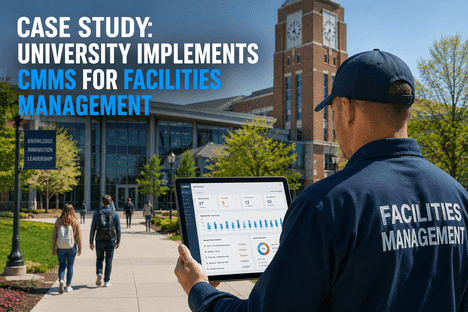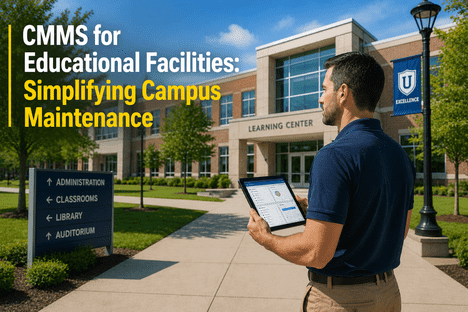
For educational institutions managing sprawling campuses across multiple buildings — from K-12 school districts to large university systems — facility maintenance is a structural cost and operational challenge that grows more complex with every aging roof, HVAC unit, and classroom. Reactive maintenance, paper-based work orders, and fragmented asset tracking drain budgets and disrupt the learning environment. When a school district's facilities team operates without centralized visibility, preventive scheduling, or predictive failure detection, emergency repairs become routine and capital planning becomes guesswork. This is the account of how a 7-campus school district serving 34,000 students reduced maintenance costs by 28%, eliminated emergency repair backlogs, and achieved campus-wide asset visibility using ifactory's AI-powered CMMS platform with IoT sensor integration and computer vision inspection.
Client Background
The district operates 47 buildings across 7 campuses — including elementary, middle, and high schools, plus administrative and athletic facilities — serving 34,000 students with a facilities staff of 68 technicians. The maintenance portfolio spans 1,200+ tracked assets: HVAC systems, boilers, roof top units, lighting infrastructure, plumbing networks, fire safety systems, athletic field equipment, kitchen appliances, and classroom technology. Before deploying ifactory's CMMS platform, all maintenance was managed through paper work orders, spreadsheet-based asset logs, and phone call requests — with no centralized system for tracking, prioritizing, or analyzing facility work. Book a Demo to see how ifactory's AI-powered CMMS transforms campus maintenance operations for K-12 and higher education facilities.
The Challenge
Educational facility maintenance is uniquely difficult. Buildings operate on tight schedules where classroom disruptions are unacceptable, budgets are fixed years in advance, and equipment spans decades of varying condition and reliability. For this district, the absence of a centralized CMMS had created a cascade of inefficiencies that were both costly and unsustainable. Book a Demo to learn how ifactory's platform addresses these specific challenges in educational environments.
The Solution: ifactory's AI-Powered CMMS with IoT and Computer Vision
The district deployed ifactory's comprehensive CMMS platform — integrating work order management, IoT sensor monitoring, AI-driven predictive maintenance, and computer vision inspection — across all 47 buildings. The platform replaced paper-based processes with a centralized digital system that connected every work request, asset record, maintenance schedule, and technician assignment in real time. ifactory's AI Vision Camera was deployed across critical mechanical rooms and building zones to automate visual inspection of equipment conditions, detect anomalies, and trigger work orders without human walkthroughs.
- Digital work order creation, assignment, prioritization, and closure from any device
- Mobile-first interface enabling technicians to receive, update, and close work orders in the field
- Automated routing by skill set, location, and priority with SLA tracking per work order
- Wireless IoT sensors on HVAC units, boilers, pumps, and electrical panels tracking temperature, vibration, and power draw
- Real-time data transmitted every 60 seconds to the CMMS platform for continuous asset health scoring
- Automated work order generation when sensor readings exceed predefined thresholds
- ifactory AI Vision Camera units installed in mechanical rooms, boiler houses, and rooftop equipment zones
- Computer vision models trained to detect leaks, corrosion, belt wear, debris accumulation, and safety violations
- Automatic inspection reports generated daily without technician walkthroughs, with anomaly images attached to work orders
- Machine learning models analyzing IoT sensor trends and AI vision anomaly frequency to predict equipment failure windows
- Automated health scores updated per asset with predicted remaining useful life estimates
- Maintenance recommendations generated with risk severity rankings and recommended service windows
- Complete digital asset registry with location, specifications, warranty, service history, and replacement cost data
- Automated preventive maintenance scheduling by calendar date, runtime hours, or condition triggers
- Parts inventory tracking with reorder alerts and usage logging per work order
- Real-time dashboards for facility directors showing work order status, asset health, technician productivity, and cost trends
- OSHA, fire safety, and ADA compliance documentation with automated inspection checklists and audit trails
- Role-based access for principals, district administrators, technicians, and external contractors
Implementation Approach
Deployment was phased across the district's seven campuses over eight weeks, beginning with the two largest high school campuses to validate the platform before expanding to elementary and middle schools. All 47 buildings were live on ifactory's CMMS within 60 days of project initiation. Book a Demo to discuss a rollout plan tailored to your district's campus configuration and maintenance priorities.
All 480 assets across two high schools were cataloged in the CMMS digital registry with location metadata, equipment specifications, warranty information, and maintenance history. IoT sensors were installed on 86 HVAC units and 12 boiler systems. AI Vision Camera units were deployed in mechanical rooms and rooftop zones. Work order digitization began immediately, with all incoming requests routed through the platform.
Asset registry, IoT sensor deployment, and AI Vision Camera installation expanded to all remaining campuses. Preventive maintenance schedules were configured for every asset class — HVAC filter changes, boiler inspections, fire alarm testing, playground equipment checks, and kitchen hood cleaning. Mobile access was activated for all 68 technicians with role-based training completed.
Historical maintenance data was analyzed to train predictive models for failure patterns specific to the district's equipment and usage profiles. AI Vision Camera anomaly detection thresholds were calibrated per building zone. Custom dashboards were configured for district leadership, campus principals, and the facilities management team with role-specific KPIs and drill-down reporting.
By month three, the platform was operating autonomously. Preventive maintenance compliance reached 94%. Emergency work orders dropped by 87%. The AI predictive engine flagged 14 assets with early degradation signatures across HVAC, plumbing, and electrical systems — enabling planned service interventions before any failure occurred and eliminating emergency classroom disruptions.
Results After Full Deployment
The transition from paper-based reactive maintenance to ifactory's AI-driven CMMS platform produced measurable improvements across cost, reliability, compliance, and operational efficiency — every dimension that determines whether an educational facility runs smoothly or struggles under the weight of deferred maintenance and emergency disruptions.
Performance Summary
| Metric | Before ifactory | After ifactory | Improvement |
|---|---|---|---|
| Annual Maintenance Spend | $1,470,000 | $1,058,000 | -28% ($412K saved) |
| Emergency Work Orders (Annual) | 642 emergency repairs | 83 emergency repairs | 87% reduction |
| Avg. Work Order Resolution | 23 days | 3.2 days | 86% faster |
| PM Compliance Rate | 41% | 94% | +53 pts |
| Avg. Asset Lifespan (HVAC) | 14 years | 19+ years (projected) | +35% |
| Director Oversight Time (Daily) | 3-4 hours | Under 30 min | ~87% less |
Key Benefits and Business Impact
The deployment of ifactory's AI-powered CMMS platform created compounding value across the district's entire facility operation — reducing costs, improving reliability, extending asset life, and freeing engineering capacity for strategic improvement initiatives that had been consistently deprioritized under the reactive maintenance workload.
The 28% reduction in annual maintenance spend — $412,000 saved — was achieved by shifting from 68% reactive emergency repairs to 84% planned preventive service. Automated scheduling, IoT condition monitoring, and AI Vision Camera inspection ensured that equipment received service before failure, eliminating premium-cost emergency callouts and extending service intervals based on actual asset condition rather than arbitrary calendar dates.
An 87% reduction in emergency work orders meant that HVAC failures during winter months, electrical outages during instruction time, and plumbing emergencies during school hours became rare exceptions rather than weekly occurrences. Predictive analytics identified degradation 5-12 days before failure, allowing all corrective work to be scheduled during after-hours maintenance windows with zero impact on classroom instruction.
IoT sensor data and AI Vision Camera inspection insights enabled maintenance teams to service equipment based on actual operating condition rather than fixed calendar intervals. This condition-based approach extended projected HVAC asset lifespan from 14 to 19+ years — a 35% improvement — deferring an estimated $2.3 million in capital replacement costs over the district's 10-year facility plan.
Automated inspection checklists, digital sign-offs, and timestamped compliance logs ensured that every OSHA-required safety check, fire alarm test, playground equipment inspection, and kitchen hood cleaning was completed on schedule with verifiable documentation. The district passed its first independent compliance audit with zero findings — a first in its operational history.
Recovering over three hours of daily facility director time from paper chasing and phone triage created capacity for capital planning, energy efficiency projects, and long-term facility improvement initiatives. Technicians gained 90+ minutes of productive field time daily by eliminating the need to return to the shop for work order assignments and parts.
The centralized asset registry with condition scores, age data, maintenance history, and replacement cost estimates transformed capital planning from guesswork into a data-driven process. The district's 10-year facility renewal plan was rebuilt with asset-level accuracy, enabling bond planning and budget requests that were defensible, prioritized, and aligned with actual facility conditions.
Conclusion
For educational institutions managing multi-building campuses with aging infrastructure and fixed budgets, maintenance is not a peripheral operational concern — it is a direct determinant of learning environment quality, occupant safety, and financial sustainability. When maintenance is managed through paper work orders, spreadsheets, and reactive response, cost overruns and classroom disruptions become structural inevitabilities rather than addressable risks. This case study demonstrates what becomes possible when campus maintenance transitions from reactive paper-based management to an AI-powered connected CMMS platform: maintenance costs drop by 28% through preventive and predictive scheduling, emergency disruptions decrease by 87% through early failure detection, asset lifespans extend by 35% through condition-based servicing, and engineering capacity shifts from firefighting to strategic improvement. Book a Demo to see how ifactory's AI-powered CMMS platform applies to your educational facility environment.
For this school district, ifactory's CMMS platform with IoT sensor integration and AI Vision Camera inspection transformed a fragmented, reactive maintenance operation into a predictive, continuously optimizing facility management system. The outcomes — $412,000 in annual savings, 87% fewer emergency repairs, 94% preventive maintenance compliance, and data-driven capital planning — were not achieved by adding staff or replacing equipment. They were achieved by making every asset, every work order, and every technician visible and connected through a single intelligent platform. Any educational institution facing similar facility maintenance challenges can achieve comparable results by making the same fundamental decision: replace paper-based chaos with digital visibility, and replace reactive firefighting with predictive control.