A regional municipal authority managing over 2,800 public infrastructure assets — spanning water treatment facilities, road maintenance depots, stormwater pump stations, public buildings, and bridge inspection programs — was operating without unified maintenance visibility across its four operational divisions. Reactive work orders consumed 64% of total maintenance budget, preventive maintenance compliance had fallen to 54% across critical civil infrastructure, and compliance documentation failures were generating regulatory notices and audit findings that the authority's engineering directorate could not resolve through manual record-keeping processes alone. Following deployment of ifactory's AI Vision Camera platform integrated with structured CMMS workflows designed for government asset management environments, the authority reduced critical infrastructure failures by 47%, raised PM compliance to 91%, eliminated all regulatory documentation non-conformances, and delivered $620,000 in annual maintenance cost reduction within 61 days of full platform activation. Book a Demo to see how this deployment model maps to your public works infrastructure portfolio.
Authority Background
The regional authority is responsible for maintaining public works infrastructure serving a population of approximately 340,000 residents across four administrative districts. Asset classes under the authority's engineering directorate include water treatment and distribution infrastructure, stormwater pump stations and drainage networks, sealed and unsealed road surfaces, public buildings and civic facilities, bridges and culverts, and environmental monitoring installations. Operations are delivered through four divisional maintenance teams — water services, civil infrastructure, buildings and facilities, and environment — each historically managing maintenance on separate work order systems with no unified asset register, no cross-divisional condition visibility, and no integration between maintenance activities and the authority's capital works planning function. Prior to the ifactory deployment, maintenance decisions across all four divisions were driven by calendar-based inspection schedules, reactive fault response, and operator reports — with no sensor-based condition monitoring infrastructure and no predictive capability at any point in the infrastructure portfolio. Book a Demo to see how this platform applies to your public works asset portfolio.
The Challenge
Government and public works maintenance operates under constraints that compound the cost of reactive maintenance models more severely than in commercial environments. Public infrastructure failures carry consequences that extend beyond direct repair cost — service disruption to residents, public safety risk, regulatory penalty, reputational damage to elected representatives, and the compounding deterioration of assets that receive deferred maintenance under constrained budget cycles. This authority's maintenance model was entirely driven by scheduled inspection and reactive fault response across all four divisions. Without real-time asset condition data, maintenance teams could not distinguish assets requiring urgent intervention from those operating safely within normal parameters. Without a unified CMMS, cross-divisional resource allocation was impossible to optimize, and capital works planning operated without reliable asset condition intelligence. The result was a maintenance operation that consistently overspent on reactive repair while simultaneously failing to prevent the infrastructure deterioration events that generated the largest public and regulatory consequences.
The Solution: ifactory AI Vision Camera Platform for Government Infrastructure CMMS
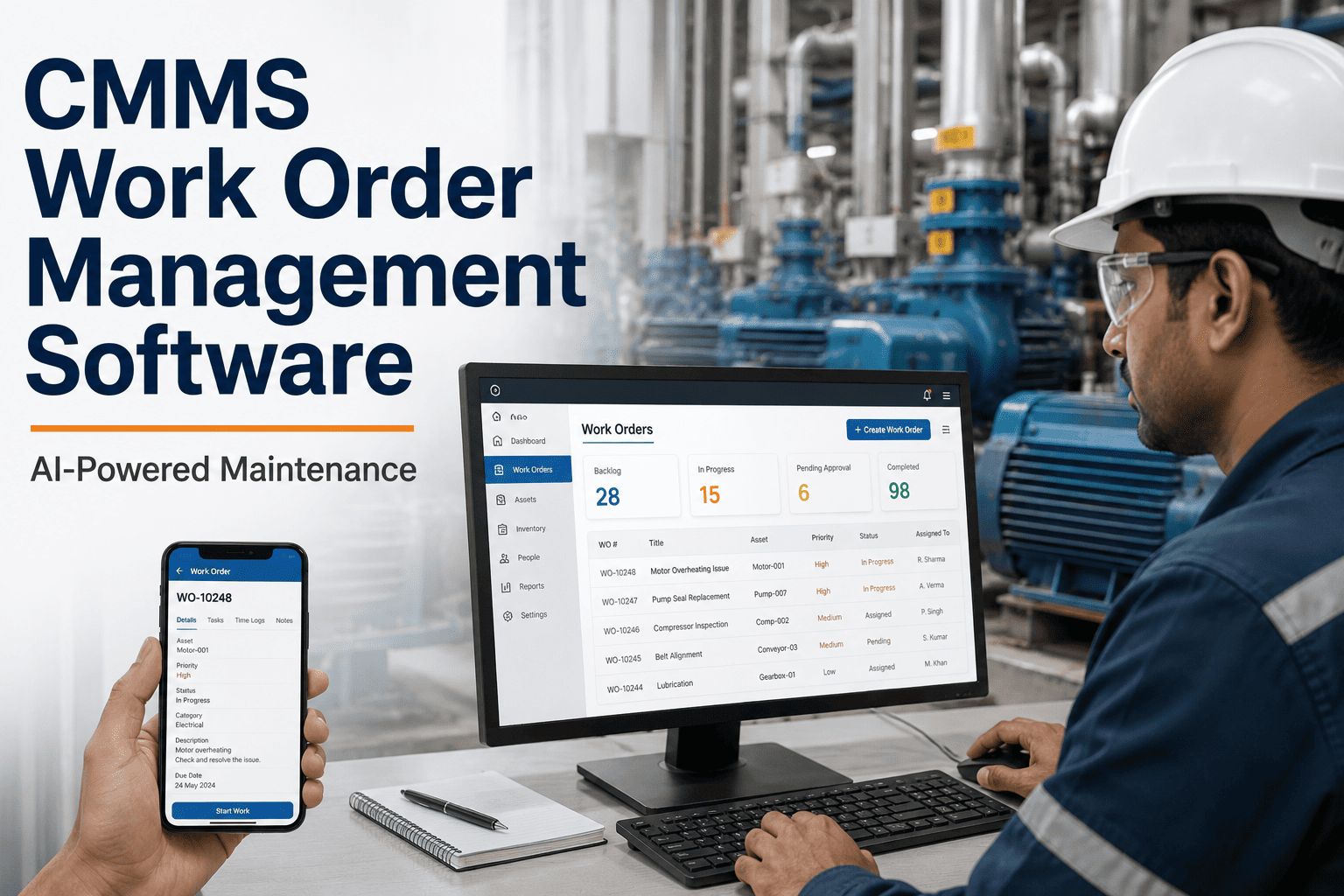
Following a competitive procurement process under the authority's asset management technology framework, the engineering directorate selected ifactory for its AI Vision Camera platform validated in critical infrastructure monitoring environments, demonstrated integration capability with existing building management and SCADA systems, and ability to deliver a unified CMMS across all four divisions without replacing existing control infrastructure. The platform was deployed across the highest-criticality asset categories in all four divisions — with an integrated dashboard providing real-time asset health scores, AI-generated maintenance priority queues, mobile work order management for field maintenance teams, and compliance-grade documentation for every maintenance event across the full portfolio. For government asset management teams assessing similar deployments, Book a Demo to see how ifactory structures public infrastructure CMMS programs.
- Real-time pump performance monitoring across all pump stations detecting flow rate anomalies, motor current drift, and vibration signatures preceding mechanical failure
- Water treatment process parameter monitoring flagging chemical dosing deviations, filter performance degradation, and quality compliance risk conditions before regulatory breach
- Pipeline pressure monitoring identifying potential main failure conditions and enabling planned repair scheduling before service disruption events occur
- AI Vision Camera structural monitoring at bridge inspection points detecting surface cracking, joint movement, and bearing degradation between scheduled inspection cycles
- Road pavement condition scoring from mobile survey data integration enabling evidence-based maintenance prioritization across the sealed road network
- Stormwater drainage network monitoring identifying blockage conditions and pump station faults before flooding or environmental discharge events occur
- HVAC condition monitoring across all civic buildings detecting performance degradation before system failure and enabling planned maintenance during low-occupancy periods
- Building services compliance monitoring generating automated documentation for fire system tests, elevator certifications, and essential services inspections required under building regulations
- Energy performance monitoring identifying HVAC and lighting system inefficiencies that represent both maintenance indicators and sustainability reporting requirements
- Machine learning models trained on government infrastructure operating baselines establishing asset-specific normal performance envelopes for accurate anomaly detection
- Multi-signal condition fusion correlating visual inspection data, sensor telemetry, and process parameters for compound fault pattern identification across all asset classes
- Public impact weighted priority scoring ranking maintenance tasks by asset criticality, service disruption risk, regulatory compliance consequence, and estimated time to failure
- Single cross-divisional CMMS replacing four isolated systems — providing engineering directorate with unified portfolio visibility, cross-divisional resource allocation, and consolidated performance reporting
- Mobile work order dispatch to field maintenance teams with full asset history, regulatory requirement data, and compliance documentation templates pre-loaded at assignment
- Condition-based PM scheduling replacing calendar-only intervals — accelerating maintenance when sensor data indicates elevated deterioration and confirming safe deferral when asset condition supports it
- Automated compliance documentation for all maintenance events — generating timestamped, evidenced records compatible with water quality, bridge safety, building services, and environmental regulatory frameworks
- Council and elected representative reporting dashboards delivering infrastructure condition summaries, maintenance performance metrics, and capital works prioritization data in formats suitable for public reporting
- Capital works planning integration linking asset condition trend data directly to long-term infrastructure investment modeling and budget submission evidence
Implementation Approach
Deployment followed a structured ten-week integration sequence designed to maintain continuous public service delivery across all four divisions throughout sensor installation and platform activation. ifactory engineers completed all sensor and AI Vision Camera installations during planned maintenance windows and low-service-demand periods — requiring zero service disruption to residents at any point during the deployment process. Existing divisional work order data was migrated into the unified CMMS asset register, establishing historical maintenance context for each asset from day one of platform operation. AI condition baselines were established within the first four weeks of continuous data collection across monitored infrastructure, enabling predictive alerts to begin generating from week five onward across all divisions.
All 2,800 portfolio assets catalogued into ifactory's unified asset register — capturing asset class, location, service history transferred from four divisional systems, regulatory compliance requirements per asset type, and current maintenance status. AI Vision Camera placement designed for highest-criticality assets across all four divisions: water pump stations, bridge inspection points, civic building HVAC plant rooms, and stormwater pump facilities. Network infrastructure assessed across all sites for sensor connectivity and data transmission. Regulatory compliance frameworks mapped per asset class to pre-configure documentation templates before platform activation.
ifactory AI Vision Camera units and supporting sensor arrays installed at water treatment plant, primary pump stations, and the four highest-traffic civic buildings during Weeks 4 and 5 — with civil infrastructure and environmental monitoring sensors completing deployment across Weeks 6 and 7. All installations completed without service interruption. Live sensor telemetry began populating the unified platform dashboard on Day 28. Mobile work order application deployed to all field maintenance teams across four divisions, with cross-divisional work order visibility activated from Day 31. Historical maintenance records migrated and validated across all four former divisional systems during the same period.
AI condition models calibrated against four weeks of continuous infrastructure telemetry spanning normal operational variation, seasonal demand patterns, and both weekday and weekend service cycles. Asset-specific performance baselines established per infrastructure category — allowing the anomaly detection engine to distinguish genuine condition degradation from expected operational variance in each asset class. During baseline calibration, the platform identified 16 assets across three divisions showing early-stage deterioration signatures. Existing calendar-based PM schedules across all four divisions restructured into the unified CMMS with condition-based escalation logic applied to all high-criticality assets from Week 9.
Predictive alert thresholds activated across all monitored infrastructure assets. Compliance documentation module launched with all regulatory framework templates live across water quality, bridge safety, building services, and environmental reporting requirements. Engineering directorate dashboard and council reporting module activated on Day 57. First AI-generated predictive alert issued on Day 58 — identifying abnormal vibration and thermal signatures on the primary pump at Pump Station 4 that was scheduled for overnight service delivery. Planned intervention completed during a low-demand window on Day 60. Post-inspection confirmed progressive bearing failure that would have caused a service outage within an estimated 5–9 days. Full platform validation completed and signed off on Day 61.
Results After Full Deployment
The transition from reactive, four-system divisional maintenance management to AI-driven predictive infrastructure CMMS produced verified improvements across every tracked performance dimension within the first 90 days of full platform operation. Critical infrastructure failures fell by 47% as predictive alerts enabled intervention before service-impacting events materialized. PM compliance rose from 54% to 91% as mobile work order management eliminated scheduling gaps across all four divisions simultaneously. And for the first time, the engineering directorate had a single, real-time view of infrastructure condition, maintenance performance, and compliance status across the entire 2,800-asset portfolio.
Performance Summary
| Metric | Before | After | Improvement |
|---|---|---|---|
| Critical Infrastructure Failures (Annual) | 74 events | 39 events | −47% Reduction |
| PM Schedule Compliance (All Divisions) | 54% average | 91% average | +37 Percentage Points |
| Regulatory Non-Conformances (Annual) | 23 notices | 0 notices | 100% Elimination |
| Reactive Work Orders as % of Total | 64% | 22% | −42 Percentage Points |
| Emergency Contractor Mobilizations (Annual) | ~112 events | ~41 events | −63% Reduction |
| Predictive Alert Lead Time | None — reactive | 5–14 days avg. | From 0 to 14 Days |
| Cross-Divisional Maintenance Visibility | 4 isolated systems | Unified real-time dashboard | Full Portfolio View |
| Annual Maintenance Expenditure | ~$2.18M | ~$1.56M | −$620K Annual Savings |
| Deployment Timeline — Full Coverage | N/A | 61 days | Fully Live in 61 Days |
Key Benefits and Business Impact
The deployment delivered outcomes that extended beyond direct maintenance cost reduction — fundamentally transforming how the authority manages infrastructure risk, regulatory compliance, public service reliability, and capital works investment decision-making across its entire portfolio.
Continuous AI Vision Camera monitoring and real-time sensor telemetry across water, civil, and building assets converted 35 annual failure events from unplanned service disruptions into planned maintenance interventions — eliminating emergency contractor mobilization costs and the public service outage consequences that generate both resident complaints and political accountability pressure for elected representatives.
Automated compliance documentation — generating timestamped, evidenced maintenance records at point of work order completion — eliminated the documentation gaps that had produced 23 regulatory non-conformances in the preceding 24 months. The authority's first post-deployment regulatory audit across water quality, bridge safety, and building services frameworks resulted in fully compliant outcomes across all inspection categories.
Replacing four isolated divisional systems with a single unified CMMS gave the engineering directorate the ability to allocate maintenance resources across divisions based on real-time portfolio priority rather than siloed divisional schedules — enabling cross-divisional workforce deployment during peak demand periods and eliminating the capacity mismatch that had been a persistent driver of both maintenance backlog and emergency contractor expenditure.
For the first time, the authority's engineering directorate was able to produce capital works prioritization submissions to the council supported by objective asset condition trend data — replacing the prior approach of elapsed-time and reactive failure history with measured degradation rates and predictive end-of-life modeling that defended budget submissions with infrastructure condition evidence rather than estimates.
Raising preventive maintenance compliance from 54% to 91% across all four divisions — sustained through automated work order escalation and condition-based scheduling — directly reduced the deferred maintenance backlog that had been the primary structural driver of reactive failure clustering and emergency budget overruns. Each percentage point of sustained PM compliance improvement represents compounding reduction in future reactive demand and asset deterioration rate.
The $620,000 structural reduction in annual maintenance expenditure — achieved without reducing maintenance staffing or service delivery commitments — represents budget that the authority was able to redirect into capital infrastructure renewal and community service improvement programs in the first full post-deployment budget cycle, demonstrating the compound public value of AI-driven infrastructure CMMS beyond the direct operational cost savings.