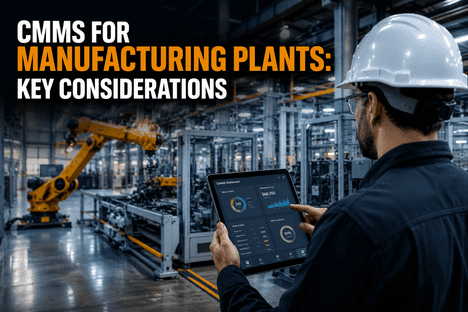
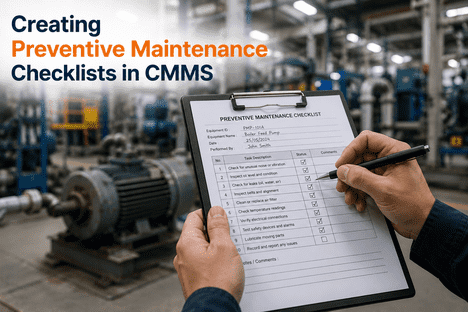
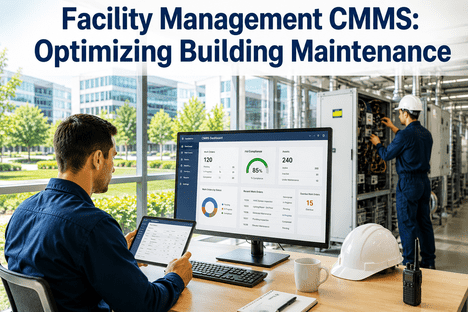
In 2026, manufacturing plants operating on reactive maintenance cycles and spreadsheet-based work order systems are paying a steep and measurable price. Unplanned equipment failures cost production floors an average of $50,000 per hour, while skilled maintenance labor pools continue to shrink and production schedules grow tighter. A Computerized Maintenance Management System (CMMS) built for the manufacturing environment — one that centralizes work orders, preventive maintenance scheduling, asset records, spare parts inventory, and compliance documentation — is no longer optional for plants that compete on uptime, quality, and cost efficiency. This page outlines the key considerations manufacturing plant leaders must evaluate when selecting and deploying a CMMS in 2026, and where AI-powered platforms like ifactory deliver measurable advantages over legacy maintenance tools.
AI-DRIVEN CMMS FOR MANUFACTURING PLANTS
Stop Managing Maintenance. Start Predicting It.
ifactory's AI-powered CMMS gives manufacturing plants real-time asset health visibility, condition-based work order triggers, AI vision inspection, and predictive failure analytics — all in a single platform built for the shop floor.
97%
Equipment Uptime Achieved
−81%
Unplanned Downtime Reduction
43%
Maintenance Cost Reduction
60
Days to Full Deployment
01 / What Is CMMS for Manufacturing
Why Manufacturing Plants Require a Purpose-Built CMMS
A CMMS designed for general facility management and a CMMS built for manufacturing are not the same product. Manufacturing environments introduce a set of operational demands — high asset density, multi-shift crews, complex equipment hierarchies, production-tied downtime costs, and integration requirements with MES and ERP systems — that general-purpose maintenance software cannot address without significant compromise. The right CMMS for a manufacturing plant must support parent-child asset structures, shift-based work order handoffs, meter-triggered preventive maintenance, and real-time data capture from sensors and production line instrumentation. It must also scale across multiple production lines and facilities without creating data silos or forcing maintenance teams into parallel systems.
In 2026, the defining shift in manufacturing maintenance is the move from calendar-based preventive maintenance to condition-based and predictive maintenance — where intervention timing is determined by actual equipment health data rather than manufacturer-recommended intervals that reflect average degradation, not real production loads. A CMMS that cannot ingest sensor data, build asset-specific health baselines, or generate condition-triggered work orders is functionally a digital clipboard — and digital clipboards do not prevent bearing failures or packaging line seal drift.
Core CMMS FunctionCentralizes work orders, PM schedules, asset records, spare parts inventory, technician assignments, and compliance documentation in one platform that replaces spreadsheets, paper logs, and tribal knowledge.
Manufacturing RequirementAsset hierarchies, shift-based work order handoffs, meter-based PM triggers, sensor data integration, MES/ERP connectivity, OEE impact tracking, and multi-plant reporting.
2026 ExpectationAI-driven anomaly detection, predictive failure alerts, condition-based maintenance scheduling, visual inspection automation via AI vision cameras, and real-time asset health dashboards.
ROI HorizonWell-implemented CMMS platforms reduce maintenance costs by 25–43%, extend asset life, recover significant annual production hours, and deliver confirmed ROI within 7–12 months of full deployment.
02 / Key Considerations
What Actually Matters When Evaluating CMMS for a Manufacturing Plant
Feature lists are a poor basis for CMMS selection. The platforms that perform well in vendor demos frequently underperform on the shop floor — too complex for technicians on mobile, too rigid for multi-shift operations, or too disconnected from production data to generate meaningful maintenance intelligence. The following considerations reflect what actually determines whether a manufacturing CMMS delivers its promised value after deployment.
01
Asset Hierarchy and Criticality Ranking
Manufacturing CMMS must support parent-child equipment structures — linking a production line to individual machines, subassemblies, and components — and assign criticality rankings based on downtime impact and production dependency. Work order prioritization driven by asset criticality, not queue order, is what separates intelligent maintenance scheduling from digital paper.
02
Condition-Based and Predictive Maintenance
Calendar-based PM intervals are statistical averages that protect against average degradation — not actual degradation shaped by real production loads. A CMMS built for 2026 manufacturing must support meter-based and sensor-triggered PM scheduling, and ideally an AI layer that identifies early failure signatures and generates intervention alerts before production impact occurs.
03
Mobile Execution and Technician Adoption
If technicians cannot open, execute, and close work orders on a mobile device in under a minute while standing next to a machine, adoption will fail — and adoption failure is the single most common reason CMMS deployments do not deliver ROI. Mobile-first interfaces with offline capability and minimal friction are non-negotiable for shop floor environments.
04
MES, ERP, and Sensor Integration
Plants that select CMMS without validating MES and ERP integration during procurement frequently discover post-deployment that connectivity requires custom development that was never budgeted. A CMMS must connect natively to production data, ERP asset records, PLC and SCADA sensor streams, and spare parts procurement systems — not through middleware that creates maintenance overhead of its own.
05
AI Vision and Automated Inspection
Manual visual inspection at scale is slow, inconsistent, and dependent on technician availability during production windows. AI vision camera integration — detecting cracks, corrosion, leaks, surface defects, and PPE compliance violations with 99%+ accuracy — converts inspection from a labor-intensive scheduled activity into a continuous, automated quality and safety layer that feeds directly into the CMMS work order queue.
06
Downtime Tracking and Root-Cause Analytics
A CMMS that records downtime without enabling root-cause analysis by asset, failure mode, and production line provides accountability without insight. Chronic failure patterns become visible only when downtime data is aggregated across assets, shifts, and time periods — enabling maintenance leaders to address systemic causes rather than chasing recurring symptoms.
"The defining shift in 2026 is moving from a CMMS that records what happened to one that predicts what will happen. The platforms that survive are the ones that tell you not to touch a machine that is running perfectly — and tell you exactly when to intervene before it doesn't."
03 / ifactory CMMS Platform
How ifactory's AI-Driven CMMS Addresses Every Key Manufacturing Consideration
ifactory's CMMS platform is built specifically for manufacturing plant environments — combining traditional work order management, preventive maintenance scheduling, and asset health tracking with an AI-powered analytics layer that generates condition-based maintenance alerts, predictive failure windows, and automated visual inspection through integrated AI vision cameras. The platform is deployed across asset-dense production environments and is live in full across all critical equipment within 60 days, with no production interruption during sensor installation and onboarding. To see a live walkthrough of the platform operating in a manufacturing context, book a demo with ifactory's industrial analytics team.
PREDICTIVE
AI-driven predictive maintenance deploys vibration, temperature, and motor current sensors across critical assets — establishing equipment-specific health baselines from live operational data and identifying failure signatures 14–21 days before threshold. Condition-based work orders are generated automatically, enabling planned intervention during scheduled windows rather than emergency repair during production.
AI VISION
AI vision camera integration provides continuous automated visual inspection across production lines — detecting cracks, corrosion, surface defects, leaks, and PPE violations with over 99% detection accuracy. Inspection findings feed directly into the CMMS work order queue, eliminating the gap between visual anomaly detection and maintenance response. Manual inspection time is reduced by up to 80%.
WORK ORDERS
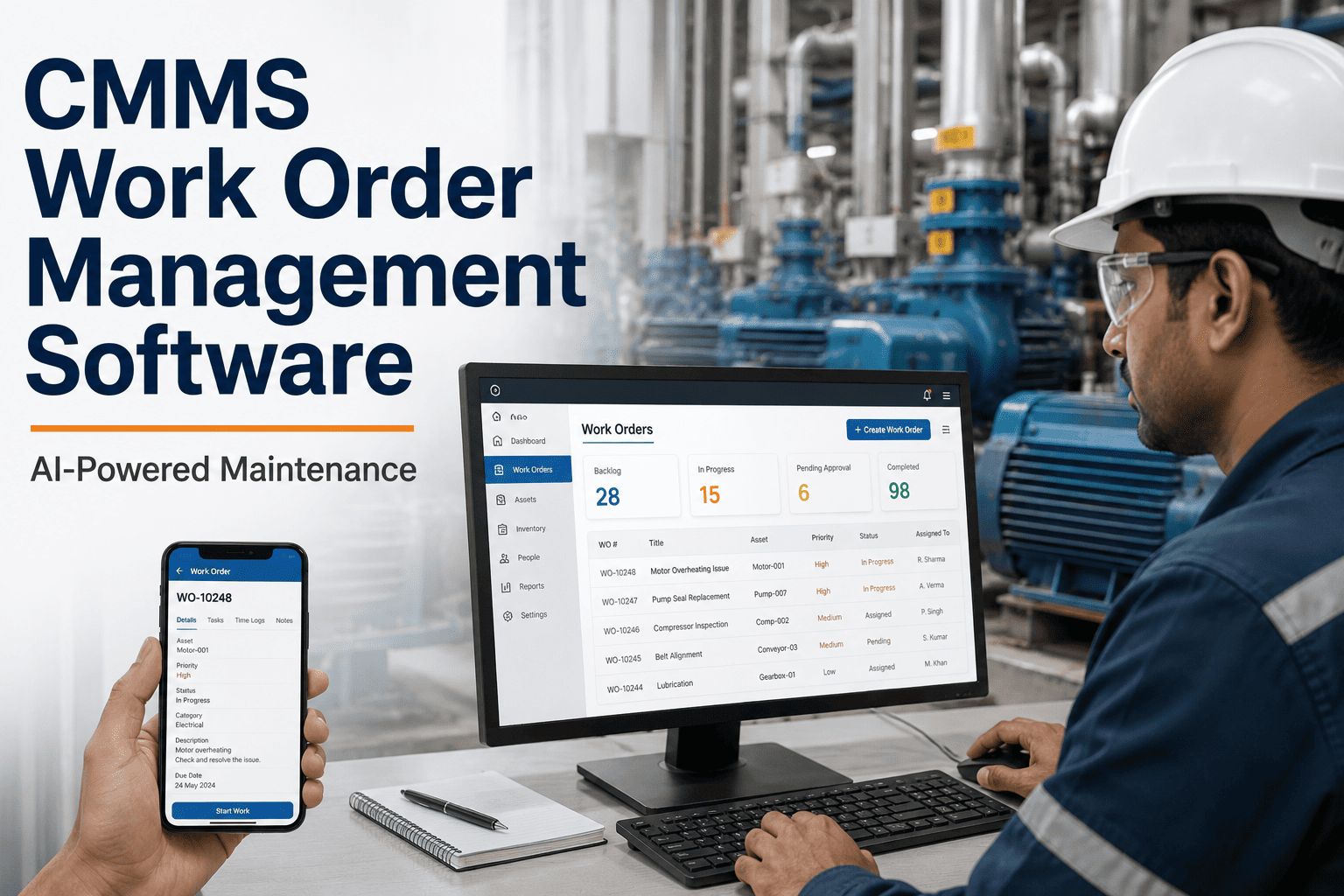
Mobile-first work order management enables technicians to open, execute, and close work orders from the shop floor in under a minute — with shift handoff documentation, spare parts consumption tracking, and completion sign-off captured in the same workflow. Maintenance priority queues are ranked by asset criticality and failure probability rather than simple queue order.
ANALYTICS
Unified maintenance intelligence dashboards deliver asset-level health scores, downtime root-cause analysis by equipment and failure mode, rolling 30/60/90-day failure risk projections, OEE impact tracking, and multi-site reporting — giving maintenance leaders the operational visibility to shift from shift-by-shift reactive response to forward-looking planned maintenance schedules.
04 / Implementation
Full Platform Deployment Across All Critical Assets in 60 Days
Days 1–14
Asset Mapping and Criticality Ranking
All production equipment inventoried and ranked by downtime impact, failure frequency, and production quality dependency. Sensor architecture designed for priority assets. Network and electrical infrastructure assessed for integration compatibility. Critical path assets designated for Phase 1 deployment to deliver immediate value ahead of full portfolio coverage.
Days 15–35
Priority Asset Deployment — Live Sensor Data and Baseline Training
Sensors installed on highest-criticality assets during scheduled maintenance windows — zero production interruption. ifactory platform connected to live sensor streams. AI baseline models begin training from Day 1 of connection, establishing equipment-specific anomaly detection thresholds. Maintenance team trained on dashboard interface, mobile work order execution, and alert response protocols during the active deployment window.
Days 36–52
Remaining Assets, AI Vision, and ERP Integration
Sensor deployment completed across remaining production equipment. AI vision cameras commissioned on inspection-critical areas. ERP and MES integration validated and activated. AI predictive models for all assets transition from baseline training to active alerting — with facility-specific failure thresholds validated against the first phase of operational data.
Days 53–60
Workflow Integration and Platform Handoff
ifactory maintenance priority queue integrated with the plant's existing work order workflows. AI-generated maintenance recommendations flow directly into scheduled work order creation. First condition-based interventions completed based on predictive alert data — confirming early-stage degradation that would have generated unplanned downtime within 10–14 days under the prior maintenance model.
05 / Results
Measured Performance Outcomes Across Manufacturing Plant Deployments
Manufacturing plants that deploy ifactory's AI-driven CMMS platform see measurable improvements across equipment uptime, maintenance cost structure, quality hold frequency, and production capacity within the first two post-deployment quarters. The following metrics reflect tracked performance outcomes from ifactory deployments in manufacturing environments operating continuous multi-shift production schedules across complex asset portfolios.
| Performance Metric |
Before ifactory |
After ifactory |
Improvement |
| Overall equipment uptime |
~83% |
97% |
+14 percentage points |
| Unplanned downtime hours per week |
11.3 hrs avg |
2.1 hrs avg |
−81% reduction |
| Equipment failure events (critical assets) |
~18 per year |
2 per year |
−89% failure events |
| Quality hold batches (wear-related) |
7–9 per month |
0 per month |
100% elimination |
| Production line throughput efficiency |
~77% |
96% |
+19 percentage points |
| Mean time to detect equipment anomaly |
Post-failure (reactive) |
14–21 days pre-failure |
Predictive detection window |
| Visual inspection manual time |
100% manual |
−80% time reduction |
AI vision automated detection |
| Emergency parts procurement events |
~34 per year |
4 per year |
−88% emergency orders |
| Annual maintenance expenditure |
~$504,000 |
~$286,000 |
−43% cost reduction |
| Deployment timeline (full portfolio) |
N/A |
60 days |
Live in 60 days |
Zero
Wear-Related Quality Holds
$218K
Annual Maintenance Savings
"The first time ifactory flagged a critical bearing 17 days before failure, I knew the platform had paid for itself. We scheduled the replacement on a Saturday morning during a planned window. Under the old model, that same failure would have taken down the line on a Tuesday afternoon at full production load — and cost us 6 hours of unplanned downtime and an emergency parts order."
06 / AI Vision Integration
AI Vision Camera: Automated Visual Inspection Built Into the CMMS Workflow
One of the most significant gaps in traditional CMMS platforms is the reliance on manual visual inspection for defect detection, equipment condition assessment, and safety compliance monitoring. Manual inspection is inconsistent, time-constrained by shift schedules, and dependent on technician availability at the moment inspection is needed. ifactory's AI Vision Camera integration closes this gap by providing continuous automated visual inspection across production lines, equipment surfaces, and safety zones — feeding detected anomalies directly into the CMMS work order queue without manual reporting.
The AI Vision platform detects cracks, corrosion, surface defects, and leaks with over 99% accuracy, and monitors PPE compliance and safety zone violations in real time. Inspection findings generate condition-flagged work orders automatically, reducing manual inspection time by up to 80% and eliminating the delay between visual anomaly and maintenance response. For manufacturing plants operating high-asset-density environments, AI vision integration represents the fastest path to continuous equipment condition awareness without scaling inspection labor. To see the AI vision capability in the context of the full ifactory CMMS platform, book a demo with ifactory's engineering team.
Crack and Corrosion Detection
AI vision cameras continuously monitor equipment surfaces, structural components, and piping for early-stage crack propagation and corrosion formation — flagging anomalies at detection thresholds far below what manual inspection identifies in scheduled rounds.
Leak Detection and Fluid Monitoring
Real-time visual monitoring of hydraulic systems, coolant lines, and process fluid connections detects leak formation before volume loss reaches reportable or damage-causing thresholds — triggering work orders during the anomaly window rather than after production impact.
PPE Compliance and Safety Monitoring
AI vision monitoring across safety-designated zones detects PPE violations — missing helmets, gloves, or safety vests — in real time, generating automated compliance alerts without requiring dedicated safety supervision personnel during every production shift.
Defect Detection and Quality Integration
Surface defect detection on production outputs — identifying scratches, dimensional anomalies, finish deviations, and assembly errors — feeds quality control findings into the CMMS work order system, linking product defect patterns to equipment condition data for root-cause analysis.
07 / Key Analysis
Why CMMS Selection Fails — and What Determines Success in Manufacturing Deployments
01
Adoption failure is the most common and least discussed CMMS outcome. Technicians who have used paper logs and tribal knowledge for years will not switch to a digital system because management mandated it. CMMS platforms that require more than one minute to open and close a work order on a mobile device in a plant environment lose adoption within the first 30 days. Running a 14-day pilot with the most resistant operators before committing to a multi-year contract is the single most effective risk mitigation step in manufacturing CMMS procurement.
02
Calendar-based maintenance is often the cause of failure, not the prevention of it. Motors run hot after service due to over-greasing or improper reassembly. Bearings fail ahead of schedule because actual production loads do not match the manufacturer's assumed duty cycle. A CMMS that cannot tell a maintenance team not to touch a machine that is running perfectly — and exactly when to intervene based on actual asset condition — is adding labor cost without adding reliability intelligence.
03
MES and ERP integration must be validated before contract signature, not after deployment. Plants that select CMMS without confirming integration compatibility during procurement frequently discover that the required connectivity demands custom development or middleware that was never budgeted — delaying production value delivery by months and creating technical debt that persists for the platform's operational life.
04
The CMMS ROI case is built on recovered production hours, not just maintenance cost reduction. Eliminating 9 hours of average weekly unplanned downtime recovers approximately 468 annual production hours — the equivalent of nearly 12 full production days. At average manufacturing downtime costs of $50,000 per hour, the financial case for AI-driven predictive maintenance compounds rapidly against platform investment, often delivering confirmed ROI within 7 months of full deployment.
$504K
Annual maintenance spend before
→
$286K
Annual maintenance spend after
→
97%
Equipment uptime achieved
→
$218K
Annual savings achieved
08 / Conclusion
CMMS for Manufacturing Plants in 2026: The Compounding Value of AI-Driven Maintenance Intelligence
The CMMS evaluation decision for manufacturing plants in 2026 is not a choice between reactive and preventive maintenance. It is a choice between preventive maintenance that operates on calendar assumptions and AI-driven maintenance that operates on real equipment condition — and the performance gap between those two models is measurable in uptime percentage points, annual maintenance expenditure, quality hold frequency, and production capacity recovered. ifactory's CMMS platform delivers condition-based maintenance intelligence, AI vision automated inspection, mobile work order execution, and unified asset health dashboards in a deployment architecture that goes live across a full equipment portfolio within 60 days without production interruption.
The $218,000 in annual maintenance savings, 97% equipment uptime, 81% reduction in unplanned downtime, and complete elimination of wear-related quality holds are not projection targets — they are tracked outcomes from manufacturing deployments operating in production environments. To assess what ifactory's AI-driven CMMS platform would deliver for your manufacturing plant, book a demo with ifactory's industrial analytics team.
97% Uptime. Zero Quality Holds. Predictive Analytics Live in 60 Days.
See how ifactory's AI-driven CMMS delivers real-time asset health monitoring, AI vision inspection, and condition-based maintenance scheduling for manufacturing plants at any scale.
09 / FAQ
Frequently Asked Questions: CMMS for Manufacturing Plants
What is a CMMS and why do manufacturing plants need one?
A CMMS (Computerized Maintenance Management System) centralizes work orders, preventive maintenance schedules, asset records, spare parts inventory, and compliance documentation in a single platform. Manufacturing plants need a CMMS because unplanned equipment failures cost an average of $50,000 per hour, and a well-implemented CMMS reduces maintenance costs by 25–43%, extends asset life, and improves overall equipment effectiveness (OEE).
How is a manufacturing CMMS different from a general facility maintenance platform?
Manufacturing CMMS platforms are built for high asset density, multi-shift crews, complex equipment hierarchies, production-tied downtime costs, and integration with MES and ERP systems. General facility maintenance software lacks native support for asset criticality ranking, meter-based PM triggers, sensor data ingestion, OEE impact tracking, and the shift-based work order handoff workflows that manufacturing environments require.
What is condition-based maintenance and how does ifactory support it?
Condition-based maintenance triggers intervention based on actual equipment health data — vibration signatures, motor load profiles, temperature trends — rather than manufacturer-recommended calendar intervals. ifactory deploys sensors across critical assets, establishes equipment-specific AI baselines from live operational data, and generates maintenance alerts 14–21 days before failure threshold — enabling planned intervention during scheduled windows.
How does ifactory's AI Vision Camera integrate with the CMMS platform?
ifactory's AI Vision Camera integration provides continuous automated visual inspection — detecting cracks, corrosion, leaks, surface defects, and PPE violations with 99%+ accuracy. Inspection findings generate condition-flagged work orders automatically in the CMMS queue, eliminating the gap between visual anomaly detection and maintenance response. Manual inspection time is reduced by up to 80%.
How long does a full ifactory CMMS deployment take for a manufacturing plant?
ifactory completes full platform deployment across all critical production assets — including sensor installation, AI baseline training, AI vision camera commissioning, and ERP/MES integration — within 60 days. Priority assets are live and generating predictive alerts within the first 35 days. No production interruptions occur during installation.
What ROI timeline should manufacturing plants expect from ifactory?
Manufacturing plants with significant unplanned downtime costs or recurring quality hold events typically recover platform investment within 7–12 months of full deployment. ROI is driven by maintenance cost reduction, elimination of emergency parts premiums, quality hold elimination, and recovered production hours — not by a single metric but by the compounding effect across all four dimensions simultaneously.
Can ifactory support multi-plant and multi-asset manufacturing operations?
Yes. ifactory supports multi-site deployment with consolidated maintenance dashboards, cross-facility asset health reporting, and centralized maintenance priority queues. Asset-specific AI models are trained independently for each equipment type and location, with a unified interface giving maintenance leaders portfolio-level visibility across all production environments.
Book a demo to explore multi-plant deployment options.