CMMS Implementation Checklist: Everything You Need
By Austin on June 2, 2026
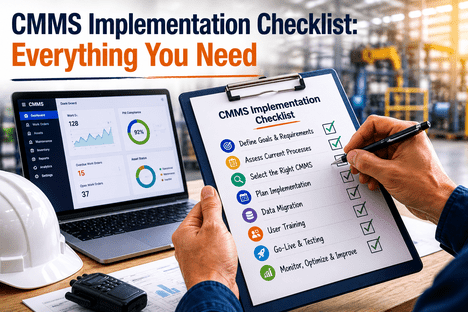
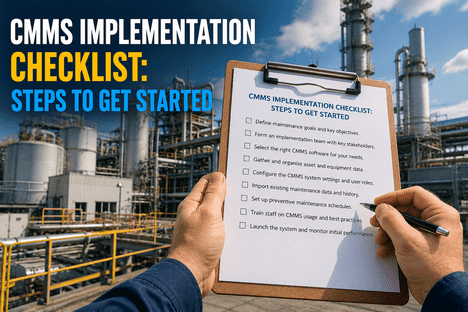
A CMMS implementation done right is one of the highest-leverage operational investments an industrial facility can make in 2026 — and one done without a structured checklist is one of the fastest ways to join the 60 to 80 percent of rollouts that underperform or stall within the first year. The failure is almost never the software. It is the approach: asset data entered without governance, technicians trained without workflow context, IoT integrations configured without OT protocol validation, and AI predictive models activated before a clean sensor baseline has been established. This checklist walks maintenance managers, reliability engineers, and operations leaders through every critical phase of a CMMS implementation — from pre-deployment planning and asset register preparation through IoT sensor integration, AI model activation, preventive maintenance configuration, and go-live adoption governance. Facilities using iFactory as their CMMS platform receive a structured deployment program that follows this exact checklist, with first sensors operational within four weeks and full predictive intelligence live by week five. Book a Demo with iFactory and receive a facility-specific implementation roadmap mapped to your asset classes and operational requirements before any engagement begins.
Deploy iFactory CMMS in 4 Weeks — With a Checklist-Driven Rollout That Delivers ROI in the First Quarter
iFactory connects to your existing SCADA, DCS, and IoT infrastructure without system replacement. Predictive maintenance intelligence, AI Vision monitoring, digital twin simulation, and automated compliance reporting — all live within the first month of deployment.
Why Most CMMS Implementations Fail — and What This Checklist Prevents
60–80% of Rollouts Underperform Within the First Year
Industry research consistently shows that 60 to 80 percent of CMMS implementations fail to meet their stated operational objectives. The failure patterns are remarkably consistent: no clear success metrics defined before go-live, asset data migrated without governance, technicians trained without workflow context, and IoT integrations skipped or deferred. Every failure mode is organizational, not technical. This checklist addresses each failure mode at the phase where it originates — before it becomes structurally embedded in every analysis the system produces. Book a Demo to see how iFactory's structured deployment program prevents each of these failure modes at your facility.
The Right Implementation Produces 20–30% Maintenance Cost Reduction in Year One
Organizations that follow a structured implementation process — clean asset register, validated IoT data pipeline, AI models activated on correct baselines, and technician adoption governed through a pilot-first rollout — report maintenance cost reductions of 20 to 30 percent within the first year, technician adoption rates above 90 percent, and unplanned downtime reductions of 30 to 50 percent. The checklist phases below are the operational requirements that separate those outcomes from a system that becomes shelfware at 60 percent adoption after eighteen months of underperformance.
60–80%Of CMMS implementations fail to meet stated objectives within the first year
4 WeeksiFactory deployment timeline to first sensors operational and predictive monitoring active
30–50%Unplanned downtime reduction achieved with structured iFactory deployment on industrial assets
94%+AI failure prediction accuracy on compressors, pumps, and turbines from day one of deployment
Phase 1 — Pre-Deployment Planning & Business Case
Phase 2 — Asset Register Preparation & Data Governance
Phase 3 — IoT Sensor Integration & OT Connectivity
Phase 4 — AI Model Activation & Predictive Maintenance Configuration
The following sequence reflects the order in which implementation phases are most efficiently completed to build each layer on validated outputs from the previous phase — and to deliver measurable ROI before the implementation project formally closes.
01
Planning & Objectives
Define success metrics, assemble the implementation team, and map existing OT infrastructure.
→
02
Asset Register & Data Migration
Build a clean asset hierarchy and migrate 12–24 months of validated maintenance history.
→
03
IoT & OT Integration
Connect sensors, validate data flow, and configure AI Vision camera integration on priority assets.
→
04
AI Model Activation
Activate pre-trained predictive models, establish baselines, and configure automated work order generation.
→
05
Pilot, Go-Live & Optimization
Run a technician pilot, confirm readiness criteria, go live, and measure ROI at 30/60/90 days.
CMMS Implementation: Common Failure Points by Phase
Implementation Phase
Most Common Failure Point
Consequence
Risk Level
Pre-Deployment Planning
No measurable success criteria defined before go-live
No basis for evaluating deployment success; ROI claims unverifiable
High
Asset Register & Data Migration
Dirty or incomplete asset data migrated without validation
Structurally corrupted predictive models and compliance records from day one
High
IoT Sensor Integration
Sensor data gaps or calibration errors not identified before AI activation
AI model baselines established on incomplete data — producing persistent prediction inaccuracy
High
AI Model Activation
Autonomous alerts enabled before baseline validation with operations team
High false positive rates destroy technician trust in the system within weeks
High
Technician Adoption
Big-bang rollout without pilot phase or floor champion designation
60% adoption rate, system abandoned within 18 months
High
Post Go-Live Governance
No MOC process for AI model updates affecting inspection intervals
Model drift produces non-conservative maintenance intervals; compliance exposure accumulates
Medium
READY TO IMPLEMENTIFACTORY CMMS DEPLOYMENT
Deploy iFactory CMMS With a Structured 4-Week Rollout That Follows This Exact Checklist
iFactory's deployment methodology delivers OT infrastructure integration in weeks one and two, AI model activation in week three, first predictive work orders in week four, and full analytics, compliance dashboards, and team handoff by week five — with measurable ROI evidence in the first quarter.
Expert Perspective: What Separates Successful CMMS Deployments From Expensive Failures
The pattern in every CMMS deployment that succeeds is the same: the team defined what success looked like before any configuration started, they migrated asset data with a reliability engineer in the room validating every record, they ran a two-week pilot with three real technicians on live work orders before touching the rest of the facility, and they had a floor champion from the technician crew who could tell their peers exactly how the system made their specific job easier. The pattern in every deployment that fails is also the same: big-bang go-live on dirty data with a 30-minute feature tour passed off as training. The checklist phases above are not process bureaucracy — they are the exact steps that separate a 20 to 30 percent maintenance cost reduction from eighteen months of fighting an underperforming system at 60 percent adoption.
Reliability Engineering Perspective — Industrial Operations, North America
4 WeeksiFactory Deployment to First Sensors Operational
90%+Technician Adoption Rate With Structured Rollout
Week 3First ROI Evidence From Avoided Downtime and Deferred Maintenance
6–9 MonthsTypical Full Platform Cost Recovery Timeline
Conclusion: The Checklist Is the Deployment — Skip a Phase, Pay for It Later
A CMMS implementation checklist is not process overhead — it is the operational architecture that determines whether a facility joins the 20 to 40 percent of deployments that deliver measurable ROI or the 60 to 80 percent that stall at partial adoption and are eventually abandoned. Every phase in this checklist addresses a documented failure mode at the point where it originates: dirty asset data at migration, sensor calibration gaps before AI activation, false positive alert rates before technician exposure, and big-bang go-lives without pilot validation. iFactory's deployment program is structured around this exact checklist — delivering first sensors operational in four weeks, first predictive work orders in week four, and full analytics, compliance dashboards, and operations team handoff by week five. Facilities that complete the structured deployment program report measurable ROI evidence at week three and full platform cost recovery within six to nine months. Reliability and operations teams ready to begin their implementation are encouraged to Book a Demo with iFactory and receive a facility-specific implementation roadmap mapped to their asset classes, OT infrastructure, and operational objectives before any commitment is made.
1. How long does a CMMS implementation typically take from planning to full go-live?
A structured CMMS implementation following the eight phases in this checklist typically takes 6 to 12 weeks for industrial facilities. iFactory's deployment program delivers first sensors operational and predictive monitoring active within four weeks, with full analytics platform, compliance dashboards, and operations team handoff completed by week five — significantly faster than enterprise CMMS implementations that require six to eighteen months.
2. How much historical maintenance data should be migrated for AI predictive model accuracy?
Migrating 12 to 24 months of historical work orders, inspection records, failure events, and parts consumption data for priority assets provides the training foundation that AI predictive models need to establish accurate degradation baselines. iFactory's ML models are also pre-trained on 500,000 hours of industrial equipment sensor data, enabling 94 percent failure prediction accuracy from day one even where historical facility data is limited.
3. Does iFactory require replacing existing SCADA or DCS systems during implementation?
No — iFactory connects directly to existing SCADA, DCS, PLC, and historian infrastructure via OPC-UA, MQTT, Modbus, and REST API without requiring replacement of any existing control systems. Integration is completed within the first two weeks of the deployment program without operational shutdown.
4. What is the most common reason CMMS implementations fail to reach 90% technician adoption?
Big-bang go-live rollouts without a structured pilot phase and without a floor champion from the technician team are the primary drivers of adoption failure. Organizations that run a 2 to 4 week pilot with 3 to 5 technicians on live work orders before full-facility rollout, and designate a respected peer as the adoption advocate, consistently achieve adoption rates above 90 percent within the first 90 days.
5. How quickly does iFactory's AI Vision module begin detecting anomalies after implementation?
iFactory's AI Vision module begins detecting visual anomalies — leaks, corrosion, mechanical misalignment, and surface defects — from the first day it is connected to existing camera infrastructure. Computer vision anomaly detection does not require a baseline learning period; findings are linked directly to CMMS work orders and asset records from go-live, moving leak detection capability from weeks to hours.
6. When should ROI measurement begin after a CMMS go-live?
ROI measurement should begin at week three of deployment, using the pre-implementation baseline documented in the planning phase. Facilities deploying iFactory typically see measurable avoided cost evidence at week three from deferred maintenance and energy savings, with full platform cost recovery within six to nine months through combined maintenance cost reduction, demand charge savings, and compliance labor elimination.
GET STARTEDBEGIN YOUR CMMS IMPLEMENTATION
Start Your CMMS Implementation With a Facility-Specific Deployment Roadmap
iFactory's implementation team maps every checklist phase to your asset classes, OT infrastructure, regulatory obligations, and operational objectives — delivering a structured deployment roadmap before any platform commitment.