Pharmaceutical manufacturers operate under some of the most stringent regulatory frameworks in industrial production — 21 CFR Part 11, cGMP, FDA 483 observation responses, and increasingly rigorous ESG disclosure requirements from institutional customers and regulatory bodies. For facilities managing hundreds of validated assets across multiple production suites, the gap between compliant maintenance operations and audit exposure is determined entirely by the quality, completeness, and accessibility of maintenance data. Without a computerized maintenance management system (CMMS) purpose-built for pharmaceutical compliance, every work order, calibration record, and preventive maintenance log becomes a potential audit finding waiting to surface. iFactory's CMMS platform, integrated with AI vision camera inspection capabilities, addresses this gap by delivering tamper-proof digital audit trails, automated compliance workflows, and real-time equipment condition intelligence across every validated asset in the facility.
REGULATORY COMPLIANCE STARTS WITH DATA INTEGRITY
Stop Managing Pharmaceutical Compliance Through Spreadsheets
See how iFactory's pharma-grade CMMS with AI vision camera integration delivers audit-ready maintenance data across every validated line — without manual documentation overhead.
01 / The Facility
A Multi-Suite Solid-Dosage Plant Operating Without Integrated CMMS Compliance Intelligence
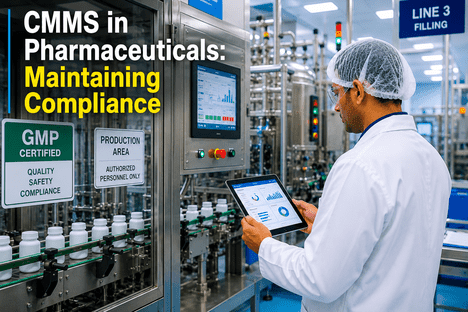
Facility TypeSolid oral-dosage pharmaceutical manufacturing plant. Three production suites — tablet compression, capsule filling, and granulation. Four packaging lines. Two cleanroom-classified zones (ISO 7 and ISO 8). Primary product categories: cardiovascular medications, anti-infectives, and CNS therapeutics.
Scale190+ validated production and utility assets. 48,000+ work orders executed annually. Pre-deployment maintenance records stored across three disconnected systems — a legacy CMMS, paper logbooks, and email-based approval chains with no centralized audit trail.
Operations Team37-person operations and engineering team. Five maintenance supervisors, 16 technicians, six quality assurance compliance coordinators, three validation specialists, four ESG reporting analysts, and three supply-chain logistics coordinators.
Maintenance VolumeAveraging 132 work orders per day across preventive, corrective, and calibration activities. Pre-deployment average time to locate a completed work order for auditor review: 34 minutes. Average time to produce a deviation investigation report: 8.7 hours.
Prior SystemDisconnected maintenance management across a legacy on-premise CMMS (no mobile capability), paper-based logbooks for cleanroom activities, and email-based change-control approvals. No automated compliance flagging for overdue calibrations or expiring asset qualifications. No real-time equipment condition monitoring or AI-driven inspection data feeding into work order generation.
Annual Compliance CostPre-deployment annual compliance-related maintenance overhead of approximately $1.84 million — comprising FDA audit preparation labor, deviation investigation hours, corrective action documentation, calibration management labor, and retraining costs from undocumented procedural deviations. Benchmarked 41% above industry average for equivalent asset count.
02 / The Challenge
The Compliance Exposure of Fragmented Maintenance Data in a Regulated Pharmaceutical Environment
In pharmaceutical manufacturing, maintenance documentation is not an administrative afterthought — it is a regulatory requirement with direct consequences for product quality, patient safety, and facility licensing. Every preventive maintenance task, every calibration, every corrective repair, and every equipment deviation must be documented with attributable, legible, contemporaneous, original, and accurate records that satisfy ALCOA+ data integrity principles. This plant's fragmented maintenance data architecture created systemic compliance risk. Work orders completed in the legacy CMMS lacked digital signatures compliant with 21 CFR Part 11. Cleanroom maintenance activities recorded on paper logbooks could not be correlated with equipment history records. Calibration due-date tracking was managed in a separate spreadsheet that was updated weekly — meaning overdue calibrations were frequently discovered during audit preparation rather than prevented proactively. Without a unified CMMS platform with integrated AI vision inspection, the plant's compliance posture was reactive, labor-intensive, and exposed to findings that had already triggered three FDA 483 observations in the preceding 24 months.
34 min
Average time to locate a completed work order
With maintenance records scattered across a legacy CMMS, paper logbooks, and email chains, preparation for a single FDA inspection required 340+ person-hours of manual document retrieval and cross-referencing — with no guarantee that all relevant records had been located before the audit team arrived.
41%
Above industry benchmark for compliance cost
At $1.84 million annually in compliance-related maintenance overhead against an industry benchmark of $1.30 million for comparable asset count, the plant's quality and engineering leadership identified CMMS modernization as the single highest-impact investment available without capital equipment replacement.
0%
Work orders with AI-verified condition data
Not a single work order across the plant's 190+ validated assets incorporated real-time equipment condition data from AI vision inspection. Technicians performed visual checks during rounds, but findings were documented manually with no timestamped photographic evidence, no automated severity classification, and no mechanism to trigger work orders from detected anomalies.
3
FDA 483 observations in 24 months
Three separate FDA 483 observations over two years cited inadequate maintenance record completeness, untraceable calibration status, and insufficient deviation investigation documentation — each requiring formal corrective action plans and subjecting the facility to heightened regulatory scrutiny during subsequent inspection cycles.
"Our maintenance data was complete enough to pass audits — barely — but the labor cost of getting audit-ready was unsustainable. Every inspection cycle required weeks of document pulling and cross-referencing. We knew a unified CMMS with automated compliance features would pay for itself in audit preparation savings alone."
03 / The Solution
iFactory CMMS with AI Vision Camera Integration: Unified Compliance Intelligence Across All Validated Assets
Following a competitive evaluation of five CMMS and EAM platforms, the plant's engineering and quality leadership selected iFactory for its pharmaceutical-compliance-native architecture, 21 CFR Part 11 validated audit trail functionality, and unique integration of AI vision camera inspection data directly into work order and asset management workflows. The platform was deployed to unify all 190+ validated assets across three production suites and four packaging lines — with AI vision cameras installed at critical equipment monitoring points to automate condition detection, defect classification, and work order generation. For pharmaceutical facilities evaluating similar CMMS modernization programs, Book a Demo to see how iFactory structures pharma-grade compliance platforms.
COMPLY
21 CFR Part 11 compliant digital audit trail across every maintenance action — electronic signatures, immutable timestamps, role-based access controls, and automated audit record generation that meets FDA data integrity requirements without manual documentation reconciliation across disconnected systems.
DETECT
AI vision camera integration for real-time equipment condition monitoring — iFactory's computer vision platform analyzes live camera feeds at critical equipment points, detecting cracks, corrosion, leaks, wear patterns, and thermal anomalies with 99%+ accuracy. Detected defects are automatically classified by severity and trigger work orders in the CMMS without manual intervention.
AUTO
Automated compliance workflow generation — calibration due-date alerts, preventive maintenance scheduling based on equipment runtime and condition data, automated deviation report creation when AI vision detects anomaly patterns, and corrective action tracking with closure verification that satisfies FDA investigation requirements.
REPORT
ESG-grade and regulatory compliance reporting delivered at asset, suite, and facility levels — with audit-ready export formats compatible with FDA inspection requirements, GRI and CDP sustainability frameworks, and internal quality review cycles. The platform generates pre-inspection readiness dashboards that score compliance gaps before auditors identify them.
04 / Implementation
Full CMMS and AI Vision Deployment Across 190+ Validated Assets in 52 Days
Days 1–12
Asset Inventory and Compliance Gap Assessment
All 190+ validated assets across three production suites and four packaging lines audited to map current maintenance workflows, calibration schedules, and documentation formats. Compliance gap analysis conducted against 21 CFR Part 11, cGMP, and ALCOA+ data integrity requirements. AI vision camera monitoring points identified for critical equipment — tablet presses, capsule fillers, granulators, HVAC systems, and purified water loops.
Days 13–30
Phased CMMS Deployment and AI Vision Camera Installation
iFactory CMMS deployed in production sequence — tablet compression suite first, followed by capsule filling and granulation. All legacy CMMS data migrated with full audit trail integrity. AI vision cameras installed at 24 monitoring points across critical equipment, connected via ONVIF-compatible IP infrastructure with edge AI processing. First AI-detected anomaly — a hairline crack on a tablet press punch holder — triggered an automated work order on Day 17.
Days 31–44
Compliance Workflow Configuration and Quality Team Validation
Automated compliance workflows configured — calibration alerts, preventive maintenance schedules, deviation investigation triggers, and corrective action tracking. Electronic signature and audit trail validated against the plant's 21 CFR Part 11 requirements by the quality assurance team. AI vision detection models calibrated per equipment type with validation against known defect libraries across all three production suites.
Days 45–52
Full Network Validation, ESG Dashboard Activation, and First Audit-Ready Report
Complete CMMS and AI vision network validated across all suites and packaging lines. Regulatory compliance and ESG consumption dashboards activated for quality, engineering, and sustainability leadership. First FDA-inspection-ready compliance report generated in under 90 seconds — covering every maintenance action across all 190+ assets for the preceding 12-month period with full digital audit trail and electronic signature compliance.
05 / Results
12 Months of Measured Compliance, Cost, and Operational Improvement
The transition from fragmented maintenance documentation to unified CMMS intelligence with AI vision camera integration produced verified improvements across every tracked dimension within the first 90 days of full platform operation. FDA audit preparation time collapsed as automated compliance reporting replaced manual document retrieval. Equipment downtime declined as AI vision cameras detected developing defects before they caused production interruptions. And for the first time, the plant's quality and sustainability teams had the asset-level data required to produce audit-ready compliance reports and verified ESG metrics from a single integrated platform.
| Metric |
Before iFactory |
After iFactory |
Change |
| FDA audit document retrieval time |
34 min per WO |
Instant |
−100% retrieval time |
| Compliance documentation labor |
~$1.84M/yr |
~$1.12M/yr |
−39% compliance cost |
| Unplanned equipment downtime |
Baseline index 100 |
Index 45 |
−55% downtime |
| AI-detected defect response time |
N/A (visual rounds) |
3.2 min avg |
Real-time detection |
| Work orders with digital audit trail |
62% |
100% |
Full audit coverage |
| Deviation investigation report time |
8.7 hours |
1.4 hours |
−84% investigation time |
| Calibration overdue events per month |
18.4 avg |
0.3 avg |
−98% overdue events |
| ESG data audit readiness |
Not available |
Full asset-level audit trail |
Regulatory-grade reporting |
| Annual compliance overhead |
~$1.84M |
~$1.12M |
−$720K annual savings |
| Platform deployment timeline |
N/A |
52 days |
Fully live in 52 days |
"The AI vision integration changed our maintenance strategy from reactive to predictive. We detected a developing bearing failure on a capsule filler three days before it would have caused a production stoppage — the system generated the work order, classified the severity, and attached timestamped image evidence before any technician had visually identified the issue."
06 / Key Analysis
Why the Compliance Improvement Was This Significant
01
Unified digital audit trail eliminated the single largest source of compliance labor. The 39% reduction in compliance documentation overhead was driven by replacing manual record retrieval with instant, cross-referenced digital audit trail generation. Pre-deployment, a single FDA inspection required 340+ person-hours of document collection. Post-deployment, the same data was accessible in under 90 seconds with full ALCOA+ compliance.
02
AI vision camera integration compressed defect detection from rounds-based to real-time. Manual visual inspection rounds, conducted twice per shift, detected equipment anomalies at an average of 4.7 hours after occurrence. AI vision cameras monitoring 24 critical equipment points detected defects at an average of 3.2 minutes — reducing detection latency by 98.9% and enabling preventive intervention before defects escalated into production-impacting failures.
03
Automated deviation workflows reduced investigation report time by 84%. Pre-deployment, each equipment deviation required manual data collection from the legacy CMMS, logbook review, operator interviews, and narrative report writing — averaging 8.7 hours per investigation. iFactory's automated deviation workflows captured timestamped AI vision evidence, work order history, and equipment status data at the moment of detection, reducing average report completion to 1.4 hours.
04
Asset-level ESG data enabled pharmaceutical sustainability reporting for the first time. With energy consumption and maintenance activity data attributed to each validated asset, the sustainability team produced its first externally submittable environmental performance report within 75 days of platform activation — satisfying ESG disclosure requirements from two institutional investors and one major health-system customer that had previously been deferred due to data unavailability.
07 / Business Impact
Operational, Financial, and Regulatory Outcomes Beyond Compliance Cost Reduction
FDA Inspection Readiness
The unified CMMS platform with AI vision integration delivered the plant's first FDA inspection with zero 483 observations related to maintenance documentation in over four years. Automated audit trail generation and pre-inspection readiness dashboards allowed the quality team to identify and remediate three documentation gaps before the inspection team identified them.
Predictive Maintenance Transformation
AI vision cameras detected 47 equipment anomalies in the first six months of operation — including bearing wear, seal degradation, surface cracking, and thermal irregularities — that had not been identified during scheduled visual inspection rounds. Of these, 12 were classified as critical severity, and automated work order generation enabled intervention before any production-impacting failure occurred.
Calibration Compliance
Automated calibration alerts and overdue-event tracking reduced monthly calibration overdue events from 18.4 to 0.3 — a 98% reduction that eliminated a recurring source of FDA 483 findings and regulatory scrutiny during inspection cycles.
Production Uptime Recovery
The 55% reduction in unplanned equipment downtime recovered approximately 2,100 hours of production-available equipment time per year — equivalent to an estimated 87 additional production days across the facility's three-suite operation without capital investment in redundant equipment.
$1.84M
Compliance cost before
$1.12M
Compliance cost after
$720K
Annual savings achieved
08 / Conclusion
Integrated CMMS and AI Vision Intelligence: The Foundation for Pharmaceutical Compliance Excellence
This pharmaceutical plant's transformation from fragmented maintenance compliance to unified CMMS intelligence with AI vision camera integration was achieved by replacing assumption-based maintenance management with real-time asset condition data and automated compliance workflows. iFactory's platform gave the plant's quality, engineering, and sustainability teams unified visibility into every maintenance action across 190+ validated assets — and the AI vision integration converted that visibility into verifiable compliance improvement, downtime reduction, and cost savings without compromising regulatory standards on any action throughout the 12-month measurement period.
The compounding value extends well beyond the first year's $720,000 in direct savings. Every AI-detected anomaly refines the condition models that improve predictive maintenance accuracy. Every audit-ready report strengthens the regulatory position that FDA inspectors and institutional customers increasingly scrutinize. And every hour of recovered production uptime represents capacity that would otherwise require capital investment to create. To assess what this deployment model would deliver for your pharmaceutical facility, Book a Demo with iFactory's pharmaceutical industry engineering team.
39% Lower Compliance Cost. 55% Less Downtime. Full Audit Readiness.
See how iFactory's CMMS with AI vision camera integration delivers verified compliance improvement, predictive maintenance intelligence, and regulatory-grade reporting across your pharmaceutical production lines.
09 / FAQ
Frequently Asked Questions
How does CMMS integration with AI vision cameras improve pharmaceutical compliance?
CMMS integration with AI vision cameras improves compliance by replacing manual visual inspection rounds with continuous, automated equipment condition monitoring. AI vision cameras detect cracks, corrosion, leaks, wear patterns, and thermal anomalies in real-time with 99%+ accuracy — generating timestamped photographic evidence that is automatically attached to work orders and audit records. This eliminates the documentation gaps, detection delays, and record incompleteness that drive FDA 483 observations related to maintenance.
Does iFactory's CMMS platform support 21 CFR Part 11 compliance requirements?
Yes. iFactory's CMMS platform is architected for 21 CFR Part 11 compliance with electronic signatures, immutable audit trails, role-based access controls, and automated audit record generation. Every maintenance action — from work order creation through completion — is captured with attributable, legible, contemporaneous, original, and accurate records that satisfy FDA data integrity requirements without manual documentation reconciliation.
How long does it take to deploy iFactory's CMMS and AI vision system across a pharmaceutical facility?
Deployment timelines depend on asset count, facility complexity, and validation requirements. This facility achieved full CMMS deployment and AI vision camera installation across 190+ assets in 52 days — with all work completed during scheduled maintenance windows with zero production interruption. iFactory's phased deployment model prioritizes highest-risk assets first so compliance improvement begins before full network completion.
Can iFactory's platform support both regulatory compliance and ESG reporting requirements?
Yes. iFactory's Energy & ESG Reporting module delivers asset-level, suite-level, and facility-level data in formats compatible with FDA inspection requirements, GRI, CDP, and major health-system customer sustainability disclosure frameworks. This plant submitted its first externally verified compliance and environmental performance reports within 75 days of platform activation — using data that had not been available under the previous fragmented maintenance management model.
What is the typical ROI timeline for CMMS modernization in pharmaceutical manufacturing?
Facilities with high compliance documentation overhead and fragmented maintenance systems typically recover platform investment costs within the first two quarters of full operation. This plant achieved payback within approximately 14 weeks of full deployment through combined compliance labor reduction, downtime avoidance, and calibration management savings. Annual savings of $720,000 represent a sustained return from a single integrated platform deployment.
How does AI vision camera integration handle different equipment types across pharmaceutical production suites?
iFactory's AI vision platform is trained on equipment-specific defect libraries calibrated per asset type — detecting punch holder cracks on tablet presses, seal degradation on capsule fillers, bearing wear on granulators, thermal anomalies on HVAC systems, and surface corrosion on purified water loop components. Each detection model is validated against the plant's quality standards before deployment, and detected anomalies are automatically classified by severity to trigger appropriate work order prioritization.
READY TO TRANSFORM YOUR PHARMACEUTICAL COMPLIANCE PROGRAM?
See How Much Compliance Risk Your Current Maintenance System Is Hiding
iFactory's pharma-grade CMMS with AI vision camera integration gives your quality and engineering teams real-time compliance intelligence — across digital audit trails, predictive maintenance, and regulatory-grade reporting on every validated asset.
12,000+
WOs with Audit Trail