Implementing a Computerized Maintenance Management System is one of the highest-leverage operational decisions an industrial facility can make in 2026—but industry research consistently shows that 60 to 80 percent of CMMS rollouts underperform or stall entirely within the first year. The problem is never the software. It is almost always the approach: data entered without governance, technicians trained without context, pilots skipped in favor of big-bang go-lives, and success metrics defined too late to course-correct. A structured, phase-by-phase implementation—built around clean asset data, role-specific training, IoT sensor integration, and AI-powered predictive capability—is what separates facilities that transform their maintenance operations from those that return to spreadsheets within six months. To see how iFactory's CMMS platform, connected to AI vision cameras and IoT sensor networks, accelerates implementation and delivers measurable ROI within 90 days, Book a Demo with our platform engineering team.
Why Most CMMS Implementations Fail Before They Start
The Four Mistakes That Derail 60% of Industrial CMMS Deployments
The uncomfortable reality of CMMS adoption in 2026 is that the technology itself is rarely the limiting factor. Modern platforms—particularly those with IoT integration and AI-powered analytics—are more capable and easier to configure than at any point in the history of industrial software. The failure modes are organizational and procedural: teams go live without cleaning asset data first, producing a system polluted with duplicate records and inconsistent naming conventions from day one. Technicians receive identical training regardless of their role, leaving shift supervisors with skills they cannot use and reliability engineers without the analytical depth the system provides. Pilots are skipped in favor of facility-wide rollouts that create too much disruption to be corrected gracefully. And success metrics are defined retrospectively, after go-live, when baselines are no longer measurable. Understanding these failure modes is the prerequisite to avoiding them.
The 8-Step CMMS Implementation Framework
A Phase-by-Phase Roadmap From Business Case to Continuous Optimization
IoT and AI Vision Integration: The Capability That Defines Modern CMMS
Why Sensor-Connected Work Orders Are the Standard, Not the Future
A CMMS configured without IoT sensor integration operates as a sophisticated work order tracker—useful, but operating at roughly 30% of its potential value. The remaining value is unlocked when every sensor reading, vision camera detection, and production process event is connected to the work order management layer. In iFactory's implementation framework, IoT and AI vision integration is not a phase-two enhancement; it is built into Step 05 of the initial deployment sequence, ensuring that predictive maintenance capability is operational before the system goes live at full scale.
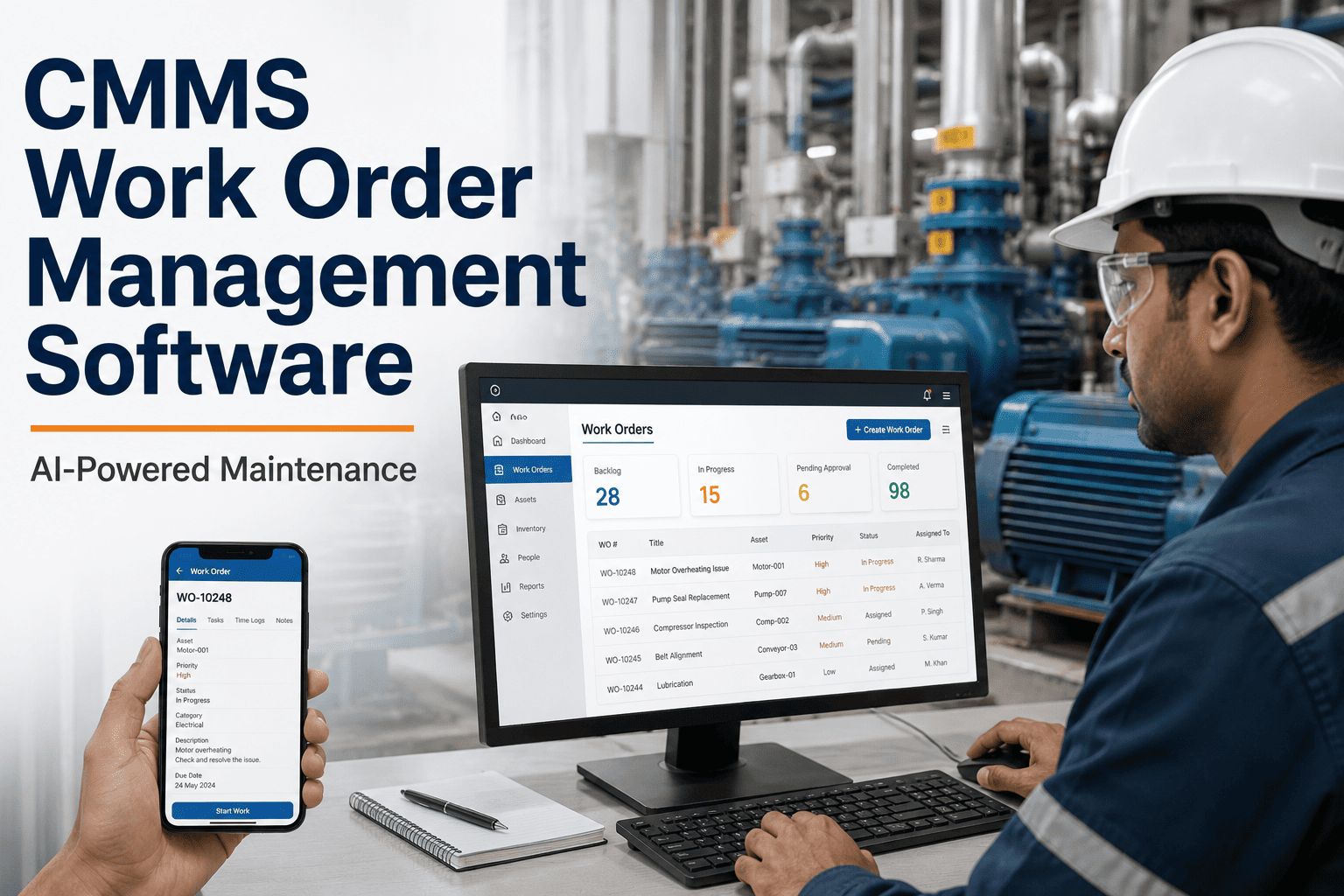
iFactory's AI vision cameras, deployed at critical inspection points across the production environment, continuously analyze surface quality, component alignment, and process conformance. When the vision system detects an anomaly—a surface defect on a casting, a misaligned component in a rolling mill, an abnormal wear pattern on a conveyor—it generates a work order automatically, with the detection timestamp, asset location, and defect image pre-attached. The technician receives a fully documented work order on their mobile device before the fault has been manually observed by any human inspector. This is not process automation layered on top of CMMS—it is the operational definition of predictive maintenance at industrial scale. To see iFactory's AI vision and CMMS integration in a live facility environment, Book a Demo with our platform team.
| Implementation Phase | Timeline | Primary Deliverable | Key Risk if Skipped | ROI Indicator |
|---|---|---|---|---|
| Business Case & Metrics | Week 1–2 | Baseline KPIs documented | No measurable ROI narrative | Foundation for all measurement |
| Asset Hierarchy & Data Cleanse | Week 2–5 | Structured, validated asset register | Permanently corrupted analytics | Data quality score vs. legacy |
| Workflow & PM Configuration | Week 4–6 | Work order templates and PM schedules | PM compliance gaps persist | PM compliance rate improvement |
| IoT and AI Vision Integration | Week 5–8 | Sensor-to-work-order automation live | Predictive maintenance impossible | Alert-to-intervention lead time |
| Training & Pilot | Week 7–10 | Role-trained users, pilot validation | Low adoption, system abandoned | Work order digital closure rate |
| Full Rollout | Week 10–16 | All departments live on CMMS | Siloed adoption by department | Planned vs. unplanned ratio |
| Continuous Optimization | Month 4 onward | KPI trending, ML model maturation | Platform value plateaus | Maintenance cost per production unit |
Change Management: The Implementation Layer That Determines Adoption
Why Technician Buy-In Is the True Critical Path
Change management is not a soft element of CMMS implementation—it is the implementation. A perfectly configured system that nobody uses is operationally worse than a spreadsheet that everybody updates, because the spreadsheet at least captures real data. The facilities that achieve 85%+ CMMS adoption within 90 days share a consistent set of practices that have nothing to do with software configuration and everything to do with how the change is communicated, demonstrated, and reinforced.
CMMS Implementation for Energy Management and OEE Improvement
How a Structured Deployment Supports Sustainability, OEE, and Compliance Goals
A CMMS implemented with IoT sensor integration and AI-powered analytics does more than manage work orders—it becomes the operational data foundation for energy management, overall equipment effectiveness (OEE) improvement, and environmental compliance. When asset health data, production context, and maintenance event history are unified in a governed data layer, the CMMS produces insights that drive decisions at every organizational level: from the technician on the shop floor to the energy manager optimizing utility consumption to the operations director benchmarking OEE across production lines.
Energy management benefits emerge directly from sensor integration. When a motor's current draw is monitored continuously and correlated with production load, anomalous energy consumption patterns—indicating bearing friction, misalignment, or hydraulic inefficiency—are detectable weeks before they manifest as failures. Correcting these conditions in their early stages reduces energy waste and prevents the far higher cost of emergency repair. OEE improvement follows from the shift away from reactive maintenance: every unplanned downtime event captured in the CMMS with a failure code and root cause attribution becomes a data point that drives PM schedule optimization. Over 12–18 months of structured data accumulation, the planned-to-unplanned maintenance ratio improves measurably, and OEE trends upward as the frequency of production-interrupting failures declines.
Conclusion
Implementing a CMMS in 2026 is not a technology project—it is an operational transformation that determines the quality of every maintenance decision made in your facility from go-live forward. The step-by-step framework is clear: define measurable success criteria before touching software, build a clean asset hierarchy before migrating any data, integrate IoT sensors and AI vision systems before the pilot, train by role rather than by group, run a controlled pilot before full deployment, and measure KPIs against documented baselines from day one. When that discipline is applied consistently across all eight phases, the result is not merely a functioning CMMS—it is a predictive maintenance capability that improves with every confirmed failure event, a work order dataset that trains machine learning models continuously, and an operational intelligence foundation that gives technicians, engineers, operations directors, and executive sponsors the information they need to act before failures occur rather than after.
The facilities that extract the most value from their CMMS investments are those where implementation is treated as an organizational change program—not a software deployment. Data governance, role-specific adoption, executive sponsorship, and IoT integration are not optional enhancements. They are the structural requirements for a platform that pays for itself within the first year and continues compounding value with every year of operation that follows.
Frequently Asked Questions
How long does a full CMMS implementation take for an industrial facility?
A focused pilot covering critical assets is typically operational within 6–10 weeks. Full facility deployment—covering all departments, asset classes, IoT integrations, and enterprise system connectivity—typically takes 4–6 months with a phased approach. Cloud-based platforms with clean, structured asset data can have teams operational within 1–2 weeks for small to mid-sized organizations. The critical path in most implementations is not platform configuration but data readiness: organizations with structured asset registers and documented OPC-UA tag lists deploy significantly faster than those migrating from undocumented legacy systems or paper-based records.
What data do we need to prepare before CMMS implementation begins?
The minimum data preparation required for a successful implementation includes a complete asset register with standardized naming conventions and equipment hierarchies, 12–24 months of historical maintenance records for in-scope assets, current spare parts inventory with part numbers linked to asset classes, OEM maintenance specifications and recommended PM intervals, and current sensor tag lists for assets with existing IoT monitoring. Organizations that invest 2–4 weeks in data preparation before configuration begins consistently complete implementation faster and see analytics value earlier than those who attempt to clean data in parallel with go-live activities.
How does iFactory's AI vision camera integrate with the CMMS work order system?
iFactory's AI vision cameras continuously analyze production environments for surface defects, component misalignment, and process anomalies. When the vision system detects an anomaly, it generates a work order automatically in the CMMS with the detection timestamp, asset location, and defect image pre-attached. The assigned technician receives the fully documented work order on their mobile device before the fault has been observed by any human inspector. This sensor-to-work-order automation eliminates the manual inspection-to-reporting gap that allows defects to propagate undetected and is operational from Step 05 of the iFactory implementation framework.
What is the typical ROI timeline for a structured CMMS implementation?
Organizations that follow a structured, phased implementation approach typically achieve positive ROI within 6–12 months of full deployment. The largest and fastest savings come from the shift away from reactive maintenance—emergency repairs cost 3–5x more than the same work done as planned maintenance. A single prevented unplanned outage on a critical asset can recover the full implementation cost within the first 90 days. Industry benchmarks show an average 20% reduction in total maintenance costs within the first year of structured deployment, with ongoing improvement as predictive models mature on accumulated failure event data.
How do we manage the transition from paper-based or legacy maintenance records to a CMMS?
The transition from paper or legacy systems requires a structured data migration plan rather than a direct transfer. Begin by auditing existing records to identify which historical data is accurate and valuable enough to migrate—typically the most recent 12–24 months of maintenance events for critical assets. Standardize failure codes and asset naming conventions before any data entry begins. Run the CMMS in parallel with existing processes during the pilot phase, allowing the team to validate that the new system captures equivalent operational reality before the legacy system is retired. Discontinue parallel tracking by department after each group achieves 30 days of live operation with acceptable data quality metrics.
Does iFactory's CMMS support sustainability and energy management reporting?
Yes. When iFactory's CMMS is connected to IoT sensor networks monitoring motor current, utility consumption, and process efficiency, the platform produces energy cost per production unit reporting, anomalous energy consumption alerts linked to specific assets and failure modes, and maintenance event correlation with energy waste patterns. Carbon intensity tracking—tCO2 per production unit—is available as a dashboard KPI when energy and production data are unified in the platform's governed data layer. This reporting supports both internal sustainability management objectives and external regulatory disclosure requirements.
What is the minimum historical data required to build predictive maintenance models?
For assets with failure modes that occur multiple times per year—such as bearing degradation, seal wear, or filter fouling—12–18 months of quality sensor data combined with structured failure code history is typically sufficient to build models with meaningful predictive accuracy. For lower-frequency but higher-consequence failures, 3–5 years of historical data may be needed to accumulate enough confirmed failure events for robust model training. Facilities with less than 24 months of unified historical data typically start with threshold-based anomaly detection rather than full machine learning predictive models, then transition as the data lake accumulates sufficient labeled failure history. This phased approach delivers immediate value from day one while building toward more sophisticated predictive capability over time.
How do we measure CMMS implementation success at the executive level?
Executive-level CMMS success reporting should focus on four primary metrics: planned-to-unplanned maintenance ratio (target: 70% planned within 12 months of full deployment); maintenance cost per production unit versus pre-implementation baseline; OEE improvement attributable to reduced unplanned downtime; and cumulative avoided downtime cost versus platform investment. These metrics should be documented against baselines captured before implementation begins and reported to executive sponsors on a monthly cadence from go-live forward. Facilities that build CMMS performance data into existing operational reporting cadences sustain executive engagement and secure the budget for ongoing optimization and platform expansion.