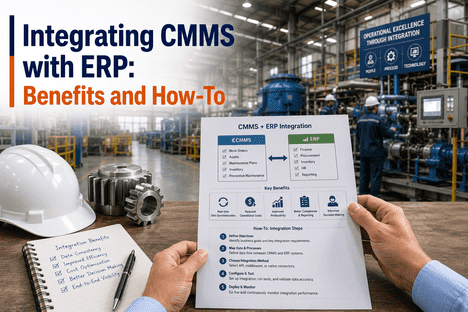
Integrating a Computerized Maintenance Management System (CMMS) with an Enterprise Resource Planning (ERP) system is one of the most impactful digital transformation decisions an industrial organization can make in 2026. In most manufacturing environments, these two systems operate in isolation — the ERP holds financial data, procurement records, and HR information, while the CMMS manages work orders, asset histories, and preventive maintenance schedules. This siloing forces technicians to re-enter data manually, delays cost reporting by days, and prevents leadership from seeing a real-time picture of maintenance performance. iFactory's AI vision camera platform closes the gap further by generating inspection data that feeds directly into both CMMS and ERP workflows — delivering automated, sensor-verified quality records that eliminate the last manual handoff between production, maintenance, and finance.
AI VISION · CMMS INTEGRATION · ERP CONNECTIVITY · INDUSTRY 4.0
See How iFactory's AI Vision Platform Connects CMMS, ERP, and Quality Data in Real Time
iFactory's AI vision camera system generates automated inspection records that integrate directly with your CMMS and ERP — eliminating manual data entry, closing audit gaps, and giving maintenance and finance teams a unified operational view from a single platform.
Why CMMS and ERP Integration Is a Structural Requirement in Industry 4.0
The shift toward Industry 4.0 has fundamentally changed what manufacturers expect from their technology stack. Real-time data visibility, automated decision-making, and cross-system connectivity are no longer optional — they are the baseline expectation for competitive industrial operations. When CMMS and ERP systems run independently, organizations face a persistent data lag problem: maintenance costs take days to reach financial ledgers, spare parts consumed on a work order take hours to update ERP inventory records, and procurement approvals require manual handoffs between departments that should be automated. This structural gap is not a minor inconvenience. It is a measurable drag on asset uptime, inventory accuracy, and financial reporting integrity. Integrating CMMS with ERP removes these manual bridges and creates a continuous data flow where every maintenance event has a corresponding financial, procurement, and asset record updated in real time.
The case for integration has accelerated sharply as AI and IoT adoption have matured. Modern CMMS platforms now receive sensor data from connected equipment and use predictive algorithms to generate work orders before failures occur. For that workflow to deliver its full value, the resulting work order — including parts required, labor estimated, and cost impact — must flow immediately into the ERP for procurement and financial processing. Without integration, the predictive maintenance signal is generated but the organizational response is still manual and delayed. iFactory's AI vision cameras extend this connected data model to production quality: every inspection event becomes a timestamped data record that flows into both the quality module of the CMMS and the financial reporting layer of the ERP simultaneously — without any operator intervention. Manufacturers ready to see this in action can Book a Demo with iFactory's integration specialists.
48 hrs
average delay for maintenance cost data to reach ERP financial reports without integration
30–60%
reduction in manual data re-entry labor after CMMS-ERP integration deployment
2–4 wks
typical CMMS-ERP integration deployment timeline via API for most industrial environments
99.8%
defect detection accuracy achieved when iFactory AI vision feeds quality data into CMMS workflows
Root Cause Analysis
Why CMMS-ERP Data Silos Persist and the Operational Damage They Cause
Despite widespread recognition that disconnected systems reduce operational efficiency, CMMS-ERP data silos remain common across manufacturing, pharmaceutical, food and beverage, and industrial operations in 2026. The root causes are largely organizational and technical — not a lack of awareness. Understanding why these silos persist is the first step to designing an integration approach that actually eliminates them rather than creating a new layer of manual synchronization on top of existing workflows.
01
Duplicate Data Entry Across Disconnected Systems
When CMMS and ERP operate independently, maintenance technicians record parts usage in the CMMS while warehouse staff track the same inventory transaction in the ERP — with no automatic connection between the two records. This duplication creates persistent discrepancies in stock levels, delays procurement decisions, and forces reconciliation exercises at month end that consume hours of administrative time. Every manual re-entry step is also a data quality risk: typos, omissions, and timing gaps between systems produce the kind of data integrity failures that trigger both operational disruptions and regulatory audit findings.
02
Maintenance Costs Invisible to Financial Reporting Until Month End
Without integration, labor hours and parts costs recorded in the CMMS do not flow into ERP financial ledgers until someone manually exports and uploads them — typically on a weekly or monthly basis. This lag means that finance and plant leadership are making capital allocation decisions using maintenance cost data that is already weeks out of date. Equipment that is consuming disproportionate maintenance budget goes undetected until the period-end report, long after the opportunity for early intervention has passed. Real-time cost posting from CMMS work order closures to ERP financial accounts is one of the highest-value outcomes of a properly implemented integration.
03
Procurement Delays Caused by Manual Work Order Handoffs
When a CMMS work order requires a spare part that is not in stock, the current process in most unintegrated environments involves a technician notifying a planner, who then manually creates a purchase requisition in the ERP, which then routes through approval workflows before becoming a purchase order. Each manual handoff adds hours or days to a process that should be automated end-to-end. Integrated CMMS-ERP environments trigger ERP purchase requisitions automatically when a work order is released and the required part falls below reorder threshold — completing the procurement chain without any manual intervention between the maintenance event and the purchasing decision.
04
Quality Inspection Data Isolated from Maintenance and Financial Systems
Production quality data generated during inspection — defect counts, rejection rates, equipment performance indicators — typically lives in a separate quality management system or spreadsheet that neither the CMMS nor the ERP can access in real time. This means that a spike in cosmetic defects caused by a worn tooling component does not automatically generate a CMMS work order for tooling inspection, and the associated scrap cost does not post to the ERP financial account until it is manually entered. iFactory's AI vision cameras solve this specific integration gap by generating structured quality data records that connect directly to CMMS maintenance triggers and ERP cost centers without any manual intervention between inspection and reporting.
Key Benefits
Five Measurable Benefits of Integrating CMMS with ERP
A properly implemented CMMS-ERP integration does more than eliminate manual data entry. It fundamentally changes how maintenance organizations operate — shifting from reactive, paper-based processes to proactive, data-driven asset management with full financial visibility. The following five benefits represent the highest-impact outcomes that industrial operations consistently realize after successful CMMS-ERP integration, particularly when AI-driven inspection data from platforms like iFactory is included in the connected data model. Operations teams ready to map these outcomes to their specific environment can Book a Demo with iFactory's industrial integration team.
01
Real-Time Inventory Synchronization and Procurement Automation
When CMMS work orders consume spare parts, the corresponding inventory deduction updates ERP stock records in real time — eliminating the scenario where the CMMS shows a part as available while the ERP has already flagged it as depleted. Automated reorder triggers flow from CMMS consumption events into ERP purchase requisition workflows without manual intervention, reducing stockout-driven downtime and eliminating over-purchasing caused by inaccurate inventory visibility. Facilities with integrated CMMS-ERP inventory management consistently report a 15–25% reduction in spare parts carrying costs alongside a measurable improvement in first-visit work order completion rates.
02
Automated Maintenance Cost Posting to ERP Financial Ledgers
Every closed CMMS work order carries labor hours, parts cost, and contractor expenses that should flow immediately to ERP cost centers and financial reports. With integration active, this cost posting happens automatically at work order closure — giving finance teams accurate maintenance expenditure data in real time rather than at month end. Budget owners can identify equipment with escalating maintenance costs before they exceed thresholds, allowing proactive capital decisions about repair-versus-replace that were previously impossible to make with timely data. This real-time financial visibility is particularly valuable in asset-intensive industries where maintenance costs represent 15–40% of total operating expenditure.
03
Predictive Maintenance Workflows Triggered by AI and IoT Data
In Industry 4.0 environments, CMMS platforms receive condition data from connected sensors and AI inspection systems and use this data to generate predictive work orders before equipment failures occur. For this capability to deliver its full operational value, the resulting work order — including required parts, estimated labor, and cost impact — must flow into the ERP for procurement and financial processing immediately. iFactory's AI vision cameras contribute to this workflow by detecting early-stage equipment degradation signals in production output quality — surface finish changes, dimensional drift, coating inconsistency — that indicate tooling wear or mechanical deviation before it produces a line stoppage or a batch rejection event.
04
Unified Audit Trail for Regulatory and Compliance Reporting
Regulated industries including pharmaceutical, food and beverage, and medical device manufacturing require complete audit trails linking maintenance activities to production events, quality outcomes, and financial records. A disconnected CMMS-ERP environment cannot produce this unified audit trail because the records exist in separate systems with no verified linkage between them. Integration creates an unbroken chain of evidence: a quality deviation detected by iFactory's AI vision cameras triggers a CMMS work order, the work order closure posts to the ERP financial ledger, and all three events are linked by batch number, timestamp, and asset ID — satisfying regulatory requirements for objective evidence of process control without any manual documentation assembly.
05
Mobile Work Order Access Without Office Visits or Manual Data Entry
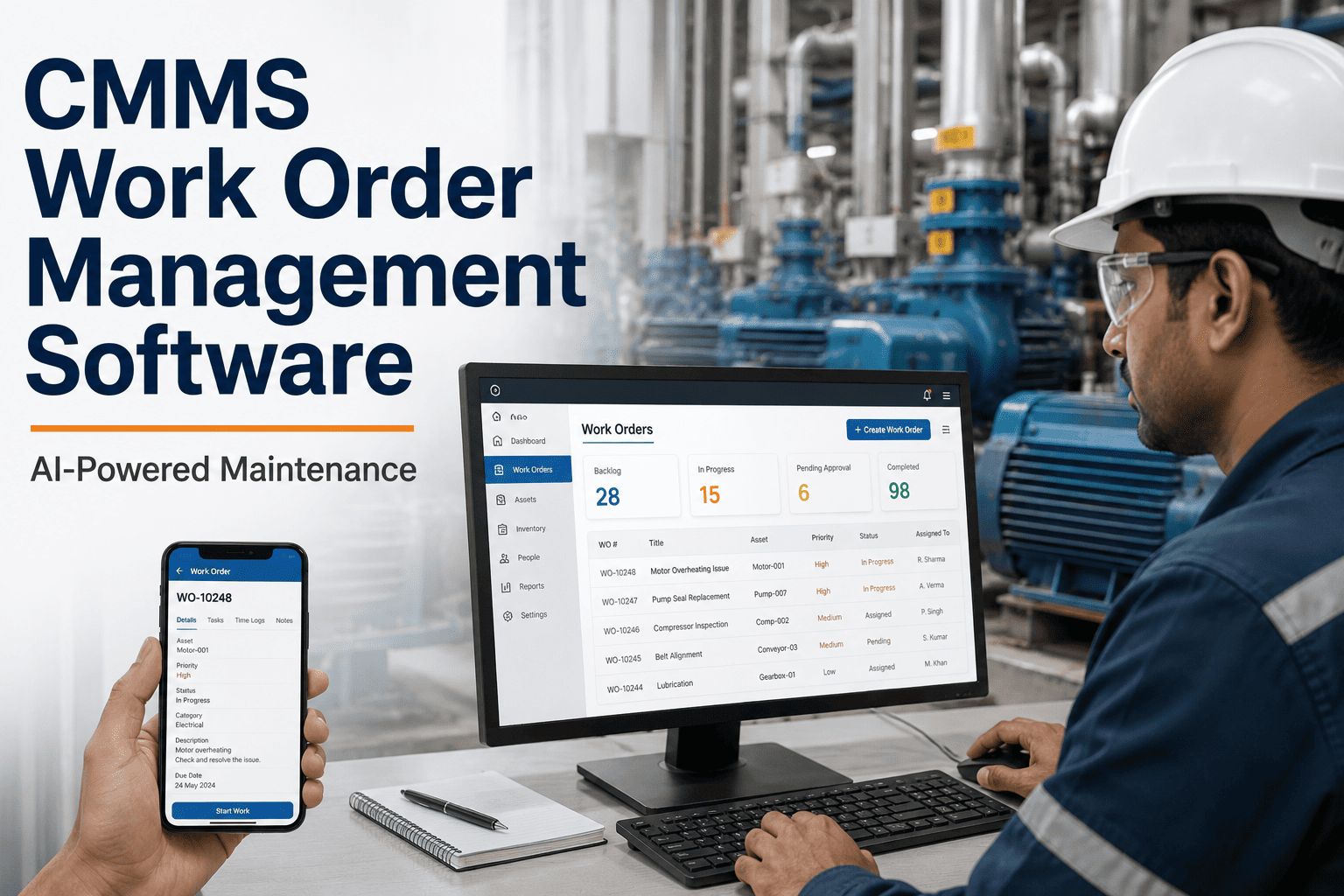
Integrated CMMS-ERP environments allow field technicians to access work orders, complete checklists, record parts usage, and close jobs directly from a mobile device — with every action flowing back to the ERP automatically. Technicians no longer need to return to an office to submit paper job cards or re-enter completion data into a desktop system at the end of a shift. This mobile-first workflow reduces the administrative overhead that pulls technicians away from wrench-time activities, improves data capture accuracy by eliminating transcription delays, and gives supervisors real-time visibility into work order status and technician location across the facility floor.
AI VISION · CMMS DATA · ERP INTEGRATION · QUALITY AUTOMATION
Connect Your CMMS and ERP with AI Vision Quality Data from the Production Line
iFactory's AI vision camera platform generates structured inspection data that integrates directly with your CMMS maintenance workflows and ERP financial systems — delivering real-time quality visibility without manual data entry between production, maintenance, and finance.
Performance Benchmark
CMMS-ERP Integration Performance Comparison — Isolated vs. Connected Operations
The following benchmark compares operational performance metrics for industrial facilities operating with disconnected CMMS and ERP systems versus those with full API-based integration including AI-driven quality data feeds. Performance data reflects outcomes across manufacturing, pharmaceutical, and food and beverage operations where CMMS-ERP integration has been implemented alongside automated inspection platforms.
CMMS-ERP Integration Performance Benchmark — 2026
Integration Architecture
How CMMS-ERP Integration Works: Key Data Flows and Connection Points
Understanding the technical architecture of a CMMS-ERP integration helps operations and IT teams design a connection that eliminates data silos rather than simply adding a new synchronization layer on top of existing manual processes. The following primary data flows represent the integration points that deliver the highest operational value across most industrial environments, with iFactory's AI vision platform contributing quality inspection data as an additional real-time input to the connected system. Teams seeking a technical walkthrough of how iFactory's inspection data integrates with their specific CMMS and ERP configuration can Book a Demo with iFactory's integration team.
Work Order to Financial Cost Center Posting
When a CMMS work order is closed, labor hours, parts costs, and contractor expenses are automatically posted to the corresponding ERP cost center or asset account. This eliminates the manual export-and-upload process that delays cost visibility by days or weeks. Finance teams see accurate maintenance expenditure in real time, and budget variance alerts can be configured to trigger automatically when individual assets exceed monthly maintenance thresholds — enabling proactive capital decisions before costs escalate further.
Parts Consumption to ERP Inventory Deduction
Every spare part consumed on a CMMS work order triggers an automatic inventory deduction in the ERP system, keeping stock levels synchronized across both platforms in real time. When inventory falls below reorder point, the ERP generates a purchase requisition automatically and routes it through the established approval workflow. This bidirectional inventory sync prevents the stockout-versus-overstock imbalances that result from two systems independently tracking the same physical inventory without communicating with each other.
AI Vision Quality Data to CMMS Maintenance Triggers
iFactory's AI vision cameras detect production quality deviations — surface defects, dimensional inconsistencies, coating failures — that indicate underlying equipment wear or process drift. These inspection events flow directly into the CMMS as condition-based maintenance triggers, generating work orders for tooling inspection, calibration checks, or equipment adjustment before the degradation produces a batch rejection or line stoppage. This connection between quality inspection data and predictive maintenance workflows represents one of the highest-value integration points available in modern Industry 4.0 manufacturing environments.
ERP Procurement Status Back to CMMS Parts Availability
Integration is bidirectional: when the ERP processes a purchase order and receives a delivery confirmation, the updated inventory availability is pushed back to the CMMS so maintenance planners see accurate parts availability when scheduling upcoming work orders. This closed-loop procurement visibility prevents the common planning failure where a work order is scheduled based on expected parts availability, only to be delayed because the delivery status was never reflected in the CMMS. Planners working from accurate ERP-sourced inventory data consistently achieve higher first-visit completion rates and shorter mean time to repair across their asset populations.
Implementation Roadmap
How to Integrate CMMS with ERP: A Phased Implementation Approach
A successful CMMS-ERP integration requires a structured, phased approach that starts with the highest-value data flows, validates them before expanding scope, and includes a clear plan for incorporating AI-driven quality data sources. The following roadmap reflects integration patterns validated across industrial operations ranging from single-site manufacturers to multi-plant enterprises with complex ERP environments including SAP S/4HANA, Oracle, and Microsoft Dynamics.
Phase 1
Data Flow Mapping and Integration Specification (Weeks 1–3)
Identify every point where data currently moves manually between CMMS and ERP — every re-entry, every export, every email handoff between maintenance and procurement or finance. Quantify the volume and frequency of each manual transfer to prioritize integration scope by operational impact. Map the data fields, formats, and validation rules that each system uses for shared data types including asset IDs, cost centers, parts numbers, and work order codes. This specification becomes the technical blueprint for the API integration design and the acceptance criteria for integration testing in Phase 2. Include AI vision data sources — such as iFactory's inspection platform — in the integration specification to ensure quality event data is connected from the outset rather than retrofitted later.
Outcome: Integration data map, prioritized workflow list, technical specification document
Phase 2
Pilot Integration on Highest-Value Data Flow (Weeks 4–10)
Deploy the integration on a single bidirectional data flow — typically work order cost posting to ERP financial ledgers or spare parts consumption to ERP inventory deduction — and validate end-to-end data accuracy before expanding scope. Run the integrated and manual processes in parallel for two to four weeks to confirm that the automated data flow matches the manual records in every case. Establish exception handling procedures for data validation failures and configure alerting for synchronization errors that require human review. Once the pilot data flow is validated and operating reliably, the configuration template becomes the standard for all subsequent integration points added in Phase 3.
Outcome: Validated pilot integration, exception handling procedures, expansion-ready configuration template
Phase 3
Full Integration Rollout Including AI Vision Quality Data (Weeks 11–20)
Expand integration to all remaining data flows identified in Phase 1, including procurement automation, mobile work order access, and asset condition data from IoT sensors and AI vision inspection systems. Activate iFactory's AI vision camera integration to connect production quality events to CMMS maintenance triggers and ERP scrap cost accounts in real time. Configure continuous process verification dashboards that draw on live data from both CMMS and ERP to give operations leadership a unified view of asset performance, maintenance cost trends, and quality outcomes across all production lines. Conduct a mock regulatory audit using the integrated system's unified audit trail to confirm compliance readiness before the next scheduled external inspection.
Outcome: Full CMMS-ERP-AI vision integration active, unified reporting live, audit trail verified
Frequently Asked Questions
CMMS and ERP Integration — Frequently Asked Questions
What is the difference between CMMS and ERP, and why do they need to be integrated?
A CMMS is purpose-built for maintenance operations — managing work orders, asset histories, preventive maintenance schedules, and technician workflows. An ERP manages the broader business: finance, procurement, HR, and supply chain. They need to be integrated because maintenance activities generate financial costs, consume inventory, and trigger procurement events that must be reflected in the ERP to give leadership an accurate operational picture. Without integration, both systems hold partial data and neither can provide a complete view of asset performance or maintenance cost.
How does AI vision camera data connect to CMMS and ERP systems?
iFactory's AI vision cameras generate structured inspection records for every unit inspected — including defect type, severity, timestamp, and production batch linkage. These records flow into the CMMS as condition-based maintenance triggers when defect patterns indicate equipment wear, and into the ERP as scrap cost postings when rejections affect batch yield. This connection between production quality data and maintenance and financial systems creates a closed-loop improvement cycle that disconnected quality inspection systems cannot deliver.
How long does a CMMS-ERP integration typically take to implement?
Most API-based CMMS-ERP integrations targeting the primary data flows — cost posting, inventory synchronization, and procurement automation — complete within two to four weeks for a pilot deployment on a single data flow. Full enterprise rollout covering all integration points typically takes twelve to twenty weeks depending on the complexity of the ERP environment, the number of production sites, and whether AI vision quality data sources are included in the integration scope.
Does CMMS-ERP integration require replacing either existing system?
No. CMMS-ERP integration operates above both existing systems via API connections — the CMMS continues to manage maintenance execution and the ERP continues to manage financial and procurement operations. The integration layer creates automated data flows between them without requiring either system to be replaced, reconfigured, or taken offline. iFactory's AI vision platform follows the same non-disruptive integration model, connecting to existing CMMS and ERP infrastructure via standard APIs without requiring changes to established workflows in either system.
What ROI should manufacturers expect from CMMS-ERP integration?
Industrial manufacturers typically achieve measurable ROI from CMMS-ERP integration within six to twelve months through reductions in manual data entry labor, improved spare parts inventory accuracy, faster procurement cycle times, and better maintenance cost visibility enabling earlier corrective action. Facilities that include AI vision quality data in the integration scope — connecting inspection outcomes to CMMS maintenance triggers — report additional ROI through avoided batch rejections, reduced rework costs, and lower recall liability across their production operations.
How does CMMS-ERP integration support predictive maintenance programs?
Predictive maintenance programs depend on condition data from sensors and inspection systems flowing into the CMMS to generate work orders before failures occur. For those work orders to trigger procurement and financial actions immediately, the CMMS must be integrated with the ERP. Without this connection, a predictive work order is generated in the CMMS but the corresponding parts request and cost estimate sit in an isolated system until someone manually transfers them — defeating the speed advantage that predictive maintenance is supposed to deliver. iFactory's AI vision platform strengthens predictive programs further by contributing production quality data as an additional condition signal that indicates equipment degradation before it is detectable through traditional sensor channels. Manufacturers ready to explore this capability can
Book a Demo with iFactory's team.
AI VISION CAMERAS · CMMS INTEGRATION · ERP CONNECTIVITY · 2026
Add AI Vision Quality Data to Your CMMS-ERP Integration and Close the Last Data Gap
iFactory's AI vision camera platform generates structured, timestamped inspection records that connect directly to your CMMS maintenance workflows and ERP financial systems — delivering the real-time quality visibility that completes your Industry 4.0 data architecture.