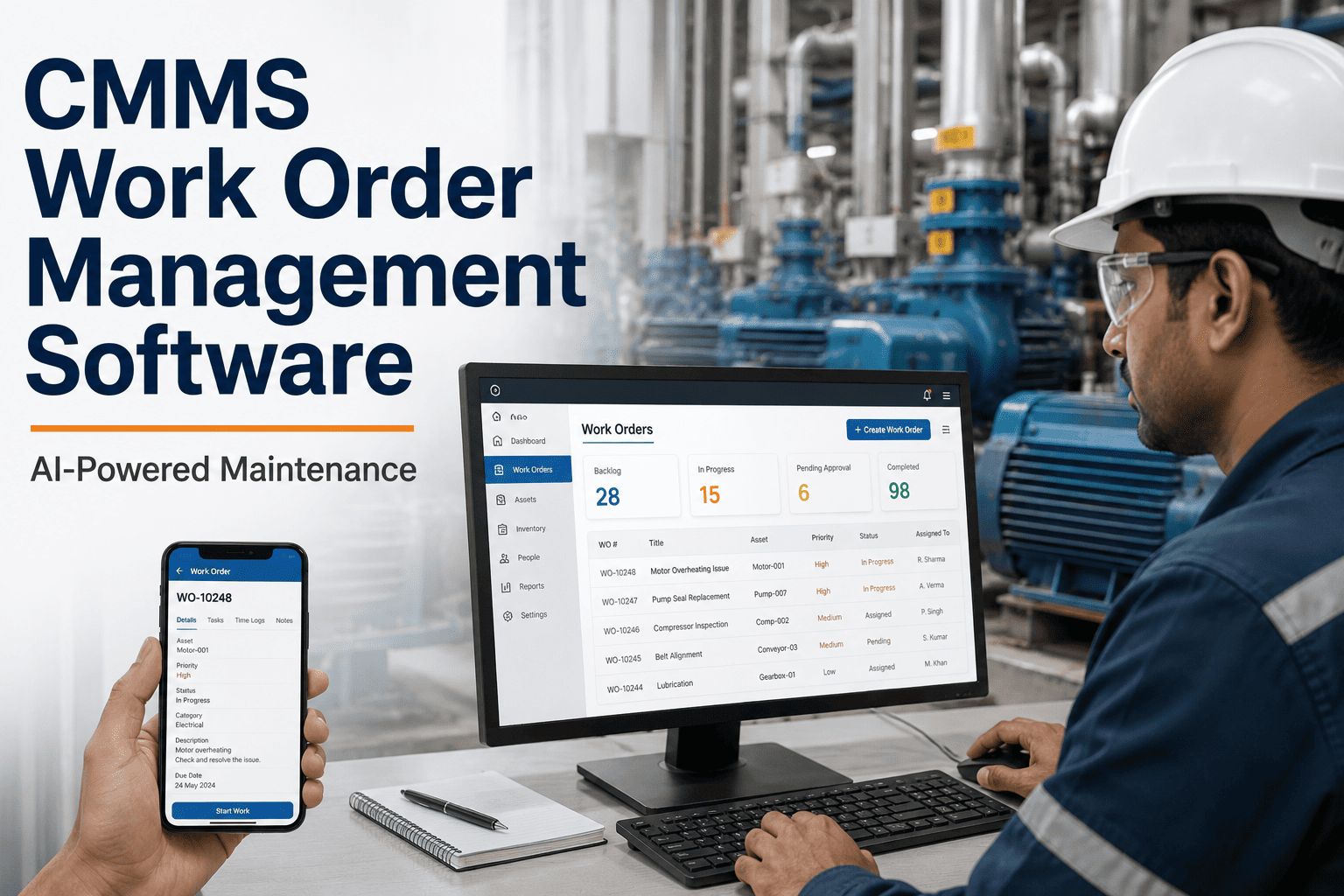
Modern industrial operations are generating more asset health data than ever before — vibration signatures, temperature trends, ultrasonic readings, oil particle counts, and motor current analysis flowing continuously from thousands of sensors across every plant floor. Yet for most organizations, this condition monitoring data exists in a silo, disconnected from the Computerized Maintenance Management System (CMMS) where work orders are planned, technicians are dispatched, and maintenance history is recorded. Bridging that gap — integrating condition monitoring data directly into the CMMS — is the defining maintenance technology challenge of Industry 4.0, and the organizations that solve it are achieving measurable gains in asset availability, maintenance cost reduction, and overall equipment effectiveness (OEE) that competitors relying on manual inspection cycles simply cannot match.
Ready to Connect Your Condition Monitoring Data to Smarter Maintenance Decisions?
iFactory's AI vision platform captures real-time asset health signals and pushes actionable alerts directly into your maintenance workflow — closing the gap between sensor data and work order execution.
Why Integrating Condition Monitoring Data into CMMS Is a 2026 Priority
Condition monitoring and CMMS have historically operated as parallel, non-communicating systems. Condition monitoring platforms — whether vibration analyzers, thermal imagers, or acoustic emission detectors — capture real-time signals about asset health. CMMS platforms manage the maintenance response: scheduling PMs, issuing work orders, tracking parts inventory, and recording labor time. The problem is that when these systems don't talk to each other, the intelligence gathered by condition monitoring never reliably triggers the maintenance action it should.
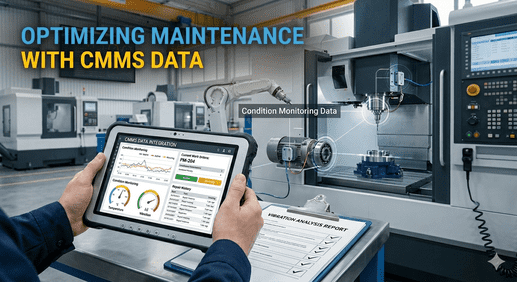
In practice, this disconnect means a vibration analyzer may flag an imminent bearing failure at 2:00 AM, but that alert sits in a monitoring dashboard until a technician manually reviews it during a morning walkthrough — hours or days later. By then, secondary damage may have occurred, or the maintenance window may have passed. True integration eliminates this latency: when a condition monitoring sensor crosses a threshold that indicates impending failure, the CMMS automatically generates a prioritized work order, assigns it to the appropriate technician, flags the required spare parts, and logs the anomaly to the asset's maintenance history. The result is a closed-loop predictive maintenance system that responds in minutes, not days.
Closed-Loop Work Order Automation
Condition alerts automatically trigger CMMS work orders without human intervention, dramatically reducing the time between anomaly detection and maintenance response.
Asset Health Dashboards
Unified dashboards combine live sensor readings with historical maintenance records, giving reliability engineers a complete view of every asset's condition and care history.
IoT-Driven Preventive Maintenance
Integration enables condition-based PM triggers that replace fixed-interval schedules, ensuring maintenance happens when data says it's needed — not by the calendar.
AI-Powered Failure Prediction
Machine learning models trained on combined condition and maintenance history data predict failure windows weeks in advance, enabling planned interventions during scheduled downtime.
What Condition Monitoring Data Actually Includes — and What the CMMS Does With It
To design an effective integration, it is essential to understand both sides of the data exchange. Condition monitoring data encompasses a wide range of physical measurements collected by sensors, inspection tools, and AI vision systems deployed on or near industrial assets. On the CMMS side, this incoming data must be mapped to specific asset records, evaluated against threshold rules, and translated into actionable maintenance records.
| Condition Data Type | Monitoring Technology | CMMS Action Triggered | Maintenance Strategy | Business Impact |
|---|---|---|---|---|
| Vibration Signatures | Accelerometers, FFT Analyzers | Bearing/gear fault work order | Predictive | Critical |
| Thermal Anomalies | AI Vision Camera, IR Thermography | Electrical/mechanical inspection WO | Predictive / CBM | Critical |
| Oil Particle Count | Online Oil Monitors | Lubrication PM task update | Condition-Based | High |
| Motor Current Draw | MCSA Sensors, Energy Meters | Motor health check work order | Predictive | High |
| Visual Defect Detection | iFactory AI Vision Camera | Immediate defect work order + image log | Real-Time CBM | Critical |
| Acoustic Emission | Ultrasonic Detectors | Leak/crack inspection WO | Predictive | High |
Step-by-Step: How to Integrate Condition Monitoring Data into Your CMMS
A successful integration is not a single technology purchase — it is an architectural project that requires careful planning across data infrastructure, business rules, and organizational change management. The following five-step framework reflects best practices drawn from Industry 4.0 implementations across heavy manufacturing, process industries, and energy operations in 2025–2026.
Asset Register Alignment and Tagging
Every condition monitoring data stream must be traceable to a specific asset in the CMMS. Begin by auditing your CMMS asset register to ensure every monitored piece of equipment has a unique asset ID, location hierarchy, and criticality classification. Map each sensor or monitoring point to its corresponding CMMS asset record. Without this foundation, incoming condition data cannot be reliably associated with the correct maintenance history, work order queue, or spare parts inventory — rendering the integration meaningless.
Establish an IoT Data Gateway or Integration Layer
Condition monitoring sensors generate high-frequency, heterogeneous data streams that the CMMS is not designed to ingest directly. An IoT data gateway — or middleware integration layer — normalizes, filters, and contextualizes sensor data before it reaches the CMMS. This layer handles protocol translation (MQTT, OPC-UA, Modbus), engineering unit conversion, data quality filtering, and timestamp synchronization. Modern integration platforms like Azure IoT Hub, AWS IoT Greengrass, and purpose-built industrial iPaaS solutions perform this function, and platforms like iFactory's AI vision system include native data output formats compatible with leading CMMS APIs.
Define Alert Thresholds and Work Order Trigger Rules
The business logic that transforms a sensor reading into a CMMS work order is the most operationally consequential step in the integration. Alert thresholds must be set with input from reliability engineers, equipment OEMs, and maintenance supervisors. For each asset and monitored parameter, define: warning thresholds that generate an inspection notification, critical thresholds that auto-generate a priority work order, and failure thresholds that trigger an emergency shutdown procedure. AI-driven anomaly detection models, such as those embedded in iFactory's platform, can dynamically adjust these thresholds based on operating context — recognizing, for example, that a temperature reading acceptable during a warm summer startup is anomalous under cool overnight conditions.
Configure Bi-Directional Data Flow Between Systems
A fully mature integration is not one-directional. Condition monitoring data flowing into the CMMS to trigger work orders is only half the value. The CMMS must also send feedback back to the condition monitoring platform: when a work order is completed, what was found, what parts were replaced, and whether the root cause matched the anomaly alert. This feedback loop trains the AI models that generate future alerts, improving prediction accuracy over time and building a rich failure-mode library tied to real asset performance history. Most leading CMMS platforms — including IBM Maximo, SAP PM, Infor EAM, and UpKeep — offer REST API endpoints that support this bi-directional exchange.
Validate, Monitor, and Continuously Improve
Post-integration, the system requires active governance to remain effective. Establish a weekly or monthly review of alert-to-work-order conversion rates, false positive rates, and mean time between failure versus prediction. Track OEE improvements attributable to condition-based maintenance interventions. Tune threshold rules based on post-work-order findings, and retrain AI models as new failure modes are documented. Organizations that treat CMMS-condition monitoring integration as a living system — rather than a one-time IT project — consistently outperform those that deploy and forget.
"Organizations that successfully integrate condition monitoring with their CMMS report a 30–40% reduction in unplanned downtime and a 20–25% decrease in total maintenance costs within 18 months of deployment. The key is not the sensors themselves — it is the intelligent connection between what sensors detect and what maintenance teams actually do about it. Closing that gap is where AI and CMMS integration deliver their most measurable ROI."
— Reliability Engineering Strategist, Industrial Technology Review, 2025
How iFactory's AI Vision Camera Powers Real-Time Condition Monitoring for CMMS Integration
iFactory's AI vision camera platform is purpose-built for the condition monitoring use cases that feed directly into CMMS workflows. Unlike traditional sensor-based monitoring that captures only a single physical parameter per channel, computer vision captures the full visual state of an asset — detecting surface defects, misalignments, abnormal operating positions, leak signatures, foreign object contamination, and thermal anomalies simultaneously from a single camera installation. This multi-parameter, image-based condition data can be structured, time-stamped, and pushed to any CMMS via API, enabling the same closed-loop predictive maintenance architecture described above — with photographic evidence automatically attached to every work order generated.
iFactory AI Vision Camera Capabilities Relevant to CMMS Integration
Continuously monitors asset surfaces, conveyor systems, and production lines for visual anomalies — generating structured defect data that maps directly to CMMS asset records and triggers prioritized work orders without manual intervention.
AI models trained for industrial environments detect early-stage thermal signatures of electrical faults, bearing overheating, and structural stress — condition signals that feed predictive maintenance modules in connected CMMS platforms.
iFactory's platform exports structured alert data — asset ID, defect classification, severity level, timestamp, and image evidence — in formats compatible with IBM Maximo, SAP PM, Infor EAM, UpKeep, and custom CMMS environments via REST API.
Vision-based cycle time monitoring and downtime event capture feed OEE calculation engines — providing the asset performance context that makes CMMS maintenance records analytically meaningful for reliability improvement initiatives.
To see how iFactory's AI vision camera integrates with your existing CMMS infrastructure and condition monitoring stack, Book a Demo with our industrial intelligence team.
What CMMS-Condition Monitoring Integration Means for Maintenance Strategy in 2026
The integration of condition monitoring data into CMMS is not merely an IT infrastructure upgrade — it is a fundamental shift in maintenance philosophy, from time-based to evidence-based asset management. Organizations making this transition in 2025–2026 are redefining what best-practice maintenance looks like across every industrial sector.
Integrated systems shift maintenance spend from emergency repairs — which carry a 3–5× cost premium over planned interventions — to condition-triggered predictive actions that are scheduled during planned downtime windows.
Work orders generated by condition data carry asset health context, sensor readings, and photographic evidence — giving technicians the diagnostic information they need before they arrive at the asset, reducing mean time to repair (MTTR).
Every condition-triggered work order completion adds sensor-correlated data to the asset's maintenance history, building a failure-mode library that improves future AI prediction accuracy and informs capital replacement decisions.
Condition monitoring integration surfaces energy consumption anomalies — motors running out of spec, compressed air leaks, inefficient process setpoints — enabling targeted interventions that reduce energy waste and support ESG reporting requirements.
Closed-loop condition-CMMS integration directly improves all three OEE components: availability (less unplanned downtime), performance (fewer speed losses from degraded assets), and quality (defects caught before production runs).
Industries subject to equipment safety regulations — pharmaceutical, food and beverage, aerospace, oil and gas — benefit from the automated audit trails that CMMS-integrated condition monitoring creates, documenting every alert, response, and outcome.
Connect Your Condition Monitoring Data to Your CMMS — Starting Today
iFactory's AI vision camera platform delivers real-time asset condition data in CMMS-ready formats — closing the loop between anomaly detection and work order execution across your entire facility.
The Integration Architecture Stack: From Sensor to Work Order
Understanding the full technology stack that connects condition monitoring sensors to CMMS work orders helps maintenance leaders make informed platform and vendor decisions. Each layer of the stack carries distinct technical requirements and integration considerations that must be addressed during the project scoping phase.
Core Layers of a Condition Monitoring–CMMS Integration Stack
Physical sensors (vibration, temperature, current, acoustic) and AI vision cameras capture real-time asset condition signals. iFactory's AI vision camera operates at this layer, generating structured defect and anomaly data from visual inspection of assets and production lines.
Edge computing nodes perform initial signal processing, anomaly scoring, and data normalization before transmission — reducing bandwidth requirements and enabling sub-second response times for critical alerts that cannot tolerate cloud round-trip latency.
Cloud or on-premise IoT platforms aggregate multi-source condition data, apply machine learning models for failure prediction, and maintain the threshold rule sets that determine when and what type of CMMS action should be triggered.
API-level integration with the CMMS translates condition alerts into structured work orders — pre-populated with asset ID, failure mode description, priority classification, required skill set, and attached sensor evidence for technician reference at point of repair.
Key Milestones in Condition Monitoring–CMMS Integration (2022–2026)
Industrial IoT sensor costs dropped below $50 per node, making pervasive condition monitoring economically viable for mid-market manufacturers for the first time — creating the data volume that makes CMMS integration both possible and necessary.
IBM Maximo, SAP PM, and Infor EAM released native IoT integration modules, reducing the custom development burden for organizations seeking to connect condition monitoring data streams to established CMMS environments.
Computer vision platforms, including iFactory's AI vision camera, achieved the inference speed and model accuracy required for real-time industrial condition monitoring — adding visual defect detection to the condition data types that CMMS integrations can now process and act upon.
Industry-wide data from manufacturers with mature CMMS-condition monitoring integrations confirmed 30–40% unplanned downtime reductions and 20–25% maintenance cost decreases — moving predictive maintenance integration from technology experiment to boardroom investment priority.
Leading manufacturers are deploying AI systems that not only trigger work orders from condition data but autonomously optimize the entire maintenance schedule — balancing urgency, resource availability, production impact, and parts lead times in real time without planner intervention.
Integrating Condition Monitoring Data into CMMS — Common Questions Answered
What is the difference between condition monitoring and predictive maintenance?
Condition monitoring is the practice of continuously measuring asset health parameters — vibration, temperature, current, visual state — in real time. Predictive maintenance is the maintenance strategy that uses condition monitoring data, often analyzed by AI models, to predict when a failure will occur and schedule intervention before it happens. CMMS integration is what connects these two layers to the maintenance execution system where work orders are managed and labor is dispatched.
Which CMMS platforms support condition monitoring data integration?
Most enterprise CMMS platforms now offer API-based integration or native IoT modules, including IBM Maximo (with Predict and Monitor modules), SAP PM with IoT connectors, Infor EAM, UpKeep, Fiix, and eMaint. The integration approach varies — some use pre-built connectors, others require middleware or iPaaS platforms like MuleSoft or Azure Integration Services to bridge condition monitoring data sources and the CMMS API.
How does AI vision camera data integrate with a CMMS?
AI vision cameras like iFactory's platform output structured alert data — including asset ID, defect type, severity score, timestamp, and annotated image evidence — via REST API or webhook. This data is consumed by an integration layer that maps it to CMMS asset records and automatically creates work orders pre-populated with the visual evidence and defect context the technician needs. The image is attached to the work order, giving maintenance personnel a documented record of what the camera detected before they arrive at the asset.
How long does a CMMS-condition monitoring integration project typically take?
A focused integration covering a single facility and a defined set of critical assets typically takes 8–16 weeks from scoping to go-live, assuming the CMMS asset register is already well-maintained and API documentation is available. Complexity increases with the number of condition monitoring data sources, the diversity of sensor protocols, and the degree of custom business logic required for alert-to-work-order rules. Platforms like iFactory that provide CMMS-ready API outputs significantly reduce integration development time.
How does CMMS-condition monitoring integration support sustainability goals?
Integration surfaces energy consumption anomalies — motors running outside of efficient operating ranges, compressed air leaks, thermal inefficiencies in heat exchangers — that would otherwise go undetected between scheduled inspections. When these anomalies automatically trigger CMMS work orders, energy waste is addressed promptly. The CMMS also maintains a documented record of energy-related maintenance interventions that supports sustainability reporting, ESG audits, and ISO 50001 energy management system requirements.