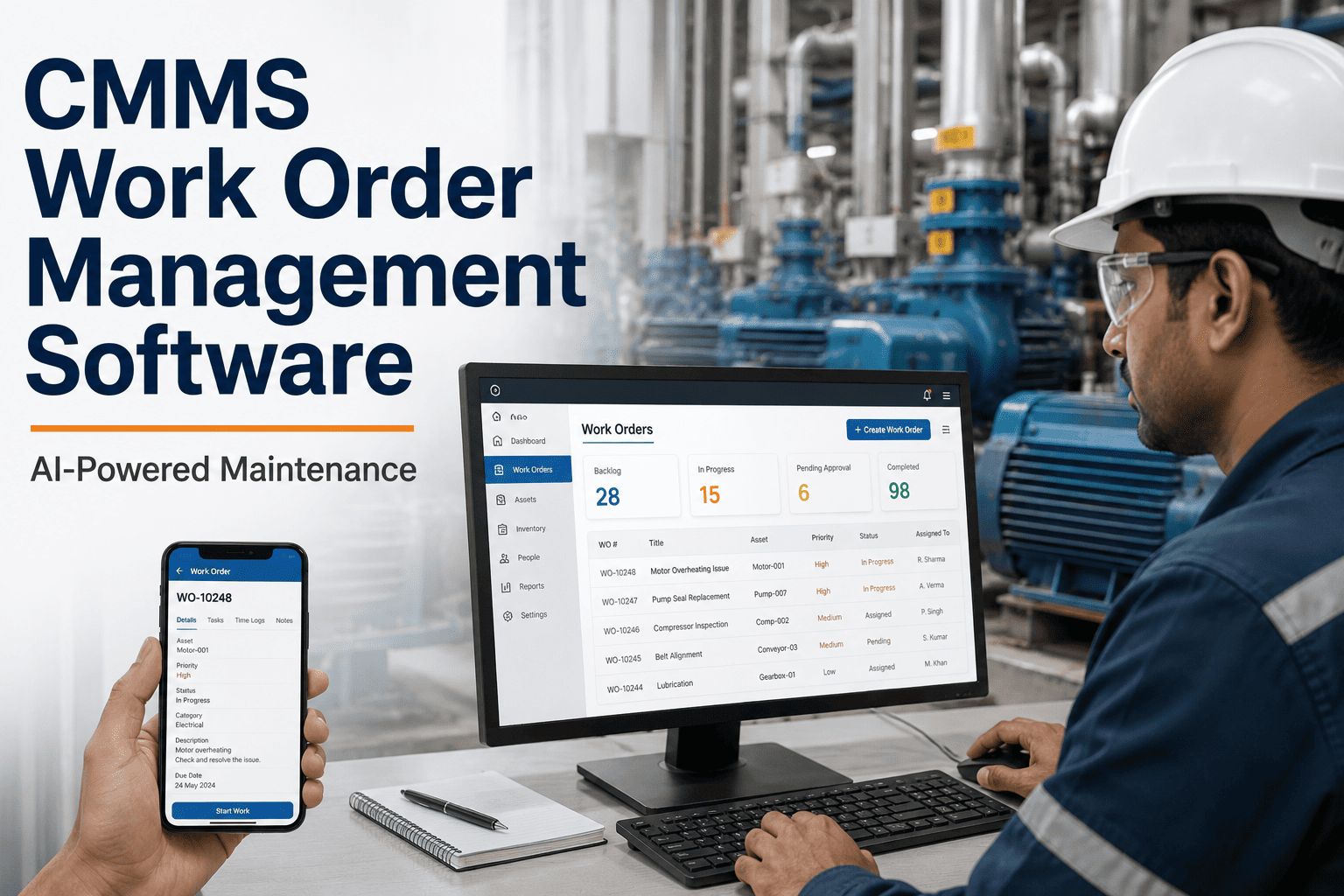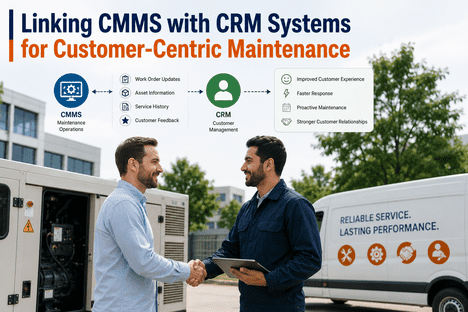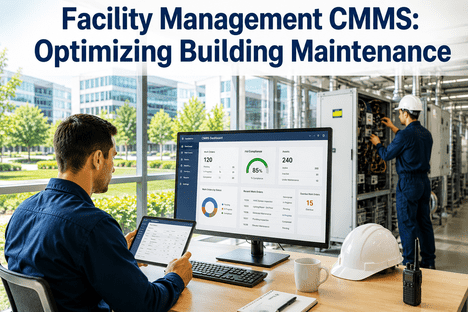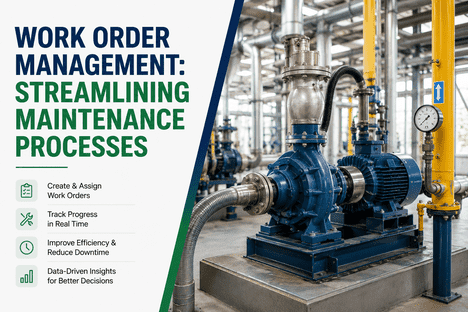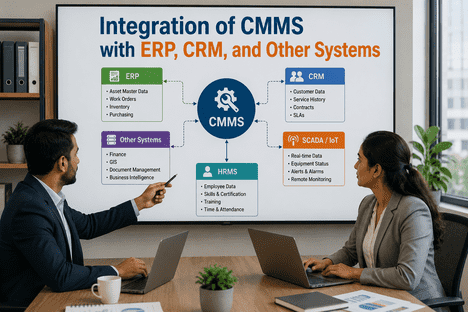
In modern industrial operations, the integration of Computerized Maintenance Management Systems (CMMS) with Enterprise Resource Planning (ERP), Customer Relationship Management (CRM), and other enterprise systems has become a critical enabler of operational excellence. A CMMS that operates in isolation cannot deliver the full value of predictive maintenance, asset lifecycle optimization, or data-driven reliability engineering — because it lacks the contextual data that lives in adjacent systems. When a CMMS is integrated with ERP platforms such as SAP or Oracle, maintenance teams gain real-time visibility into spare parts inventory, procurement timelines, and capital asset accounting. Integration with CRM systems connects maintenance history to customer assets, enabling service organizations to predict equipment failures before they impact client operations. Beyond ERP and CRM, modern CMMS integration extends to IoT sensor networks, AI vision platforms, and digital twin environments — creating a unified data fabric that spans the entire asset lifecycle. For operators managing complex facilities with hundreds of assets, the integration of CMMS with ERP, CRM, and other systems is not a convenience — it is a structural requirement for achieving Industry 4.0 maturity.
Why CMMS Integration With ERP and CRM Is Essential for Modern Maintenance
The gap between isolated maintenance systems and integrated enterprise platforms costs industrial operators millions in unplanned downtime, excess inventory, and reactive repair premiums. When a CMMS is connected to an ERP system, work order data flows directly into procurement and accounting — enabling automatic purchase order generation for spare parts, accurate labor cost allocation, and depreciation tracking that reflects actual asset condition rather than calendar-based schedules. CRM integration adds another dimension: for organizations providing equipment maintenance services, integration with systems like Salesforce or ServiceNow means that every inspection event, repair action, and parts replacement is automatically linked to the customer asset record, generating a complete service history that supports SLA compliance, warranty management, and predictive service scheduling. The iFactory AI Vision Camera feeds visual inspection data directly into this integrated ecosystem — capturing corrosion, wear, and defect imagery that is classified by AI models and pushed as structured data into the CMMS, where it triggers work orders, updates asset health scores, and informs ERP-level capital planning decisions.
Key Integration Points: CMMS to ERP, CRM, IoT, and AI Platforms
A comprehensive CMMS integration strategy touches multiple enterprise systems, each serving a distinct purpose within the asset management lifecycle. The most impactful integration points span financial systems, customer-facing platforms, and emerging AI-driven inspection technologies that generate condition data automatically.
Bidirectional synchronization between CMMS and ERP enables automatic spare parts reservation at work order creation, real-time inventory level verification, procurement request generation, and capital asset cost tracking. Maintenance labor hours and material costs flow into ERP for accurate asset valuation and depreciation alignment with physical asset condition.
For service-oriented organizations, CRM integration links every maintenance event to the customer asset record. Service history, warranty claims, SLA performance metrics, and predictive maintenance alerts are visible in the CRM, enabling customer-facing teams to communicate proactively with clients about equipment health and upcoming service requirements.
IoT sensor data — vibration, temperature, pressure, and oil analysis — feeds real-time condition monitoring into the CMMS, triggering alerts when parameters exceed thresholds. AI vision platforms like the iFactory AI Vision Camera add visual intelligence, automatically detecting defects, coating failures, and structural anomalies and writing findings directly into the CMMS as structured, severity-ranked work items.
Digital twin integration connects CMMS data with 3D asset models and RBI algorithms, creating a living representation of asset health that updates with every inspection event and work order. This enables operators to visualize degradation trends, simulate maintenance scenarios, and optimize inspection intervals based on actual condition data rather than fixed calendar schedules.
The total cost and complexity of integration varies by system architecture, but modern API-first CMMS platforms have significantly reduced implementation barriers. RESTful APIs, OData connectors, and pre-built middleware adapters now enable integrations that once required months of custom development to be completed in days or weeks. Organizations that have completed these integrations report 30–50% reductions in unplanned downtime, 20–35% improvements in spare parts inventory turns, and measurable gains in maintenance workforce productivity through elimination of duplicate data entry across systems. Book a Demo to see how iFactory's AI-driven inspection data integrates with your existing CMMS and ERP environment.
The Role of AI and Computer Vision in CMMS Integration
The most significant advancement in CMMS integration over the past three years has been the incorporation of AI-generated asset condition data. Traditional CMMS integrations moved structured transactional data — work orders, parts usage, labor hours — between systems. AI integration adds a new category: visual and sensor-derived condition data that provides direct evidence of asset health. Computer vision systems deployed in industrial environments capture thousands of high-resolution images per inspection event, classify defects using machine learning models trained on millions of labeled examples, and push structured findings into the CMMS as actionable work items with severity scores, GPS coordinates, and photographic evidence. This eliminates the manual inspection report interpretation step that has historically been a bottleneck between data collection and maintenance action. The iFactory AI Vision Camera is designed specifically for this workflow — it mounts on robotic crawlers, drones, or fixed positions and delivers AI-classified visual data that integrates natively with major CMMS platforms through standardized APIs. Book a Demo to see how AI vision data transforms your CMMS from a transactional record system into a predictive intelligence platform.
| Dimension | Traditional CMMS Integration | AI-Enhanced Integration |
|---|---|---|
| Data Types | Work orders, inventory transactions, labor records, purchase orders | All traditional data plus AI-classified visual defects, corrosion maps, UT thickness readings, thermal anomalies |
| Update Frequency | Batch synchronization — daily or weekly data exchange cycles | Real-time or near-real-time — findings pushed to CMMS within minutes of AI processing |
| Decision Support | Reactive — work orders created after failures or scheduled calendar intervals | Predictive — AI condition data triggers work orders before failure with severity-based prioritization |
| Data Quality | Manual entry dependent — transcription errors, inconsistent descriptions, missing fields | AI-graded consistency — every defect record follows the same classification schema with no human variability |
| ERP Impact | Limited — maintenance cost data reaches ERP but without condition context for capital planning | Full lifecycle visibility — ERP receives condition-based asset valuations, RBI-adjusted depreciation schedules, and predictive capital replacement forecasts |
Building an Integrated Maintenance Ecosystem: A Practical Framework
Organizations that succeed with CMMS integration follow a structured approach that prioritizes data standardization, API capability assessment, and phased deployment. The first step is establishing a common data model — ensuring that asset identifiers, location codes, failure codes, and work order classification systems are consistent across all systems before integration begins. Without this foundation, data quality issues in the CMMS propagate into ERP and CRM systems, undermining the value of the entire integration. The second step is evaluating API readiness across each target system. Modern CMMS platforms with RESTful APIs and webhook support enable event-driven integration patterns where a work order status change in the CMMS can trigger an inventory reservation in the ERP and a customer notification in the CRM in a single automated sequence. The third step is incorporating AI-generated condition data as a first-class data source within this architecture. Platforms like iFactory's AI Vision Camera are built with integration as a core design principle — inspection data is structured, API-accessible, and immediately consumable by downstream systems without intermediate human processing.