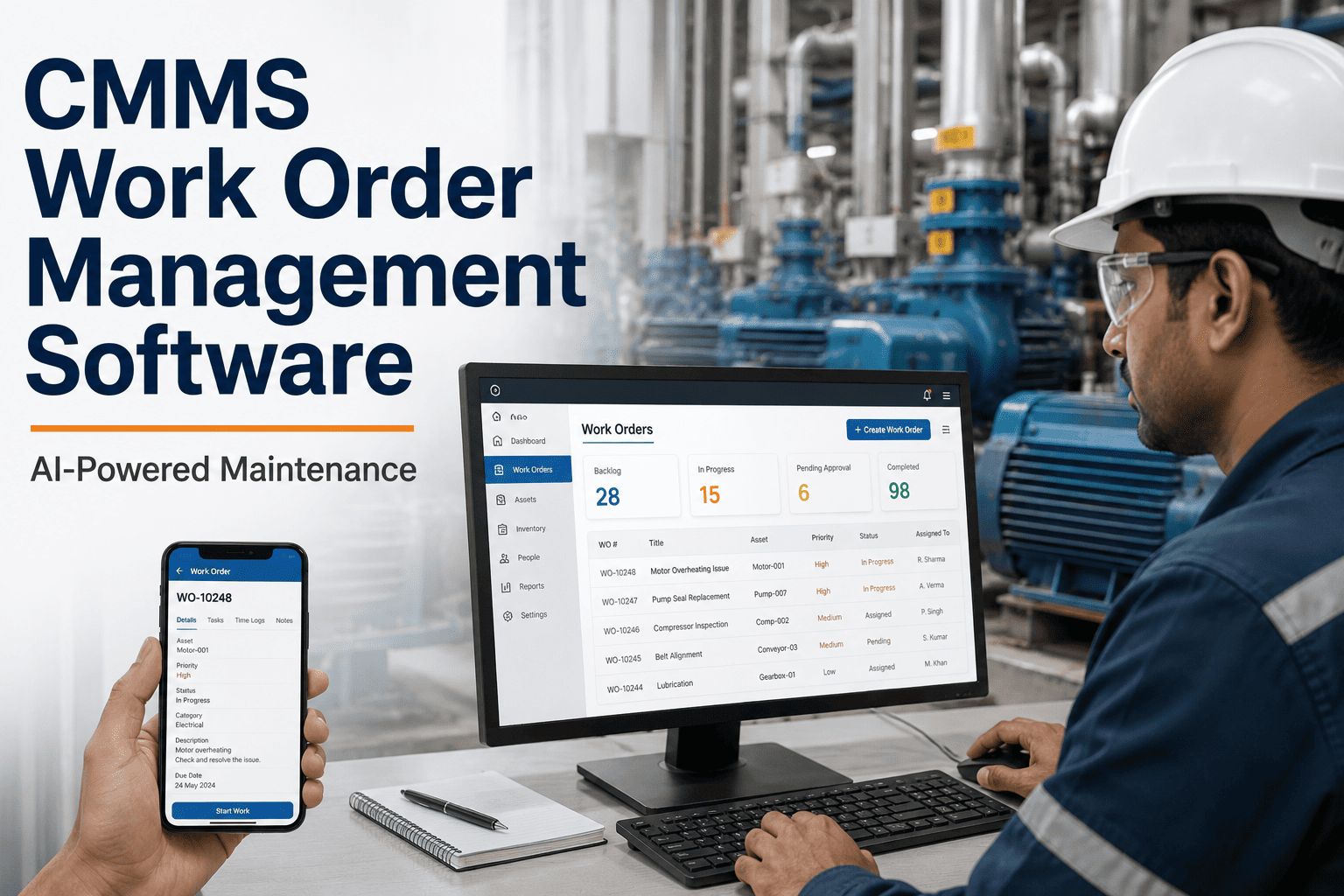
Reliability-Centered Maintenance (RCM) provides a structured analytical framework for determining the maintenance requirements of physical assets in their operating context — shifting maintenance strategy from reactive repair to proactive function preservation. When embedded within a Computerized Maintenance Management System (CMMS), RCM principles — asset criticality analysis, failure mode and effects analysis (FMEA), and condition-based task selection — become executable workflows that drive daily maintenance decisions rather than static documents stored in binders. The seven core RCM questions defined by SAE JA1011 — What does the asset do? How can it fail? What causes failure? What happens when it fails? Does it matter? Can it be prevented? What should be done? — map directly into CMMS modules for asset hierarchy management, work order classification, and preventive maintenance scheduling. Organizations implementing RCM within modern CMMS platforms report 35–50% reduction in unplanned downtime, 20–30% lower maintenance costs, and measurable improvements in overall equipment effectiveness. iFactory AI connects RCM decision logic directly to daily operations through its AI Vision Camera and IoT sensor integration — linking visual inspection data, asset failure histories, and real-time condition monitoring into a unified CMMS that prioritizes work orders by reliability impact rather than calendar date.
Implement Reliability-Centered Maintenance in Your CMMS
iFactory integrates asset criticality scoring, FMEA workflows, and IoT condition monitoring into a single CMMS platform — so your maintenance team executes RCM-driven work orders, not calendar-based guesses.
The Seven RCM Questions Mapped to CMMS Workflows
RCM is not a maintenance interval optimization exercise — it is a sequential decision logic that must be applied function by function and failure mode by failure mode. Each answer shapes which options are available in the next step. Modern CMMS platforms embed this decision logic directly into asset records, work order templates, and condition monitoring feeds — transforming the seven questions from a workshop exercise into a continuous reliability management system. The table below maps each RCM question to its CMMS implementation and the measurable business impact it drives.
| RCM Question | CMMS Implementation | Business Impact |
|---|---|---|
| 1. What are the asset functions and performance standards? | Asset hierarchy with function-linked job plans and performance baseline records | Clear scope for every maintenance task — eliminates ambiguous work orders |
| 2. How can the asset fail to fulfill its functions? | Functional failure library tagged to asset types in the CMMS database | Standardized failure coding enables cross-asset reliability trend analysis |
| 3. What causes each functional failure? | FMEA failure mode records linked to asset IDs with root cause classification | Drives targeted condition monitoring instead of blanket PM coverage |
| 4. What happens when each failure occurs? | Failure effect documentation with downtime cost and safety impact scoring | Quantified consequence data feeds criticality matrix and budget allocation |
| 5. Does the failure matter? | Criticality scoring (safety, environmental, operational, non-operational) | Maintenance budget concentrated on failures that threaten production or safety |
| 6. What proactive task prevents or detects the failure? | Condition-based or time-based task templates with sensor trigger integration | Right maintenance type applied to each failure mode — no over-maintenance |
| 7. What if no proactive task is suitable? | Run-to-failure designation with spare parts strategy and response plan | Economic clarity — maintenance spend justified by risk reduction value |
Asset Criticality Analysis and FMEA Integration in CMMS
Before any FMEA worksheet is opened, every asset in the facility must be ranked by criticality — the combined effect of failure consequence severity and failure probability. Criticality matrices score safety impact, environmental impact, production impact, and asset replacement cost on a structured scale. Assets scoring in the top 15–25% of criticality receive full RCM analysis with detailed FMEA treatment. The remaining assets are addressed with streamlined maintenance strategy reviews or retained on existing PM schedules until RCM bandwidth expands. Attempting full RCM across the entire asset register simultaneously is the most common cause of RCM program failure.
FMEA is the analytical engine that powers RCM. For every asset designated for full analysis, the FMEA worksheet records each function, functional failure, failure mode, failure effect, consequence category, and selected maintenance task. Task selection follows the RCM decision hierarchy: condition-based monitoring tasks are evaluated first, time-based preventive tasks second, failure-finding inspections for hidden failures third, and default actions — redesign or run-to-failure — where no proactive task is technically feasible or economically justifiable. Each selected task must have a defined interval, responsible craft, required resources, and acceptance criteria loaded directly into the CMMS work order template. iFactory's platform supports this workflow by connecting FMEA outputs directly to automated work order generation, ensuring that RCM analysis never gets shelved as a static document. Book a Demo to see how iFactory converts FMEA data into live maintenance schedules.
AI, IoT, and Predictive Maintenance for RCM Execution
Condition-based maintenance is the highest-priority task type in the RCM decision hierarchy — yet most facilities lack the sensor infrastructure and data integration to make it operational across their critical assets. iFactory's AI Vision Camera and IoT sensor platform close this gap by connecting visual inspection data, vibration analysis, temperature trending, and pressure monitoring directly into the CMMS. When a monitored parameter crosses its alert threshold, the CMMS generates a condition-based work order automatically — eliminating the delay between anomaly detection and maintenance action.
AI-driven anomaly detection on continuous sensor streams identifies degradation signatures weeks or months before functional failure occurs, effectively measuring P-F intervals in real time across every instrumented asset. This data feeds directly back into the RCM consequence assessment and task selection decisions, creating a continuous improvement loop that keeps maintenance strategies aligned with actual asset condition rather than manufacturer recommendations. Operations using iFactory's integrated RCM-CMMS platform typically achieve 40–60% reduction in reactive maintenance within the first 12 months of deployment.
Deploy RCM in Your CMMS Within Weeks, Not Months
iFactory's phased deployment methodology ensures measurable ROI from Phase 1. Built-in FMEA tools, asset criticality scoring, and automated work order generation compress the gap between analysis and execution.
Phased RCM Implementation Within Your CMMS Environment
Full-facility RCM implementation is a multi-year program. The most successful deployments use a criticality-prioritized phased approach, achieving measurable ROI from the highest-consequence assets in Phase 1 before expanding to the broader asset register. iFactory's CMMS platform supports each phase with integrated FMEA tools, asset criticality scoring, and predictive analytics.
Reliability-Centered Maintenance in CMMS — Frequently Asked Questions
Build a Reliability-Centered Maintenance Program with iFactory CMMS
iFactory connects asset criticality scoring, FMEA workflows, AI Vision Camera condition monitoring, and IoT sensor integration into a single CMMS platform — delivering per-asset reliability strategies, automated work order generation, and continuous improvement analytics that keep your maintenance program aligned with actual operating conditions.