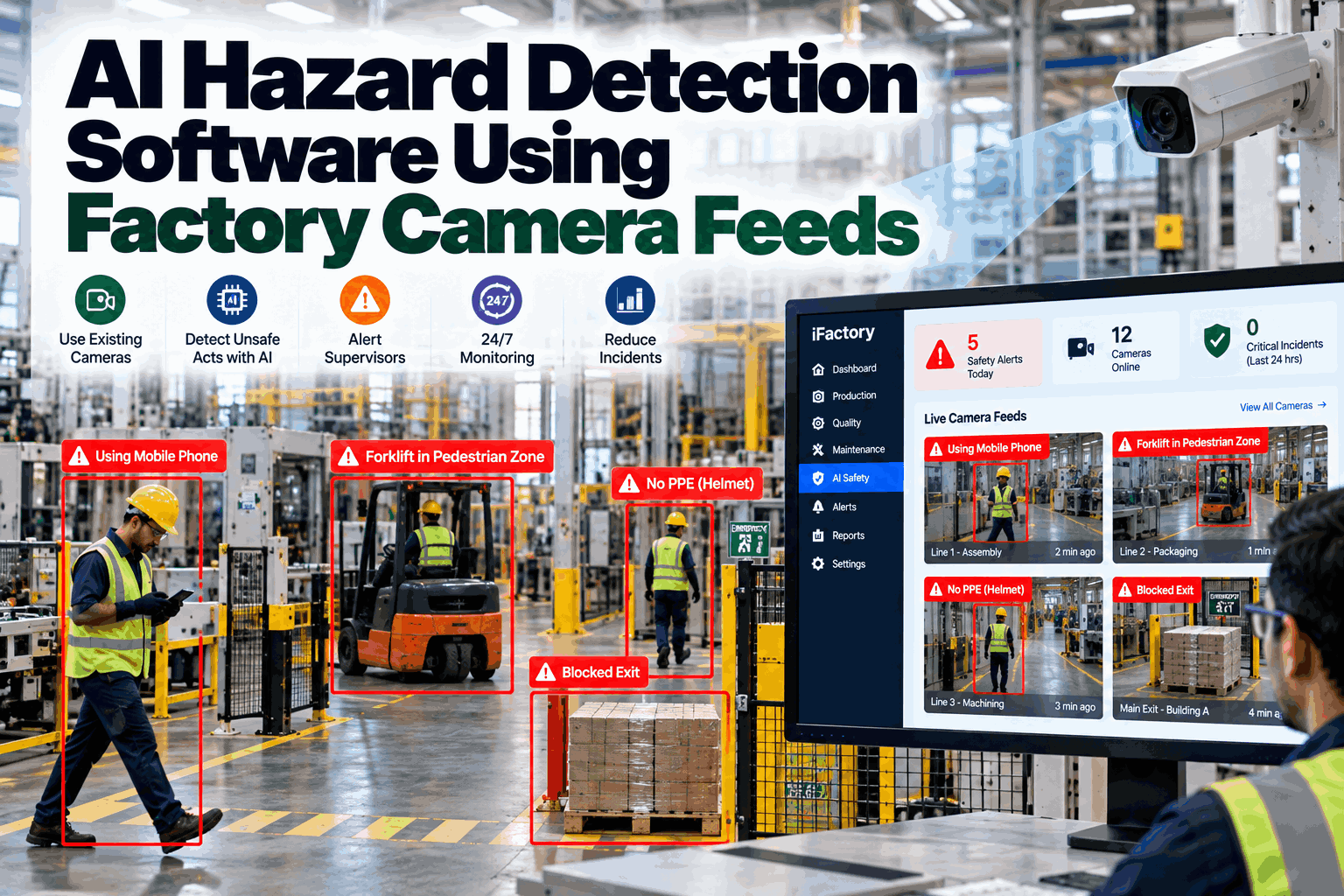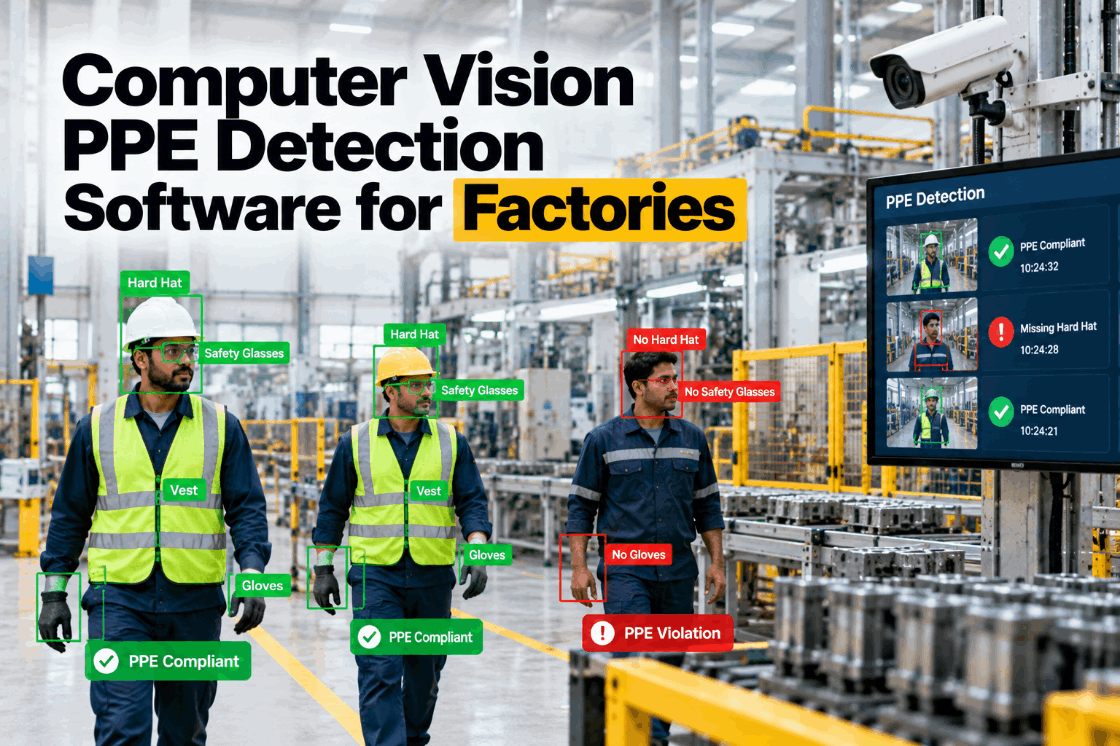
Personal protective equipment only works when it is worn, and most factories have no reliable way to know whether it is. Supervisors do walk-rounds, safety teams do audits, and both see a few minutes of an eight-hour shift. The hard hat that comes off inside the press shop or the safety glasses pushed up on a forehead at the grinder go unseen until someone is hurt. Computer vision changes what can be seen. Cameras already installed on production lines can check whether people entering a zone are wearing the PPE that zone requires, raise an alert within seconds and build a record of where and when gaps occur. Done properly, it does this without identifying anyone. This guide covers OSHA’s PPE rules, how vision detection works, what it can and cannot detect reliably, zone rules, privacy and how to deploy it. To see PPE detection on a sample line, book a short walkthrough.
Computer Vision PPE Detection Software for Factories: See Missing PPE the Moment It Matters
Hard hats, eye protection, gloves and high-visibility clothing checked by camera at every zone, with alerts in seconds and no face recognition, so PPE rules hold on every shift.
Why PPE Rules Break Down Between Audits
NIOSH estimates that about 2,000 US workers a day sustain a job-related eye injury that needs medical treatment, with about a third treated in hospital emergency departments. Many of those injuries happen to people who had eye protection available and were not wearing it at that moment.
Enforcement data tells the same story. In OSHA’s final list for fiscal year 2025, respiratory protection was the fifth most-cited standard with 2,294 citations and eye and face protection in construction was ninth with 1,965. PPE is the last line of defense, and it is the control most dependent on behavior, minute by minute.
Traditional checks cannot close the gap. A supervisor who walks each area four times a shift sees perhaps ten minutes of it. Audits are less frequent still. People put PPE on when they see the auditor, so observation itself changes the result.
Continuous, anonymous monitoring shows what actually happens. We can review your PPE zones on a call.
What OSHA Requires for PPE
OSHA’s general industry PPE rules start with 29 CFR 1910.132 and continue with standards for each body part.
The hazard assessment is the foundation. It defines which PPE is required in which area, and those requirements become the zone rules a vision system checks. Vision does not replace the assessment; it verifies that what the assessment requires is actually worn.
Our specialists can turn your hazard assessment into zone rules.
How Computer Vision PPE Detection Works
Vision PPE detection uses deep-learning object detection, typically models from the YOLO family, running on video from standard cameras.
Video from existing or new cameras covering zone entries and work positions.
The model finds each person in the frame, without identifying who they are.
For each person, the model checks for hard hat, eyewear, gloves, vest or other required items.
The result is compared with the PPE required in that zone.
A missing item triggers an alert to the supervisor or a local signal.
Events are logged by zone, time and PPE type for trend analysis.
Processing happens on a server at the plant, so video does not need to leave the site. Only events, such as a missing-PPE detection with a short blurred clip, are stored.
The system detects PPE, not people. It does not need to know who someone is to see that a hard hat is missing, which is the basis for deploying it in a privacy-respecting way.
Most plants can start with cameras they already have at zone entries. See it running in a demo.
What Vision Can Detect Reliably
Published research shows that accuracy depends heavily on the item and the camera distance. Results come from different datasets and are not directly comparable, but the pattern is consistent.
| PPE item | Published results | Practical guidance |
|---|---|---|
| Hard hats | About 93% average precision in one benchmark; 100% precision and recall at 5 m in a controlled study | Reliable at typical camera distances |
| High-visibility vests | About 90% average precision; 100% precision and recall at 5 m in a controlled study | Reliable at typical camera distances |
| Safety glasses | About 85% average precision; recall of 58% at 5 m in a controlled study | Use close-range cameras at entries and workstations |
| Gloves | 99% recall in a controlled study; weaker in field datasets | Use close-range views of the hands; expect confusion with sleeves |
| Hearing protection | Recall of 54% at 5 m in a controlled study | Close-range cameras only |
The studies behind these figures, published in PeerJ Computer Science in 2022 and at a SCITEPRESS conference in 2023, give the same explanation: small and transparent items are hard to see from a distance. One reported overall accuracy falling from 99% at 3 meters to 89% at 5 meters.
The practical lesson is to match the camera to the item. Hard hats and vests can be checked from wide-area cameras. Glasses, gloves and hearing protection need cameras placed close to entry points or workstations, with good lighting.
A site survey shows which items can be checked from which cameras. Ask our team to plan one.
Zone Rules That Match the Hazard
PPE requirements differ across a plant. Zone rules make the system check the right thing in the right place.
Zones drawn on each camera view: press shop, grinding cell, forklift aisle, chemical store.
Required items taken from the hazard assessment for that area.
Close-range cameras at entries check small items as people come in.
An alert only after PPE is missing for a set number of seconds, to avoid noise.
Marked pedestrian routes or escorted visits with different rules.
Local reminder first, supervisor alert next, pattern review weekly.
Illustrative. Patterns by entry, time and item usually point to a fixable cause such as an empty dispenser.
Patterns matter more than individual events. We report them by zone and time in every rollout.
Keeping Alerts Trustworthy
An alert system that is often wrong will be ignored. Several measures keep alerts credible.
Close, well-lit views for small items; wide views only for hard hats and vests.
Alert only when PPE is missing for several seconds, not on a single frame.
Tune thresholds per zone so uncertain detections are not alerted.
Exclude walkways, offices and areas outside the zone.
Supervisors mark false alerts; the model is refined on images from your own site.
A camera cannot confirm that eyewear is rated to ANSI Z87.1 or that a helmet is the right type and class.
That last point matters. Vision can tell whether something is worn, not whether it is the correct specification for the hazard. Glove type, lens rating and helmet class remain matters for the hazard assessment, issue controls and periodic checks.
Our engineers tune thresholds zone by zone during the pilot.
Privacy, Trust and the Law
Cameras that monitor people at work raise legitimate concerns. A sound design addresses them directly.
Trust decides whether the system works. Sites that introduce PPE detection as a way to fix supply, layout and habit problems, and that report results by zone and not by person, see far better acceptance than those that use it for discipline.
We share a worker communication template with every pilot.
Spot Checks Versus Continuous Detection
The difference shows in what the safety team knows.
- A few minutes of each shift observed
- People behave differently when watched
- Results recorded as impressions
- Night and weekend shifts rarely checked
- Causes of non-use unknown
- Improvement hard to measure
- Every entry to every zone checked
- Consistent, unobtrusive observation
- Compliance measured by zone and item
- All shifts covered equally
- Patterns point to causes
- Before and after measured
Continuous detection does not remove the supervisor’s role. It directs it: instead of walking rounds looking for missing PPE, supervisors act on patterns and spend time on coaching and fixing causes.
See a week of zone results for a sample line in a session.
PPE Detection Deployment Checklist
Use this checklist to plan a deployment.
Most sites start with one or two zones where the risk is clearest. Plan yours in a site survey.
What PPE Detection Is Worth
Value comes from injuries avoided and from finally having data.
Many sites find that most gaps trace to a handful of fixable causes: a dispenser in the wrong place, a zone boundary nobody can see, glasses that fog in one area. Fixing those raises compliance more than any amount of reminding.
A two-week measurement in one zone usually shows the main causes. Book one with our advisors.
How iFactory Delivers Computer Vision PPE Monitoring
Hard hats, vests, eyewear and gloves, matched to camera range.
Required PPE per zone from your hazard assessment.
Local signals and supervisor alerts with persistence filters.
Compliance by zone, entry, shift and item.
No face recognition, blurred clips, on-premise processing.
Refined on images from your own lines.
It runs on the iFactory AI server at your plant. Share your camera layout and we will plan the first zones in a working session.
Measure Real PPE Compliance in One Zone
Pick one zone and its required PPE. We connect a camera, measure compliance for two weeks without identifying anyone and show where and when the gaps occur.
Eye protection was not detected on 2 of 9 entries this shift. Both were at the east entry, where the safety glasses dispenser has been empty since 06:40.
A Supply Problem Found From a Pattern
This exchange shows how a production supervisor might use iFactory.
iFactory ships as a pre-configured NVIDIA AI server, racked and ready with the vision PPE monitoring models loaded. Rack it, plug in power and Ethernet, and the AI is live on your network. Our scope covers cameras, sensors and data connections across production lines, zone entries and material handling areas, CMMS, HR, training and access control integration, cabling and network setup, supervisor and safety team training, and 24×7 remote monitoring. Alerts and records support your safety team; they do not replace your procedures, competent persons or legal duties.
Server installed, system links live, existing permits, inspections, training and incident records loaded.
Workflows and models configured to your own procedures, then piloted in one area with your safety team reviewing every alert.
Rollout to the agreed areas and sites, supervisor and safety team training, and 24×7 remote monitoring in place.
Software, server and integration come as one package. For pricing on your site, contact our sales team.
Frequently Asked Questions
Deep-learning object detection finds each person in the camera view and checks for items such as hard hats, vests, eyewear and gloves, then compares the result with the PPE required in that zone.
Hard hats and high-visibility vests are detected reliably at typical distances. Safety glasses, gloves and hearing protection are smaller and need close-range, well-lit cameras; published recall for glasses fell to 58% at 5 meters in one study.
It does not need to. The system detects PPE on a person without identifying them, and faces can be blurred in stored clips.
No. The employer must still assess hazards, choose PPE and certify the assessment under 1910.132(d). Vision verifies that the required PPE is worn.
No. It can show that eyewear or a helmet is worn, not that it is rated to ANSI Z87.1 or the correct helmet type and class. That remains part of issue control and inspection.
The first zones can typically be live within a 6–12 week rollout, often using existing cameras. Plan it with our specialists.
Make PPE Rules Hold on Every Shift
iFactory checks required PPE at every zone, alerts in seconds, finds the causes behind the gaps and protects privacy by never identifying individuals.
Illustrative. Zone-level results with no face recognition. Smaller items are checked only where cameras are close enough to see them.