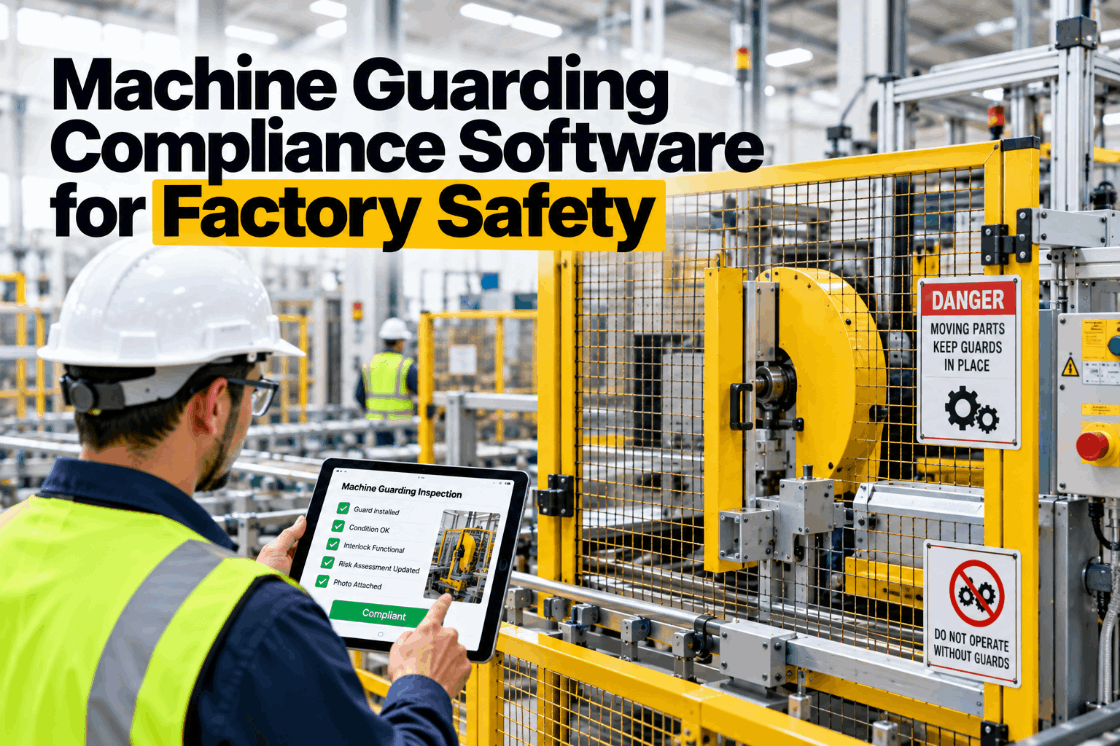
Every machine with moving parts needs guarding, and every guard needs someone to check it is still there and still working. That sounds simple until a plant counts its machines. Hundreds of presses, conveyors, saws, mixers and robots, each with several guards and safety devices, each changed over the years by maintenance, tooling changes and production pressure. Guards get removed for a jam and not replaced. Interlocks get bypassed. Risk assessments go out of date after a modification. Machine guarding software keeps an inventory of every guard and device, schedules inspections, links each machine to its risk assessment and records what was found and fixed. This guide covers OSHA Subpart O, the hazards that must be guarded, guards and devices, risk assessment, inspections and what a guarding register should contain. To see a guarding register in use, book a short walkthrough.
Machine Guarding Compliance Software for Factory Safety: Every Guard Inventoried, Inspected and Linked to Risk
A register of every machine, guard and safety device, with scheduled inspections and a current risk assessment per machine, so guarding stays in place after every jam, changeover and modification.
Why Guarding Failures Keep Causing Amputations
Employers must report amputations to OSHA within 24 hours. In 2024, federal OSHA received 9,034 severe injury reports, of which 2,426 were amputations, 27% of the total. Manufacturing accounted for 1,348 of those amputations, far more than any other sector.
OSHA responds with targeted enforcement. Its National Emphasis Program on amputations in manufacturing was renewed in June 2025 for five years, focusing on machine guarding and the control of hazardous energy. Machine guarding general requirements, 29 CFR 1910.212, was the tenth most-cited standard in fiscal year 2025 with 1,498 citations, and lockout/tagout, 1910.147, was fourth with 2,562.
The pattern behind these numbers is consistent. Guards exist when the machine is installed, then erode. They are removed during maintenance, defeated to clear jams faster or made ineffective by a change in tooling. Without a register and an inspection routine, nobody knows which machines have drifted.
A register turns guarding from an assumption into a checked fact. We can review your machine list on a call.
What OSHA 1910 Subpart O Covers
Subpart O of 29 CFR 1910 contains the machinery and machine guarding standards for general industry.
| Section | Subject | Applies to |
|---|---|---|
| 1910.211 | Definitions | Terms used across the subpart |
| 1910.212 | General requirements for all machines | Every machine not covered by a specific section |
| 1910.213 | Woodworking machinery | Saws, jointers, planers and similar |
| 1910.215 | Abrasive wheel machinery | Grinders and abrasive wheels |
| 1910.216 | Mills and calenders | Rubber and plastics machinery |
| 1910.217 | Mechanical power presses | Presses, with detailed inspection and control rules |
| 1910.218 | Forging machines | Hammers, presses and upsetters |
| 1910.219 | Mechanical power-transmission apparatus | Belts, pulleys, shafts, gears and chains |
Section 1910.212 is the catch-all. It applies to any machine without a more specific rule, which is why it is the section cited most often. Power presses and power transmission have their own detailed requirements, including inspection records for presses.
Mapping each machine to the section that applies is the first step of a register. Our specialists do this with your asset list.
What 1910.212 Requires for All Machines
The general requirements are short, which makes them broad.
Because the rule is performance-based, the employer has to decide what guarding is adequate for each machine. That decision is the risk assessment, and it needs to be written down and kept current.
Linking each machine to its documented assessment is what makes compliance provable. See it in a demo.
Hazards to Guard and Machines to Watch
Guarding addresses a known set of mechanical hazards.
Where the machine cuts, shapes, bores or forms the material.
Where rotating parts meet each other or a fixed part, such as rolls, belts and gears.
Shafts, couplings, spindles and flywheels that can catch clothing or hair.
Material ejected from cutting and grinding.
Belts, pulleys, chains and sprockets, often on older equipment.
Moving beds, rams and slides that crush or shear.
OSHA’s amputation guidance lists the machines most often involved: mechanical power presses, press brakes, conveyors, printing presses, roll-forming machines, shears, food slicers, meat grinders, band saws and drill presses. A register should flag these as higher priority for inspection.
Conveyors deserve special mention because they are everywhere and often overlooked. Nip points at pulleys and transfer points, and exposed drive components, are common findings.
Ranking machines by hazard and history focuses inspection effort. Ask our team how priorities are set.
Guards Versus Safeguarding Devices
OSHA guidance separates guards, which are physical barriers, from devices, which stop or prevent motion.
- Fixed guards: permanent barriers, most reliable
- Interlocked guards: stop the machine when opened
- Adjustable guards: set for different stock sizes
- Self-adjusting guards: move with the material
- Checked for presence, fixing and condition
- Covered by ISO 14120 design guidance
- Presence-sensing: light curtains, scanners, mats
- Two-hand controls: both hands away from the hazard
- Pullbacks and restraints: keep hands out
- Gates: close before the cycle starts
- Checked for function, muting and bypass
- Interlocks covered by ISO 14119
Devices need functional testing, not just a visual check. A light curtain can be in place and powered yet muted or bridged. Inspection tasks should say exactly how to test each device and what result to record.
Control system reliability matters too. ISO 13849-1, revised in 2023, defines performance levels from PL a to PL e for the safety-related parts of control systems. The required level comes from the risk assessment, and the register should record it for each safety function.
Our engineers can help define test steps for each type of device.
Risk Assessment per Machine
A documented risk assessment for each machine is the foundation of a guarding program. ANSI B11.0 and ISO 12100 describe the method.
Limits, intended use, operating modes and people exposed.
Every task: operation, setup, cleaning, jam clearing and maintenance.
Severity, exposure and possibility of avoidance for each hazard.
Design changes first, then guards and devices, then procedures and training.
Confirm controls are installed and effective; record residual risk.
Reassess after modifications, incidents or new tasks.
Non-routine tasks cause many injuries. Clearing a jam or adjusting a guide is when guards come off, so the assessment has to cover those tasks and link to lockout procedures. OSHA requires each energy control procedure to be inspected at least annually.
Illustrative. Coverage numbers show management where the program is incomplete.
Coverage is the first number to track. We report it from day one of a rollout.
Running Guard Inspections That Find Problems
An inspection routine keeps guarding from eroding.
List every guard and device on every machine, with a photo of the correct condition.
Operator checks each shift; documented inspections weekly or monthly by risk; presses per 1910.217.
Presence, fixing, condition and function, with test steps for devices.
Pass, fail and photos, captured on a mobile device at the machine.
Defects raise work orders; the machine’s status reflects open defects.
Trends by area, machine type and cause, including bypassed interlocks.
Photos of the correct condition make inspections faster and more consistent. A new inspector can compare what they see with the reference, instead of relying on memory of how the machine should look.
Linking defects to maintenance work orders is what gets guards fixed. Discuss it with our advisors.
Machine Guarding Checklist
Use this checklist to test a guarding program.
Most plants find their register is incomplete before anything else. A guarding review measures the gap.
What a Guarding Register Is Worth
Value comes from prevented injuries and reduced enforcement exposure.
Amputations are among the most serious and costly injuries in manufacturing, and each one must be reported to OSHA within 24 hours, which often leads to an inspection. Preventing one is worth far more than the cost of the program.
A review of your machine list against the register model shows where to start. Book one with our safety team.
How iFactory Delivers the Machine Safety and Guarding Register
Every guard and device with reference photos.
Frequencies by risk, with test steps for devices.
Assessment, residual risk and performance level per machine.
Findings raise work orders and change machine status.
Modifications prompt reassessment.
Assessment and inspection coverage by area.
It runs on premises and connects to your CMMS. Share your machine list and we will build the first register in a pilot.
Find the Machines Your Guarding Program Has Missed
Share your machine list and inspection records. We measure assessment and inspection coverage and show which high-risk machines need attention first.
The light curtain muting circuit was found bridged during the weekly check, and the machine’s risk assessment was last reviewed 26 months ago, before the tooling change.
A Bypassed Light Curtain Found in a Weekly Check
This exchange shows how a plant safety manager might use iFactory.
iFactory ships as a pre-configured NVIDIA AI server, racked and ready with the machine safety and guarding register models loaded. Rack it, plug in power and Ethernet, and the AI is live on your network. Our scope covers cameras, sensors and data connections across production lines, press shops and maintenance areas, CMMS, HR, training and access control integration, cabling and network setup, supervisor and safety team training, and 24×7 remote monitoring. Alerts and records support your safety team; they do not replace your procedures, competent persons or legal duties.
Server installed, system links live, existing permits, inspections, training and incident records loaded.
Workflows and models configured to your own procedures, then piloted in one area with your safety team reviewing every alert.
Rollout to the agreed areas and sites, supervisor and safety team training, and 24×7 remote monitoring in place.
Software, server and integration come as one package. For pricing on your site, contact our sales team.
Frequently Asked Questions
The part of OSHA’s general industry standards covering machinery and machine guarding, sections 1910.211 to 1910.219, including general requirements for all machines and specific rules for presses, woodworking, abrasive wheels and power transmission.
One or more methods of guarding to protect people from hazards such as the point of operation, ingoing nip points, rotating parts, flying chips and sparks, with guards affixed to the machine where possible.
A guard is a physical barrier. A device, such as a light curtain or two-hand control, stops or prevents hazardous motion. Devices need functional testing as well as visual checks.
Standards such as ANSI B11.0 and ISO 12100 call for a documented risk assessment per machine, reviewed after modifications. It is the basis for deciding what guarding is adequate.
Operators should check before use; documented inspections are typically weekly or monthly depending on risk. Mechanical power presses have specific inspection requirements under 1910.217.
A guarding register for one area can typically be live within a 6–12 week rollout, starting from your asset list. Plan it with our specialists.
Know Every Guard Is in Place and Working
iFactory inventories guards and devices, schedules inspections, links risk assessments and routes defects to maintenance, so guarding survives every jam and changeover.
Illustrative. Power transmission and conveyor guards are often inspected least, so they are tracked as their own group.