EHS Audit Software: Schedule, Score and Close Every Finding

By Josh Brook on October 22, 2026

ehs-audit-software-schedule-score-close-every-finding

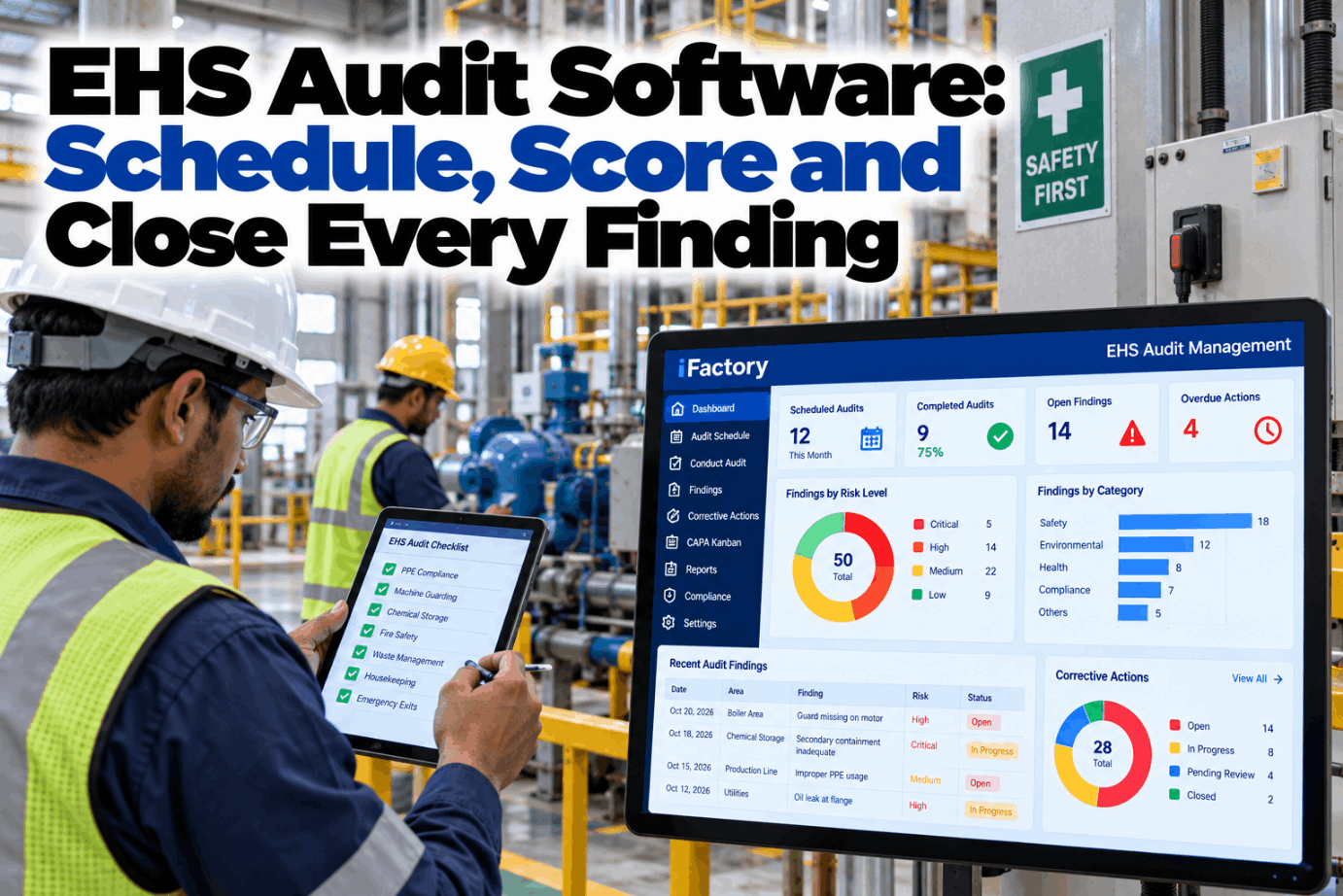
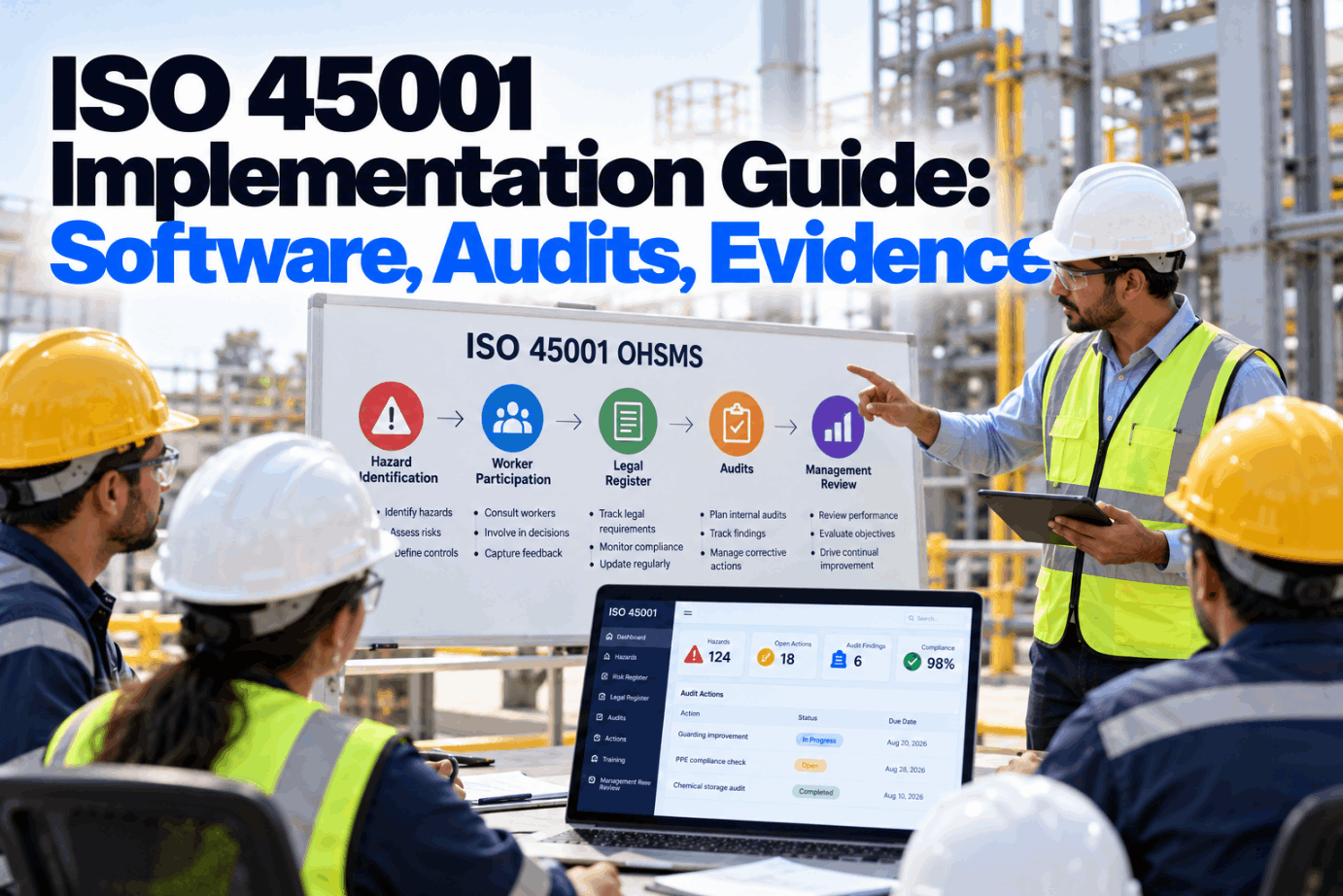
An EHS audit is only as useful as what happens after it. Many plants run their audits on time, then lose the findings in spreadsheets, email threads and paper reports that nobody reads twice. EHS audit software keeps the whole loop in one place: the audit schedule, the protocol, the finding with its risk score, the corrective action and the proof that it worked. See a press shop audit go from voice note to closed finding in a short audit module demo.

EHS AUDIT SOFTWARE · AUDIT MODULE

Schedule, Score and Close Every EHS Audit Finding

iFactory Audit Module gives auditors a protocol library on their handheld. They speak or type each finding, the risk score is worked out on the spot, and every action goes straight to the CAPA kanban until it is verified closed.

Machine guarding audit · Press shop18 of 24
Voice note · 10:14"Light curtain on press 4 bypassed with tape. Photo taken."
iFactory confirmedFinding F-07 raised: light curtain bypass, press 4. Severity 5 × likelihood 3 = 15, High. Sent to the CAPA board for the maintenance lead.
Severity5
Likelihood3
Score15 · High
Due date set by your high-risk rule · photo attached
INTERNAL SAFETY AUDIT REQUIREMENTS

What ISO 45001 and ISO 14001 Ask of an Internal Audit

Both standards put internal audit in clause 9.2. Audits must run at planned intervals and show whether the management system meets your own requirements and the standard, and whether it is effectively implemented and maintained. ISO 14001 was revised in April 2026, and its 9.2.2 now also asks for audit objectives, not just criteria and scope. The matrix sets the two side by side. Our support team can map your current audit set to both.

Requirement
ISO 45001 clause 9.2
ISO 14001:2026 clause 9.2
Where it lives in the software
Planned intervals
Yes
Yes
Audit programme calendar
Programme contents
Frequency, methods, responsibilities, consultation, planning and reporting
Frequency, methods, responsibilities, planning and reporting
Programme with owners and methods per audit
What drives frequency
Importance of the processes and results of previous audits
Environmental importance, changes affecting the organisation, previous results
Risk-weighted schedule that tightens after findings
Each audit defines
Criteria and scope
Objectives, criteria and scope
Audit plan fields on every audit
Auditors
Objective and impartial
Rotation rule, no auditing your own area
Results go to
Relevant managers, workers and worker representatives, other interested parties
Relevant management
Distribution list on each report
Evidence kept
Documented information on the programme and results
Audit record, photos and notes kept together
COMPLIANCE AUDIT AND INTERNAL SAFETY AUDIT

Four Kinds of EHS Audit, One Way to Record Findings

Most plants run several kinds of audit, and each answers a different question. A management system audit asks whether the system works as a whole. A compliance audit checks legal duties such as OSHA standards and permit conditions. Layered audits and routine inspections check everyday conditions on the floor. When all four use the same finding format and the same risk score, leaders can compare them and see where problems really cluster. See all four on one board in a short demo.

Does the system work?
Management system auditAgainst ISO 45001 or ISO 14001 and your own procedures. Typically each area at least once a year.
Are we meeting the law?
Compliance auditAgainst OSHA standards, state rules and permit conditions. Frequency set by legal risk.
Is the standard followed today?
Layered process auditAgainst a short list of key safety controls. Every shift, weekly and monthly by layer.
Is this kit in safe condition?
InspectionAgainst set checklists, such as monthly visual checks of portable fire extinguishers.
AUDIT SCHEDULE

An Audit Programme That Follows the Risk

A good audit schedule is not the same audit every month. High-risk topics such as lockout and machine guarding get audited more often, and any area with recent findings moves up the list. The example below shows how a plant might spread a year of compliance audits. Your own programme should reflect your hazards, legal duties and past results. Plan yours with our support team.

Audit topic
J
F
M
A
M
J
J
A
S
O
N
D
Lockout and energy control
Machine guarding
Chemical storage and labelling
Forklift and traffic routes
Waste and environmental aspects
Emergency preparedness
Full OH&S system audit
Planned auditAdded after a high findingFull system auditExample programme only
How often is often enough?

Neither ISO 45001 nor ISO 14001 sets a fixed audit frequency. They ask you to base it on how important each process is and what earlier audits found. Write that logic into the programme, so an auditor can see why lockout is checked four times a year and forklift routes twice.

AUDIT SCORING

Score Every Finding the Same Way

A finding list with no ranking makes every item look equally urgent. A simple 5 × 5 risk matrix fixes that: rate how bad the outcome could be (severity, 1 to 5) and how likely it is (likelihood, 1 to 5), then multiply. The bands and response times below are an example policy, not a rule from any standard. Set your own bands in a scoring session.

S ↓ L →
1
2
3
4
5
5
5
10
15
20
25
4
4
8
12
16
20
3
3
6
9
12
15
2
2
4
6
8
10
1
1
2
3
4
5
20–25
CriticalStop the task, act the same shift
10–16
HighInterim control now, fix within days
5–9
MediumPlanned fix within weeks
1–4
LowFix at the next routine chance
F-07 · Light curtain bypassed
5 × 3 = 15
Possible amputation, bypass seen once. High.
F-09 · Unmarked forklift crossing
4 × 5 = 20
Serious injury, people cross every shift. Critical.
F-12 · Eyewash weekly check gaps
3 × 2 = 6
Delayed first aid if needed, unit works. Medium.

Ask Where Every Finding Stands

Plant managers shouldn't need a spreadsheet to know what is still open. iFactory answers in plain language from the CAPA kanban, with owners, due dates and whether the fix has been checked.

Plant manager and iFactory
Plant managerWhat is still open from the September guarding audit?
iFactoryThree findings. F-07, the light curtain bypass, is in Verify with a re-check due Friday. Two medium items are in Action and on time.
Plant managerHas the bypass shown up anywhere else?
iFactoryNo. None of the last 12 supervisor checks on the press line found a bypass.
LAYERED PROCESS AUDIT SAFETY

Short Daily Checks Between the Big Audits

Layered process audits come from the automotive industry, where the AIAG CQI-8 guideline describes short, frequent checks by several levels of leaders. The same idea works well for safety. Supervisors spend about ten minutes on a few yes or no questions every shift, managers repeat a sample weekly and plant leaders monthly. Problems surface in days, not at the next annual audit. Our support team can help you write the questions.

Layer 3 · Plant leadersMonthly, sample of areas
Layer 2 · Managers and engineersWeekly, other areas than their own
Layer 1 · SupervisorsEvery shift, about 10 minutes
Example layer 1 safety questions
Yes / NoAll guards in place on running machines?
Yes / NoLocks used for every jam clearing today?
Yes / NoForklift pre-use check done this shift?
Yes / NoWalkways and exits clear?
Yes / NoChemical containers labelled at the station?
EHS AUDIT SOFTWARE EXAMPLES

From Audit Finding to CAPA Kanban

Every finding becomes a card the moment it is raised, with its score, photo, owner and due date. The card moves left to right as the team finds the cause, acts and checks the result. The board below is an illustration, not a customer record. See cards link to work orders in a kanban demo.

Open 2
F-14Spill kit missing at drum store3 × 3 = 9
F-15Exit sign out, warehouse3 × 2 = 6
Root cause 1
F-09Unmarked forklift crossing4 × 5 = 20
Action 2
F-11Guard bolts loose, saw 24 × 2 = 8
F-12Eyewash weekly check gaps3 × 2 = 6
Verify 1
F-07Light curtain bypassed5 × 3 = 15
Closed 1
F-03Blocked electrical panelEffective ✓
EHS AUDIT SOFTWARE BEST PRACTICES

Two Gates Before a Finding Can Close

Fixing the symptom is a correction. Removing the cause so it doesn't come back is a corrective action, and ISO 45001 clause 10.2 asks you to review whether the action was effective. So a finding should pass two gates: proof the action was done, then proof it worked. Set your own gates with our support team.

1
Action done?Evidence: photo of the fix, closed work order, revised procedure
→
2
Did it work?Evidence: re-check after a set period, clean layered audits, no repeat finding
→
✓
CloseVerified by someone other than the action owner
Gate 2 fails? The card goes back to Root cause, with the evidence attached.
AUDIT REPORT

An Audit Report People Can Act On

ISO 19011, the guideline for auditing management systems, describes what an audit report should hold. In practice the most useful reports are short, ranked by risk and linked to actions, so readers see what matters first. The software builds the report from the audit itself, so nothing is retyped. See a report built live in a report demo.

Internal audit report · Press shop guardingRef IA-2026-041 · v1
1Objectives, scope and criteriaWhy, where and against what
2Audit team and datesAuditors, roles, time on site
3Findings ranked by scoreEvidence, photo, clause, risk score
4Good practice seenWhat to keep and share
5ConclusionOverall view of conformity and effectiveness
6Actions and ownersLinked live to CAPA cards
7DistributionManagers, workers and their representatives
EHS AUDIT SOFTWARE COST AND ROI

A Simple Way to Size the Time Saved

The main value is findings that actually close, which is hard to price honestly. The time spent typing reports and chasing actions is easier to size. The worksheet uses assumed inputs to show the arithmetic only. Swap in your own numbers, or build the case with our support team.

Audits per month24, assumed
Minutes to type up each report40, assumed
Report time per month24 × 40 = 960 min
Open findings chased by email per month30, assumed
Minutes per chase10, assumed
Chasing time per month30 × 10 = 300 min
Total admin time per year(960 + 300) ÷ 60 = 21 h per month × 12 = 252 h
TURNKEY AI DEPLOYMENT

Audit Module and AI Server, Delivered Ready to Run

Voice notes, photo tagging and report drafting run on site, so audit evidence stays on your network. A pre-configured NVIDIA AI server ships racked and ready with the Audit Module and speech models loaded. You rack it, plug in power and Ethernet, and the AI is live. Scope it in a deployment call.

What's Included
  • Pre-configured NVIDIA AI server, racked and ready
  • Protocol library for ISO 45001, ISO 14001 and OSHA topics
  • Mobile audit app with voice notes and photos
  • Risk matrix set to your own bands
  • CAPA kanban linked to every finding
  • Audit programme calendar with reminders
  • Remote monitoring and support
Live in 6–12 weeks
Wk 1–4
Install and Load

Server racked, your protocols and risk bands loaded, auditors set up.

Wk 5–8
Pilot Audits

First audits on handhelds in one area, findings flowing to the kanban.

Wk 9–12
Full Programme

Yearly programme live, layered audits started, first review with leaders.

HOW iFACTORY FITS

One Loop From Audit Plan to Verified Fix

iFactory joins the parts that usually live apart: the schedule, the audit itself, the scoring and the follow-up. Our support team can show it with your own protocols.

1
Protocol library. Ready audit protocols you can adjust, mapped to clauses and your own rules.
2
Mobile audits with voice notes. Speak the finding, add a photo and hear it read back before saving.
3
Risk-scored findings. Severity × likelihood worked out on the spot, using your bands.
4
Actions pushed to the CAPA kanban. Owners, due dates and a two-gate check before closing.
1000+
Industrial clients running iFactory
99.9%
Platform uptime for audit teams
6-12 wks
From racked server to full audit programme
FREQUENTLY ASKED QUESTIONS

What EHS Leaders Ask About Audit Software

What does EHS audit software do?
It plans the audit programme, gives auditors protocols on a handheld, records findings with photos and notes, scores them by risk and tracks each corrective action until it is verified. Reports are built from the audit itself, and all records stay in one place for management review and certification audits.
What does ISO 45001 require for internal audits?
Clause 9.2 requires audits at planned intervals that check conformity and effective implementation. The programme sets frequency, methods, responsibilities, consultation, planning and reporting, based on the importance of processes and previous results. Auditors must be objective and impartial, results go to relevant managers, workers and their representatives, and records are kept.
How should audit findings be scored?
Most plants use a severity × likelihood matrix, often 5 × 5. A finding with severity 4 and likelihood 3 scores 12. The score bands and response times are your own policy, so write them down and apply them the same way across all auditors and sites.
Can layered process audits be used for safety?
Yes. The method from the AIAG CQI-8 guideline uses short yes or no checks by several levels of leaders. For safety, supervisors check guards, locks, forklift pre-use checks and walkways every shift, with managers and plant leaders auditing samples weekly and monthly.
When can an audit finding be closed?
Only when there is evidence that the action was done and that it worked. ISO 45001 clause 10.2 asks you to review the effectiveness of corrective actions. A re-check after a set period, clean follow-up audits and no repeat finding are common forms of evidence.
How do we start?
Load your current protocols, agree risk bands and pick one area for a pilot, such as machine guarding in the press shop. Once findings are flowing to the kanban, add the full programme and layered audits. Our support team can plan the pilot with you.

Close the Loop on Every Audit

Plan the programme, audit by voice on the floor, score each finding the same way and close only what is proven to work. iFactory is delivered turnkey and goes live in 6 to 12 weeks.
Audit programme · Q4 example
Audits plannedOn calendar, owners named
FindingsScored severity × likelihood
ActionsTracked on the CAPA kanban
ClosureTwo gates, verified evidence
Ready for management review

Share This Story, Choose Your Platform!