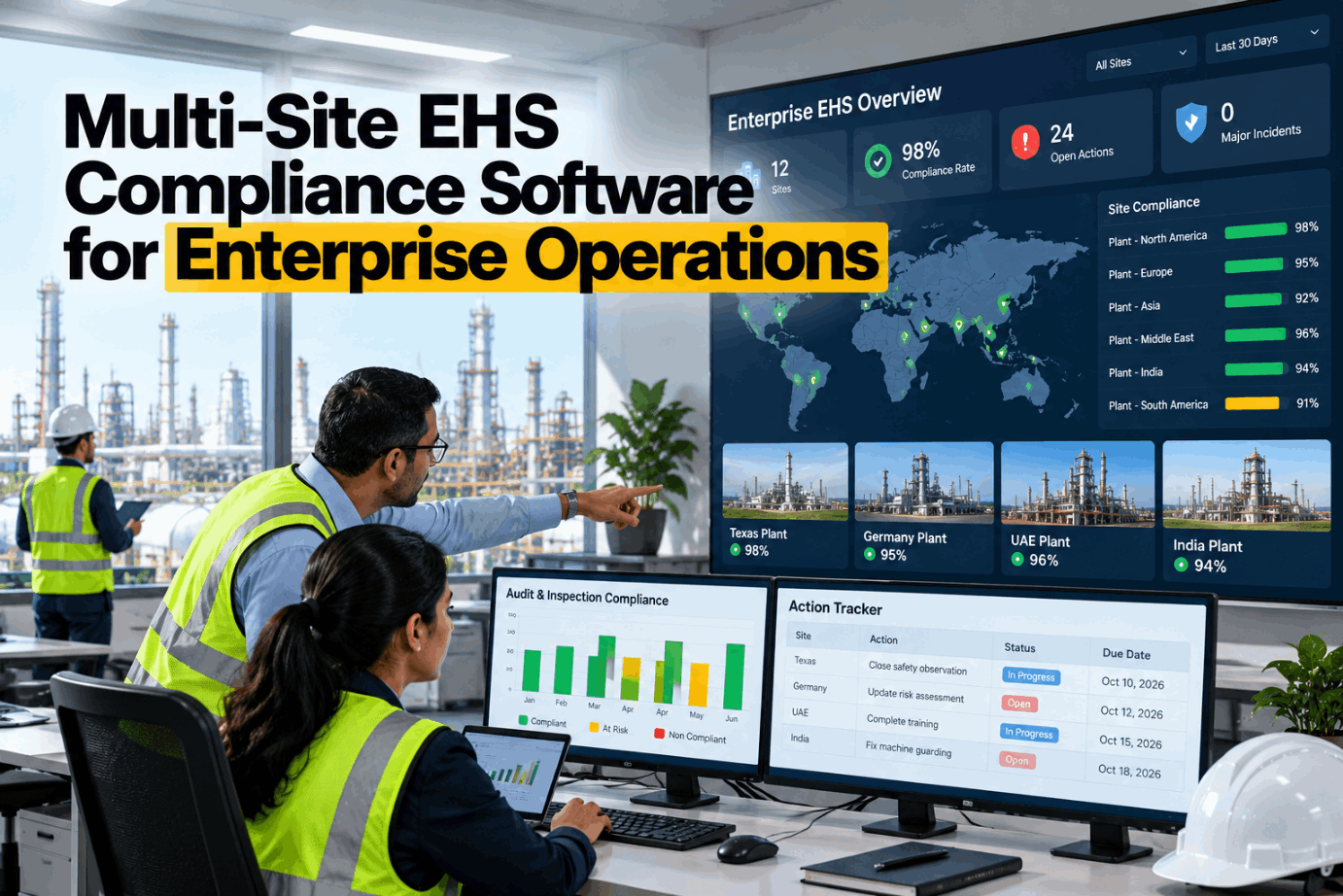
A company with ten plants usually has ten ways of managing safety and environmental compliance. Each site has its own spreadsheets, its own incident categories, its own way of tracking corrective actions and its own understanding of what the regulations require. Corporate EHS leaders spend their time collecting and reconciling data instead of improving performance, and nobody can say with confidence whether a hazard cited at one plant has been fixed at the others. Regulators, meanwhile, treat the company as one employer: a repeat violation can rest on a citation at a different facility. Multi-site EHS software gives every site the same processes and definitions, rolls data up to enterprise dashboards and still lets each site manage its own permits, rules and priorities. This guide covers site-level obligations, enterprise exposure, what to standardize, metrics, management systems and rollout. To see an enterprise EHS view, book a short walkthrough.
Multi-Site EHS Compliance Software for Enterprise Operations: One Standard, Every Facility
Incidents, inspections, corrective actions and compliance tasks run the same way at every site, rolled up to enterprise dashboards, with local rules and permits kept under local control.
Why Multi-Site EHS Is Harder Than Single-Site EHS
The National Safety Council estimates that work injuries cost the United States $181.4 billion in 2024, with an average cost of $48,000 per medically consulted injury and $1.54 million per death. The Bureau of Labor Statistics recorded 2.5 million nonfatal injuries and illnesses in private industry that year, a total recordable case rate of 2.3 per 100 full-time workers.
For a multi-site company, the challenge is not only preventing those injuries but knowing where the risk is. When every site keeps its own records in its own format, corporate leaders see totals weeks late and cannot tell whether a low rate reflects good performance or under-reporting. Good practices stay local, and so do unresolved hazards.
Enforcement treats the company as a whole. Under OSHA policy, a repeat violation can be based on a prior citation at any of the employer’s facilities under federal OSHA, generally within five years. A hazard cited at one plant and left uncorrected at another becomes a much larger liability.
One system across all sites turns local knowledge into company knowledge. We can review your current set-up on a call.
What Each Establishment Must Do
OSHA recordkeeping under 29 CFR 1904 is organized by establishment, which means by site.
Every one of these applies site by site, with corporate accountable for all of them. A missed posting or late submission at one small site is still the company’s violation.
Our specialists can map which obligations apply to each of your establishments.
How Enforcement Reaches Across Sites
Several enforcement mechanisms look at the employer as a whole.
In 2026, up to $16,550 per serious violation and $165,514 per willful or repeated violation; no inflation increase was applied this year.
A repeat can rest on a prior citation at another facility of the same employer.
OSHA’s Severe Violator Enforcement Program, revised in 2022, includes nationwide referral procedures and keeps employers listed for at least three years.
Corporate-wide settlement agreements bind all covered locations; a 2023 retail example covered all stores under federal OSHA with $1.35 million in penalties.
EPA reports such as Tier II inventories and TRI are filed for each facility.
OSHA publishes establishment-level injury data and enforcement results.
The implication is that a finding at one site should trigger a check at all sites. Without a shared system, that check depends on emails and goodwill. With one, it becomes an assigned action with a due date at every relevant site.
Cross-site action tracking is the feature enterprise teams use most. See it in a demo.
A Compliance Calendar Across Sites
Many obligations recur on fixed dates for every facility. A few examples show how quickly the calendar fills.
| Date | Obligation | Applies to |
|---|---|---|
| February 1 | Post OSHA Form 300A summary | Each establishment required to keep records |
| March 1 | EPCRA Tier II chemical inventory report | Each facility above reporting thresholds |
| March 2 | Electronic submission of OSHA injury data | Each covered establishment |
| April 30 | End of 300A posting period | Each establishment |
| July 1 | Toxics Release Inventory Form R | Each covered facility |
| Ongoing | Permit renewals, inspections, training and state deadlines | Each site, by its permits and state |
Multiply these by the number of sites and add permit-specific and state-specific dates, and the calendar becomes impossible to manage by memory. A central calendar with site-level owners shows what is due, what is done and what is late.
Loading each site’s obligations into one calendar is part of every rollout.
What to Standardize and What to Leave Local
Enterprise EHS works when it standardizes the right things and leaves the rest to the sites.
- Incident categories and severity definitions
- Corrective action workflow and due-date rules
- Core inspection and audit templates
- Key metrics and how they are calculated
- Management of change and risk assessment methods
- Reporting periods and review cadence
- Site permits and their conditions
- State and local regulatory requirements
- Site-specific procedures and hazards
- Language and local terminology
- Local inspection routes and frequencies
- Site priorities and improvement plans
The usual mistake is to standardize too much or too little. Force every site into identical checklists and local teams work around the system. Standardize nothing and the dashboards compare numbers that mean different things.
A workable rule is that definitions and workflows are global, while content is local. Every site reports a recordable injury the same way; each site decides what goes on its own weekly inspection.
Our advisors help define that boundary with your site leaders.
Metrics That Compare Sites Fairly
Incidence rates normalize injuries by hours worked so sites of different sizes can be compared.
Illustrative. The 200,000 figure represents 100 full-time workers for a year, per BLS.
Rates are lagging indicators: they describe what has already happened. OSHA’s 2019 guidance on leading indicators describes them as proactive, preventive and predictive measures. Examples include inspections completed on time, corrective actions closed on time, near misses reported, training completed and hazards found per inspection.
Comparing leading and lagging indicators side by side is revealing. A site with a low injury rate and few near-miss reports may simply be reporting less. A site with many near misses and fast corrective action closure is often the safer one.
Showing both kinds of indicator for every site is how enterprise dashboards earn trust. Ask our team for an example.
Management Systems and Multi-Site Certification
Many enterprises certify their sites to ISO management system standards, and a common platform makes that far easier.
The ISO 14001 transition is a practical example of why a common system matters. Every certified site must move to the 2026 edition, and a shared platform lets the central team roll out revised procedures and track each site’s progress.
Our engineers can map your management system structure into the platform.
Rolling Out Across Many Sites
Enterprise rollouts succeed when they are staged.
Definitions, workflows and metrics agreed with a group of site and corporate leaders.
Different sizes and processes, to test the core against real variety.
Refine configuration into a template other sites can adopt quickly.
Groups of sites, each with local content loaded and local champions trained.
HR, CMMS, training and incident data sources connected.
A regular review of metrics, actions and system changes across sites.
Local champions matter more than software features. A site EHS lead who helped shape the template will bring the site along; one who had it imposed will keep the old spreadsheet running in parallel.
Incidents, inspections and observations entered on site.
Corrective actions assigned locally with due dates.
Significant findings sent to all relevant sites as actions.
Metrics calculated the same way for every site.
Regional and corporate reviews focus on outliers.
Good practices turned into company standards.
See how a finding at one site becomes an action at others in a session.
Multi-Site EHS Checklist
Use this checklist to test an enterprise EHS program.
Most enterprises find their sites define incidents differently. An EHS review measures how far apart they are.
What an Enterprise EHS Platform Is Worth
Value comes from risk seen earlier and effort no longer spent on collecting data.
Analyst firm Verdantix estimated the EHS software market at $1.9 billion in 2023 and forecast $4.5 billion by 2029, growth of about 14.6% a year. That investment reflects how many companies have decided that spreadsheets cannot manage enterprise risk.
A comparison of how three of your sites record the same incident usually makes the case. We can run it in a working session.
How iFactory Delivers the Enterprise Multi-Site EHS Platform
One incident, inspection and action workflow for all sites.
Site permits, procedures and state rules managed locally.
Leading and lagging indicators by site, region and company.
Findings at one site assigned as actions at others.
Every site’s obligations with owners and status.
Records and documents for multi-site certification.
It runs on premises or in your private environment, with each site connected. Share your site list and we will design the structure in a pilot.
See How Differently Your Sites Manage the Same Risk
Share incident and action data from three sites. We compare definitions, closure times and open actions and show what a common standard would reveal.
Site 9 has 23 corrective actions more than 30 days overdue. Three relate to the same hazard that was cited at Site 4 last year, which raises the risk of a repeat citation.
A Repeat Risk Seen From the Enterprise View
This exchange shows how a corporate EHS director might use iFactory.
iFactory ships as a pre-configured NVIDIA AI server, racked and ready with the enterprise EHS management models loaded. Rack it, plug in power and Ethernet, and the AI is live on your network. Our scope covers cameras, sensors and data connections across every facility, with regional and corporate dashboards, CMMS, HR, training and access control integration, cabling and network setup, supervisor and safety team training, and 24×7 remote monitoring. Alerts and records support your safety team; they do not replace your procedures, competent persons or legal duties.
Server installed, system links live, existing permits, inspections, training and incident records loaded.
Workflows and models configured to your own procedures, then piloted in one area with your safety team reviewing every alert.
Rollout to the agreed areas and sites, supervisor and safety team training, and 24×7 remote monitoring in place.
Software, server and integration come as one package. For pricing across your sites, contact our sales team.
Frequently Asked Questions
Software that runs safety and environmental processes the same way across all of a company’s facilities, rolls data up to enterprise dashboards and lets each site manage its own permits and local requirements.
Yes. A separate OSHA 300 log is required for each establishment expected to operate for a year or longer, with the annual summary certified by an executive and posted from February 1 to April 30.
Yes. Under OSHA policy a repeat violation can be based on a prior citation at another facility of the same employer, generally within five years, and carries a maximum penalty of $165,514 in 2026.
Number of cases multiplied by 200,000 and divided by hours worked. TRIR uses all recordable cases; DART uses cases with days away, restriction or transfer.
Definitions, workflows and metrics. Site permits, state requirements, local procedures and priorities should stay under local control.
A pilot at the first sites can typically be live within a 6–12 week rollout, with further sites added in waves. Plan it with our specialists.
One EHS Standard Across Every Facility
iFactory gives every site the same processes and definitions, shows leaders where risk is building and turns a finding at one plant into action at all of them.
Illustrative. Rates per 100 full-time workers. Lagging rates are shown beside leading indicators for the same sites.