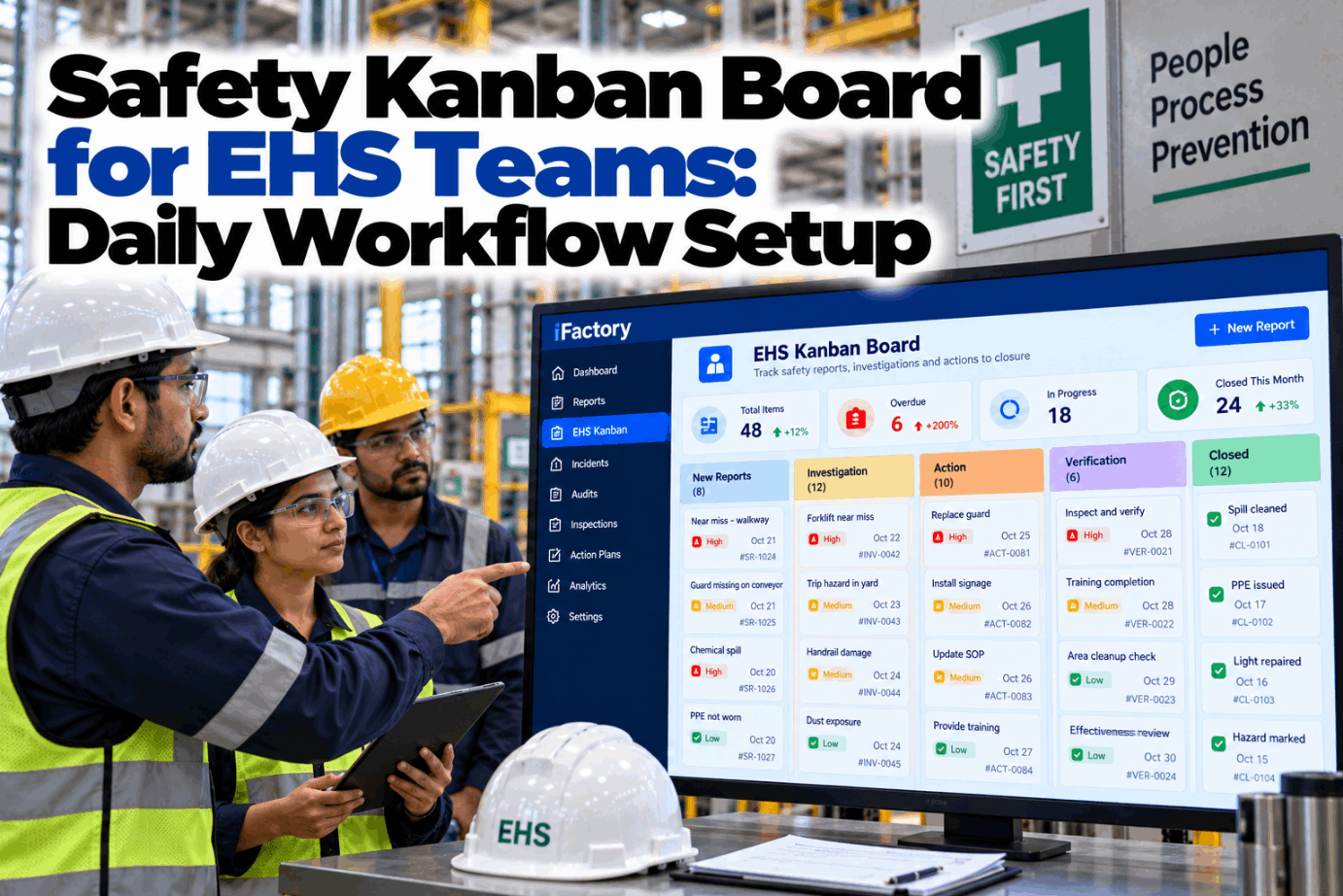
Most EHS teams don't lose track of safety work because they don't care. They lose it in inboxes, spreadsheets and audit reports that nobody opens twice. A near miss is logged, an action is agreed, and three months later nobody can say whether the guard was fitted or whether it worked. A safety kanban board puts every report, investigation and action in one visible flow, with limits that stop the team taking on more than it can finish. See a live board on real plant data in a short EHS kanban demo.
EHS KANBAN · DAILY WORKFLOW
One Board From First Report to Verified Fix, Moved From the Floor
With iFactory EHS Kanban, cards are raised automatically from reports, audits and inspections. Supervisors move them by voice from the floor, and cards that sit too long are escalated automatically, so nothing goes quiet.
Plant 2 · EHS boardStand-up 08:15
Cards in each column against its WIP limit
New reports4
Investigation4/4
Action6/8
Verification2/3
Supervisor, Line 3 · voice"Card 214, guard refitted on conveyor 3. Move to verification."
SAFETY KANBAN BOARD EHS
A Factory Idea Brought Back to the Factory
Kanban means "signboard" in Japanese. Toyota developed it under Taiichi Ohno from the late 1940s onward to pull work only when the next step was ready for it. David J. Anderson later turned the idea into the Kanban Method for knowledge work, set out in his 2010 book Kanban: Successful Evolutionary Change for Your Technology Business. EHS work fits the method well: it arrives unevenly, competes with production for attention and is easy to start and hard to finish. Ask our EHS team how the method maps to your current process.
01Make the work visibleEvery report, investigation and action is a card in a column, not a line in someone's inbox.
02Limit work in progressEach column has a cap. When it is full, the team finishes work before starting more.
03Manage the flowWatch how long cards wait, not just how many there are, and fix the place they get stuck.
EHS WORKFLOW BOARD
Five Columns, Each With a Clear Way In and Out
A column is only useful if everyone agrees what it means. Write an entry rule and an exit rule for each one and put them on the board. That stops arguments at stand-up about whether a card is "really" in action, and it makes the verification column a real gate instead of a parking spot. Set your own column rules in a board design session.
New reportsNo limit
Enters whenA hazard, near miss, incident, audit finding or failed inspection item is reported
Leaves whenTriaged: risk lane, owner and first containment agreed
InvestigationWIP 4
Enters whenAn investigator has capacity and pulls the card
Leaves whenCauses found and actions agreed with the people doing the work
ActionWIP 8
Enters whenEach action has one owner, a due date and a control type
Leaves whenThe owner says the control is in place, with evidence
VerificationWIP 3
Enters whenAction is reported done
Leaves whenSomeone other than the owner confirms the control works in real use
ClosedArchive
Enters whenVerification passed and records filed
Leaves whenNever. Reopened cards go back to Action
CARD ANATOMY
What Every Safety Card Should Carry
A card is a small record, not a sticky note. It should tell anyone at stand-up what happened, how serious it is, who owns it and how long it has been waiting, without opening anything else. The example below shows the fields that make a card useful. Get a starter card layout from our support team.
SK-214High risk
Conveyor 3 tail pulley guard missing after belt change
SourceWeekly guarding audit
AreaPacking hall, Line 3
OwnerMaintenance planner
DueThu, end of shift
Control typeEngineering: fixed guard
Age in column2 days
Photo, audit item and interim barrier attachedVerifier: area supervisor
1ID and laneUnique number and risk lane, so the card is easy to find and rank
2Plain titleWhat and where, in words anyone on the shift understands
3SourceReport, audit or inspection that raised it, linked back
4One owner, one dateA named role and a due date, never "the team"
5Control typeWhere the fix sits in the hierarchy of controls
6Age in columnDays since the card last moved, the number that drives escalation
SWIMLANES BY RISK LEVEL
Serious Hazards Get Their Own Fast Lane
If every card sits in one pile, a loose handrail and a missing machine guard wait in the same queue. Horizontal swimlanes split the board by risk, so high-risk cards are always at the top and are reviewed first. The targets below are examples only. Your own procedure and risk matrix set the real ones. Agree lanes and targets with our EHS consultants.
WIP LIMITS EHS
Why Fewer Open Investigations Finish Sooner
Little's Law, proved by John Little in 1961, links three long-run averages in any stable system: average work in progress equals throughput multiplied by average lead time. Turned around, lead time equals WIP divided by throughput. If your team finishes a fixed number of investigations a week, every extra open one adds waiting time to all the others. A WIP limit makes that visible and stops it. Size your own limits with our support team.
Lead time = WIP ÷ throughput
Investigation column, no limit
Average open investigations12
Investigations finished per week4
Average lead time12 ÷ 4 = 3 weeks
Same team, WIP limit of 6
Average open investigations6
Investigations finished per week4
Average lead time6 ÷ 4 = 1.5 weeks
Illustrative figures. The limit does not raise throughput by itself. It shortens the wait for each card. If new reports keep arriving faster than 4 a week, they queue in New reports instead, which is the signal that the team needs more investigators, not more open files.
Start near the team sizeA common starting point is one or two cards per person working the column, then tune.
No limit on New reportsNever discourage reporting. Limit the work, not the hazards people tell you about.
Full column means swarmWhen a column is at its limit, help finish a card there before pulling a new one.
Cards That Raise Themselves and Chase Themselves
iFactory raises a card automatically when a report, audit finding or failed inspection item comes in. Supervisors move cards by voice, and any card that stops moving is escalated automatically before it goes stale.
EHS manager and iFactory · Monday stand-up
EHS managerWhat is stuck on the board this morning?
iFactoryTwo cards. SK-198 has waited 6 days in Action for guard parts, and SK-205 has waited 4 days in Verification with no verifier booked.
EHS managerPut SK-205 on the Line 3 supervisor for today.
iFactoryDone. SK-205 verifier set to Line 3 supervisor, due end of shift. SK-198 is flagged blocked on parts.
STALE-CARD ESCALATION
A Card That Stops Moving Climbs the Ladder
Age is the most honest number on the board. A card that hasn't moved is either blocked, forgotten or too big. Escalation rules make sure someone notices before it matters, and they climb in steps so managers only see what the team couldn't fix. The thresholds below are examples for each lane. See escalation rules working in an escalation walkthrough.
Step 1
Nudge the ownerHigh 1 day · Medium 5 days · Low 10 days without a moveStep 2
Tell the supervisorHigh 2 days · Medium 10 days · Low 20 daysStep 3
Raise at stand-up with the area managerHigh 3 days · Medium 15 days · Low 30 daysStep 4
Plant manager reviewAny high-risk card past its due date, or any card reopened twice
DAILY STAND-UP ROUTINE
Fifteen Minutes, Walked From Right to Left
Kanban teams usually walk the board from right to left, starting with the work closest to done. For EHS that means verification first, because a finished action nobody has checked is the cheapest win on the board. Keep it standing, keep it short and talk about cards, not people. Get a stand-up script for your shifts from our EHS specialists.
0–3 min
VerificationWhich cards can be checked and closed today, and who verifies3–7 min
ActionBlocked and ageing cards first. What does each owner need?7–10 min
InvestigationAny investigator stuck on access, data or interviews10–13 min
New reportsTriage: lane, owner, containment. Thank the reporter13–15 min
Pull and escalatePull cards into free slots, confirm today's escalations
ACTION VERIFICATION COLUMN
Done Is Not the Same as Effective
ISO 45001 clause 10.2 asks organisations to review the effectiveness of any action taken after an incident or nonconformity, and to keep evidence of the result. OSHA's guidance on hazard controls warns that all controls tend to degrade over time, and suggests tracking both the work on each control and the reviews of it. The verification column is where that happens. Build a verification step into your board in a verification setup call.
DONE: THE OWNER SAYS
- The guard has been fitted
- The procedure has been revised
- The crew has been briefed
- The sign is up
EFFECTIVE: THE VERIFIER CHECKS
- The guard stays fitted through a full shift and a belt change
- People doing the job say the new method works for them
- No new hazard came with the fix
- Risk assessment and training records match the change
If verification fails
The card goes back to Action with the reason written on it, and the reopen count goes up by one. Two reopens on the same card is a sign the cause was not found, so it returns to Investigation.
VOICE CHANGES FROM THE FLOOR
Move a Card Without Walking Back to the Office
Boards fall behind when the people who do the work have to find a screen to say so. With voice, a supervisor wearing gloves on the floor says what changed, iFactory reads back what it understood, and the card moves only after a yes. Hear how it handles plant noise and local terms from our support team.
SAFETY KANBAN BOARD EHS FOR PLANT MANAGERS
Five Flow Measures Worth a Weekly Look
Counting open actions tells you little. Flow measures tell you whether safety work is moving and where it gets stuck. The snapshot below is an illustration of a weekly review, not real plant data. Review it with EHS and production leads together, because most blocked cards wait on production time or parts. Set up your weekly review in a board review demo.
Lead time, high lane9 daysReport to verified close, average
Throughput11 / weekCards verified and closed
Oldest card34 daysSK-161, low lane, Action
Blocked share3 of 19Open cards flagged blocked
Reopened2Failed verification this week
TURNKEY AI DEPLOYMENT
Board, Voice Agent and AI Server in One Package
iFactory delivers EHS Kanban as a turnkey bundle. A pre-configured NVIDIA AI server ships racked and ready with the board, the voice agent and the links to your reporting, audit and inspection forms pre-loaded, so speech is processed on site. You rack it, plug in power and Ethernet, and the AI is live. Confirm the scope for your plant with our integration team.
What's Included
- Pre-configured NVIDIA AI server, racked and ready
- EHS Kanban with your columns, lanes and WIP limits
- Cards raised automatically from reports, audits and inspections
- Voice agent tuned to your areas and plant terms
- Stale-card escalation rules per lane
- Stand-up and verification training for supervisors
- 24x7 remote monitoring of server and software
Live in 6–12 weeks
Wk 1–4
Install and Connect
Server racked, report, audit and inspection sources linked, open actions loaded as cards.
Wk 5–8
Pilot Board
One area runs daily stand-ups on the board, voice phrases and limits tuned.
Wk 9–12
Go-Live and Training
All areas on the board, escalation switched on, supervisors trained on every shift.
HOW iFACTORY FITS
A Safety Board That Keeps Itself Current
iFactory EHS Kanban is built for teams who spend their day on the floor, not at a desk. See the full board in a live board tour.
1
Cards raised automatically. Reports, audit findings and failed inspection items land in New reports with source and photos linked.
2
Voice from the floor. Supervisors move, block and query cards by voice, with every change read back first.
3
Stale cards escalated. Age rules per lane notify owners, supervisors and managers in steps.
4
Verified before closed. WIP limits and a verification gate keep the board honest.
1000+
Industrial clients running iFactory
99.9%
Platform uptime for round-the-clock plants
6-12 wks
From racked server to a live safety board
FREQUENTLY ASKED QUESTIONS
What EHS Teams Ask About Safety Kanban Boards
What is a safety kanban board?
It is a visual board that shows every piece of EHS work as a card moving through columns, typically New reports, Investigation, Action, Verification and Closed. Each column has an agreed entry and exit rule, and most columns have a work-in-progress limit so the team finishes work before starting more.
How do we set WIP limits for an EHS team?
Start near the number of people working each column, often one or two cards per person, then watch how long cards wait and adjust. Never put a limit on New reports, because you never want to discourage reporting. When a column hits its limit, the team helps finish a card there instead of pulling a new one.
Why does a WIP limit shorten lead times?
Little's Law says that, on average in a stable system, lead time equals work in progress divided by throughput. If a team closes 4 investigations a week and holds 12 open, each takes about 3 weeks. Hold 6 open at the same rate and each takes about 1.5 weeks. The limit shortens the wait, it doesn't make the team faster.
Why have a separate verification column?
Because a finished action isn't always an effective one. ISO 45001 clause 10.2 calls for reviewing the effectiveness of actions taken, and controls can degrade over time. A verifier who isn't the action owner checks the control in real use before the card closes.
How do cards get onto the board?
In iFactory, cards are raised automatically from hazard and near-miss reports, audit findings and failed inspection items, with the source linked. Supervisors can also raise a card by voice from the floor. Each new card starts in New reports and is triaged at the next stand-up.
Can we start with one area?
Yes, and most plants should. Pick one area with an engaged supervisor, load its open actions as cards and run a daily stand-up for a few weeks before adding more areas. Our
support team can help you plan that pilot.
Every Hazard on One Board, Every Fix Verified
Raise cards automatically from reports, audits and inspections, move them by voice and let stale cards escalate themselves. The full system is delivered turnkey and goes live in 6 to 12 weeks.
Example board setup · Plant 2
ColumnsNew, Investigation, Action, Verification, Closed
LanesHigh, medium, low, expedite
Card sourcesReports, audits, inspections, voice
EscalationFour steps by card age
Nothing closes without verification