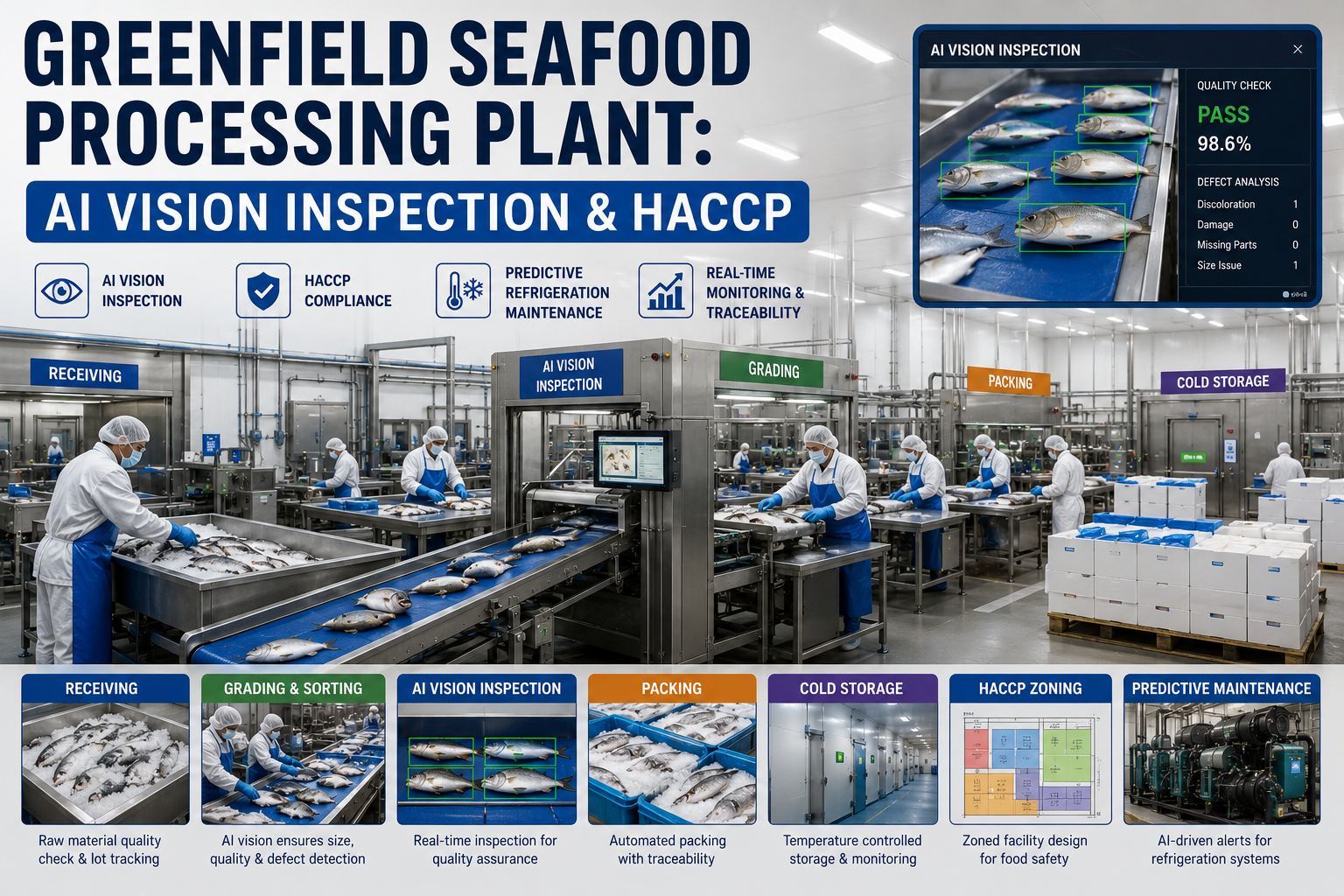
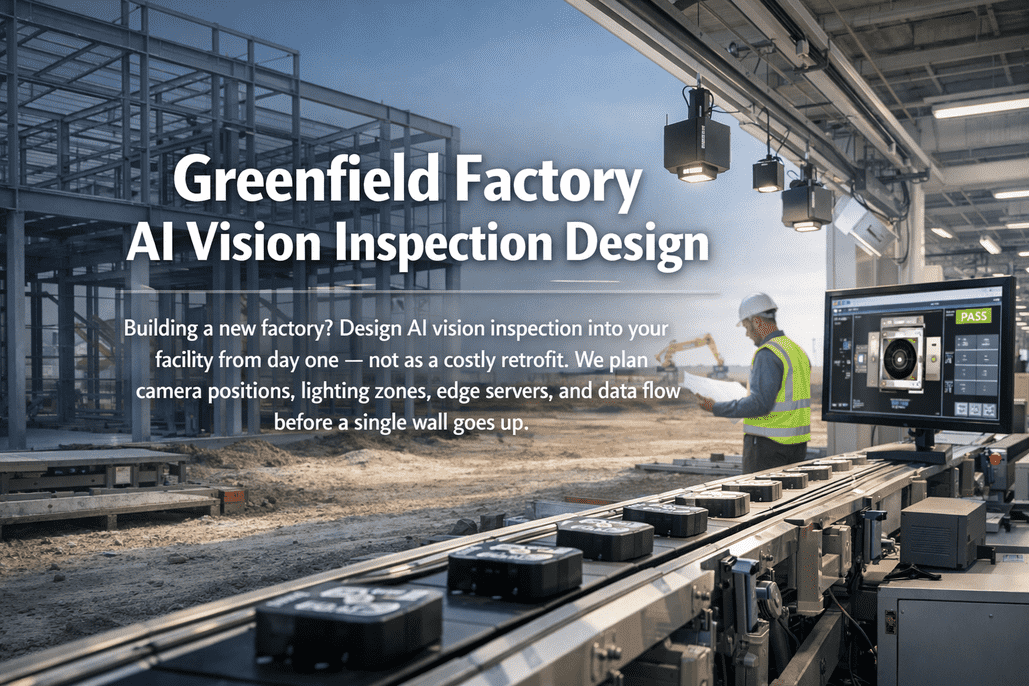
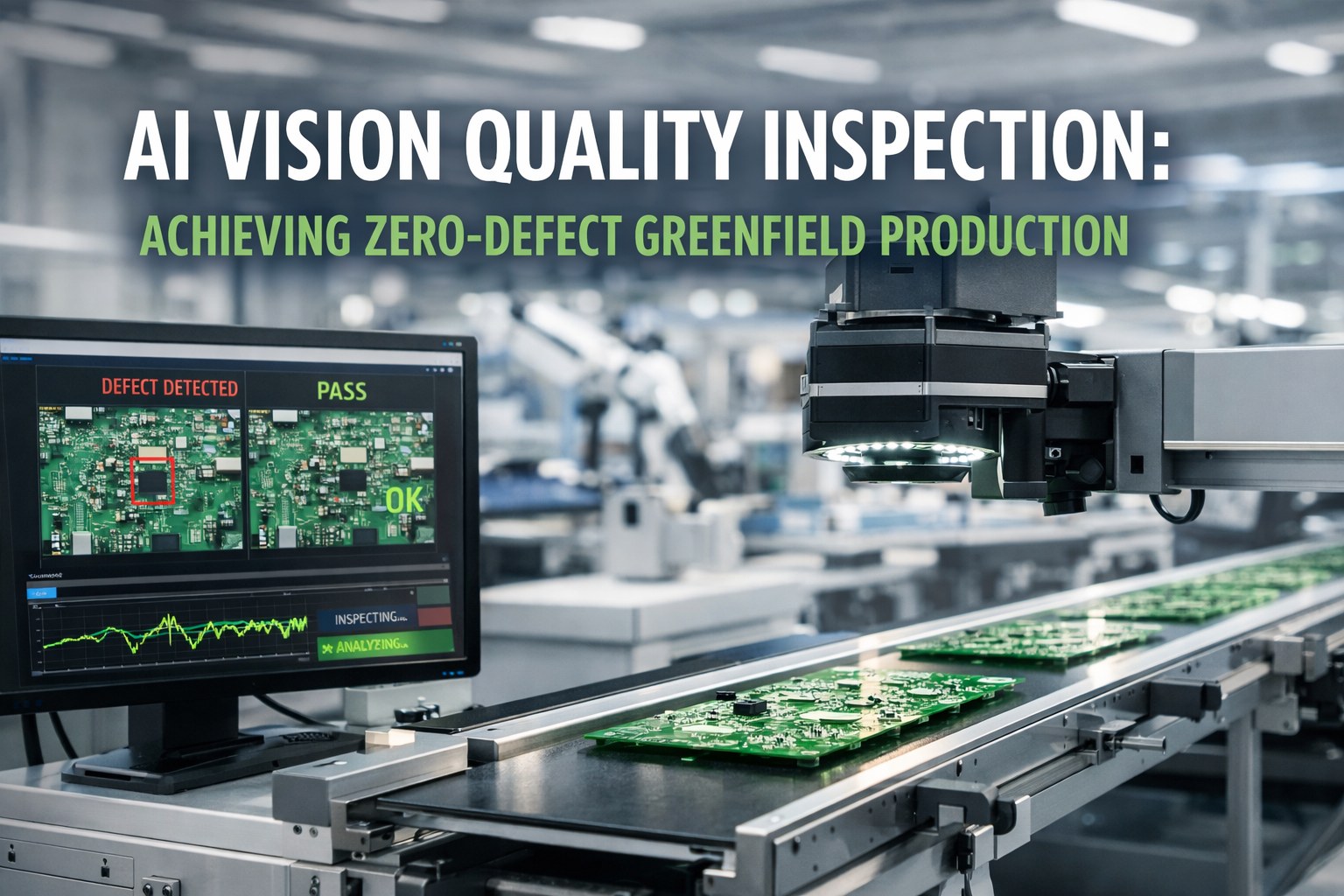
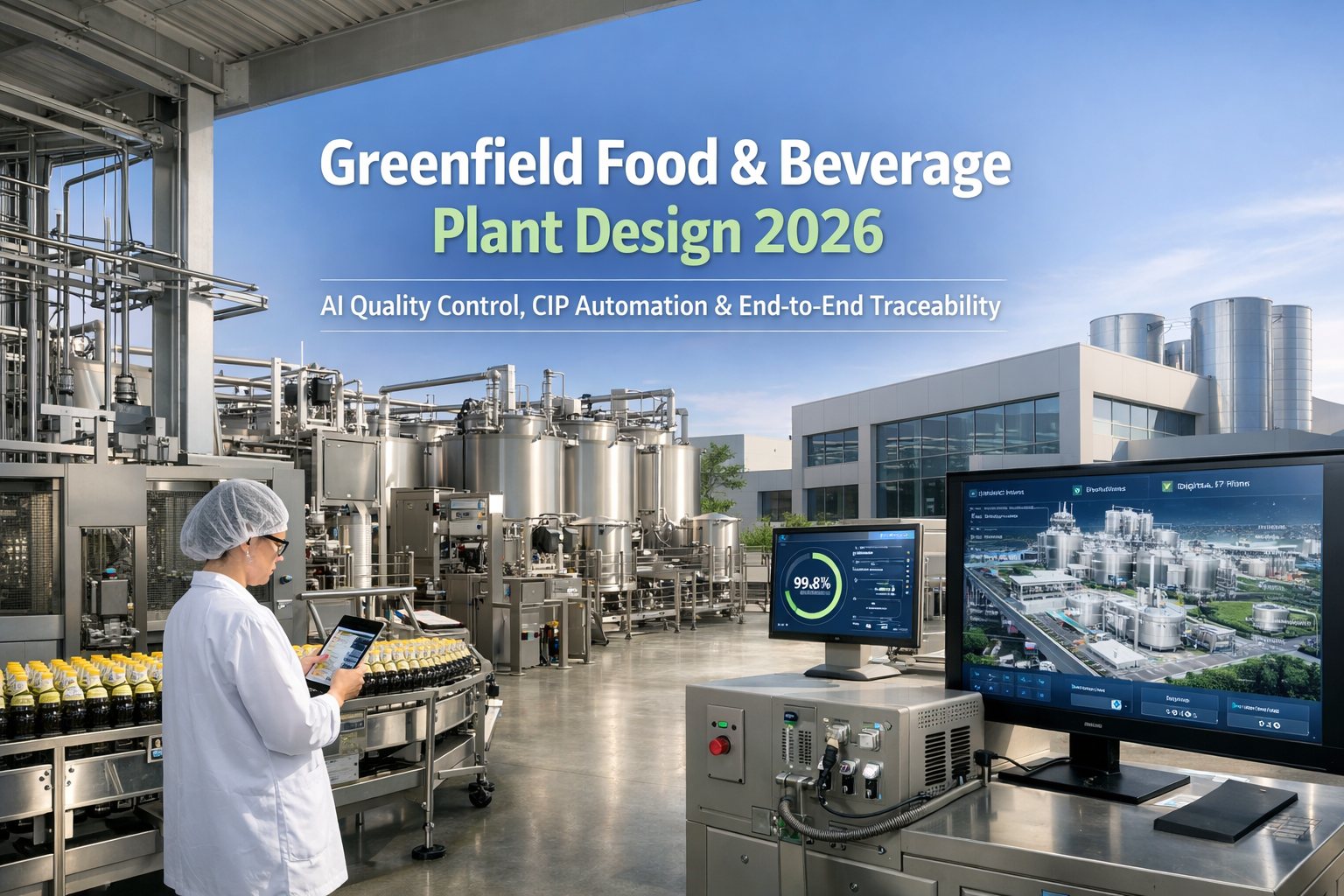
Food safety starts at facility design. Each year, contaminated food sickens 600 million people globally. A single food recall costs $10M per incident in direct costs — plus immeasurable brand damage. Manual inspection catches only 70% of foreign objects, and sampling-based quality control leaves 90% of production volume uninspected. Retrofitting AI vision into existing washdown environments creates reflection nightmares from stainless steel surfaces, water film, and steam that destroy AI accuracy. When you design AI vision into your greenfield food facility, washdown-rated cameras are integrated into the sanitary design, lighting is engineered for transparent and reflective packaging, and HACCP documentation flows automatically from every critical control point. AI-powered X-ray and optical inspection detects contaminants as small as 0.5mm at full line speed — metal, glass, bone, plastic, and stone that metal detectors and human inspectors miss entirely. Design Your Food Safety Vision
The Cost of Missing What Matters
Foreign Object Recall
A single glass fragment in a jar of baby food triggers a nationwide recall: $10-15M in direct costs, regulatory investigation, and brand reputation damage that takes years to rebuild. Manual inspection catches 70% at best. X-ray + AI catches 99.9%+ of metal, glass, bone, and stone contaminants as small as 0.5mm. Greenfield: X-ray and optical inspection stations designed into the line from day one.
$10-15M per recall incidentAllergen Mislabeling
Wrong allergen declaration on a label can be fatal for allergic consumers. FDA and FSMA require 100% label verification. OCR/OCV vision systems read every label at line speed — lot code, expiry date, allergen statement, barcode, and nutritional panel. One missed label in a million is one too many. Greenfield: label verification cameras at every packaging station.
$5-10M per mislabeling recallUnderfill / Overfill
Underfill: regulatory violation and consumer complaints. Overfill: product giveaway that erodes margins — 1% overfill on a high-volume line wastes $100K-$500K annually. AI fill-level monitoring with sub-millimeter accuracy on every container eliminates both problems. Greenfield: fill-level cameras positioned at optimal angles during line design.
$100K-$500K/yr in giveawaySeal Failure
A compromised seal allows microbial contamination, reducing shelf life or causing spoilage that reaches consumers. Vision systems inspect seal integrity on every package — detecting incomplete seals, wrinkles, contamination in the seal zone, and mis-registration. Greenfield: seal inspection cameras integrated into the sealing machine design.
Full batch rejection + recall riskBuilding a new food facility? Design Your Food Safety Vision — we specify camera, lighting, and AI models for every HACCP critical control point in your production line.
Food Product Inspection Matrix
| Product Type | Inspection Tasks | Technology | Detection Capability | Line Speed | Compliance Standard |
|---|---|---|---|---|---|
| Beverages (Bottles/Cans) | Fill level, cap presence/torque, label verification, foreign object | Area scan + backlight (fill); X-ray (contaminant); OCR (label) | ±0.5mm fill; 0.5mm metal in liquid | 600-1,200 units/min | HACCP; FDA 21 CFR 110; FSMA |
| Dairy Products | Seal integrity, date code, fill weight, container defects | Area scan + thermal for seal; checkweigher + vision | Seal defects >0.5mm; ±1g weight | 200-600 units/min | HACCP; PMO (Grade A); FSSC 22000 |
| Meat / Poultry | Foreign objects (bone, metal, plastic), color grading, portion sizing | X-ray (bone/metal); multispectral (contamination); 3D (sizing) | Bone fragments >1mm; metal >0.5mm | 100-400 packages/min | HACCP; USDA FSIS; BRC |
| Bakery / Snacks | Shape verification, color consistency, count, packaging integrity | Area scan + color camera; X-ray for dense contaminants | Shape ±2mm; color ΔE <3 | 300-800 units/min | HACCP; BRC; SQF |
| Ready Meals / Frozen | Component presence, fill level, seal integrity, foreign objects | X-ray + optical; multispectral for tray inspection | Metal/glass/bone >1mm in mixed product | 60-200 trays/min | HACCP; FSSC 22000; retail specs |
| Confectionery | Shape/size sorting, wrapping integrity, print quality, count | Area scan + high-speed sorting; OCR for print | Shape ±1mm; wrapping completeness | 500-1,500 units/min | HACCP; BRC; IFS |
Washdown-Rated Camera & Lighting
IP69K Camera Housings
316L stainless steel housings rated for high-pressure (1,450 PSI), high-temperature (80°C) washdown with caustic chemicals. Electro-polished surfaces with no crevices for bacterial harborage. Optical-grade glass windows with hydrophobic coating. Withstand daily CIP/COP cycles without degradation. In greenfield: camera housing specs included in equipment design — no aftermarket enclosures needed.
Sanitary Mounting Design
Mounting brackets sloped to prevent water pooling (3-5° minimum). All fasteners: 316L stainless, Allen head (no Phillips that trap debris). Cable glands: IP69K rated with food-grade seals. Cable routing: through sanitary conduit or sealed cable tray with smooth internal surfaces. In greenfield: mounting points and cable routes designed into the equipment frame during engineering.
Lighting for Wet Environments
IP69K LED bar lights and dome lights with 316L housings. Sealed optics prevent moisture ingress during washdown. Anti-condensation heating prevents fogging on camera and light windows in refrigerated production areas. Multi-spectral LED (white, blue, NIR) for detecting contamination invisible under standard lighting. In greenfield: lighting positions engineered for optimal contrast — not fighting reflections from stainless steel surfaces.
Edge Compute Outside Washdown Zone
GPU inference hardware in a climate-controlled technical area adjacent to production — never in the washdown zone. Fiber optic connections from cameras (fiber is inherently waterproof and EMI-immune). IP69K industrial network switches at the line; standard managed switches in the technical area. Latency: under 50ms from camera trigger to eject decision.
Foreign Object Detection: Technology Comparison
| Technology | Detects | Minimum Size | Strengths | Limitation | Greenfield Integration |
|---|---|---|---|---|---|
| X-Ray Inspection | Metal, glass, stone, bone, dense plastic, calcified material | 0.5-1.5mm (density-dependent) | Detects inside sealed packages; works through foil/metalized film | Cannot detect low-density plastics or thin film | Inline station with conveyor integration; shielded cabinet in line layout |
| Metal Detection | Ferrous, non-ferrous, stainless steel | 0.5mm Fe; 1.0mm non-Fe; 1.5mm SS | Simple, proven, lower cost; high-speed capable | Only detects metal; affected by product effect (wet/salty products) | Tunnel detector sized to product and line; aperture designed for max sensitivity |
| AI Optical Vision | Color anomalies, foreign material on surface, contamination | 2mm+ (visible spectrum); 0.5mm+ (hyperspectral) | Detects soft contaminants (hair, insects, plant material) that X-ray misses | Surface only; cannot see inside sealed packages | Cameras above/below conveyor; lighting optimized for product contrast |
| Hyperspectral Imaging | Plastic, rubber, organic contamination by material composition | 1-2mm | Identifies contaminant type by spectral signature; detects clear plastic in food | Higher cost; requires more compute; slower than standard vision | Dedicated inspection station with controlled lighting; GPU for spectral processing |
Not sure which detection technology covers your product risks? Design Your Food Safety Vision — we specify the optimal combination of X-ray, metal detection, optical, and hyperspectral for your specific products and contaminant risks.
Fill-Level & Packaging Quality Monitoring
Area scan cameras with backlight detect the liquid meniscus through transparent bottles with sub-millimeter accuracy. For opaque containers, gamma-ray or capacitive sensors complement vision. AI compensates for foam, bubbles, and product viscosity variations that confuse simple threshold-based systems.
Cameras verify cap presence, orientation, skew, and tamper-evident band integrity. Torque verification through visual indicators (breakaway ring position). Detects cross-threaded caps, missing liners, and damaged closures at 600-1,200 bottles per minute. Eject signal to PLC within 20ms of detection.
For heat-sealed trays, pouches, and blisters: cameras detect incomplete seals, wrinkles, channel leaks, and contamination in the seal zone. Transmitted light through the seal area reveals voids invisible from above. Vacuum decay testing integrated with vision for quantitative seal-strength verification.
OCR/OCV reads every printed character: lot code, expiry date, allergen declarations, nutritional panels. Barcode grading (ISO 15416/15415) ensures scannability throughout the supply chain. AI detects label skew, wrinkles, missing labels, and wrong product labels — preventing the allergen mislabeling incidents that trigger $5-10M recalls.
Key Benefits & ROI
Food Safety Is Not a Retrofit — It's a Foundation
iFactory designs complete AI vision inspection for food and beverage greenfield facilities — washdown-rated cameras, X-ray/optical/hyperspectral foreign object detection, fill-level monitoring, label verification, and HACCP-compliant documentation — all engineered into your facility before construction.
Frequently Asked Questions
One Contaminated Product = $10M Recall. One Vision System = Prevention.
Design foreign object detection, fill verification, label compliance, and seal integrity into your food facility before the first production run. Zero retrofit. Zero sampling gaps. Zero excuses.