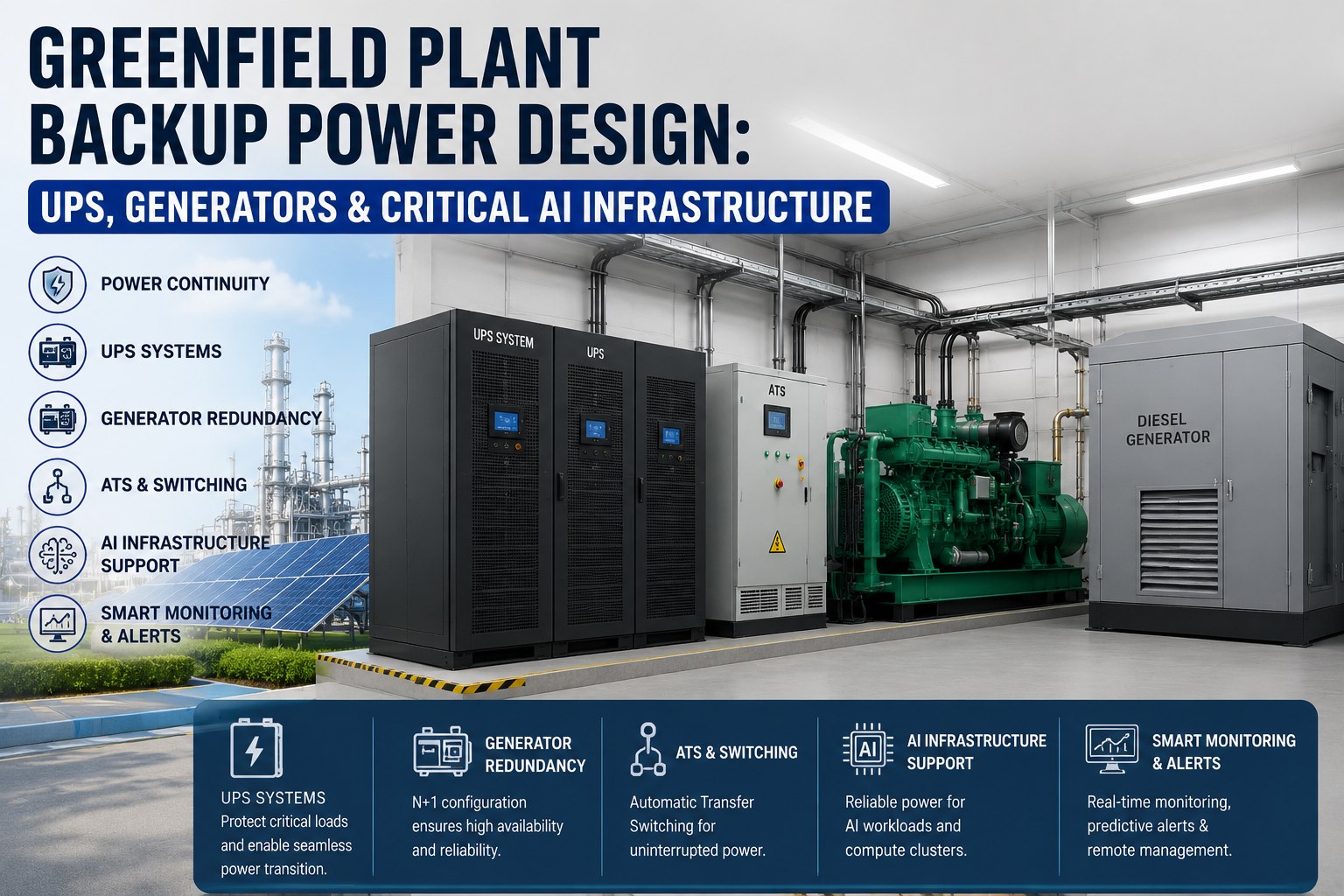
Power outages cost manufacturing plants between $1,000 and $50,000 per minute depending on production line value, batch destruction risk, and AI compute infrastructure exposure. A 90-second outage at a pharmaceutical plant destroys a batch worth $2M. A 15-minute outage at an automotive line costs $400K in lost throughput. A power transient lasting 20 milliseconds — far too short for any generator to start — can crash an entire AI inference cluster mid-process. Backup power in a greenfield plant is not a generator on a concrete pad. It is a tiered architecture: UPS for instantaneous bridge, BESS for short-duration recovery, generators for extended outage, all coordinated by automatic transfer switching designed before the building electrical drawings are issued. Book a greenfield backup power design consultation to specify your tiered power architecture before main switchboard procurement begins.
Greenfield Plant Backup Power Design — UPS, Generators & AI Infrastructure 2026
The Power Outage Timeline — What Fails at Each Second, and What Backs It Up
0 to 10 seconds
UPS (Online Double-Conversion)
Protects: AI compute, PLCs, SCADA, MES servers, process controllers
Without UPS: AI inference clusters crash, control loops freeze, batch processes corrupt — all within first power cycle
T + 10 s
ATS detects sustained outage — generator start signal
10 to 30 seconds
UPS continues bridging while generator starts
Bridges: All critical loads remain online via UPS battery
Risk: Undersized UPS battery runtime forces emergency shutdown before generator picks up load
T + 30 s
Generator at synchronous speed — ATS transfers load
30 seconds to hours
Diesel or gas generator carries plant essential loads
Protects: Production lines, HVAC, lighting, safety systems, full UPS recharge
Risk: Fuel supply, generator cooling, and load step capability all critical — sudden load steps can trip generator
T + Extended
AI monitoring detects extended outage — schedules load shedding to extend runtime
Beyond generator fuel limit
BESS (Battery Energy Storage System) + Solar PV + AI orchestration
Protects: Mission-critical AI compute, life-safety systems, controlled shutdown sequence
Greenfield design: BESS plant room, solar interconnect, and AI load orchestrator are designed in — not added later
20 msTransient long enough to crash AI inference clusters — too short for any generator
$1K–$50KPer minute outage cost depending on production line and batch exposure
10–15 yrLithium-ion UPS lifespan vs. 3 to 5 years for lead-acid — lower TCO
N+1 to 2NRedundancy levels — driven by criticality tier, not facility size
Load Criticality Tiering: The First Design Decision Before Sizing Anything
Every load in your greenfield plant fits into one of four criticality tiers — and the tier determines whether it gets utility power only, generator backup, UPS bridge, or full N+1 redundant UPS plus generator plus BESS. Sizing the backup system without first classifying every load means either over-protecting non-critical equipment (massive CapEx waste) or under-protecting critical loads (the outage that ends production). In a greenfield plant, this load tiering happens before the main switchboard is specified — because the tier dictates which busbar each circuit lands on.
AI inference clusters, MES core servers, process control PLCs, batch reactor controllers, safety instrumented systems
UPS Online Double-Conversion
N+1 or 2N redundancy
Generator backup
Dual feeders
Tolerance: Zero milliseconds — no transient acceptable
Production line motors, conveyors, robots, SCADA workstations, HVAC for clean rooms, process exhaust fans
Generator backup (no UPS)
N+1 generator redundancy
ATS transfer
Tolerance: 10 to 30 seconds — acceptable transfer time to generator
Emergency lighting, fire alarm panels, smoke evacuation fans, fire pumps, evacuation systems, security access control
NFPA 110 Level 1 generator
Local battery for lighting
Dedicated ATS
Tolerance: 10 seconds (NFPA 110 Type 10) — life safety code mandate
General lighting, office HVAC, warehouse, parking, exterior lighting, non-production equipment
Utility power only
Manual restart acceptable
Tolerance: Hours — accept full outage and manual restart sequence
Need a load criticality tiering exercise for your greenfield electrical brief? Book a backup power design consultation — we will classify every load and produce the tier schedule before your switchboard is specified.
UPS vs. BESS vs. Generator: Which Power Source Bridges Which Window
UPS, BESS, and generator are not interchangeable backup sources — each bridges a different time window and protects against a different failure mode. The mistake greenfield projects make is buying one of them and assuming it provides full backup coverage. It does not. A complete tiered architecture requires all three, sized to overlap their coverage windows seamlessly.
UPS
Uninterruptible Power Supply
0 to 10 minutes typical
TechnologyOnline double-conversion topology — battery always in the path
Battery optionsLithium-ion (10–15 yr life) or VRLA lead-acid (3–5 yr life)
Response timeZero transfer — output continuous through utility loss
Use for: Tier 1 loads — AI compute, control PLCs, MES servers. Sized for runtime equal to generator start time plus 50% safety margin.
BESS
Battery Energy Storage System
15 minutes to 4 hours
TechnologyContainerised Li-ion racks with inverters and BMS — utility-scale
Dual purposeBackup + peak shaving + solar storage + demand response
Capacity100 kWh to 10+ MWh scalable
Use for: Extended bridge during generator failure, ride-through for short outages without starting generator, AI load orchestration during shutdown sequence.
Generator
Diesel / Gas Standby
30 seconds to days
FuelDiesel (most common), natural gas, biogas — fuel storage governs runtime
Start time10 to 30 seconds to synchronous speed + load step capacity
Size range100 kW to 5+ MW per unit, paralleled in larger installations
Use for: Sustained backup — production loads, life safety, UPS battery recharge. NFPA 110 compliance required for life safety installations.
Automatic Transfer Switch: The Decision Engine That Makes Backup Power Actually Work
The Automatic Transfer Switch (ATS) is the most overlooked component in backup power design — and the most consequential. ATS determines how quickly utility loss is detected, when the generator start signal fires, when the load is transferred from utility to generator, and when the load returns to utility after the outage. Wrong ATS specification produces a system where the generator runs but never picks up the load, or where the transfer creates a transient that crashes downstream equipment. In a greenfield plant, ATS specification is part of the electrical brief — not an afterthought added during commissioning.
ATS Architecture for a Greenfield Plant — Open vs. Closed vs. Soft Transition
Open Transition
100–300 ms break
Break-before-make. Brief power interruption during source change.
Best for: T2/T3 loads with motor restart tolerance. Cheapest ATS option.
Avoid for: Tier 1 AI/IT loads — even 100 ms causes downstream UPS battery discharge events
Closed Transition
0 ms — synchronous
Make-before-break. Both sources momentarily paralleled (under 100 ms). No interruption.
Best for: Testing and return-to-utility transfers. Avoids unnecessary UPS battery cycles.
Requires: Utility approval (back-feed prevention), synchronising relay, dedicated controls
Soft Loading Transition
0 ms + ramped
Closed transition + gradual load ramp between sources over 5–30 seconds.
Best for: Large generator parallel installations, microgrid operations, BESS integration
Requires: Most sophisticated controls — typically specified with full SCADA integration
Greenfield design rule: For mission-critical plants with AI infrastructure, specify closed transition ATS for the main generator and dedicated open-transition ATS for life safety per NFPA 110 (life safety loads must be on a separate ATS from optional standby loads — never share).
Specify Your Backup Power Tiering Before the Main Switchboard Is Ordered
iFactory's greenfield backup power consultation covers load criticality tiering, UPS sizing and topology, BESS specification, generator sizing and redundancy, ATS architecture, and AI infrastructure load profile assessment — all delivered before your electrical engineer issues drawings or your switchboard is procured.
AI Infrastructure: Why Standard UPS Sizing Rules Do Not Apply
AI compute loads behave fundamentally differently from traditional IT loads on backup power. NVIDIA Blackwell GPUs at 132 kW per rack — scaling to 250–900 kW per rack by 2027 — produce instantaneous load transitions that propagate upstream and can trip a generator before it picks up steady-state load. A standard UPS sized to traditional IT rules will undersize battery capacity, the generator load step will fail, or the upstream transformer will saturate. AI infrastructure requires power architecture designed specifically for its dynamic load behaviour — not retrofitted from a data centre playbook written for 10 kW racks.
1
Power Density Escalation
10 kW racks (legacy) → 132 kW (Blackwell) → 250–900 kW (Rubin, 2026–27)
Greenfield implication: Size electrical infrastructure for future density at design — not current loads. Retrofitting rack power feeds requires switchboard replacement.
2
Dynamic Load Transitions
AI inference workloads create millisecond-scale load steps from 30% to 100% utilisation
Greenfield implication: UPS must handle high crest factor and step load response. Generator must be specified for AI-specific load profile — not standard kVA derating.
3
Uptime Requirements
AI workloads target 99.99999% uptime (seven 9s) — 3.15 seconds per year of allowed downtime
Greenfield implication: 2N redundancy required for true mission-critical AI. N+1 is insufficient for seven-9s uptime targets.
4
Grid Interconnection Delays
Utility interconnection timelines for AI-class facilities now stretch 3 to 7 years in major markets
Greenfield implication: Behind-the-meter power generation (gas turbines, fuel cells, BESS) increasingly required as primary — not backup — source.
Expert Perspective: Backup Power Is an Architecture, Not a Product
Most greenfield plants we audit have a generator and a UPS and consider their backup power complete. They have not classified their loads. They have not specified ATS transition type. They have not modelled what happens to their AI inference cluster when a 20-millisecond transient passes through an inadequately specified UPS. The result is a $400,000 generator that never has its load picked up correctly, a UPS that runs out of battery 8 seconds before the generator stabilises, and an AI compute room that goes offline every time the grid sneezes — even though the plant has full backup power on paper. Backup power is an architecture: tier classification, UPS topology, BESS integration, generator sizing, ATS transition type, fuel storage, AI load orchestration. Each element must be specified together at greenfield design, before the main switchboard is procured. The cost of getting it right at greenfield is a fraction of the cost of every variation order, generator upgrade, and AI compute restart that follows when it is not.
— iFactory Greenfield Consulting, Critical Power Engineering Practice 2025 to 2026
132 kW
Per-rack power density for current NVIDIA Blackwell — scaling to 900 kW by 2027
3.15 s
Allowed annual downtime at seven 9s (99.99999%) uptime for mission-critical AI
3–7 yr
Grid interconnection delays for AI-class loads in major US markets — driving onsite generation
Want a tiered backup power architecture designed for your greenfield plant? Talk to our power systems team — we will produce the load tier schedule, UPS specification, generator brief, and ATS architecture before your electrical drawings are issued.
Architect Your Greenfield Backup Power for Production Resilience and AI Reliability
iFactory's greenfield backup power consultation delivers load criticality tier classification, UPS topology and sizing specification, BESS integration architecture, generator sizing and redundancy strategy, ATS architecture with transition type per load tier, and AI infrastructure load profile assessment — all delivered as a coordinated electrical brief before main switchboard procurement begins.
Frequently Asked Questions
What is the difference between N+1 and 2N redundancy in backup power, and when is each used?
N+1 redundancy means the system has one additional component beyond the number required to carry the load — for example, two 500 kW generators when the load is 500 kW, where the second generator is the backup. 2N redundancy means the entire power system is duplicated — two independent paths each capable of carrying 100% of the load, with no shared components. N+1 is appropriate for production-critical loads where a single generator failure should not cause production stoppage. 2N is required for mission-critical AI infrastructure targeting 99.999%+ uptime where any single point of failure cannot be tolerated. 2N approximately doubles infrastructure CapEx but eliminates the failure modes that N+1 cannot protect against — such as a busbar fault affecting both N and +1 generators sharing the same switchgear.
Why does AI compute infrastructure require special UPS specification compared to traditional IT loads?
AI workloads create rapid, large-magnitude load transitions that traditional UPS systems were not designed to handle. NVIDIA Blackwell GPUs at 132 kW per rack can swing from 30% to 100% utilisation in milliseconds during inference workloads. These transitions propagate upstream through the UPS and can exceed the generator's load step capability — causing the generator to reject the load entirely during transfer. Specifying UPS for AI loads requires high crest factor capability (typically 3:1 or higher), oversized inverter capacity for step load response, and dynamic battery management. Standard UPS sized using traditional kVA derating rules will undersize the battery and inverter for AI workloads — producing a UPS that meets data sheet specifications but fails under actual AI load behaviour.
When should a greenfield plant specify lithium-ion vs. lead-acid UPS batteries?
Lithium-ion is now the default specification for any greenfield UPS where the runtime requirement exceeds 5 minutes or the UPS will run continuously for the life of the facility. Lithium-ion delivers 10 to 15 years of useful life vs. 3 to 5 years for VRLA lead-acid — meaning two to three battery replacements avoided over the facility lifecycle. Lithium-ion also has higher energy density (smaller footprint), better partial state-of-charge tolerance, and faster recharge. The CapEx premium is approximately 30 to 50% over lead-acid, but TCO over 15 years is significantly lower including battery replacement labour, transportation, and environmental disposal cost. Lead-acid remains acceptable for short runtime requirements (under 5 minutes) where battery replacement cost is low and capital is constrained.
What ATS transition type should be specified for an AI manufacturing facility?
An AI manufacturing facility should specify closed transition ATS for the main production and AI compute loads — where utility and generator are momentarily paralleled (under 100 ms) during transfer to avoid any power interruption. Closed transition requires utility approval (back-feed prevention) and synchronising controls but eliminates the UPS battery discharge cycle that occurs every time an open-transition ATS transfers loads. Life safety loads must be on a separate ATS, typically open transition per NFPA 110 — the National Electrical Code prohibits sharing life safety and optional standby loads on the same ATS. For very large facilities with parallel generators, soft loading transition (closed + ramped load transfer) is specified for the main bus, with dedicated open-transition ATS for life safety.
How does iFactory's greenfield backup power consultation work?
iFactory's consultation covers your full electrical load schedule classification into tiers T1 (mission critical), T2 (production critical), T3 (life safety), and T4 (non-critical), UPS topology and battery technology selection per tier with runtime calculation, BESS integration architecture if applicable for your power resilience goals, generator sizing with redundancy strategy (N+1 or 2N) and fuel storage sizing for required runtime, ATS architecture with transition type specified per load tier and NFPA 110 compliance check, AI infrastructure load profile assessment if applicable, and an electrical brief document for your electrical engineer to design from. All outputs are specification-ready before main switchboard procurement begins.
Book your greenfield backup power consultation here.