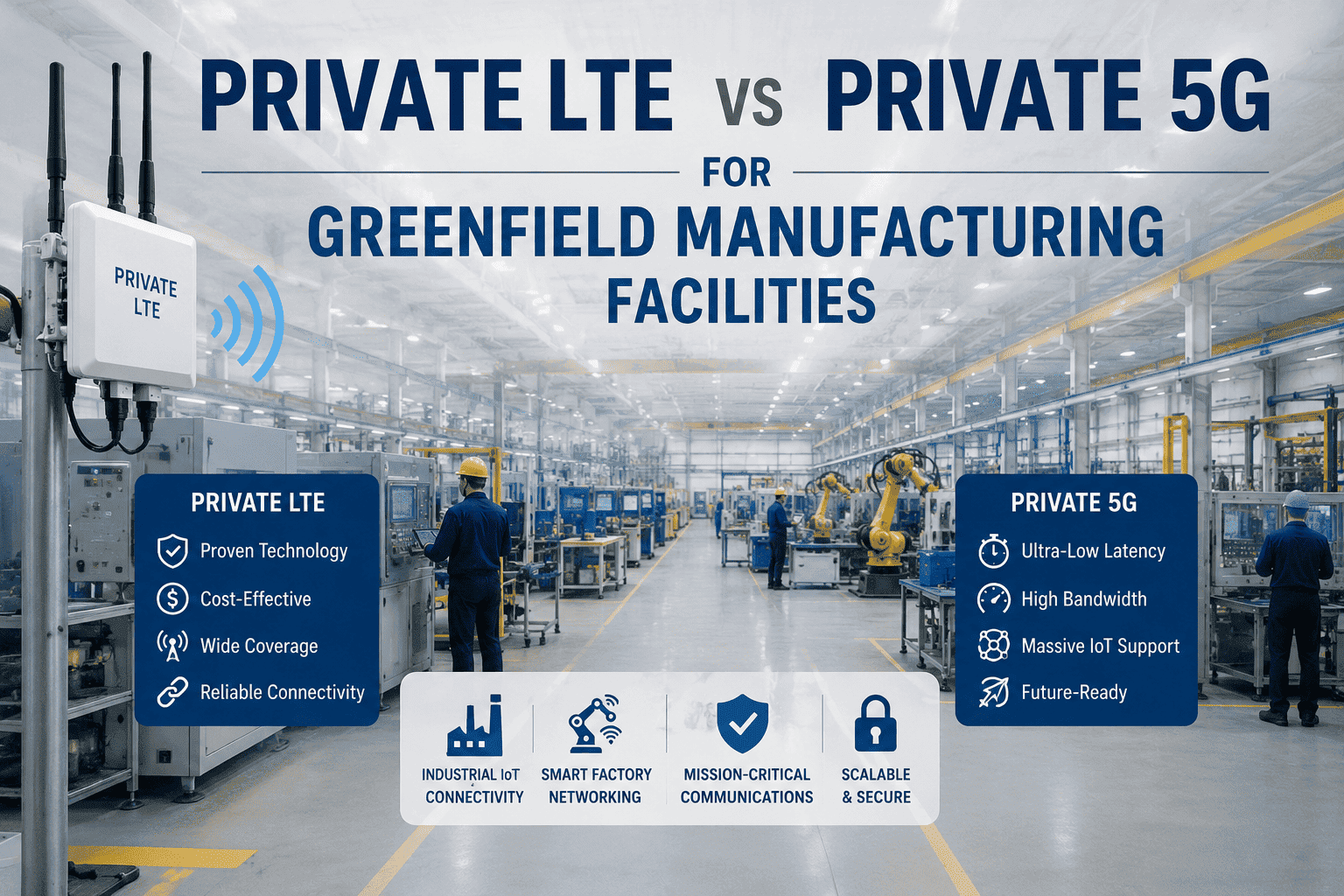
Your greenfield factory will generate thousands of data points per second — from cobots and AMRs broadcasting location beacons at 10 Hz, to AI vision systems streaming 4K quality inspection, to IoT sensors feeding predictive maintenance models in real-time. The wireless network you choose determines whether all of that works flawlessly or fails at the worst possible moment. Private 5G delivers sub-10ms latency, seamless AMR handoff, and support for up to 1 million devices per square kilometer — but costs 3-5x more to deploy. WiFi 6 is ubiquitous, cheap, and fast for most use cases — but struggles with mobility handoff, interference in metal-rich environments, and guaranteed QoS under load. The real answer for most greenfield factories isn't one or the other — it's a strategic hybrid architecture where each technology handles what it does best. This guide gives you the technical comparison, use case mapping, and decision framework to get it right from design phase. Book a consultation to design your factory's network architecture.
Head-to-Head: Private 5G vs. WiFi 6 for Manufacturing
| Specification | Private 5G | WiFi 6 (802.11ax) | Winner For Greenfield |
|---|---|---|---|
| Latency | <1 ms (URLLC), <10 ms typical | 10-30 ms typical, variable under load | 5G — critical for real-time robot control |
| Reliability (99.999%) | Designed for URLLC; 99.999% achievable | Best-effort; no guaranteed QoS | 5G — for safety-critical and mission-critical |
| Mobility / Handoff | Seamless handoff; zero packet loss during roaming | "Make and break" AP handoff; AGVs may stop | 5G — essential for AMR/AGV fleets |
| Device Density | Up to 1M devices/km² | ~200-500 devices per AP; congestion under load | 5G — for high-density sensor deployments |
| Coverage per Access Point | Large radius; penetrates metal, walls, obstacles | Shorter range; attenuated by metal and machinery | 5G — fewer APs needed in industrial environments |
| Network Slicing | Yes — dedicated virtual networks per application | No native slicing; VLAN-based separation only | 5G — isolate safety, production, and IT traffic |
| Security | SIM/eSIM authentication; encrypted by design; licensed spectrum | WPA3; shared spectrum vulnerable to interference | 5G — for OT security and IP protection |
| Throughput | Up to 20 Gbps (theoretical); 1-4 Gbps typical | Up to 9.6 Gbps (theoretical); 1-2 Gbps typical | Comparable — both adequate for most factory use |
| Deployment Cost (CAPEX) | $150K-$500K+ for mid-size facility | $30K-$100K for mid-size facility | WiFi 6 — 3-5x lower initial cost |
| Device Ecosystem | Growing but limited; industrial 5G modules emerging | Ubiquitous; all laptops, tablets, phones, most IoT | WiFi 6 — broadest device compatibility |
| Spectrum | Licensed (CBRS 3.5 GHz in US) or private bands | Unlicensed 2.4/5/6 GHz; shared with neighbors | 5G — interference-free guaranteed bandwidth |
| Time to Deploy | 3-6 months (spectrum, infrastructure, integration) | 2-4 weeks for basic deployment | WiFi 6 — faster initial deployment |
The comparison makes the pattern clear: Private 5G wins on reliability, latency, mobility, and security. WiFi 6 wins on cost, speed of deployment, and device ecosystem. A greenfield factory needs both — the question is which applications go on which network.
Use Case Mapping: Which Network for Which Application
Mission-Critical & Mobile Applications
General Connectivity & Stationary Applications
Applications That Work on Both
Not sure which applications need 5G vs. WiFi in your facility? Book a free network architecture review — we'll map your use cases to the right technology and design the hybrid topology.
The Hybrid Architecture: How to Design Both into Your Greenfield
The modern greenfield factory doesn't choose between 5G and WiFi — it architects a hybrid network where each technology handles what it does best. The Unified Namespace (UNS) sits above both networks, ensuring all data flows into a single event-driven bus regardless of transport layer.
Greenfield Network Decision Framework
| Decision Factor | Choose Private 5G If... | Choose WiFi 6 If... | Choose Hybrid If... |
|---|---|---|---|
| AMR/AGV Fleet | 10+ mobile robots requiring seamless roaming | Few or no mobile robots; fixed paths with wired backup | Mixed fleet with some needing guaranteed handoff |
| Latency Requirements | Applications need <10ms guaranteed (robot control, safety) | All applications tolerate 20-50ms (monitoring, dashboards) | Mix of real-time and non-critical applications |
| Device Density | 1,000+ connected devices across production floor | <500 devices; manageable with segmented WiFi | High OT density + standard IT connectivity needs |
| Facility Environment | Metal-rich, high-ceiling, multi-zone with RF interference | Standard office/light industrial; minimal RF obstacles | Mixed zones (production floor + offices + warehouse) |
| Security Requirements | IP-sensitive; multi-tenant; OT/IT strict isolation needed | Standard enterprise security sufficient | OT on 5G for isolation; IT on WiFi for convenience |
| Budget | $150K-$500K+ available for network infrastructure | <$100K network budget; rapid deployment needed | $200K-$600K for comprehensive dual-network |
Greenfield Network Planning Checklist
Design Your Factory Network Right the First Time
iFactory's greenfield consulting includes full wireless network architecture — RF site surveys, 5G/WiFi hybrid design, UNS integration, and AMR connectivity planning — all from the building design phase.
Frequently Asked Questions
Your Factory's Intelligence Is Only as Good as Its Network
AI, digital twins, and autonomous robots all depend on the wireless network underneath them. Get the architecture right from design phase — not after the first AMR stops mid-aisle.