Wi-Fi was never designed for the factory floor—and in greenfield manufacturing, where AGVs, robotic cells, thousands of IIoT sensors, and real-time digital twins all demand unbreakable connectivity, the limitations of traditional wireless are a non-starter. Private cellular networks solve this by giving manufacturers their own dedicated spectrum, SIM-based security, and carrier-grade reliability without sharing bandwidth with the public. But the decision between private LTE and private 5G isn't straightforward: LTE is mature, cost-effective and proven in production environments, while 5G delivers the ultra-low latency and massive device density that Industry 4.0 demands. This guide breaks down the differences, maps each technology to real manufacturing use cases and gives you a practical framework for choosing the right architecture. iFactory's greenfield consulting team designs connected factory architectures built on the right network foundation.
Greenfield Connectivity Guide
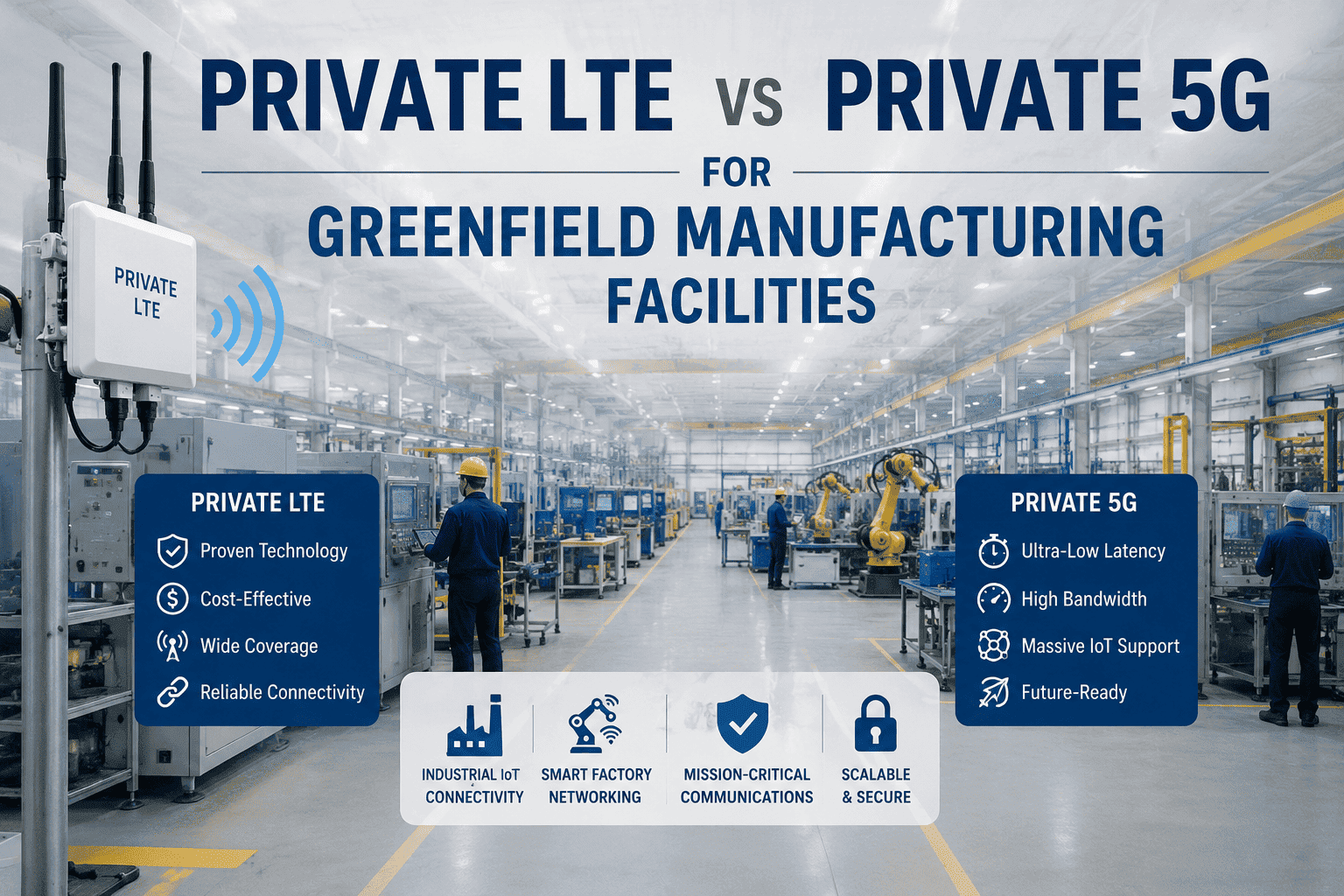
Private LTE vs Private 5G
Two paths to factory-grade wireless — which fits your greenfield build?
Private LTE
Proven + Cost-Effective
Latency10–50 ms
Speed100–300 Mbps
Devices / cell~1,000
StatusProduction-proven
VS
Private 5G
Future-Ready + Ultra-Performance
Latency1–10 ms
Speed1–10 Gbps
Devices / cell1,000,000
StatusRapid adoption
Head-to-Head: Full Comparison
Private LTE and private 5G aren't competing—they're different maturity points on the same cellular evolution. LTE is the reliable workhorse running in hundreds of factories today. 5G is the next-generation platform enabling capabilities that LTE physically cannot deliver. Here's how they compare across the metrics that matter most.
Capability
Private LTE
Private 5G
Edge
Latency
10–50 ms
1–10 ms
5G
Peak Speed
100–300 Mbps
1–10 Gbps
5G
Device Density
~1,000 / cell
1M / km²
5G
Upfront Cost
Lower CAPEX, mature supply chain
Higher CAPEX, evolving ecosystem
LTE
Ecosystem Maturity
Wide device support, proven
Growing fast, some gaps
LTE
U.S. Spectrum
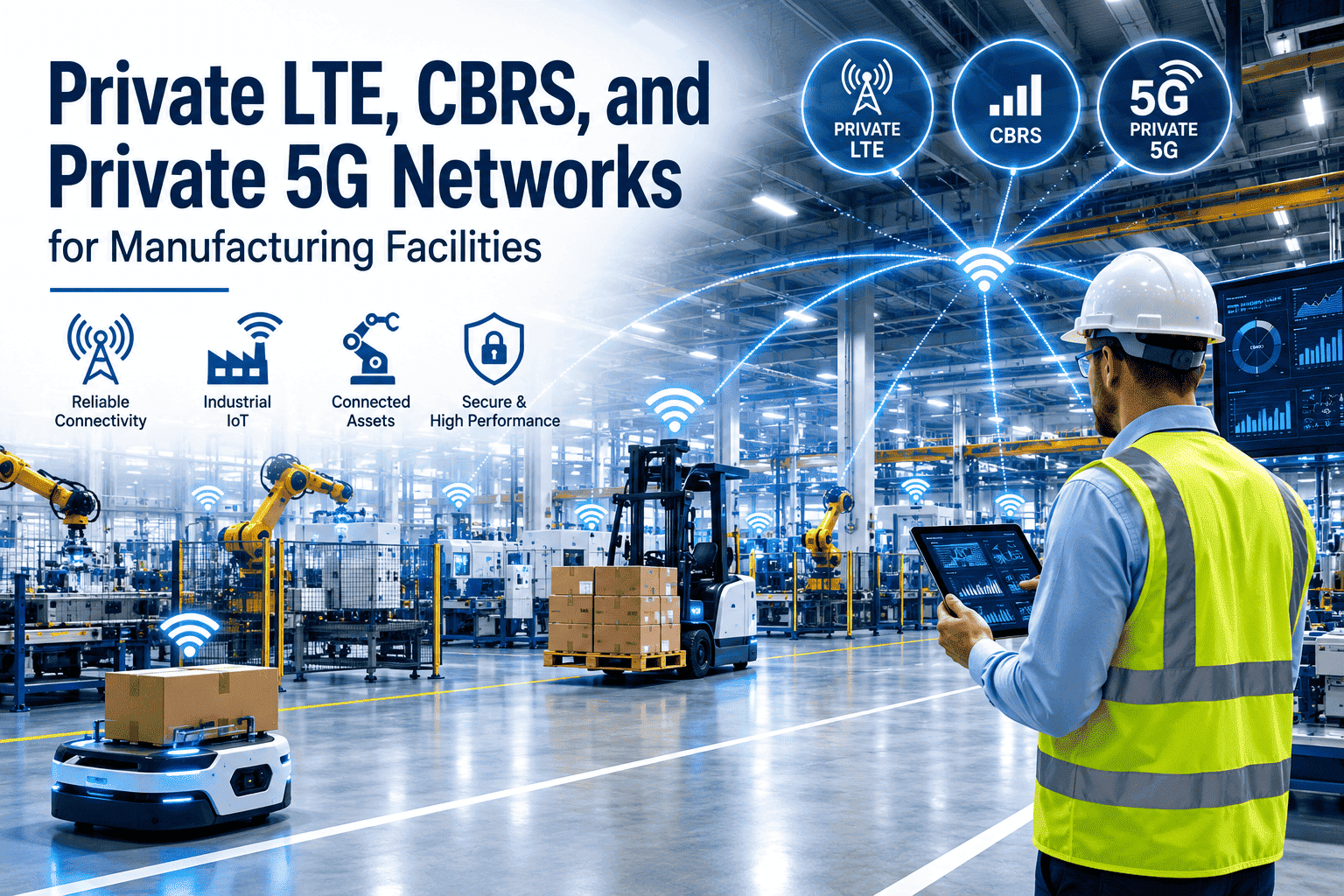
CBRS 3.5 GHz (no license fee)
CBRS + C-Band + mmWave
Tie
Network Slicing
Not natively supported
Native — isolate by application
5G
Not sure whether LTE or 5G fits your factory? Book a connectivity assessment for a recommendation based on your use cases.
Design Your Connected Factory Architecture
iFactory's greenfield consultants help you choose between private LTE, 5G, and hybrid architectures—then design the coverage, capacity, and integration your factory floor demands.
Use Case Mapping: Match the Network to the Application
The smartest approach isn't choosing one technology for everything—it's matching the right network to each application tier. Not every sensor needs 1 ms latency, and not every AGV can justify the cost premium of 5G.
IIoT Sensor Networks
Low bandwidth, wide coverage — LTE handles thousands of periodic readings cost-effectively
Mobile Worker Devices
Rugged tablets, handhelds, voice — seamless handoffs cover entire facilities including yards
Asset Tracking / RTLS
Real-time location of tools, WIP, and personnel across indoor and outdoor zones
Basic AGV / Forklift Fleet
Navigation, fleet management, and telemetry where sub-10ms latency isn't critical
Autonomous Mobile Robots
Real-time collision avoidance and path planning require sub-10ms latency
Machine Vision / AI QC
High-res camera streams to edge AI need Gbps bandwidth without wires
AR/VR Maintenance
Augmented reality headsets demand low latency and high bandwidth simultaneously
Closed-Loop Control
Replacing wired PLC-to-actuator links requires deterministic sub-5ms delivery
Hybrid Architecture: Why Most Greenfields Use Both
The most cost-effective greenfield strategy is a layered architecture: LTE as the wide-coverage baseline for sensors, mobile devices, and basic connectivity, with 5G overlaid in specific zones where ultra-low latency or massive bandwidth is non-negotiable. This controls cost while future-proofing the facility.
AMR corridors, vision inspection stations, AR bays, robotic cells
Deploy only where sub-10ms latency or Gbps throughput is required
Facility-wide IIoT sensors, mobile devices, asset tracking, basic AGV fleet, yard ops
Cost-effective blanket coverage for 80% of all connected devices
Layer 1
Shared Infrastructure
CBRS spectrum (3.5 GHz), SIM-based auth, unified core network, edge compute
LTE and 5G share spectrum, security, and management — deploy once, evolve over time
Want a hybrid architecture designed for your specific factory? Schedule a network planning session with our connectivity team.
Expert Perspective
"Starting with LTE now means you're not closing the door on 5G—you're building a foundation and gaining expertise in private networking that will carry forward. LTE and 5G share CBRS spectrum, core architecture, and SIM-based security. The migration path is an evolution, not a rip-and-replace."
— Industrial Private Network Best Practice
$7.2B
projected private LTE/5G spend by 2028
22%
CAGR for private cellular investment 2025–2028
20–90%
productivity gains from private network deployments
Ready to design your factory's wireless backbone? Connect with our greenfield consulting team for a connectivity roadmap.
Conclusion: Build the Network That Grows With Your Factory
Your greenfield factory's wireless network is the nervous system connecting every sensor, robot, vehicle, and operator on the floor. Private LTE delivers proven, cost-effective connectivity for the majority of use cases today. Private 5G unlocks autonomous robots, machine vision, AR maintenance, and closed-loop wireless control that will define competitive manufacturing in the next decade. The smartest greenfield strategy deploys LTE facility-wide and overlays 5G where its capabilities are non-negotiable—controlling cost, accelerating time-to-production, and creating a clear migration path as the 5G ecosystem matures.
Design Your Factory's Connected Architecture
From spectrum planning to base station placement to IIoT integration—iFactory's greenfield consultants design private networks that deliver day-one connectivity and scale to Industry 4.0.
Frequently Asked Questions
What is the difference between private LTE and private 5G for manufacturing?
Private LTE delivers 100–300 Mbps with 10–50 ms latency—sufficient for IIoT sensors, mobile devices, asset tracking, and basic AGV connectivity. Private 5G provides 1–10 Gbps with 1–10 ms latency and supports up to one million devices per square kilometer—required for autonomous robots, machine vision, AR/VR, and closed-loop wireless control. LTE is production-proven; 5G is rapidly maturing.
Book a consultation to determine which fits your needs.
What is CBRS and how does it enable private factory networks?
CBRS (Citizens Broadband Radio Service) is a 3.5 GHz spectrum band in the U.S. that lets enterprises deploy private LTE and 5G without purchasing expensive licensed spectrum. It uses a three-tier sharing system: incumbent users, priority access licensees, and general authorized access (GAA). Most factories operate on GAA, which requires no license fees—just an approved SAS (Spectrum Access System). This makes CBRS the primary enabler of affordable private cellular for U.S. manufacturers.
Should my greenfield factory start with LTE or go directly to 5G?
For most greenfield manufacturers in 2026, starting with LTE facility-wide and overlaying 5G in specific zones is optimal. LTE handles 80% of connectivity needs at lower cost with a mature device ecosystem. Deploy 5G where its capabilities are non-negotiable—AMR corridors, machine vision, AR bays. Since LTE and 5G share CBRS spectrum and core infrastructure, the migration is incremental, not rip-and-replace.
How many base stations does a private factory network need?
A typical 200,000 sq ft facility needs 4–8 small cells for LTE coverage, with more in high-density areas. 5G mmWave requires additional cells due to shorter range but provides higher per-cell capacity. Indoor small cells cover 10,000–50,000 sq ft each depending on frequency band and obstructions. A professional RF site survey during greenfield design is essential to determine placement before conduit and power rough-ins are installed.
Is private cellular more secure than Wi-Fi for manufacturing?
Yes—significantly. Private cellular uses SIM-based mutual authentication, which is inherently more secure than Wi-Fi's methods. All traffic is encrypted end-to-end using 3GPP standards. Dedicated spectrum means factory traffic isn't shared with public users. Private 5G adds network slicing, creating isolated virtual networks so safety-critical control traffic is separated from general sensor data at the network level.