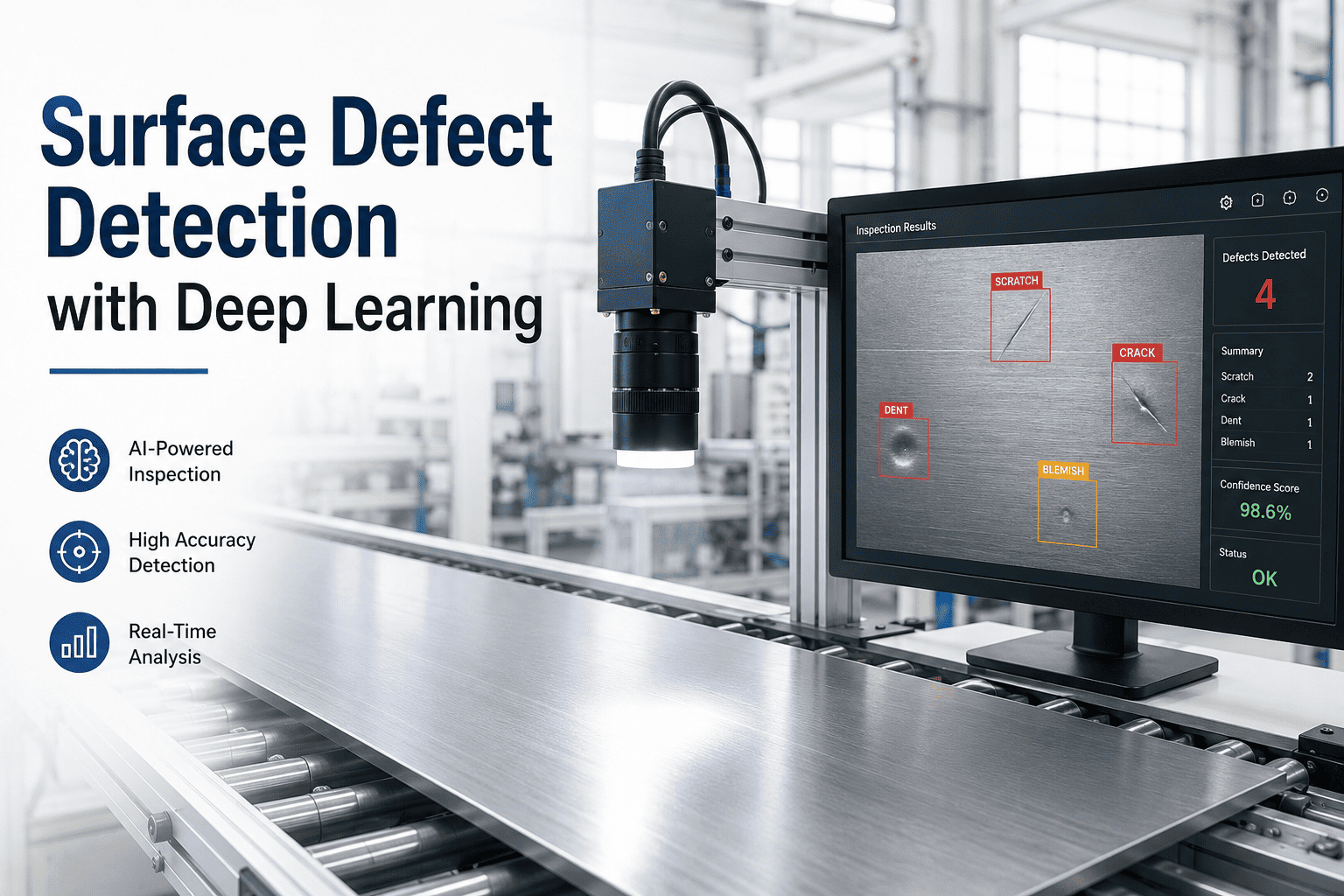
A human inspector is remarkably good at spotting a surface defect in the first hour of a shift and measurably worse by the tenth, not from lack of skill but from the simple physiology of sustained visual attention. Under fatigue, at high line speed, and in less-than-ideal lighting, manual inspection can miss a substantial share of surface defects that a customer or downstream station will eventually find instead. Deep-learning vision does not get tired, distracted, or inconsistent between shifts. See the detection rate on your own parts by booking a demo.
The Fatigue Curve Manual Inspection Cannot Escape
This is not a skill problem. It is a physiology problem. Sustained visual attention at line speed degrades predictably over the course of a shift, regardless of how experienced the inspector is.
Detection Accuracy Across a Shift
The gap between human and AI inspection is not largest at the start of a shift — it is largest by the end of it, exactly when fatigue is at its peak.
Why the Gap Widens as a Shift Goes On
The comparison between human and AI inspection is not static across a shift. It compounds, and understanding why explains why deep-learning vision delivers its biggest advantage late in the day rather than early.
A human inspector at the start of a shift is close to their best possible performance, which is part of why pilot comparisons run during a single fresh morning sometimes understate the real-world gap between manual and automated inspection. The meaningful difference emerges over the following hours, as sustained attention on a repetitive visual task degrades in a way that is well documented in vision science and difficult to counteract with breaks alone, given typical production scheduling constraints. A deep-learning model has no equivalent decay curve — the tenth hour of inspection runs against the exact same weights and thresholds as the first.
This has a direct implication for how an inspection lead should read a pilot result. A short trial run during a single well-rested shift will likely show a closer gap between human and AI performance than a full week of production data will reveal. The honest comparison, and the one worth basing a deployment decision on, looks at detection accuracy averaged across an entire week including the final hours of the least favorable shifts, since that is where the case for deep-learning vision becomes unambiguous.
The Model Types Behind the Detection
Not every defect is caught the same way. Different model architectures are suited to different jobs, from a quick line-speed decision to a precise pixel-level boundary.
Manual Inspection vs Deep-Learning Vision
The comparison is not close on any dimension that matters for a production quality program running at full volume.
| Dimension | Manual Inspection | Deep-Learning Vision |
|---|---|---|
| Detection accuracy by hour ten | Under 80% typically | 99%+ sustained |
| Coverage | Sampled or fatigue-limited | 100% of parts, every shift |
| Consistency across shifts | Varies by inspector | Identical criteria every time |
| New defect type response | Retraining inspectors, weeks | Retrained model, days to weeks |
| Documentation | Manual log, inconsistent detail | Full defect map per part automatically |
What Changes Once Every Part Is Inspected
Full coverage at consistent accuracy does more than reduce escapes — it changes what inspection leads spend their time doing.
What Inspection Leads Do Differently Once Coverage Is Full
Full-coverage inspection does not just reduce escapes. It changes the job of an inspection lead from constant manual triage toward genuine process improvement work.
When inspection was sampled or fatigue-limited, most of an inspection lead's day went toward managing the sampling plan itself — deciding which parts to check, rotating inspectors to manage fatigue, and reconciling inconsistent judgment calls between shifts. Once every part is inspected automatically at a consistent standard, that daily management burden mostly disappears, and what is left is a steady stream of defect data that can actually be analyzed for patterns. A recurring scratch defect that appears every Tuesday afternoon, correlated with a specific tooling changeover, is the kind of insight that was always technically available in a fully-sampled dataset but rarely surfaced when inspection coverage itself was inconsistent.
The other shift is in how new defect types get handled. Under a manual system, training inspectors on a new defect category means retraining a rotating group of people, some of whom may not see that specific pattern again for weeks. Under a deep-learning system, the same defect gets labelled once by a quality engineer and then applied consistently to every part on every shift going forward, which is part of why inspection leads increasingly treat model retraining as a routine maintenance task rather than a disruptive retraining program.