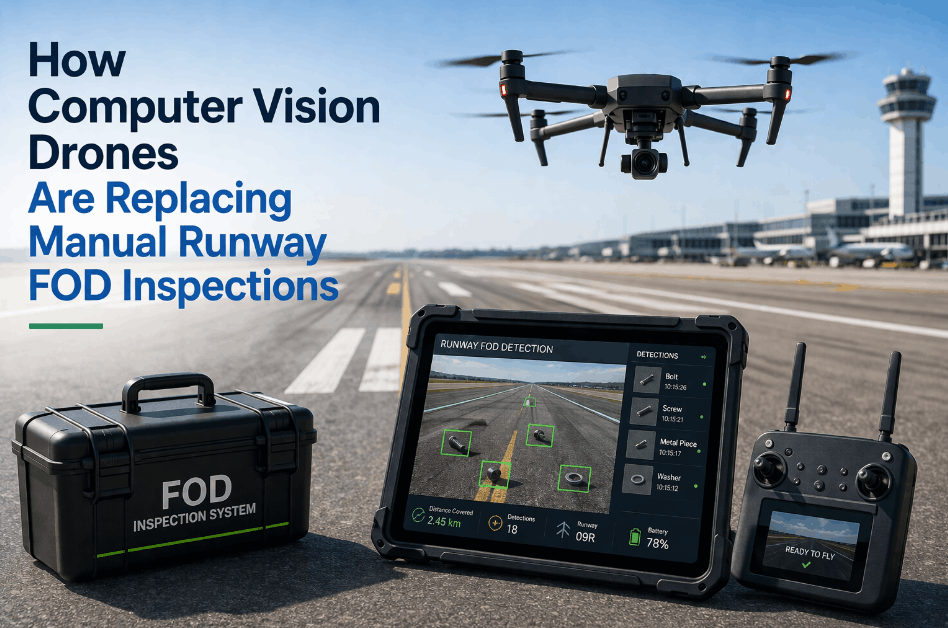
A single bolt on a runway destroyed a Concorde and killed 113 people. The titanium strip that caused the crash of Air France Flight 4590 in 2000 had fallen from a thrust reverser on a preceding aircraft and lay undetected on the pavement for four minutes before the next takeoff roll. Twenty-six years later, most airports still rely on human eyes scanning kilometres of tarmac at dawn to find debris the size of a coin before it finds an engine. Foreign Object Debris costs the global aviation industry between $4 billion in direct damage and $22.7 billion when delays, cancellations, and operational disruption are included. Every 10,000 aircraft movements produce an average of 12.8 FOD incidents. Manual visual inspection detects 24 percent of them. The gap between what is at stake and what human patrols can catch is not a technology problem. It is a deployment gap, and quadruped robots are closing it runway by runway.
Airside Safety Automation 2026
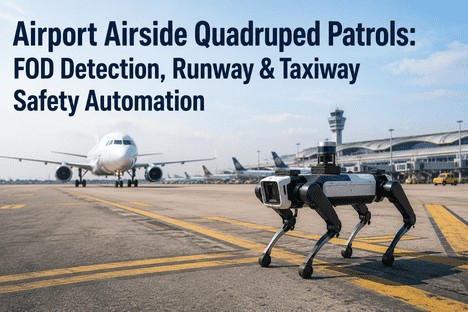
Airport Airside Quadruped Patrols
FOD Detection, Runway and Taxiway Safety Automation
A technical guide to deploying quadruped robots for automated FOD detection, runway condition monitoring, taxiway inspection, and ICAO-compliant airside safety patrols across airport movement areas.
$22.7B
Total annual global cost of FOD including direct damage, flight delays, cancellations, and lost revenue. Boeing estimates direct costs alone at $4 billion per year for engine and tyre damage.
24%
Of FOD detected by manual visual inspection. Human patrols operating at ICAO minimum frequency miss three-quarters of debris. Autonomous systems with AI vision achieve detection rates above 95 percent across all visibility conditions.
12.8
FOD incidents per 10,000 aircraft movements globally. At a major hub handling 1,000 daily movements, that is more than one FOD event every single day. Each incident carries direct damage costs averaging $26 per flight.
Cover More Runway in Less Time. Detect More Debris. Reduce Human Exposure.
iFactory connects quadruped airside patrol data to your FOD management program and CMMS workflow — auto-logging debris detection events, mapping incident locations to GPS coordinates, and routing findings to maintenance teams before the next movement enters the zone.
The FOD Detection Gap: Manual Patrols vs. Quadruped Autonomous Patrols
Metric
Manual Walkdown
Quadruped Autonomous Patrol
Detection rate
24% of debris detected
95%+ with AI vision and thermal imaging
Coverage frequency
4 inspections per day (ICAO minimum)
Continuous 24/7 patrol capability with auto-docking
Operational impact
Runway closure required during inspection
Patrols between movements; no closure needed
Visibility conditions
Degraded in fog, rain, darkness
Thermal + 20x zoom effective in all conditions
Crew required
2-3 trained inspectors per shift
Remote operator monitors multiple robots
Documentation
Manual paper or clipboard logging
Auto-timestamped GPS records with imagery
Why Quadruped Robots Are the Right Form Factor for Airside FOD Patrol
Wheeled platforms struggle with the airside environment. Runway shoulders, taxiway edges, grass verges, and gravel access roads create terrain that wheeled robots cannot reliably navigate. Drones offer aerial coverage but cannot inspect under-wing areas, read ground-level gauge readings, or carry the sensor payload required for detailed condition assessment. Quadruped robots bridge this gap. They walk on four articulated legs that handle uneven pavement, gravel, grass, stairs, and slopes up to 30 degrees. They carry multi-sensor payloads including thermal cameras, 20x zoom electro-optical cameras, acoustic imagers, and gas detectors. They dock and recharge autonomously between patrol cycles. And they operate in all weather conditions that would ground a drone or strand a wheeled unit.
Sensor 01
Thermal Imaging
Detects surface anomalies, pavement temperature differentials, and hidden debris embedded in rubber deposits. Effective in complete darkness and through light fog.
Sensor 02
AI Vision
Machine learning models trained on thousands of FOD images identify bolts, pavement fragments, luggage hardware, tyre debris, and wildlife in real time during autonomous patrol.
Sensor 03
Acoustic Imaging
Detects compressed air leaks from ground support equipment, hydraulic fluid escapes from aircraft servicing vehicles, and structural anomalies in pavement that precede spalling.
Sensor 04
GPS Geolocation
Every FOD detection is recorded with precise GPS coordinates. Maintenance teams receive the exact location of debris, pavement defect, or foreign object for targeted removal without searching.
Every Debris Detection Becomes a Documented FOD Event. Every FOD Event Becomes a Closed-Loop Action.
iFactory routes quadruped patrol findings simultaneously to your FOD management log for ICAO compliance and your CMMS for debris removal work order generation. One detection cycle produces two documented outcomes with zero additional effort.
Regulatory Compliance: Mapping Quadruped Patrols to ICAO and FAA FOD Requirements
FAA Advisory Circular AC 150/5210-24A establishes the framework for airport FOD management programs. ICAO Doc 9137 Part 2 defines international standards for pavement surface conditions and debris detection. Both frameworks require airports to demonstrate systematic inspection procedures, documented detection records, and verifiable removal actions. Quadruped patrol platforms operating through iFactory satisfy each of these requirements as a native output of the patrol cycle rather than an additional administrative burden.
FAA AC 150/5210-24A Compliance
Requires airports to implement a FOD management program covering prevention, detection, removal, and evaluation. Quadruped patrols with iFactory provide the structured detection record and removal documentation required to demonstrate an active FOD program in audit conditions.
ICAO Doc 9137 Part 2 Compliance
Requires systematic inspection of movement areas for debris and contaminants. iFactory's patrol scheduling engine generates inspection records at configurable intervals, GPS-tagged to specific runway and taxiway segments, with timestamped evidence of each patrol completion.
FAA 14 CFR Part 139 Alignment
Mandates a self-inspection program for certificated airports covering movement areas. Quadruped patrol data integrates directly into the airport's inspection record system, providing the structured evidence trail required for FAA compliance inspections and certification renewal.
IATA Safety Management System
IATA SMS framework requires hazard identification and risk mitigation for airside operations. Quadruped patrols detect debris hazards before they cause damage, and iFactory logs each finding as a safety event within the SMS hazard register.
The Safety Case
Every Human Airside Patrol Carries a Risk That Quadrupeds Eliminate
Airside patrols expose personnel to moving aircraft, vehicle traffic, jet blast, and rapidly changing weather conditions. A worker conducting a FOD walkdown on an active taxiway is statistically more likely to be injured during the inspection than by the debris they are searching for. Quadruped robots remove the human from the movement area entirely while increasing patrol frequency, detection accuracy, and documentation quality.
The Business Case
A Single FOD Engine Ingestion Costs More Than a Quadruped Deployment
A single fan blade replacement following FOD ingestion costs $500,000 to $2 million depending on engine type. A tyre blowout from runway debris costs $30,000 to $100,000 including aircraft downtime. A single prevented FOD event can offset the annual cost of a quadruped patrol deployment. The business case is built on the frequency of FOD events multiplied by the cost per event, minus the detection improvement rate that autonomous patrols deliver.
Frequently Asked Questions
iFactory connects to airport CMMS platforms, FOD management systems, and SMS databases via API, webhook, or flat-file integration. Every FOD detection event captured during a quadruped patrol is automatically timestamped, geolocated with GPS coordinates, and classified by debris type using AI vision analysis. The platform routes each event to the FOD removal workflow in your CMMS, creates a safety event record in your SMS, and logs the inspection completion for ICAO and FAA compliance documentation. All major airport operational platforms including IFS, SAP, and mainstream CMMS providers are supported. Get In Touch to connect your airside patrol data to your existing compliance systems.
Yes. Quadruped robots can be deployed to patrol runway shoulders, taxiway edges, and apron boundaries during active flight operations without requiring runway closures. The robot navigates outside the movement area while scanning the full runway width using thermal and zoom cameras. For full runway surface inspections, patrols are scheduled between arrival and departure waves during natural operational gaps, typically completing a 3,000-metre runway scan in 25 to 35 minutes. iFactory's patrol scheduling engine coordinates with flight schedules to identify optimal inspection windows and logs each patrol completion against the airport's FOD management program timeline. Book a Demo to see a live airside patrol schedule configured for your airport's movement pattern.
Airports deploying quadruped patrols with AI vision detection report FOD detection rate improvements from the baseline manual detection rate of 24 percent to 95 percent or higher, depending on debris type and environmental conditions. The improvement is driven by three factors: thermal imaging capability that detects metallic and non-metallic debris invisible to the human eye, 20x optical zoom that identifies objects the size of a bolt at 50 metres, and 24/7 patrol frequency that eliminates the gap between scheduled manual inspections. Most airports achieve a 4x to 5x increase in FOD detection volume in the first quarter of deployment, with the highest gains in low-visibility conditions and night operations where manual detection effectively drops to zero. Get In Touch to start tracking FOD detection rate improvements across your airside patrol operations.
The Debris You Cannot See Is the Debris That Costs You the Most. Quadruped Patrols Close the Gap.
iFactory connects quadruped airside patrol data to FOD detection logs, CMMS work orders, and ICAO compliance records in one platform. Built for airport operations where runway safety and operational uptime depend on detecting what human patrols consistently miss.