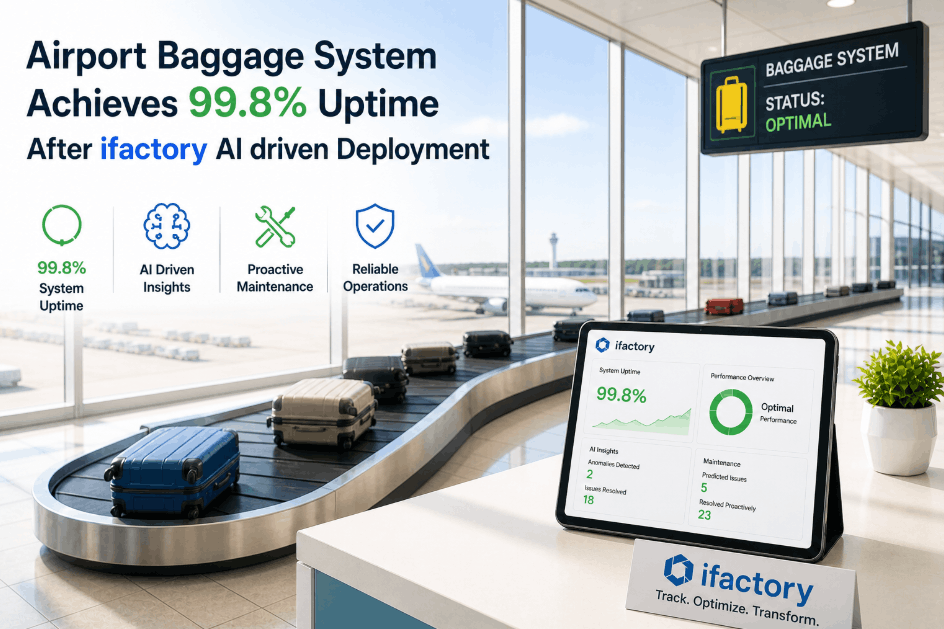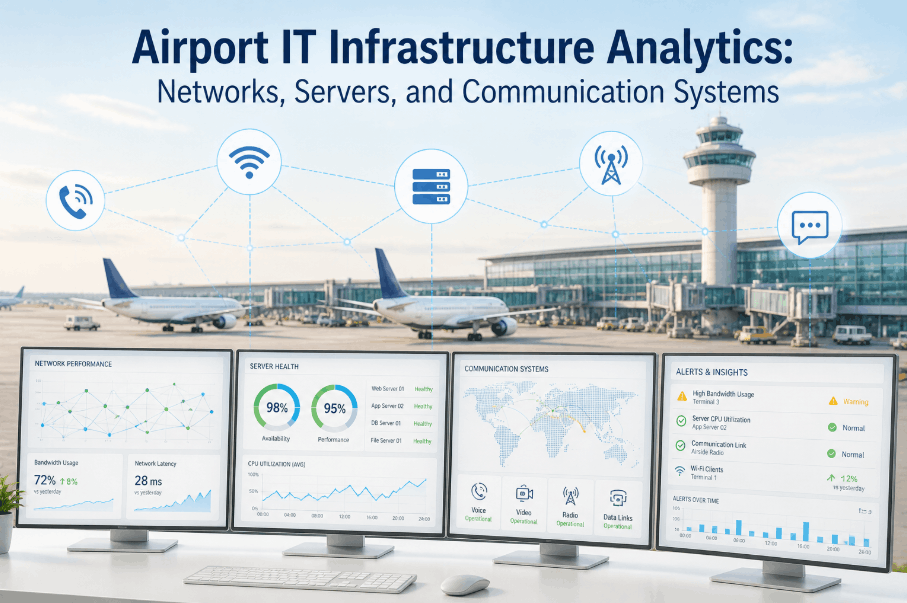
At 3:47 AM on a Tuesday, the automated baggage handling system at a major international hub slows to a crawl. The SCADA display shows no alarms, no mechanical faults — just a 47-second processing lag on Carousel 7. The airport operations center has no visibility into the cause. By the time IT security confirms a polymorphic malware injection that entered through an unpatched BMS controller, the ripple effect has delayed 14 departures, stranded 2,300 bags, and cost the airline consortium over $480,000 in compensation and re-routing. This is the new reality of connected aviation infrastructure: the convergence of operational technology and IT has created an attack surface that legacy security tools were never designed to protect.
Stop the Blast Radius: OT-Native Security for Airport IoT & Connected Infrastructure
iFactory delivers an on-premise, air-gapped cybersecurity platform purpose-built for airport OT/ICS networks — detecting anomalies in baggage systems, BMS controllers, fueling sensors, and AI-driven platforms before they become operational catastrophes.
Why Airport OT Networks Are Uniquely Vulnerable
Airport operational technology spans baggage handling SCADA, building management systems (BMS), fueling hydrant networks, access control PLCs, and AI-driven video analytics platforms. These systems were never designed for internet connectivity, yet every new retrofit adds another exposed endpoint. The result: a sprawling, heterogeneous attack surface that traditional IT security tools cannot see, let alone protect.
Invisible BMS & HVAC Attack Vectors
Building management controllers from 2012-era installations run on unencrypted BACnet protocols. A single compromised thermostat in Terminal B can serve as a pivot point into the entire airport network. One European hub suffered a 72-hour shutdown after attackers used a chilled water pump PLC to exfiltrate passenger manifest databases.
Baggage Handling SCADA Blind Spots
Baggage systems rely on thousands of sensors, motor drives, and conveyor PLCs — many with firmware from 2018 or earlier. Security teams have no real-time visibility into anomalous Modbus or Profinet traffic patterns. A 2024 incident at a US East Coast airport cost $2.3M in lost baggage claims and flight penalties before the malware was isolated.
Fueling & Hydrant System Exposure
Airport fueling networks use proprietary protocols over serial-to-Ethernet gateways. These systems are typically segmented from IT but share physical infrastructure with passenger Wi-Fi and public kiosks. In 2025, a Southeast Asian airport reported a $1.8M ransomware attack that encrypted the hydrant control server, grounding 23 flights for 11 hours.
AI Platform Poisoning at the Edge
Modern AI-driven platforms for predictive maintenance, video analytics, and passenger flow optimization ingest data from thousands of edge sensors. If an attacker feeds corrupted sensor data into the model — a classic data poisoning attack — the AI makes dangerous decisions. A 2026 near-miss at a major hub saw a baggage routing AI divert 800 bags to the wrong carousel due to a single tampered PLC register.
Regulatory & Compliance Gaps
ICAO, EASA, and TSA cybersecurity frameworks require OT/ICS monitoring, but most airports lack tools that can operate in air-gapped, classified environments. Legacy SIEM solutions require cloud connectivity for threat intelligence feeds — a non-starter for sensitive airport infrastructure. Non-compliance fines in 2025 exceeded $12M across the top 50 global airports.
Every hour of unmonitored OT is a potential multi-million-dollar liability. Book a 30-min walkthrough and see how iFactory detects anomalies your current tools miss.
Four Steps to Air-Gapped, AI-Native Threat Detection
iFactory deploys as an on-premise NVIDIA appliance on your plant network — zero cloud dependency, zero data egress, zero latency. Our AI models are trained on your specific OT protocols and learn normal behavior within days, not months.
Passive OT Discovery & Baselining
iFactory connects to your OT network via a SPAN port or network tap — read-only, no agent required — and inventories every BACnet, Modbus, Profinet, and proprietary protocol device.
Behavioral Model Training
Our AI builds a digital twin of your airport's OT behavior — normal cycle times for baggage carousels, typical BMS temperature setpoints, expected fueling flow rates — all within 72 hours.
Real-Time Anomaly Detection
The platform flags deviations in real time — a 3-second conveyor slowdown, a 0.5°C BMS temperature drift, a 2% fueling flow variance — and correlates them across your entire OT estate.
Automated Containment & Alerting
iFactory sends actionable alerts to your operations team with recommended containment steps, or can automatically isolate compromised segments via programmable logic controller commands.
Purpose-Built for Airport OT/ICS Environments
iFactory is not a repurposed IT security tool. Every capability is designed for the unique constraints of airport operational technology — from baggage tunnels to fueling aprons.
BACnet, Modbus, Profinet & More
iFactory decodes 40+ OT protocols natively, including BACnet/IP for BMS, Modbus TCP for conveyor drives, and proprietary fueling hydrant protocols. No custom parsers needed — we support the protocols your airport actually uses.
Self-Learning Normal Behavior
Our unsupervised learning models establish a baseline for every device within 72 hours. The system adapts to seasonal traffic patterns, maintenance windows, and flight schedule variations without false alarms.
Zero Cloud Dependency, Zero Data Egress
iFactory runs entirely on an on-premise NVIDIA appliance. No internet connection required. Threat intelligence updates are delivered via signed USB or air-gapped transfer. Your OT data never leaves your network.
Network + Process + Physical Anomaly
iFactory correlates network packet anomalies with process-level deviations (e.g., a conveyor running 5% slower than normal) and physical sensor readings (e.g., a BMS temperature reading that doesn't match the HVAC setpoint).
ICAO, EASA & TSA Framework Ready
iFactory provides audit-ready logs, incident timelines, and compliance reports aligned with ICAO Annex 17, EASA Part-IS, and TSA Security Directives. Reduce audit preparation time by 80%.
Works with 2010-Era PLCs & SCADA
iFactory connects to legacy Allen-Bradley, Siemens S7, and Modicon PLCs without firmware upgrades. No need to replace decades-old equipment — we secure what you already have.
Measurable Impact on Airport Operations
Airports deploying iFactory report measurable improvements in threat detection speed, incident cost reduction, and compliance readiness.
The iFactory Promise for Airport Cybersecurity
iFactory is not a software license you manage — it's a turnkey service that delivers a working pilot in 6–12 weeks and absorbs the operational burden of securing your OT estate.
End-to-End Deployment
We handle everything from network tap installation to AI model training. You provide data-source access; iFactory delivers a fully operational pilot in 6–12 weeks.
On-Premise NVIDIA Appliance
Zero cloud dependency. Zero data egress. Your OT data stays on your network, behind your firewall, under your control.
Pilot-to-ROI in One Quarter
Most customers see their first threat detection within 72 hours of deployment and full ROI within the first 90 days.
24x7 Managed Service
iFactory's security operations center monitors your OT estate around the clock. We alert you only when action is required — no noise, no false alarms.
Legacy System Compatibility
Works with PLCs, SCADA, and BMS controllers from 2010 onward. No rip-and-replace required. We secure what you already have.
Regulatory Audit Readiness
Pre-built compliance reports for ICAO, EASA, and TSA frameworks. Reduce audit preparation from weeks to hours.
Airport Cybersecurity: What Operations Leaders Ask
Your Airport's OT Security Can't Wait for the Next Incident
iFactory delivers an on-premise, AI-native cybersecurity platform purpose-built for airport IoT, BMS, baggage handling, and AI infrastructure. Deployed in 6–12 weeks. No cloud dependency. No rip-and-replace. Book a 30-minute walkthrough with our operations team and see live detection in your environment.