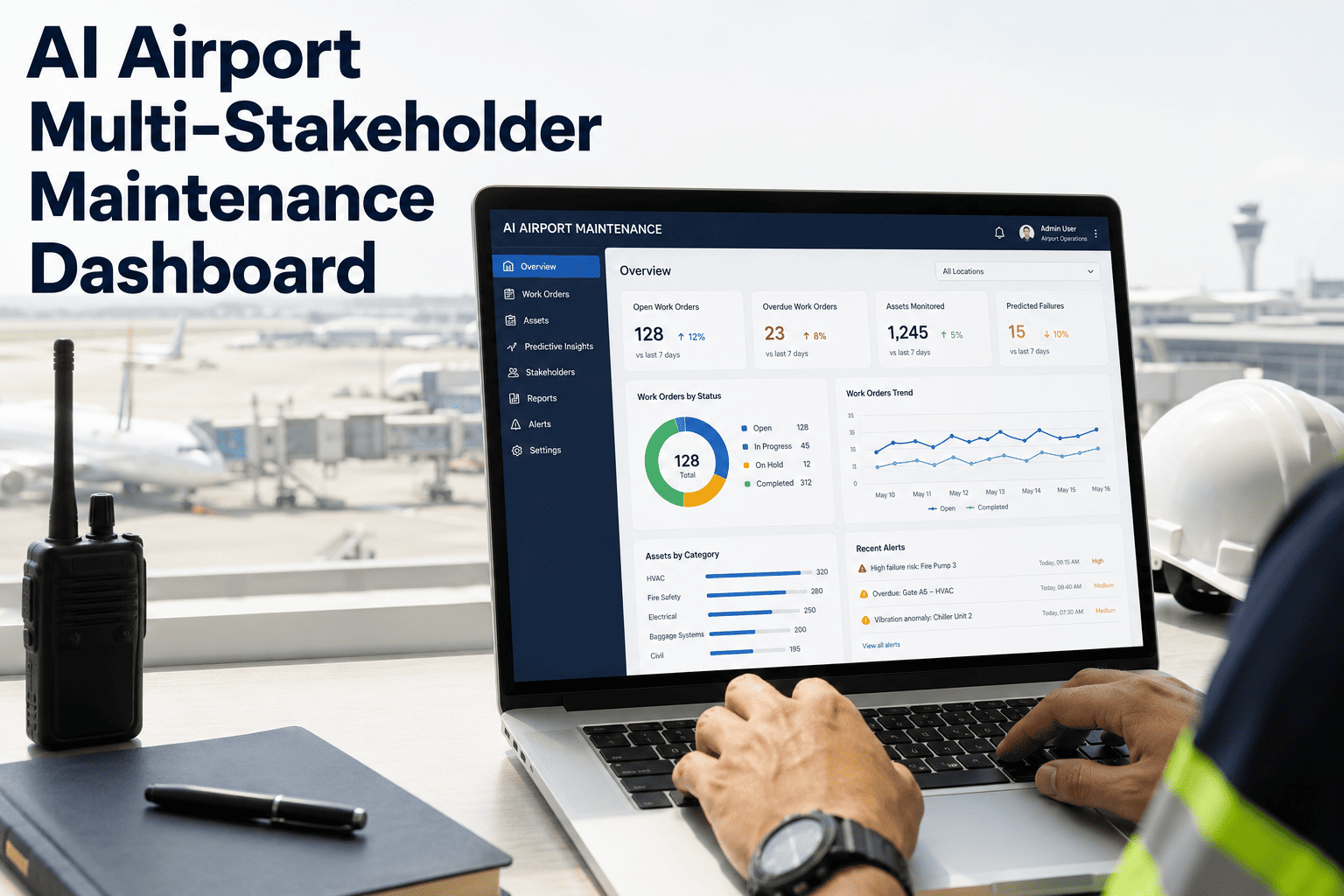
Airport vendor and contractor management has become one of the most complex operational disciplines in modern aviation infrastructure. With dozens of simultaneous stakeholders — airlines, ground handling companies, concessionaires, IT service providers, cleaning contractors, and security vendors — operating across a shared physical environment, the coordination burden on airport operations teams is immense. Airports that still rely on spreadsheets, email threads, and manual credential tracking are leaving significant performance, compliance, and revenue on the table. AI-driven vendor management platforms have transformed this landscape, giving airport operations directors the multi-stakeholder visibility they need to enforce SLAs, reduce contractor-related delays, and build a verifiable audit trail for every vendor touchpoint. To see how iFactory streamlines vendor coordination across your full airport ecosystem, book a demo and get a tailored walkthrough today.
Why Airport Vendor Management Is a Strategic Operational Priority in 2026
The modern airport is not a single organization — it is a dynamic ecosystem of contracted services operating under one roof. A mid-sized international airport may manage over 150 active vendor contracts simultaneously, spanning airside and landside operations. Ground handling agreements, concessionaire leases, IT support SLAs, engineering maintenance contracts, and regulatory compliance vendors all intersect daily. When any one of these relationships underperforms, the ripple effect is immediate: delayed aircraft turns, passenger complaints, regulatory citations, and revenue clawbacks.
Traditional airport procurement management approaches — binder-based contractor files, quarterly review meetings, and reactive SLA enforcement — cannot keep pace with the operational tempo of a 24/7 airport. The data latency alone creates systemic blind spots. By the time a ground handler's performance trend is visible in a monthly report, the damage to airline relationships and operational metrics is already done. Airport vendor AI driven platforms close this gap by providing continuous, real-time visibility into every vendor relationship across the terminal, airside, and cargo environments.
For airport operations leadership, the shift to digital vendor management is no longer a technology choice — it is a competitive and contractual necessity. Airlines are increasingly embedding performance-based vendor clauses into their handling agreements, and airports that cannot demonstrate measurable SLA compliance risk losing key carrier relationships. Book a demo to see how iFactory provides the audit-grade evidence required by modern airline vendor contracts.
Vendor credentials, insurance certificates, and work authorizations stored across email, shared drives, and paper files create compliance gaps that expose airports to liability and regulatory risk.
Ground handler turnaround times and cleaning contractor response rates degrade gradually. Without real-time airport SLA tracking, operations managers discover problems weeks after the service failure has impacted airline metrics.
Routing maintenance and service requests across multiple vendors via email and phone introduces delays, duplicate work, and zero accountability. Digital vendor work order tracking eliminates coordination friction entirely.
Airport operations directors managing 100+ vendor relationships have no single source of truth for vendor performance. Building consolidated airport vendor scorecards manually consumes dozens of administrative hours each month.
The Airport Vendor Ecosystem: Key Stakeholder Categories and Their Management Challenges
Effective airport multi-stakeholder coordination requires a nuanced understanding of each vendor category's operational characteristics. The service expectations, contractual structures, and compliance requirements for an airline ground handling agreement are fundamentally different from those governing a concessionaire lease or a security contractor relationship. AI-driven platforms must be configurable enough to manage this diversity without compromising unified visibility.
Airline Vendor Coordination and Ground Handler Management
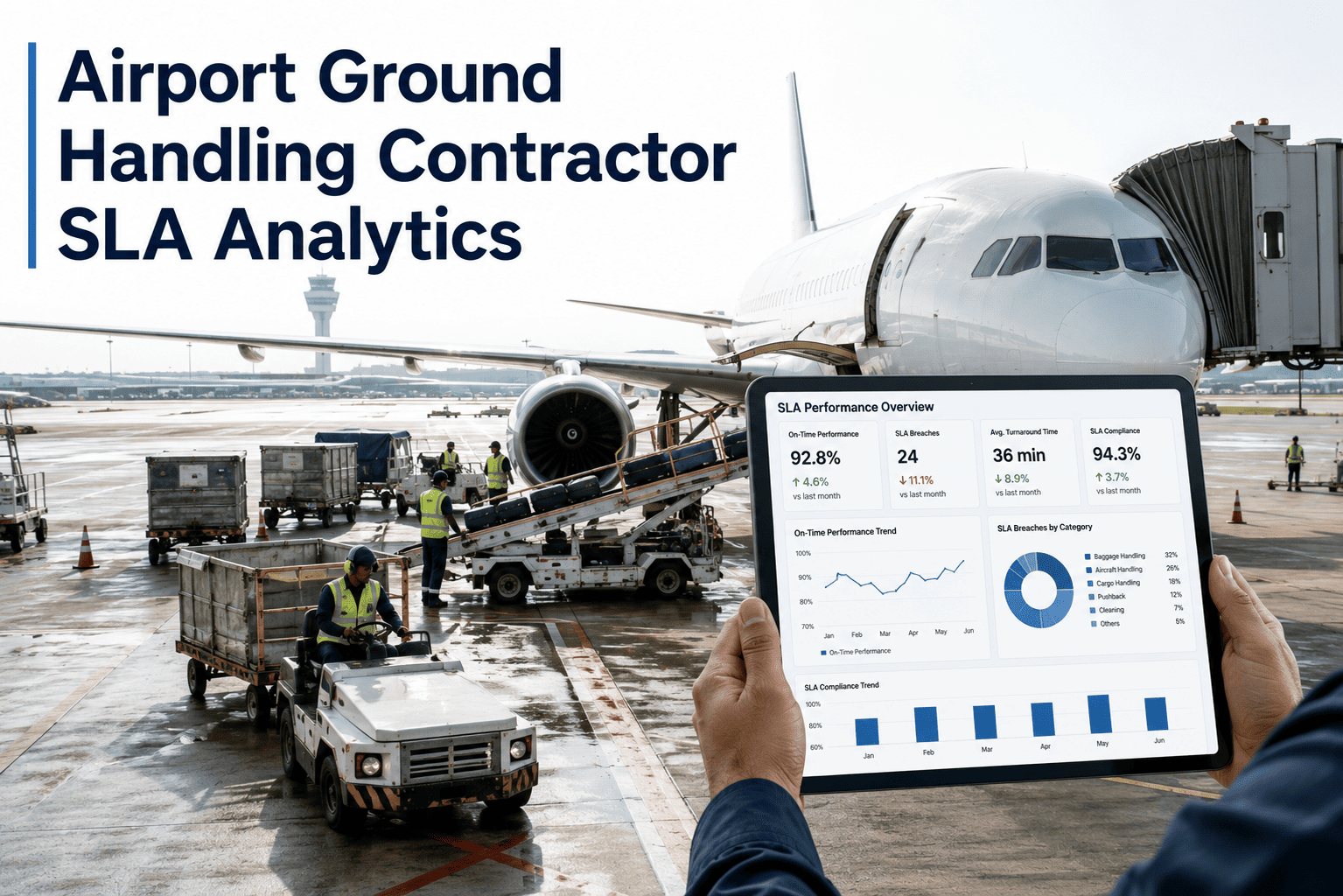
Airlines and their contracted ground handlers represent the highest-value and highest-urgency vendor relationships at any commercial airport. SLA metrics — baggage handling time, aircraft turn compliance, fueling accuracy — are measured in minutes. AI-driven platforms provide real-time turnaround dashboards that allow airport operations centers to intervene before a ground handler performance issue becomes an aircraft delay. Digital work orders for ramp service requests replace radio-and-clipboard workflows with accountable, timestamped digital records.
Airport Concession Vendor Management and Retail Contractor Compliance
Concessionaires and food & beverage operators represent a significant revenue stream and a major source of passenger experience data. Managing airport concession vendor compliance — health inspections, brand standards, lease obligations, and maintenance responsibilities — requires structured digital workflows. AI platforms automate lease milestone tracking, health permit renewals, and brand standard audit schedules, ensuring that no concessionaire obligation falls through the cracks of a manual calendar system.
Contractor Credential Management and Airside Access Compliance
Contractor credential management at airports is a security and regulatory imperative. Every contractor operating in secured zones must hold valid SIDA badges, insurance certificates, and role-specific training certifications. Manual tracking systems routinely miss expiry dates, creating unauthorized access risks and TSA compliance violations. Digital contractor credential management platforms auto-flag upcoming expirations across hundreds of contractors simultaneously — giving security and procurement teams weeks of advance notice rather than a post-breach scramble.
IT and Analytics Vendor Coordination Across Airport Technology Stack
Modern airports operate complex technology ecosystems spanning FIDS, BHS, access control, and third-party analytics platforms. Airport third-party analytics vendors require structured onboarding, API SLA management, and data governance oversight. Managing these relationships manually creates integration blind spots. Centralizing IT vendor performance data within the same platform used for ground operations provides operations directors with a complete vendor risk picture.
Facilities and Engineering Contractor Management
Building maintenance, MEP systems, and capital project contractors require structured work order workflows, safety documentation, and milestone-based payment tracking. Book a demo with iFactory to see how facilities contractor management integrates with preventive maintenance scheduling to create a unified engineering operations view across all third-party vendors.
Manual Vendor Management vs. AI-Driven Airport Vendor Coordination: A Performance Comparison
The operational and financial cost of manual airport vendor management is rarely quantified — but it is substantial. The following comparison illustrates the measurable performance gap between traditional approaches and AI-driven airport vendor management platforms across the key dimensions of multi-stakeholder coordination.
| Vendor Management Function | Manual / Legacy Approach | AI-Driven Platform Approach | Operational Gain | Risk Reduction |
|---|---|---|---|---|
| SLA Compliance Tracking | Monthly spreadsheet review | Real-time SLA dashboard with automated alerts | 80% faster issue detection | Eliminates airline contract disputes |
| Contractor Credential Management | Manual file folders and calendar reminders | Automated expiry alerts with digital certificate storage | 100% credential coverage | Zero unauthorized airside access incidents |
| Vendor Work Order Routing | Email and phone call coordination | Digital work orders with real-time status tracking | 60% reduction in resolution time | Full audit trail for every task |
| Airport Vendor Scorecarding | Quarterly manual report compilation | Automated monthly scorecards with trend analysis | 40+ hours saved per quarter | Data-backed contract renewal decisions |
| Concessionaire Compliance Audits | Ad-hoc inspections and manual logs | Scheduled digital audit checklists with photo evidence | 3x audit frequency | Consistent brand and health standard enforcement |
| Airport Procurement Management | Siloed procurement records by department | Centralized vendor database with spend analytics | Full spend visibility | Eliminates unauthorized vendor engagements |
| Multi-Stakeholder Performance Reporting | Manually assembled board-level reports | One-click executive dashboards with live KPI feeds | 20+ hours saved per reporting cycle | Supports evidence-based stakeholder governance |
Core Capabilities of an AI-Driven Airport Vendor Management Platform
Not all vendor management solutions are built for the operational complexity of airport environments. A platform purpose-built for airport multi-stakeholder coordination must deliver capabilities that go far beyond basic contract storage. The following features define what best-in-class airport vendor AI driven management looks like in practice. Book a demo to explore how iFactory delivers each of these capabilities across your specific vendor portfolio.
Monitor ground handler turnaround times, cleaning contractor response rates, and IT vendor uptime against contracted SLA thresholds in a single live view. Automated alerts notify operations managers the moment a vendor begins drifting below performance benchmarks.
Centralize SIDA badges, insurance certificates, safety training records, and regulatory licenses for every contractor. The system auto-flags expiring credentials 30, 60, and 90 days in advance — eliminating manual compliance tracking entirely.
Issue, track, and close vendor work orders digitally across all contractor categories. Every task carries a timestamped audit trail — from assignment through completion — providing irrefutable evidence for SLA dispute resolution.
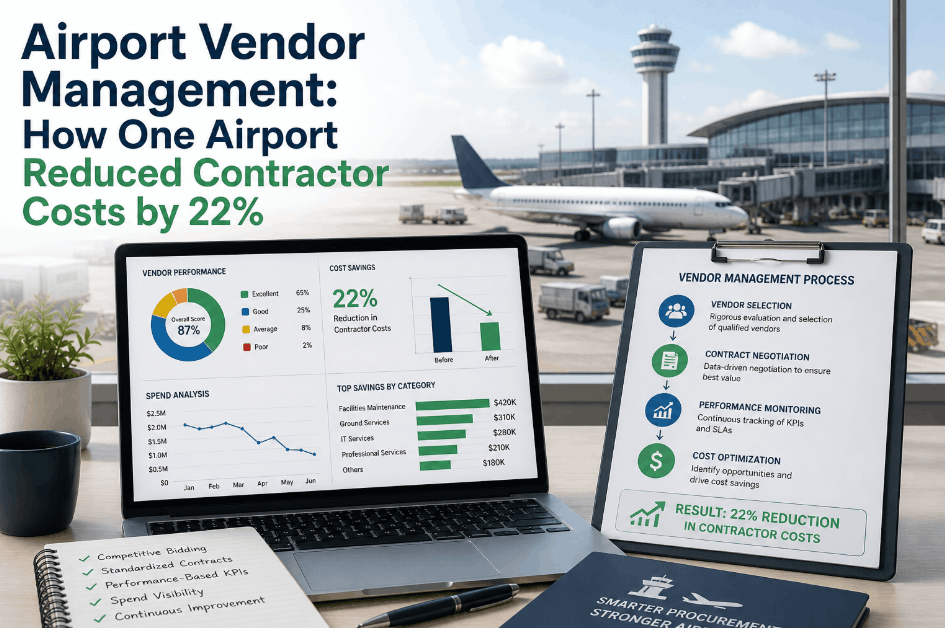
Automatically calculate vendor performance scores based on SLA compliance rates, work order resolution times, credential currency, and audit outcomes. Monthly scorecards provide procurement teams with objective data for contract reviews and renewals.
Replace fragmented email chains with structured in-platform vendor communications. Every message, escalation, and response is logged against the relevant contract, creating a searchable record that protects the airport in dispute situations.
Schedule recurring digital audits for food & beverage operators, retail vendors, and lounge operators. Mobile-first audit checklists with photo capture ensure brand and health standards are enforced consistently across all terminal zones.
Implementing Airport Vendor Management AI: A Phased Deployment Roadmap
Transforming airport vendor operations from fragmented manual processes to unified AI-driven coordination is a structured implementation journey. The following roadmap reflects the approach taken by leading airports to build a scalable, multi-stakeholder vendor management infrastructure. Leading airports book a demo to receive a deployment timeline tailored to their specific vendor portfolio size and operational complexity.
Vendor Portfolio Audit and Contract Data Migration
Map every active vendor and contractor relationship into the platform. Import existing contract terms, SLA thresholds, and expiry dates. Establish the digital credential vault by uploading current insurance certificates, licenses, and access authorizations. This creates the governance baseline for all subsequent performance management.
SLA Tracking and Work Order System Activation
Connect operational data sources — ground handling systems, FIDS, BMS — to the platform to enable real-time SLA monitoring. Activate digital work order workflows for all maintenance and service vendor categories. This phase typically reveals immediate SLA compliance gaps that were previously invisible in monthly reporting cycles.
Automated Credential Management and Compliance Scheduling
Configure automated expiry alerts for all contractor credentials across every vendor category. Schedule recurring compliance audits for concessionaires and cleaning contractors using mobile-first digital checklists. This phase eliminates the reactive compliance management that creates regulatory exposure.
AI Scorecarding and Procurement Analytics Activation
Enable automated vendor scorecarding based on three to six months of accumulated performance data. Use AI-driven spend analytics to identify consolidation opportunities and underperforming vendor relationships. This phase transforms airport procurement management from a cost center into a strategic value function.
Executive Dashboards and Airline Stakeholder Reporting
Deploy one-click executive dashboards for airport leadership and airline account management teams. Provide airlines with structured vendor performance evidence during contract negotiations. Full multi-stakeholder reporting transforms vendor management from a back-office function into a competitive differentiator in airline relationship management.
Airport Vendor Management KPIs: Measuring Multi-Stakeholder Coordination Performance
Effective airport vendor AI driven management requires a disciplined KPI framework that captures both contract compliance and operational impact. The following metrics provide operations directors with a comprehensive picture of vendor management performance across all stakeholder categories.
The percentage of contracted service levels met by each vendor category — ground handlers, cleaners, IT providers, and concessionaires — measured in real time. High-performing airports target 95%+ SLA compliance across all critical vendor relationships.
The percentage of active contractors with fully current credentials — valid SIDA access, insurance certificates, and training records. A rate below 100% represents an active security and compliance risk requiring immediate remediation.
Average time from work order issuance to confirmed completion, segmented by vendor and service category. Tracking this metric over time reveals contractor performance trends that are invisible in monthly aggregate reports.
A composite performance index combining SLA compliance, credential currency, audit scores, and responsiveness into a single vendor health score. Enables direct vendor-to-vendor comparison at contract renewal time.
The percentage of scheduled concessionaire compliance audits resulting in full compliance. Sustained pass rates above 90% indicate that brand and health standards are being maintained consistently across all retail and F&B operators.
The proportion of aircraft or passenger service delays attributable to third-party vendor performance failures. Reducing this metric directly protects airline relationships and on-time performance rankings.
Airport Vendor AI Driven Analytics: How Machine Intelligence Transforms Third-Party Performance
Beyond workflow automation, AI-driven airport vendor management platforms deliver a layer of predictive intelligence that fundamentally changes how operations directors manage third-party relationships. Pattern recognition across thousands of work orders, SLA data points, and audit results surfaces insights that no human analyst could identify in real time.
AI models analyze vendor performance trends to predict SLA breaches before they occur. When a ground handler's turnaround times begin drifting upward over a 14-day period, the system flags the risk and triggers a management review — days before the breach impacts airline metrics.
AI continuously monitors invoiced amounts against contracted rates across all vendor categories. Billing anomalies — inflated labor hours, duplicate work orders, or unauthorized rate escalations — are automatically surfaced for procurement review before payment authorization.
Airport operations are highly seasonal. AI-driven platforms compare current vendor performance against historical baselines for equivalent traffic periods — ensuring that a cleaning contractor's reduced performance during peak season is evaluated in the correct operational context.
By analyzing vendor overlap, spend concentration, and performance consistency, AI platforms identify consolidation opportunities that reduce vendor management complexity while improving service quality and leveraging procurement economies of scale.
Frequently Asked Questions: Airport Vendor and Contractor Management
iFactory stores SIDA badges, insurance certificates, and training records in a digital vault with automated alerts at 90, 60, and 30-day expiry thresholds. Security and procurement teams get a real-time compliance dashboard across the entire contractor population — eliminating manual file-checking and authorization gaps.
Yes. iFactory supports configurable SLA frameworks for every vendor category — from ground handler turnaround times measured in minutes to quarterly concessionaire brand standard audits. All performance dashboards are unified in a single operations view for airport management.
Scorecards are auto-generated monthly using weighted criteria — SLA compliance, work order resolution times, credential currency, and audit outcomes. Procurement teams get objective, benchmarked data for every contract renewal conversation without manual report building.
iFactory centralizes vendor contracts, rate cards, and work order invoicing in one platform. AI-driven spend analytics flag billing anomalies and track spend against contract caps — giving procurement teams full financial visibility across the vendor portfolio.
Yes. The platform scales from regional airports with 20–30 vendors to major hubs managing hundreds of simultaneous contracts. Smaller airports start with SLA tracking and credentials, while larger operations activate the full AI analytics suite incrementally.
Most airports complete Phase 1 onboarding — vendor data migration, contract import, and credential vault setup — within two to four weeks. SLA monitoring and work order workflows go live in Phase 2, typically within 30–45 days of initial deployment.
Yes. iFactory supports role-based stakeholder portals that give airlines and concessionaires visibility into their own SLA performance and compliance status. This transparency reduces dispute frequency and strengthens airport-airline contract relationships.
Yes. iFactory connects with FIDS, Building Management Systems, and ground handling platforms via standard API integrations. This live data feed powers real-time SLA dashboards without requiring manual data entry from operations teams.