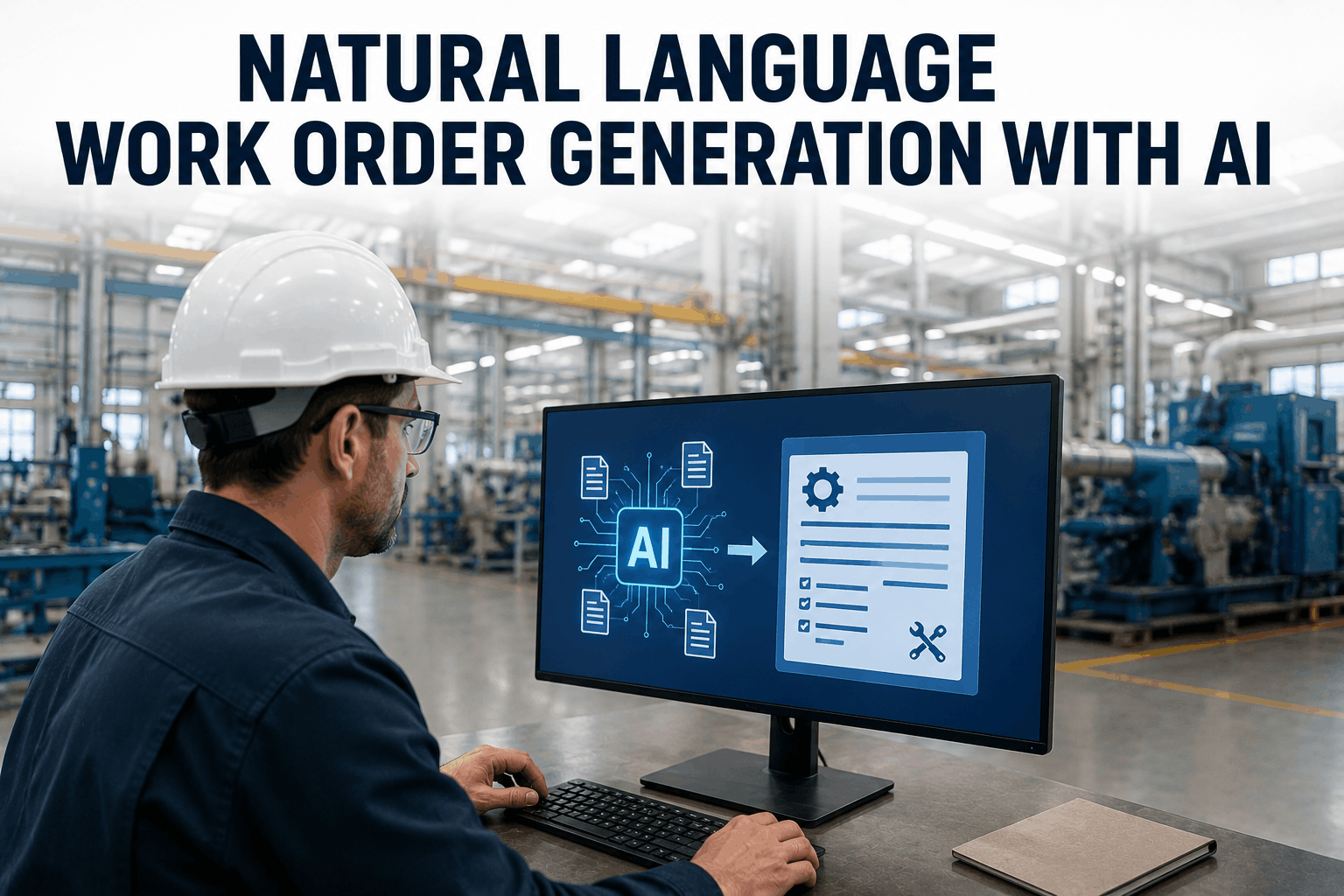
A sensor alert that says "Vibration amplitude exceeded threshold on Pump P-204" is not a work order. Converting that alert into an actionable work order — with failure description, recommended repair procedure, required spare parts, estimated repair time, safety requirements, and technician skill assignment — typically takes a maintenance planner 20 to 40 minutes per event. AI work order generation completes that conversion in seconds, using the sensor alert as input and retrieving fault history, OEM procedures, and parts data to produce a complete, execution-ready work order automatically. CMMS automation benchmarks show that facilities deploying AI work order generation reduce planning time per event by 70 to 85 percent while improving work order completeness scores that directly predict first-time fix rates. Start Trial to see how iFactory generates complete, accurate work orders from sensor alerts without planner intervention.
Turn Every Sensor Alert Into a Complete, Executable Work Order in Seconds
iFactory's AI work order generation platform converts sensor alerts into complete maintenance work orders — failure description, repair procedure, parts list, time estimate, and technician assignment — automatically, without planner involvement for standard fault types.
Why Manual Work Order Creation Is the Hidden Bottleneck in Maintenance Operations
Maintenance planning literature identifies work order quality as the single strongest predictor of first-time fix rate — more predictive than technician experience, parts availability, or procedure currency. Yet most facilities still create work orders manually, with planners converting sensor alerts and verbal fault reports into written orders under time pressure, often without access to the historical data needed to write a complete order. LLM work order research from 2025 shows that manually created work orders are missing at least one critical field — parts list, procedure reference, time estimate, or safety note — in 47 percent of cases, and that these incomplete orders are the primary driver of mid-repair interruptions where technicians must stop work to retrieve information. Teams that Book Demo with iFactory see how AI work order generation eliminates incomplete orders by retrieving and structuring all required information at the point of alert.
Alert-to-Work Order Conversion
Sensor alerts and fault codes are automatically converted into structured work orders — pulling fault description, affected component, and urgency classification directly from the alert data.
Historical Fault Context Integration
AI retrieves prior occurrences of the same fault on the same asset, what resolved each prior event, and whether those resolutions held — embedding this context in the work order failure description so the assigned technician starts with full history.
Procedure and Step Generation
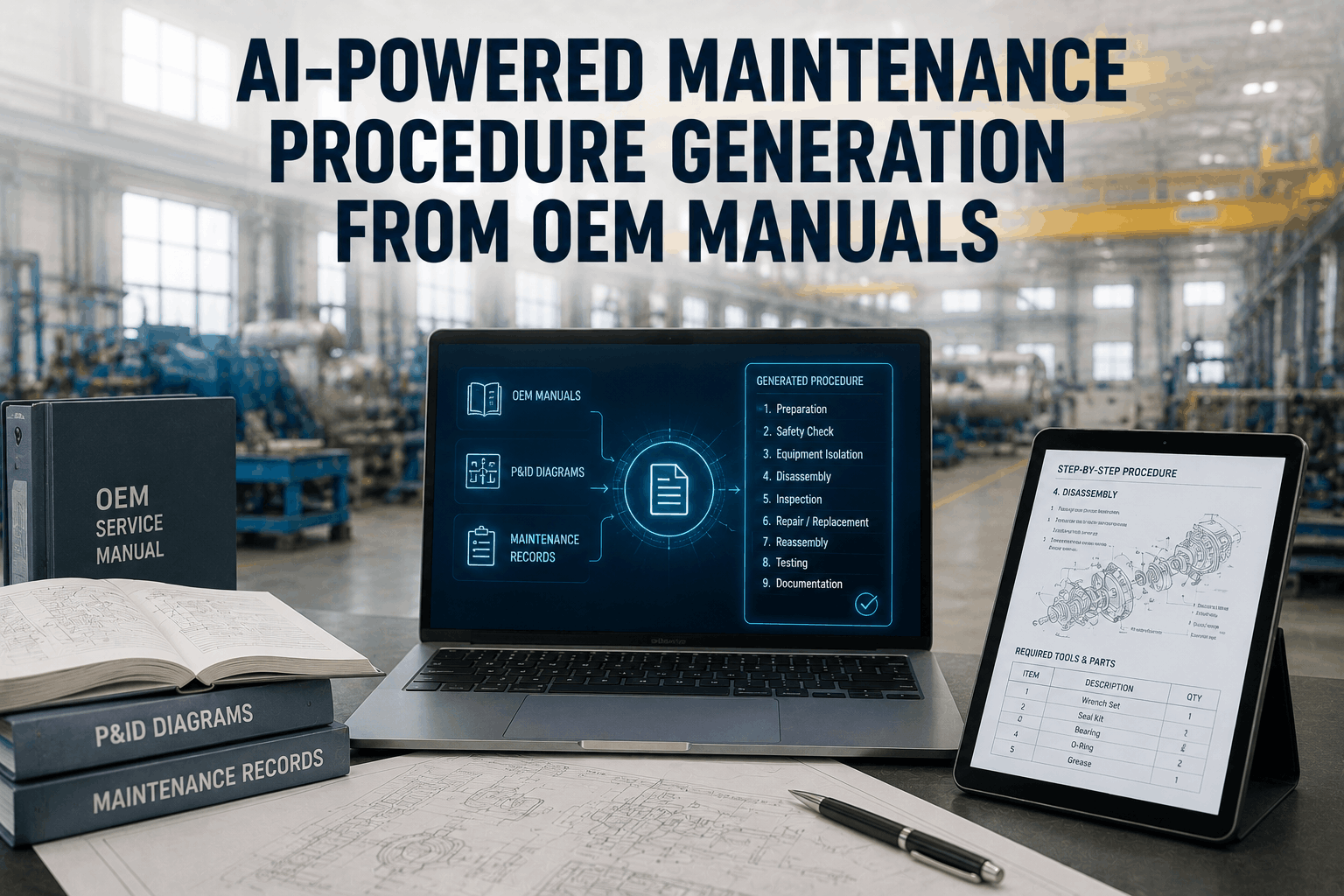
The recommended repair procedure is generated from OEM documentation and prior successful resolutions, structured as numbered steps with tool requirements and safety checkpoints embedded at the relevant stages.
Automatic Parts List Generation
Required spare parts are identified from the fault type and asset model, checked against current inventory, and listed with quantities — with procurement actions initiated automatically for parts not in stock.
Repair Time Estimation
Estimated repair time is calculated from historical durations for the same fault type on the same asset class, adjusted for current technician skill level and access constraints documented in the asset record.
Technician Skill and Availability Matching
Work orders are automatically assigned to the technician with the appropriate skill certification who has available capacity in the recommended repair window — without planner intervention for standard fault types.
Six AI Work Order Generation Applications in Industrial Maintenance
01
Predictive Alert to Complete Work Order Without Planner Input
Highest Automation Value
The highest-value application of AI work order generation converts predictive maintenance alerts into fully populated, execution-ready work orders without any planner involvement for standard fault types on well-documented assets. When the predictive model flags a bearing degradation pattern, the AI generates a work order containing the degradation summary, the recommended bearing replacement procedure from the asset's OEM documentation, the specific bearing part number checked against current stock, the estimated replacement time based on prior repairs, and an assignment to the next available technician with the relevant certification. The planner sees a complete work order in the review queue, not a raw alert requiring translation.
Planner time per work order (manual creation): 28 minutes
Planner time per work order (AI generation + review): 4 minutes
02
Natural Language Fault Report to Structured Work Order
Voice and Text Input
Technicians who report faults verbally or through free-text mobile app entries provide unstructured input that planners must translate into structured work order fields. AI work order generation processes natural language fault descriptions — "the compressor on line 3 is making a high-pitched noise and the outlet pressure is lower than normal" — and converts them into structured fault classifications, component identification, urgency assessment, and initial procedure recommendations without requiring the reporting technician to know CMMS field formats or fault code taxonomies.
Fault classification accuracy (manual planner): 71%
Fault classification accuracy (AI NLP processing): 88%
03
Inspection Finding to Corrective Work Order Chain
Inspection Integration
Routine inspections that identify deficiencies require a separate corrective work order creation step that often introduces delays between finding and remediation. AI work order generation triggers corrective work orders directly from inspection findings — when an inspector marks a seal as showing early wear, the AI generates the corrective work order with the seal part number, replacement procedure, urgency classification, and estimated repair window without requiring the inspector to return to an office workstation or submit a separate maintenance request.
Time from inspection finding to work order creation (manual): 4.2 hours
Time from inspection finding to work order creation (AI): 3 minutes
04
Preventive Maintenance Schedule to Pre-Populated Work Orders
PM Automation
Scheduled preventive maintenance events require work order creation that is largely formulaic — the same procedure, the same parts list, the same time estimate — yet many facilities still create PM work orders manually each cycle. AI generates preventive maintenance work orders automatically from the PM schedule, pre-populating all standard fields and updating parts lists based on current inventory status and any procedure updates issued since the last cycle. Planners review and release PM work orders rather than creating them.
PM work order creation time per month (manual): 14 hours
PM work order creation time per month (AI automated): 1.2 hours
05
Multi-Asset Shutdown Work Order Package Generation
Shutdown Planning
Planned shutdowns require coordinated work order packages covering multiple assets, sequenced in dependency order with shared resource constraints resolved across the entire scope. AI generates the complete shutdown work order package from the prescriptive scope recommendation — sequencing repairs by dependency, grouping work that shares scaffold or isolation requirements, pre-populating all parts lists and procedure references, and producing a coordinated schedule that avoids technician and resource conflicts across the entire shutdown window.
Shutdown package preparation time (manual): 3.5 days
Shutdown package preparation time (AI generated): 4 hours
06
Work Order Completion Note Structuring for Knowledge Capture
Knowledge Preservation
Technician completion notes — the free-text records of what was actually found and what resolved the fault — are the richest source of asset-specific knowledge in any maintenance operation and the least consistently structured. AI processes completion note text at work order closure, extracting the actual fault cause, the resolution steps taken, any deviation from the prescribed procedure, and the confirmation that the repair resolved the original fault — structuring this information into the work order record in a format that can be retrieved as context for future similar faults.
Completion notes usable for future fault retrieval (unstructured): 21%
Completion notes usable for future fault retrieval (AI structured): 89%
AI Work Order Generation: Quick Reference
Scroll for more
| Application | Input Source | Time Saved | Quality Improvement | iFactory Capability |
|---|---|---|---|---|
| Alert to Work Order | Sensor alert / predictive output | 86% per WO | Complete fields: 47% → 96% | Alert-to-WO engine |
| Natural Language Input | Technician voice/text report | NLP classification: 3 min | Classification accuracy: 88% | NLP fault classifier |
| Inspection to Corrective WO | Inspection finding record | 4.2 hours → 3 minutes | Zero manual re-entry | Inspection trigger |
| PM Schedule to Work Orders | PM schedule + procedure library | 91% monthly PM prep time | Current parts + procedures | PM auto-generation |
| Shutdown Package | Prescriptive scope recommendation | 3.5 days → 4 hours | Sequenced, conflict-free | Shutdown package builder |
How iFactory Powers AI Work Order Generation
iFactory's work order generation engine is built on the same structured maintenance data that predictive and prescriptive AI depends on — work order history, fault code taxonomy, asset documentation library, and parts inventory — combined with the LLM layer that converts this structured data into natural language work order content that technicians can understand and act on without consulting additional sources. Teams can Start Trial and see AI-generated work orders produced from their own asset data and fault history within the first week of deployment.
Multi-Source Work Order Assembly
Every AI-generated work order pulls from fault history, OEM procedures, parts inventory, and technician availability — assembling all required information in a single automated step rather than across multiple manual lookups.
Natural Language Output Technicians Can Read
Work order content is written in plain language, not database field codes — the failure description explains what is wrong and why it matters, the procedure reads as numbered steps, and the parts list specifies quantities and locations.
Planner Review and Override
AI-generated work orders enter a planner review queue with flagged fields requiring human judgment — non-standard fault types, complex multi-trade repairs, or assets with unusual condition context that the AI identifies as outside its confident generation range.
Completion Note Structuring
At work order closure, AI processes technician completion notes into structured resolution records — extracting actual cause, resolution steps, and outcome confirmation for future retrieval as fault context.
Implementing AI Work Order Generation: Six Steps
01
Connect Alert Sources and Fault Code Taxonomy
Map sensor alert formats and fault code structures to the AI work order engine — establishing the input schema the system will use to classify faults and initiate work order generation.
02
Index Historical Work Orders for Resolution Pattern Retrieval
Index prior work orders by asset, fault type, and resolution so the AI can retrieve relevant historical context when generating failure descriptions and repair recommendations for each new event.
03
Link OEM Procedure Library to Fault Type Taxonomy
Map OEM procedures and internal repair standards to the fault type classification system so the AI retrieves the correct procedure reference for each generated work order without requiring manual procedure selection.
04
Integrate Parts Inventory and Lead Time Data
Connect live parts inventory and supplier lead time data so generated work orders reflect actual parts availability and trigger procurement actions for parts not currently in stock.
05
Configure Planner Review Thresholds
Define which fault types and asset classes are eligible for fully automated work order release versus planner review — starting conservatively and expanding automation scope as generation accuracy is validated against outcome data.
06
Implement Completion Note Structuring at Work Order Closure
Activate AI completion note processing so every closed work order contributes structured resolution data back to the retrieval corpus — improving the quality of future work order generation with every closed event.
Frequently Asked Questions
What is AI work order generation in industrial maintenance?
AI work order generation uses large language models and maintenance data retrieval to automatically convert sensor alerts, fault reports, and inspection findings into complete, structured work orders — including failure description, repair procedure, parts list, time estimate, and technician assignment — without manual planner input for standard fault types.
How complete are AI-generated work orders compared to manually created ones?
iFactory benchmarks show AI-generated work orders achieve 96 percent field completeness compared to 53 percent for manually created work orders under normal planner workload conditions — the AI retrieves parts, procedures, and historical context that planners frequently skip when working under time pressure.
Can AI generate work orders for faults that have never occurred before?
Yes, with reduced confidence. For novel fault types with no historical precedent, the AI generates a work order from OEM procedure documentation and component data, flagging the generated order for mandatory planner review before release. The AI's confidence level and the basis for each generated field are displayed to the reviewing planner.
Does AI work order generation require integration with the existing CMMS?
Yes. iFactory integrates with existing CMMS platforms via API to read work order history, asset records, and parts inventory, and to write generated work orders back into the CMMS in the native format — no parallel system or duplicate data entry is required.
How does the system handle multi-trade repairs that require different technician skill sets?
Multi-trade repairs are detected during work order generation based on the procedure steps required — when a repair requires both electrical and mechanical certifications, the AI generates a coordinated work order package with sub-tasks assigned to each required skill set, with scheduling dependencies established to sequence the work correctly.
What happens when the AI generates an incorrect work order?
Incorrect generated work orders — identified by planners during review or by technicians during execution — are flagged and the deviation is fed back into the generation model. The system learns from correction patterns, progressively reducing the error rate for the fault types and asset classes where errors occurred.
How long does it take to achieve reliable AI work order generation?
Facilities with three or more years of structured work order history typically achieve reliable AI generation — above 90 percent planner acceptance rate — within 60 to 90 days of deployment for the fault types with sufficient historical data. Generation quality for novel or infrequent fault types improves more slowly as new cases accumulate.
Can technicians interact with AI-generated work orders on mobile devices?
Yes. AI-generated work orders are delivered to technician mobile devices in a readable format — the procedure steps, parts list, safety requirements, and historical fault context are all accessible in the field without requiring the technician to return to a workstation or consult separate documentation sources.
Every Alert Deserves a Complete Work Order. AI Makes That Possible Without Adding Planner Hours.
iFactory generates complete, execution-ready work orders from sensor alerts, inspection findings, and fault reports — giving your technicians everything they need to start the repair without stopping to look anything up.


.png)