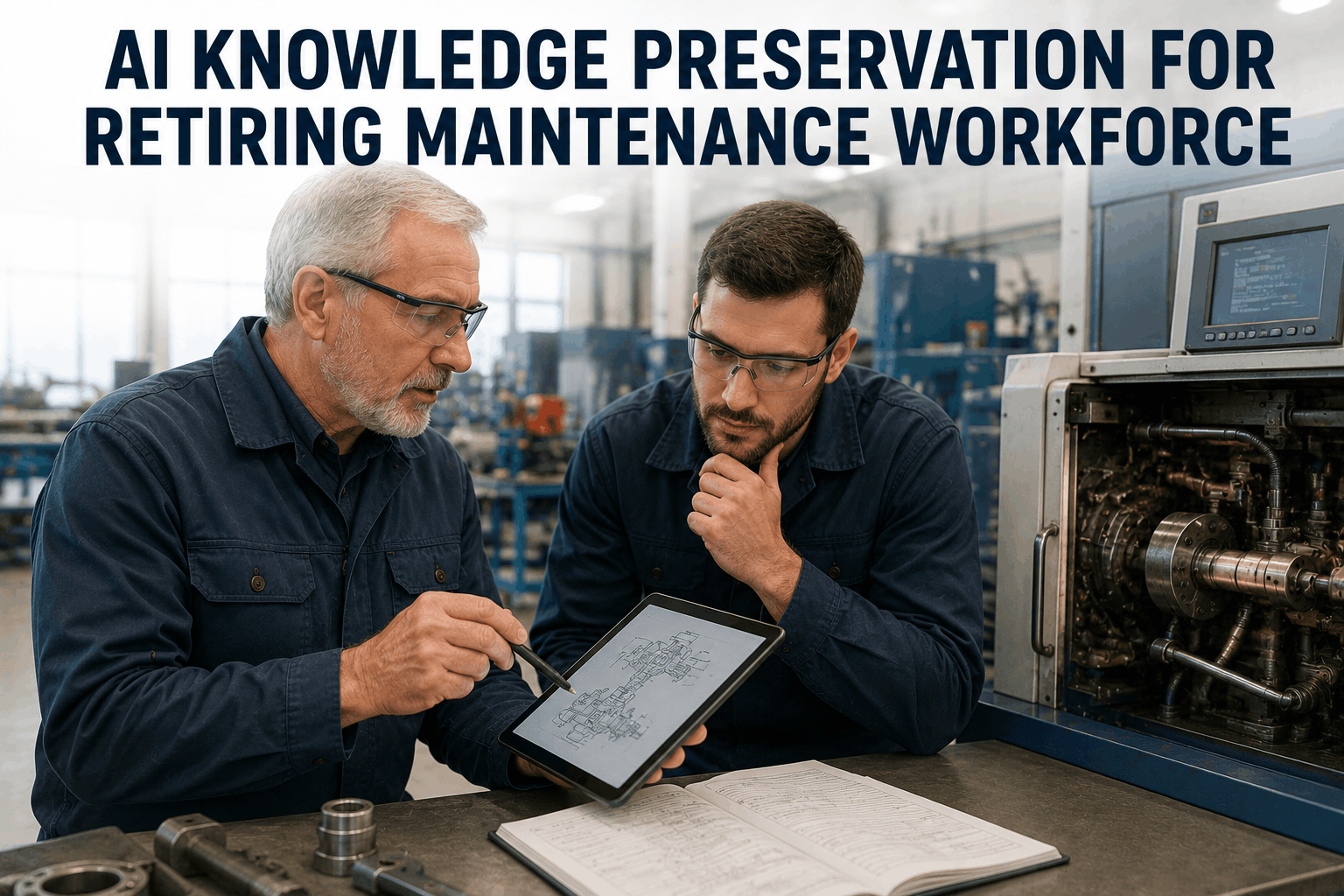
The maintenance technician with 28 years of experience on a specific compressor line knows something no manual captures: the second stage pressure fluctuates at startup when ambient temperature drops below 45°F, and the fix is a 30-second delay in the staging sequence that was figured out through three years of trial and error. When that technician retires, that knowledge retires too — unless AI captures it first. IoT Analytics reports that 40 percent of industrial maintenance workforce is eligible for retirement within five years, and the knowledge gap this creates is not addressable by hiring alone. AI knowledge preservation extracts tribal expertise from work orders, fault logs, technician interviews, and observed repair patterns, converting it into a structured, queryable knowledge base that every future technician can access. Start Trial to see how iFactory captures retiring technician knowledge before it walks out the door.
Stop Losing Institutional Knowledge With Every Retirement
iFactory's AI knowledge preservation platform extracts tribal expertise from work order history, fault logs, and technician input — converting decades of experience into a structured knowledge base that your entire maintenance team can query.
Why the Retiring Workforce Crisis Is a Knowledge Crisis, Not a Headcount Crisis
Industrial maintenance faces a structural challenge that headcount replacement cannot solve: experienced technicians carry knowledge that was never documented, cannot be transferred through training alone, and took years to accumulate through direct equipment interaction. IoT Analytics 2026 workforce data shows that facilities replacing a single experienced technician with two new hires still experience a 35 to 50 percent decline in first-time fix rates during the transition period — not because the new technicians lack skill, but because they lack the asset-specific context that made experienced technicians effective. Teams that Book Demo with iFactory see how AI knowledge capture transforms undocumented expertise into a structured system that new technicians can access on their first shift.
Work Order Pattern Extraction
AI analyzes thousands of historical work orders to identify resolution patterns for recurring fault types — capturing what worked, what did not, and under what conditions each resolution held.
Fault Log Mining
Sensor fault logs and alarm histories are processed to identify the environmental and operational conditions that precede each failure type, building asset-specific predictive signatures from accumulated history.
Technician Interview Structuring
AI-guided interview protocols prompt experienced technicians to verbalize tacit knowledge — the heuristics, workarounds, and experiential rules that never appear in formal documentation.
Repair Sequence Capture
Step sequences observed in high-quality repairs are recorded and structured into retrievable procedures that preserve the experienced technician's approach for future reference.
Exception and Edge Case Documentation
The non-standard conditions that experienced technicians handle intuitively — seasonal variations, load anomalies, upstream interactions — are documented as exception cases in the knowledge base.
Knowledge Validation and Verification
Captured knowledge is validated against historical outcomes — if the AI-extracted heuristic matches the documented repair history, it is confirmed; if it contradicts outcomes, it is flagged for expert review.
Six Forms of Tribal Knowledge AI Can Capture Before Retirement
01
Asset-Specific Fault Signatures Not in Any Manual
Highest Value Capture
Experienced technicians develop fault signatures for individual machines — subtle vibration patterns, temperature differentials, or sound characteristics that indicate a specific failure mode on that specific asset, not the asset class. AI captures these signatures by analyzing historical sensor data alongside the fault codes and repair outcomes that followed, building machine-specific diagnostic patterns that would otherwise take a new technician years to develop independently.
New technician first-time fix rate (no knowledge capture): 51%
New technician first-time fix rate (AI knowledge base): 84%
02
Seasonal and Environmental Operating Adjustments
Contextual Knowledge
Many assets behave differently under varying ambient conditions, load profiles, or upstream supply variations — adjustments that experienced technicians apply intuitively but that no standard procedure documents. AI captures these context-dependent rules by correlating repair actions with environmental and operational metadata, producing documented heuristics that explain when and why non-standard adjustments apply.
Context rules captured by traditional documentation: 12%
Context rules captured by AI pattern extraction: 71%
03
Approved Workarounds and Non-Standard Procedures
Operational Shortcuts
Every maintenance operation accumulates approved workarounds — alternative procedures that are faster, safer, or more effective than the documented method for a specific asset in a specific condition. These workarounds live in experienced technicians' heads and disappear with them at retirement. AI knowledge capture extracts these workarounds from work order narrative fields, technician interview sessions, and observed repair patterns, documenting them with their applicable conditions and validation history.
Workarounds documented in standard procedures: 8%
Workarounds recovered through AI extraction: 67%
04
Vendor and Parts Quality Intelligence
Supply Chain Knowledge
Experienced technicians know which suppliers reliably ship parts that fit and which frequently require adjustment, which part numbers have been superseded without notification, and which aftermarket alternatives are acceptable versus which caused failures. This supplier and parts quality intelligence is not recorded in any procurement system and is invaluable to new technicians who have no basis for making parts decisions beyond the purchase order. AI extracts this knowledge from work order narrative fields and technician interviews, creating a structured parts and supplier reference.
Parts quality issues documented pre-AI: 9% of known cases
Parts quality intelligence captured post-AI: 63% of known cases
05
Failure Cascade Recognition and Early Intervention Points
Diagnostic Intelligence
Experienced technicians recognize failure cascades — the sequence of secondary symptoms that reliably precede a primary failure — and intervene at the right point rather than waiting for the primary failure to occur. These cascade patterns are rarely documented because they were learned through direct observation rather than from procedures. AI extracts cascade signatures from historical sensor data and fault sequences, enabling new technicians to recognize the same patterns that experienced technicians identified through years of observation.
Cascade patterns identified pre-failure (experienced tech): 78%
Cascade patterns identified pre-failure (AI-assisted new tech): 71%
06
System Interdependency Knowledge Across Asset Boundaries
Systems Knowledge
Experienced technicians understand how one asset's behaviour affects adjacent systems — how a pressure drop in one section affects downstream equipment, or how a particular pump failure mode manifests as a temperature anomaly elsewhere in the system. This systems-level knowledge enables experienced technicians to diagnose root causes that appear to originate in equipment other than the asset that initially alarmed. AI captures these interdependency relationships from historical cases where cross-system causes were identified and documented in resolution notes.
Cross-system root cause rate (standard search): 19%
Cross-system root cause rate (AI knowledge base): 74%
Knowledge Preservation Impact: Quick Reference
Scroll for more
| Knowledge Type | Traditional Capture Rate | AI Capture Rate | Primary Source | iFactory Method |
|---|---|---|---|---|
| Asset-Specific Fault Signatures | ~5% | ~80% | Sensor history + WO outcomes | Pattern mining + interview |
| Environmental Adjustments | ~12% | ~71% | Work order metadata + logs | Contextual correlation |
| Approved Workarounds | ~8% | ~67% | WO narratives + interviews | NLP extraction |
| Parts and Supplier Intelligence | ~9% | ~63% | WO notes + procurement data | Text mining + structuring |
| Failure Cascade Signatures | ~14% | ~78% | Alarm sequences + fault history | Temporal pattern analysis |
How iFactory Powers Maintenance Knowledge Preservation
iFactory's maintenance AI platform is built on structured work order data, sensor fault histories, and inspection records — the same sources that AI knowledge extraction depends on to recover tribal expertise. When a technician retires, iFactory does not start the knowledge capture process: it has been running continuously since the first work order was logged, extracting patterns from every repair outcome, fault resolution, and technician note. Teams can Start Trial and see how iFactory's knowledge preservation system continuously builds and refines the asset-specific knowledge base your new technicians will rely on.
Continuous Work Order Mining
Every completed work order is analyzed for resolution patterns, exception conditions, and technician-noted observations — building the knowledge base continuously rather than as a one-time capture event before retirement.
Structured Interview Framework
AI-guided interview protocols help experienced technicians articulate tacit knowledge in structured formats that can be indexed, retrieved, and validated against historical outcomes.
Pattern Validation Against History
Extracted knowledge heuristics are validated against historical repair outcomes before they enter the active knowledge base — ensuring that captured tribal knowledge is accurate, not just anecdotal.
Queryable by New Technicians
Preserved knowledge is accessible through natural language query — a new technician can ask the same questions they would have asked the retiring expert and receive answers grounded in that expert's documented experience.
Implementing AI Knowledge Preservation: Six Steps
01
Identify Retirement-Risk Knowledge Holders
Map which technicians hold the highest concentration of undocumented asset-specific knowledge and prioritize capture efforts around the assets and fault types they primarily handle.
02
Connect AI to Historical Work Order Data
Index all historical work orders, fault logs, and inspection records so the AI can begin extracting patterns from the existing record before any structured interview sessions begin.
03
Conduct Structured Technician Interview Sessions
Use AI-guided interview frameworks to systematically elicit tacit knowledge from experienced technicians — covering fault signatures, workarounds, parts intelligence, and system interdependencies.
04
Validate Captured Knowledge Against Historical Outcomes
Cross-reference extracted heuristics and rules against documented repair history to confirm that captured knowledge reflects actual successful outcomes rather than faulty recollection.
05
Structure Knowledge for Retrieval by New Technicians
Organize validated knowledge into asset-tagged, fault-typed, and condition-indexed records that new technicians can retrieve through natural language queries during live repair situations.
06
Maintain and Extend the Knowledge Base Post-Retirement
Continue mining new work orders and repair outcomes to extend and refine the knowledge base after the retiring technician departs — the system learns from every repair, not just the ones performed by experts.
Frequently Asked Questions
What is AI maintenance knowledge preservation?
AI maintenance knowledge preservation uses machine learning and NLP to extract undocumented expertise from work orders, fault logs, sensor data, and technician interviews — converting tribal knowledge into structured, queryable records that survive workforce turnover.
How much maintenance knowledge is typically lost when an experienced technician retires?
IoT Analytics estimates that experienced maintenance technicians carry 60 to 80 percent of their asset-specific knowledge in undocumented form — knowledge that is unrecoverable through standard documentation practices and disappears permanently at retirement without active AI capture.
Can AI capture knowledge from technicians who resist documentation?
Yes. The most effective AI knowledge capture methods extract expertise passively from existing work order narratives, fault logs, and repair outcomes — requiring no active documentation effort from technicians. Structured interview sessions supplement this passive extraction for knowledge that does not appear in the written record.
How long does it take to build a useful AI maintenance knowledge base?
Facilities with several years of structured work order history can generate an initial knowledge base within weeks of connecting iFactory to their maintenance records. The knowledge base improves continuously as new repair outcomes are added, with meaningful improvement typically visible within 60 to 90 days of deployment.
How does iFactory handle knowledge that contradicts the standard procedure?
Captured knowledge that differs from the standard procedure is flagged for expert review rather than automatically indexed. The review process documents why the variation exists, whether it is an approved alternative for specific conditions, and what validation history supports it — preserving the workaround while maintaining procedural integrity.
What happens to the knowledge base if iFactory is disconnected?
Captured and validated knowledge records are exportable in structured formats and can be integrated into any CMMS or document management system — the knowledge base is not locked inside the platform and remains accessible regardless of future technology decisions.
Can new technicians actually use the knowledge base effectively without prior experience?
Yes. The knowledge base is designed for natural language query — a new technician describes the fault they observe in plain language and receives asset-specific guidance drawn from the captured expertise of experienced predecessors, without requiring the new technician to know what to look for in advance.
How does iFactory support ongoing knowledge capture after retirements are complete?
The platform continues mining every new work order and repair outcome, extending the knowledge base as new technicians develop their own asset-specific insights — the system captures knowledge continuously, not only during pre-retirement windows.
Your Most Experienced Technicians Are Retiring. Their Knowledge Does Not Have To.
iFactory's AI knowledge preservation platform captures tribal expertise from work orders, fault histories, and technician interviews — building the asset-specific knowledge base your future workforce will depend on from day one.