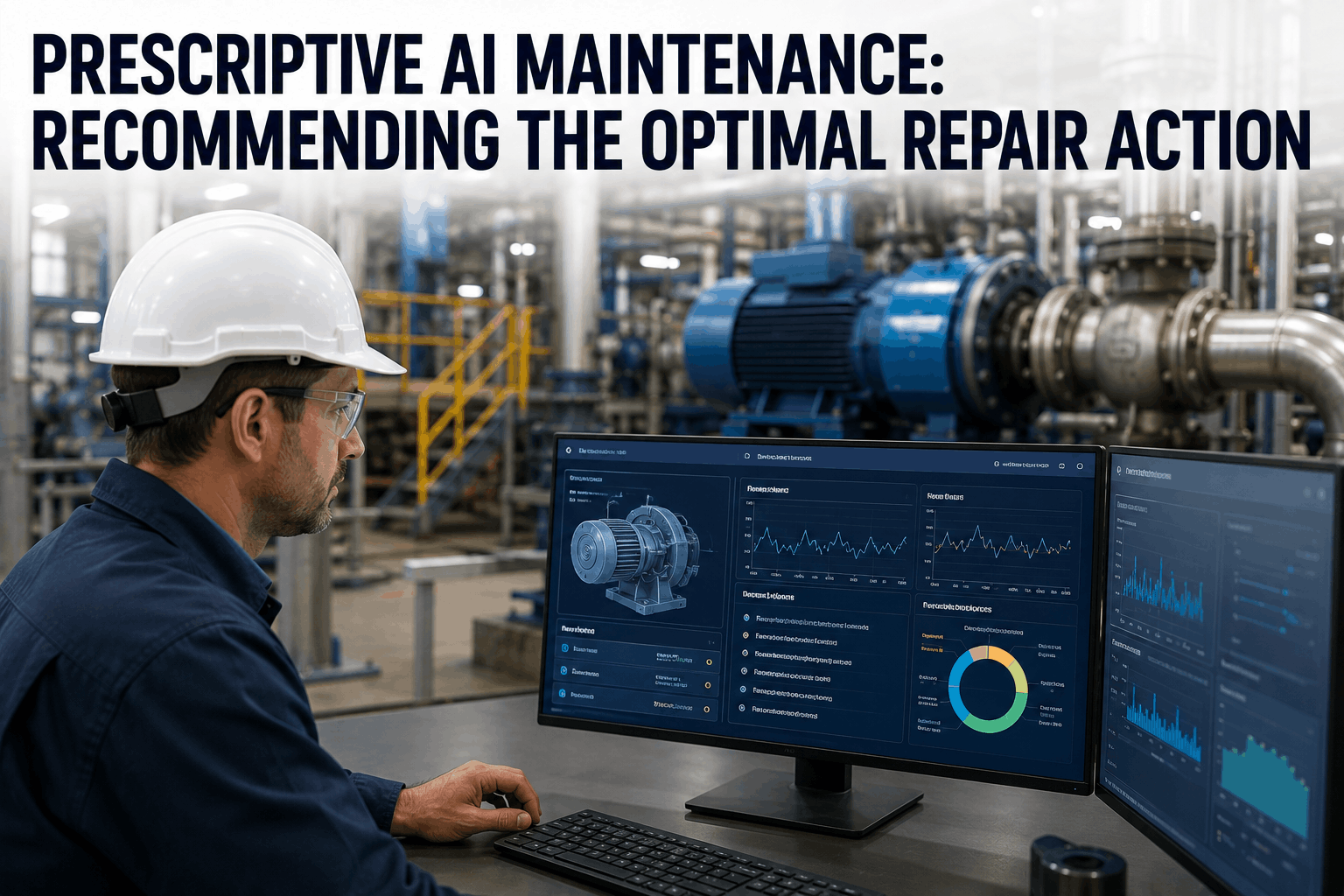
Predictive maintenance tells you a bearing will fail in 14 days. Prescriptive AI tells you which bearing, which technician to assign, which part to order today, and whether to repair during the Tuesday planned shutdown or pull the line for two hours on Thursday when downstream demand drops. The difference between prediction and prescription is the difference between an alert and a decision. Gartner's analytics maturity model places prescriptive analytics as the highest-value tier precisely because it moves from detecting a future problem to recommending the optimal response — accounting for cost, risk, parts availability, technician capacity, and production impact simultaneously. Start Trial to see how iFactory's prescriptive AI turns maintenance predictions into optimized repair recommendations your planners can execute immediately.
Move From Predicting Failures to Recommending the Optimal Repair
iFactory's prescriptive AI maintenance platform analyzes failure risk, parts availability, technician capacity, and production schedules simultaneously — recommending not just what to fix, but when to fix it, who should fix it, and what it will cost to wait.
Why Predictive Alerts Without Prescriptive Decisions Create Planner Overload
A predictive maintenance system that generates 40 alerts per week creates a prioritization problem for maintenance planners who have 12 technician hours available and must decide which alerts to act on, in what order, and how urgently. Without prescriptive decision support, planners apply experience-based judgment to triage alerts — a process that is inconsistent, time-consuming, and blind to the cost and risk implications of each ordering decision. Gartner research shows that facilities with mature predictive maintenance programs experience a paradox: more alerts improves detection coverage but increases planner workload to a point where high-priority alerts are delayed by the volume of lower-priority ones. Teams that Book Demo with iFactory see how prescriptive AI eliminates this triage bottleneck by delivering ranked, actionable repair recommendations rather than raw alert lists.
Multi-Factor Repair Ranking
Prescriptive AI ranks repair recommendations by simultaneously weighing failure probability, consequence severity, parts availability, technician capacity, and production schedule impact.
Cost-of-Wait Analysis
Every recommendation includes a cost-of-wait calculation — the incremental risk and cost added by deferring the repair one day, one week, or one shift — enabling planners to make informed deferral decisions rather than defaulting to urgency alone.
Parts Availability Integration
Repair recommendations are filtered through live parts inventory — a recommendation that requires a part with a 12-day lead time is presented differently from one where the part is on-shelf, with procurement actions initiated automatically.
Technician Capacity Matching
Recommendations are matched to available technician skill sets and current workload, producing a schedule that assigns the right skill to each repair without overloading any single technician.
Production Impact Optimization
Repair timing recommendations account for production schedules — identifying the lowest-impact window for each repair and quantifying the production loss avoided by performing maintenance at the recommended time versus at failure.
Recommendation Outcome Tracking
Prescriptive recommendations that were followed, modified, or overridden are tracked against actual outcomes — continuously refining the recommendation model based on which decisions produced the best results in practice.
Six Prescriptive AI Applications in Industrial Maintenance
01
Optimal Repair Timing Across Production and Maintenance Constraints
Highest Value Application
The most impactful prescriptive AI application in maintenance recommends the specific repair window that minimizes total cost — balancing the risk of deferral against the production disruption of early intervention. For an asset with a 30-day failure horizon and a planned shutdown in 21 days, the prescriptive recommendation is to repair at the planned shutdown rather than pulling production immediately — with the cost-of-wait quantified for each interim week. For an asset with a 5-day failure horizon and no planned downtime, the recommendation is immediate intervention with an emergency window identified in the production schedule.
Maintenance cost per unit uptime (reactive scheduling): baseline
Maintenance cost per unit uptime (prescriptive scheduling): 31% lower
02
Repair vs Replace Decision Support for Degraded Components
Asset Decision
When a component reaches a degradation threshold, prescriptive AI evaluates whether repair or replacement is the optimal action based on the component's remaining useful life distribution, repair cost versus replacement cost, the consequence of a repeat failure after repair, and the lead time for a replacement unit. The recommendation includes the economic breakeven analysis — at what remaining useful life does replacement become preferable to repair — and flags cases where the repair cost is high enough that replacement at the next scheduled opportunity is clearly preferable.
Premature replacement rate (experience-based): 28%
Premature replacement rate (prescriptive AI): 9%
03
Work Order Prioritization and Planner Queue Optimization
Planner Decision Support
Prescriptive AI converts the raw alert list into a ranked work order queue — each item ordered by the combined weight of failure urgency, consequence severity, parts readiness, and technician availability. Planners receive a queue where item one is the repair with the highest combined priority score across all factors, not simply the asset closest to predicted failure. This removes the manual triage step that consumes planner time and introduces inconsistency when different planners apply different prioritization heuristics to the same alert list.
Planner triage time per week (manual): 6.4 hours
Planner triage time per week (prescriptive AI): 0.9 hours
04
Shutdown and Turnaround Scope Optimization
Shutdown Planning
Prescriptive AI maximizes the value of every planned shutdown by recommending which additional repairs should be bundled — assets that are not yet at immediate failure risk but whose failure probability within the next inter-shutdown interval makes repair-at-shutdown clearly preferable to a mid-cycle emergency intervention. The scope recommendation also flags assets that are often repaired at shutdown but whose current degradation trajectory indicates they will not require attention in this cycle, enabling scope reduction without increasing mid-cycle failure risk.
Emergency interventions between shutdowns (standard planning): 4.2/cycle
Emergency interventions between shutdowns (prescriptive scope): 1.1/cycle
05
Spare Parts Pre-Positioning Based on Prescriptive Repair Forecast
Inventory Optimization
Prescriptive maintenance forecasts translate directly into parts pre-positioning recommendations — the 30-day repair queue prescribes which parts should be stocked now, which should be ordered with standard lead time, and which can remain at minimum stock levels given the absence of predicted demand. This converts parts inventory management from a reactive buffer strategy to a demand-driven supply plan, reducing both emergency procurement costs and the carrying cost of excess safety stock.
Emergency parts procurement events per month (reactive): 8.3
Emergency parts procurement events per month (prescriptive): 1.7
06
Continuous Recommendation Calibration From Outcome Feedback
Model Improvement
Prescriptive AI recommendations are only as good as the models that generate them, and those models improve with every decision outcome that is fed back into the system. When a planner follows a recommendation and the repair outcome matches the prediction, the model gains confidence. When a planner overrides a recommendation and documents the reason, the model learns the conditions under which human judgment outperforms the algorithm — progressively calibrating recommendations toward the decisions that experienced planners make, extended to situations where experienced judgment is unavailable.
Recommendation accuracy (first 90 days): 71%
Recommendation accuracy (after 12 months): 89%
Prescriptive AI Maintenance: Quick Reference
Scroll for more
| Prescriptive Application | Decision Supported | Key Inputs | Primary Outcome | iFactory Capability |
|---|---|---|---|---|
| Optimal Repair Timing | When to schedule each repair | Failure horizon, production schedule | 31% lower maintenance cost/uptime | Schedule optimizer |
| Repair vs Replace | Which action to take on degraded asset | RUL estimate, cost models | 9% premature replacement rate | Economic decision engine |
| Work Order Prioritization | Queue order for planners | Multi-factor scoring | 85% triage time reduction | Ranked work order queue |
| Shutdown Scope | What to include in planned downtime | Degradation forecasts, inter-shutdown risk | 74% fewer emergency interventions | Scope recommendation engine |
| Parts Pre-Positioning | What to stock and when to order | 30-day repair forecast | 80% fewer emergency procurements | Inventory demand planning |
How iFactory Delivers Prescriptive Maintenance Recommendations
iFactory's prescriptive AI layer sits above the predictive analytics engine — taking failure probability outputs and converting them into ranked, cost-optimized repair recommendations that planners can act on without additional analysis. The platform integrates with work order systems, parts inventory, technician scheduling, and production planning data to contextualize every recommendation within the operational constraints that determine what is actually executable on any given shift. Teams can Start Trial and see prescriptive recommendations generated from their own maintenance and production data within the first week of deployment.
Multi-Constraint Recommendation Engine
Every repair recommendation is optimized across failure risk, parts availability, technician capacity, and production schedule impact — not just failure probability alone.
Cost-of-Wait Quantification
Each recommendation includes an explicit cost-of-wait analysis — the incremental cost added by deferring the repair one day, one week, or one production cycle.
Planner Interaction and Override Capture
Planners can review, modify, or override recommendations with documented reasons — feedback that the system uses to improve future recommendations based on planner judgment.
Outcome-Based Model Calibration
Every completed repair feeds back into the recommendation model — actual outcomes versus predicted outcomes continuously calibrate the prescriptive engine toward higher accuracy.
Implementing Prescriptive AI Maintenance: Six Steps
01
Establish Failure Probability Inputs From Predictive Models
Prescriptive AI requires failure probability estimates as input — connect or build the predictive models that generate asset-level failure forecasts for the equipment in scope.
02
Define Consequence Severity Weights for Each Asset Class
Configure the consequence severity framework — which assets carry the highest production, safety, and cost consequences at failure — so the prescriptive engine weights recommendations appropriately.
03
Integrate Parts Inventory and Procurement Lead Times
Connect the prescriptive engine to live parts inventory and supplier lead time data so repair recommendations reflect actual parts availability, not just failure risk.
04
Connect Production Schedule Data for Timing Optimization
Integrate production scheduling data so repair timing recommendations identify the lowest-impact intervention windows within the operating calendar.
05
Configure Planner Review and Override Workflow
Establish the workflow for planner review of prescriptive recommendations — including how overrides are documented and fed back into the recommendation calibration process.
06
Track Recommendation Outcomes for Continuous Calibration
Implement outcome tracking — comparing recommended actions against actual repair results — so the prescriptive model improves continuously with each decision cycle.
Frequently Asked Questions
What is prescriptive AI maintenance and how does it differ from predictive maintenance?
Predictive maintenance identifies that a failure will occur and when. Prescriptive AI recommends the optimal response — what to fix, when to fix it, who should fix it, and what it costs to wait — integrating failure probability with operational constraints to produce actionable decisions rather than alerts.
What data does prescriptive AI need beyond the predictive failure model?
Prescriptive AI requires failure probability inputs from predictive models plus consequence severity data, parts inventory and lead times, technician skill and capacity, and production scheduling data — all of which iFactory integrates to generate contextualized recommendations.
Can prescriptive AI replace maintenance planners?
Prescriptive AI is designed to support planners, not replace them. The system handles the multi-factor analysis that would take planners hours manually and presents the output as ranked recommendations — planners retain full authority to review, modify, and override every recommendation, with their decisions fed back to improve future outputs.
How accurate are prescriptive maintenance recommendations in the first year?
Early-stage prescriptive models typically achieve 65 to 75 percent recommendation accuracy in the first 90 days. Accuracy improves to 85 to 90 percent over 12 months as the model is calibrated by actual repair outcomes and planner feedback — the system learns from every decision made on its recommendations.
How does prescriptive AI handle conflicts between failure urgency and production constraints?
When failure urgency and production constraints conflict — an asset nearing failure during a critical production run — prescriptive AI quantifies the cost of each option: immediate intervention versus deferral to a specified window. The planner sees both the cost of waiting and the production impact of acting now, and makes an informed tradeoff decision rather than guessing at the less-bad option.
What is the typical ROI timeline for prescriptive AI maintenance deployment?
Facilities deploying prescriptive AI alongside mature predictive models typically see positive ROI within 6 to 12 months, driven by reductions in emergency maintenance costs, planner overtime, premature part replacements, and unplanned production downtime. The ROI compresses when the facility has high-consequence assets where a single avoided failure event covers a significant portion of the deployment cost.
Does prescriptive AI work without a mature predictive maintenance program?
Prescriptive AI is most effective when built on top of accurate failure probability inputs from predictive models. iFactory supports staged deployment — beginning with rule-based prescriptive logic using condition thresholds and maintenance history while predictive models are trained, then transitioning to probability-driven recommendations as the predictive layer matures.
How does iFactory's prescriptive AI integrate with existing CMMS and ERP systems?
iFactory connects to existing CMMS and ERP systems via standard API integrations — reading work order history, parts inventory, technician schedules, and production data, and writing approved repair recommendations back as work orders into the CMMS without requiring duplicate data entry or parallel workflow management.
Your Predictive Alerts Are Only Valuable When They Become Executable Decisions
iFactory's prescriptive AI converts failure probability into ranked, cost-optimized repair recommendations — telling your planners not just what will fail, but what to do about it and when.



.png)