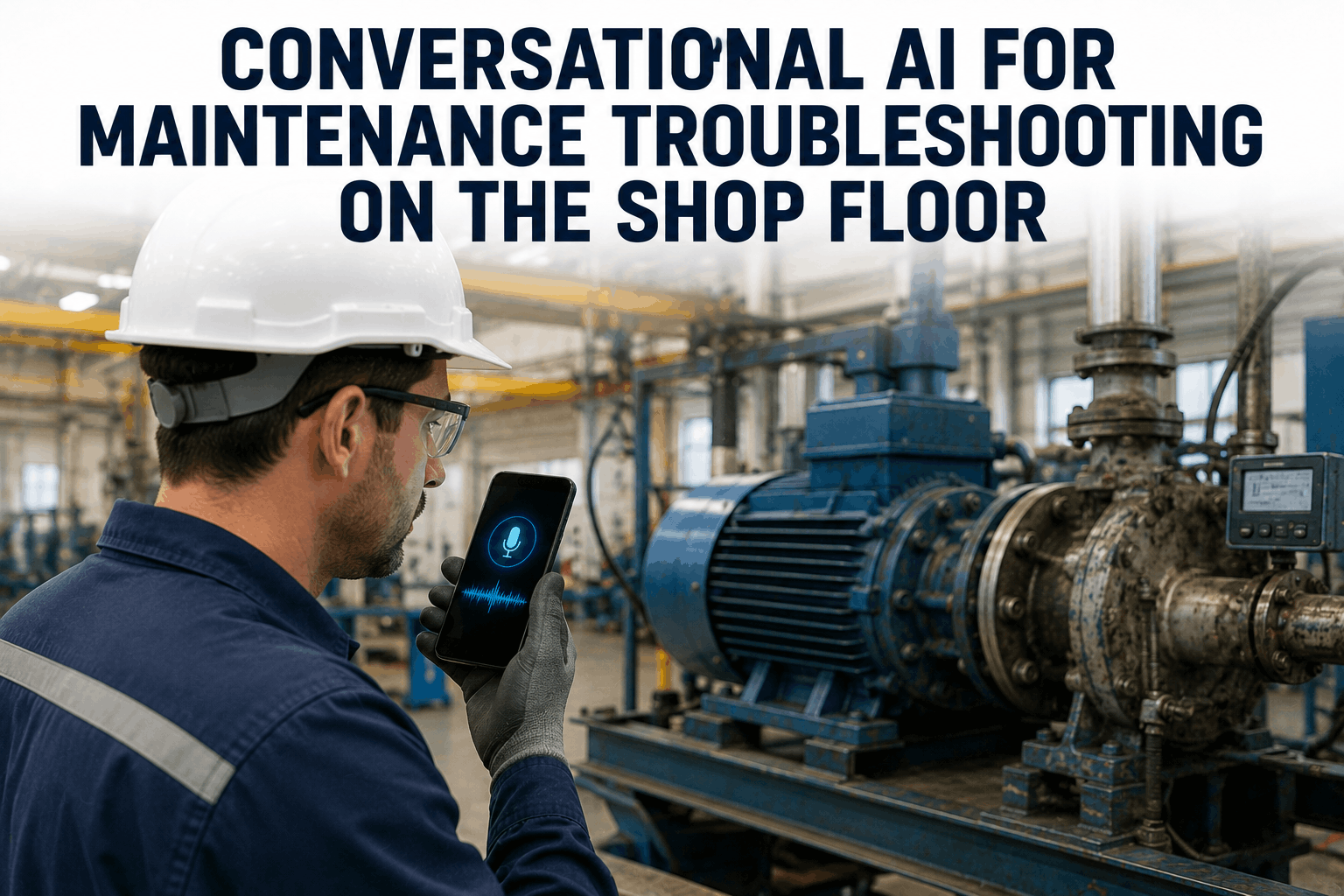
A technician standing in front of a failed pump at 2 AM does not have time to open a laptop, navigate a CMMS, search for the asset record, find the procedure, cross-reference the parts list, and then call a supervisor to ask what the last three repairs found. Conversational AI collapses this sequence into a single voice query: "Pump P-204 is making a grinding noise and the discharge pressure is reading low — what do I check first?" The AI responds with the three most likely causes based on that pump's fault history, the first diagnostic step from the OEM procedure, and a note that the mechanical seal was flagged for early wear in the last inspection. AR and voice maintenance research shows this conversational troubleshooting approach reduces mean time to repair by 38 to 44 percent by eliminating the information retrieval steps that consume the majority of diagnostic time on the shop floor. Start Trial to see how iFactory's conversational AI assistant transforms mobile maintenance troubleshooting across your fleet.
Give Every Technician a Knowledgeable Assistant in Their Pocket
iFactory's conversational AI maintenance assistant answers fault queries with asset-specific guidance — pulling the affected equipment's repair history, OEM procedures, and current inspection findings — so technicians spend less time looking and more time fixing.
Why Shop Floor Information Retrieval Is the Largest Unaddressed MTTR Driver
Time-motion studies of industrial maintenance repair events consistently show that technicians spend 35 to 50 percent of total repair time on information retrieval — finding the procedure, locating the parts, understanding the asset's fault history, and resolving ambiguities that require supervisor contact. This time is not spent diagnosing or repairing the asset; it is spent retrieving information that already exists in the organization's systems and is simply inaccessible in a useful form at the point of repair. AR and voice maintenance research from 2025 confirms that the facilities that have reduced MTTR most significantly are those that addressed information access at the point of repair rather than adding more training or better procedures stored in inaccessible locations. Teams that Book Demo with iFactory see how conversational AI eliminates the information retrieval bottleneck without requiring technicians to learn new documentation formats or CMMS navigation patterns.
Voice-Driven Fault Query
Technicians describe faults in natural language — spoken or typed — and receive diagnostic guidance without navigating menus, entering codes, or knowing the CMMS asset identifier for the equipment they are standing in front of.
Asset-Specific Response Generation
Every conversational response is grounded in the queried asset's specific history — prior faults, resolutions, known issues, and current condition assessments — not generic guidance that ignores what the maintenance team already knows about that machine.
Step-by-Step Procedure Guidance
Conversational AI delivers procedure steps one at a time in response to technician confirmation — matching the pace of the repair rather than displaying the full procedure for the technician to scroll through while holding a tool.
Parts and Tool Identification
The AI identifies required parts and tools at the relevant step of the procedure, checks current inventory status, and initiates a parts retrieval request or procurement action without requiring the technician to leave the repair location.
Supervisor Escalation Triggering
When a conversational query indicates a fault condition beyond the AI's confident guidance range — complex multi-system failures, safety-critical interventions, or novel failure modes — the system automatically escalates to a supervisor with the full conversation context attached.
Repair Log Dictation
Technicians dictate their findings and resolution actions in natural language at job completion — the AI structures these inputs into a complete work order closure record without requiring the technician to navigate CMMS fields while on the shop floor.
Six Conversational AI Applications in Shop Floor Maintenance
01
Real-Time Fault Diagnosis With Asset History Context
Highest MTTR Impact
The highest-impact conversational AI application on the shop floor provides real-time fault diagnosis grounded in that asset's specific repair history. When a technician asks about a vibration fault, the AI does not deliver a generic vibration diagnostic tree — it retrieves the three previous vibration events on that asset, what caused each one, what resolved each, and how long the resolution held, then recommends the diagnostic path that matches the current symptom profile against that asset's documented history. This collapses the experienced-technician advantage: a new technician with the conversational AI assistant approaches the repair with the same asset-specific context that would take years to accumulate independently.
MTTR without conversational AI (information retrieval included): baseline
MTTR with conversational AI (iFactory benchmark): 41% reduction
02
Procedure Navigation for Less Experienced Technicians
Skills Gap Bridge
Less experienced technicians face a particular challenge: they need the procedure most but are also least able to navigate complex multi-section manuals under time pressure at a live fault. Conversational AI presents procedures interactively — the technician confirms each step completion before receiving the next, with the AI providing clarification on request and flagging safety checkpoints before the technician proceeds. This interactive format produces higher procedure compliance than presenting the full procedure document and expecting the technician to self-navigate.
Procedure compliance rate (document reference): 61%
Procedure compliance rate (conversational AI delivery): 91%
03
Supervisor Call Elimination for Standard Fault Resolutions
Escalation Reduction
The most common reason technicians call supervisors during repairs is not technical complexity — it is information access. The technician cannot find the torque specification, cannot identify the correct replacement part number, or cannot determine whether a visible condition is within acceptable limits. Conversational AI answers these specific, bounded questions in seconds, eliminating the supervisor call entirely for information queries while preserving escalation for genuinely complex judgment calls that require experienced human input.
Supervisor calls per repair event (without AI): 1.8 average
Supervisor calls per repair event (with conversational AI): 0.4 average
04
Safety Check Delivery at Critical Procedure Steps
Safety Integration
Safety requirements embedded in conversational procedure delivery are acknowledged and confirmed before the technician proceeds — creating a documented safety compliance record at each critical step rather than relying on the technician to notice and apply safety instructions embedded in a long procedure document. When a procedure step involves high-voltage isolation, confined space entry, or chemical handling, the conversational AI delivers the applicable LOTO procedure and safety requirements before advancing to the repair step.
Safety step acknowledgment rate (document procedures): 54%
Safety step acknowledgment rate (conversational AI): 97%
05
Multi-Language Procedure Delivery for Diverse Maintenance Teams
Language Accessibility
Maintenance teams in industrial facilities often include technicians whose strongest working language is not the language in which OEM procedures are written. Conversational AI delivers procedure guidance in the technician's preferred language — translating OEM documentation and asset-specific repair history into the language the technician queries in — without requiring separate translation infrastructure or dual-language procedure maintenance. The underlying procedure source remains in a single language; the conversational interface handles translation at query time.
First-time fix rate (non-native language procedure): 63%
First-time fix rate (native language conversational AI): 84%
06
Voice-Dictated Work Order Closure and Fault Documentation
Documentation Automation
Work order documentation quality degrades under time pressure — technicians completing repairs under production urgency record minimal completion notes because CMMS data entry at a mobile terminal in a noisy shop environment is slow and cumbersome. Voice-dictated work order closure changes this dynamic: the technician describes what they found and what they did in natural language, and the AI structures the dictation into complete CMMS closure fields. This produces richer completion records with no additional technician effort, directly improving the quality of fault history available for future conversational queries.
Completion note word count (typed CMMS entry): 18 words avg
Completion note word count (voice-dictated AI structured): 94 words avg
Conversational AI Maintenance: Quick Reference
Scroll for more
| Application | Technician Input | AI Output | MTTR Impact | iFactory Capability |
|---|---|---|---|---|
| Fault Diagnosis | Natural language fault description | Asset-specific diagnostic guidance | 41% MTTR reduction | RAG-grounded diagnosis |
| Procedure Navigation | Step confirmation or query | Next step + safety flags | 91% compliance rate | Interactive procedure delivery |
| Supervisor Escalation | Complex fault indication | Escalation with full context | 78% call reduction | Auto-escalation trigger |
| Safety Delivery | Step completion confirmation | Safety check before next step | 97% acknowledgment rate | Embedded safety gates |
| WO Closure | Voice dictation of findings | Structured CMMS closure record | 5x richer documentation | Voice-to-structured NLP |
How iFactory Powers Conversational Maintenance AI
iFactory's conversational AI assistant is grounded in the same structured maintenance data that powers the broader platform — work order history, fault code taxonomy, OEM procedure library, inspection records, and parts inventory — combined with a retrieval layer that surfaces the specific asset's relevant history in response to each technician query. The conversational interface is available on mobile devices and through voice interaction, requiring no new hardware or infrastructure beyond the mobile devices maintenance teams already carry. Teams can Start Trial and deploy the conversational AI assistant to technicians using existing mobile devices within days of activation.
Mobile-First Voice and Text Interface
The conversational AI operates on technicians' existing mobile devices via voice or text — no wearable hardware, AR headsets, or specialized terminals required for core functionality.
Asset-Grounded Response Retrieval
Every response is retrieved from the queried asset's specific maintenance record — fault history, prior resolutions, known conditions — not generated from generic maintenance knowledge alone.
Interactive Procedure Step Delivery
Procedures are delivered step-by-step in response to technician confirmation, with safety checkpoints embedded at the correct sequence position rather than listed separately at the procedure header.
Voice-to-Structured Documentation
Technician voice dictation at job completion is processed into complete, structured CMMS work order closure records — producing richer fault documentation with no additional effort from the technician.
Implementing Conversational AI for Shop Floor Maintenance: Six Steps
01
Connect Asset Fault History and Procedure Library
Index the maintenance knowledge sources that ground conversational responses — work order history, OEM procedures, inspection findings, and known fault resolutions — organized by asset identifier for retrieval at query time.
02
Configure Asset Identification From Technician Input
Enable technicians to identify assets by location, description, or QR scan rather than requiring CMMS asset ID entry — the conversational AI maps natural language location descriptions to asset records in the maintenance database.
03
Define Escalation Rules for Out-of-Scope Queries
Configure which fault types, severity levels, and safety conditions trigger automatic supervisor escalation — with the full conversation context attached to the escalation notification so the supervisor arrives informed.
04
Embed Safety Gates in Critical Procedure Steps
Map LOTO requirements, confined space protocols, and chemical handling procedures to the specific procedure steps where they apply — so the conversational AI delivers safety requirements at the correct point in the repair sequence.
05
Deploy on Technician Mobile Devices With Offline Capability
Configure offline operation for the most critical procedure and parts data — technicians working in areas with limited connectivity retain access to essential guidance without requiring continuous network access.
06
Activate Voice-to-CMMS Documentation at Work Order Closure
Enable voice dictation at job completion and configure the NLP structuring rules that map dictated repair descriptions to CMMS closure fields — improving documentation completeness from the first day of deployment.
Frequently Asked Questions
What is conversational AI for maintenance troubleshooting?
Conversational AI for maintenance is a mobile assistant that answers technician fault queries in natural language — retrieving asset-specific repair history, OEM procedures, and parts data in response to voice or text questions — reducing the information retrieval time that drives the majority of shop floor MTTR in most facilities.
How much does conversational AI reduce mean time to repair?
AR and voice maintenance research benchmarks show 38 to 44 percent MTTR reduction across facilities that deploy conversational AI as the primary shop floor information interface. iFactory deployments average 41 percent MTTR reduction, driven primarily by the elimination of information retrieval steps that previously consumed 35 to 50 percent of total repair event time.
Does conversational AI require special hardware or wearables?
No. iFactory's conversational AI operates on standard iOS and Android mobile devices via voice or text input — no AR headsets, smart glasses, or specialized terminals are required for core functionality. AR hardware integration is available as an optional enhancement for facilities that choose to deploy wearable technology.
How does the AI know which asset the technician is working on?
Technicians identify assets through natural language location description ("the pump on line 3 near the east wall"), QR code scan, NFC tap, or direct asset search. The conversational AI maps the identification method to the correct asset record and retrieves that asset's maintenance history as the context for the session.
Can the conversational AI handle faults it has not seen before?
For novel fault types without historical precedent on the specific asset, the AI delivers guidance from OEM procedure documentation and similar fault patterns on comparable assets, clearly indicating that asset-specific history is not available for that fault type. Novel fault sessions are flagged for supervisor review and added to the knowledge base after resolution.
How does voice dictation improve work order documentation?
Voice dictation removes the friction of CMMS data entry in a shop floor environment — technicians describe findings and resolutions in natural speech, and the AI structures the dictation into complete work order closure fields. iFactory benchmarks show voice-dictated completion records average 94 words versus 18 words for typed mobile CMMS entries, dramatically improving the fault history available for future repair events.
What languages does iFactory's conversational maintenance AI support?
iFactory's conversational AI supports query and response in the major industrial languages — English, Spanish, French, German, Portuguese, and Mandarin in the standard deployment, with additional language support available for specific regional deployments. Technicians query in their preferred language and receive responses in the same language regardless of the language in which the underlying procedure documentation is written.
How does conversational AI interact with the existing CMMS and maintenance systems?
iFactory's conversational AI reads asset records, work order history, parts inventory, and procedure libraries from the existing CMMS via API integration, and writes structured work order closures and fault reports back to the CMMS at session end. Technicians interact with the conversational interface only — all CMMS data operations happen in the background without requiring technicians to navigate the CMMS directly on the shop floor.
The Information Your Technicians Need at 2 AM Is Already in Your System. AI Makes It Answerable in Seconds.
iFactory's conversational AI assistant gives shop floor technicians instant access to asset-specific fault history, step-by-step procedures, and parts availability — through voice or text, on the mobile device they already carry.