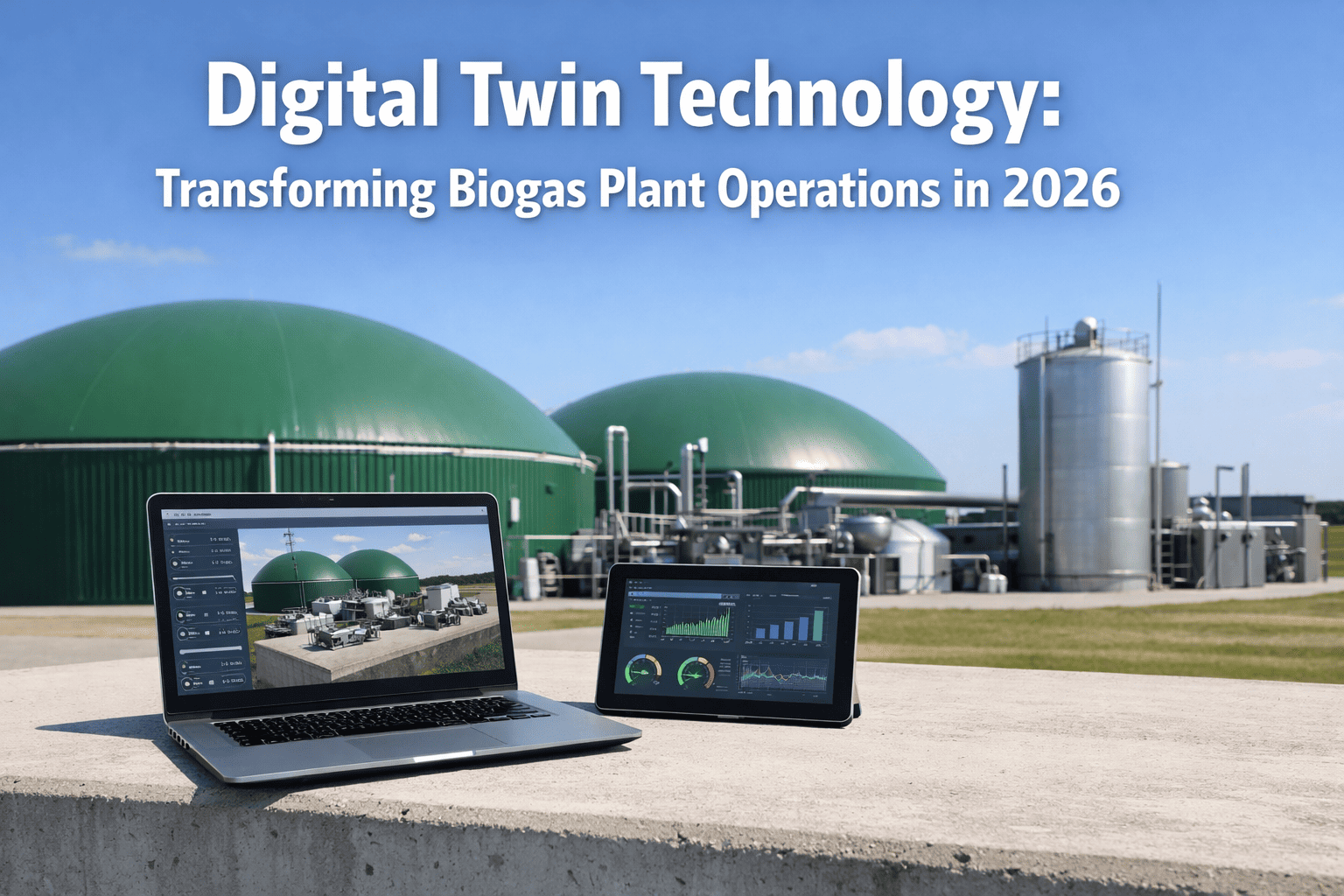
Digital Transformation Roadmap for Biogas Plant Managers
By oxmaint on March 10, 2026
Biogas plants across the world are sitting on massive untapped potential—not because the biology is failing, but because the data driving operational decisions is incomplete, delayed, or trapped in silos. Digital transformation changes that equation entirely. By layering IoT sensors, real-time data analytics, AI-driven process optimization, and connected maintenance systems onto existing biogas infrastructure, plant managers can unlock double-digit improvements in gas yield, equipment uptime, and operational efficiency without expanding physical capacity. The shift from reactive management to predictive, data-driven operations is no longer optional for biogas facilities competing in today's energy market. Connect with our digital transformation specialists to explore where your biogas plant stands on the readiness curve and what the first steps look like.
Why Biogas Plants Need a Digital Transformation Strategy
Most biogas facilities still rely on manual sampling, periodic lab analysis, and operator experience to manage complex anaerobic digestion processes. While this approach works at a basic level, it leaves significant value on the table. Feedstock variability, seasonal fluctuations, equipment degradation, and regulatory pressure create operational complexity that human intuition alone cannot optimize. A structured digital roadmap addresses each of these challenges systematically—starting with data visibility and progressing toward autonomous process control.
19,000+
Biogas plants operating across Europe alone, with global capacity growing at 8.3% annually through 2050
15–30%
Typical improvement in biogas yield reported by facilities that implement IoT monitoring and AI-based feeding optimization
60%
Of unplanned biogas plant downtime attributable to equipment issues detectable through predictive maintenance
The Five-Stage Digital Transformation Roadmap
Digital transformation is not a single technology purchase—it is a phased journey that builds capability layer by layer. Each stage delivers standalone value while creating the data foundation for the next. Rushing to advanced AI without first establishing reliable data collection leads to expensive failures. Here is the proven sequence that leading biogas facilities follow.
Your Biogas Plant Digital Transformation Journey
Stage 1 — Foundation
IoT Sensor Deployment & Data Capture
Install connected sensors across digesters, gas storage, CHP engines, and substrate handling systems. Monitor pH, temperature, pressure, gas composition (CH₄, CO₂, H₂S), flow rates, and equipment vibration in real time. Edge devices aggregate data locally and transmit to a centralized platform—eliminating manual logbooks and giving operators immediate visibility into what is happening inside every vessel.
Connect all sensor data streams into unified dashboards accessible from control rooms, tablets, and mobile devices. Configure threshold-based alerts for critical parameters—pH drops, temperature deviations, H₂S spikes, abnormal gas production rates. Operators stop relying on scheduled manual checks and start responding to actual conditions as they develop.
Live process dashboardsMobile alert notificationsHistorical trend visualizationMulti-site remote monitoring
Stage 3 — Intelligence
Data Analytics & Process Correlation
Apply statistical analysis and machine learning to accumulated operational data. Identify correlations between feedstock composition, feeding schedules, digester biology, and gas output that are invisible to manual observation. Benchmark performance across digesters, shifts, and seasonal periods to quantify where value is being lost and where optimization opportunities exist.
Deploy AI models that predict biogas production based on planned feeding schedules, forecast equipment failures before they occur, and recommend optimal operating parameters. Predictive feeding algorithms adjust substrate recipes dynamically to maximize methane yield while preventing biological inhibition. Predictive maintenance triggers work orders for pumps, mixers, and CHP engines based on actual condition data rather than fixed calendar intervals.
Predictive feeding algorithmsEquipment failure forecastingAutomated work order generationMethane yield optimization models
Stage 5 — Autonomy
Closed-Loop Control & Continuous Improvement
Connect AI recommendations directly to SCADA and PLC systems for automated process adjustments. The plant continuously self-optimizes—adjusting feed rates, mixing intensity, and temperature setpoints without manual intervention while human operators oversee and approve strategic decisions. Digital twins simulate process changes before physical implementation, reducing risk and accelerating innovation cycles. Reach out to our team to discuss which stage fits your current readiness level.
Closed-loop automated controlDigital twin simulationSelf-learning process modelsContinuous efficiency gains
See How a Digital Platform Connects Every Stage of Your Roadmap
From IoT data collection to AI-driven optimization, a unified platform ties sensor data, analytics, maintenance workflows, and reporting into one system—so your biogas plant moves through each transformation stage without losing data or momentum.
Each technology layer serves a distinct role in the digital biogas plant. Understanding what each layer does—and how they integrate—helps plant managers prioritize investments and avoid buying technology that does not connect to the broader system.
Technology Stack for Digital Biogas Operations
IoT Sensors & Field Devices
pH probes, temperature transmitters, gas analyzers (CH₄, CO₂, H₂S), ultrasonic flow meters, pressure sensors, and vibration monitors installed across digesters, gas lines, and mechanical equipment. These are the eyes and ears of the digital plant.
Edge Computing & Gateways
Local processing units that aggregate sensor data, run initial anomaly detection, buffer readings during connectivity gaps, and communicate with cloud platforms. Ensures critical alerts fire even without internet access.
Cloud Data Platform & Analytics
Centralized data storage, visualization dashboards, historical trending, and advanced analytics engines. Correlates process data with feedstock records, weather data, and maintenance history to generate operational insights.
AI & Machine Learning Models
Trained on plant-specific operational data to predict biogas yield, detect biological inhibition early, optimize feeding schedules, and forecast equipment failures. Models improve continuously as more data accumulates.
CMMS & Maintenance Integration
Connects condition data to maintenance workflows—generating work orders when equipment health degrades, tracking spare parts, scheduling preventive tasks, and documenting compliance. Closes the loop between detection and action.
SCADA / PLC Integration
Bidirectional connection between the digital platform and plant control systems. Enables automated process adjustments—feed rate changes, mixer speed control, temperature regulation—based on AI recommendations or threshold triggers.
Not sure which technology layer to prioritize first?Talk to our biogas digitalization specialists for a readiness assessment that maps your current infrastructure to the right starting point.
What to Monitor: Critical Biogas Plant Parameters
Effective digital transformation starts with knowing exactly which parameters to track. The table below maps every critical measurement point in a biogas facility to its optimization value and the digital technology that captures it.
Biogas Plant Digital Monitoring Matrix
Parameter
Measurement Point
Why It Matters
Digital Solution
pH Level
Each digester vessel
Indicates biological health—acidification causes process failure
Weighing systems and volumetric sensors linked to feeding algorithms
Equipment Vibration
Pumps, mixers, CHP engines
Early indicator of bearing wear, imbalance, or mechanical failure
Wireless vibration sensors with predictive maintenance triggers
Organizational Change: The Human Side of Digital Transformation
Technology alone does not transform a biogas plant—people and processes do. The most common reason digital initiatives stall is not technical failure but organizational resistance. A successful roadmap addresses change management with the same rigor as technology deployment.
01
Executive Sponsorship & Vision
Secure commitment from plant ownership and senior management. Define clear transformation goals tied to business outcomes—not just technology adoption. Communicate the "why" before introducing the "what."
02
Operator Training & Skill Development
Upskill plant operators to use digital dashboards, interpret data trends, and respond to AI-generated alerts. Invest in hands-on training rather than classroom theory—people learn digital tools by using them on real plant data.
03
Process Standardization
Document standard operating procedures for feeding, sampling, maintenance, and emergency response. Digital tools work best when the underlying processes are consistent. Variation in human procedures creates noise that masks real insights.
04
Cross-Functional Collaboration
Break silos between operations, maintenance, laboratory, and management teams. Digital platforms create shared visibility, but the real value comes when different teams act on the same data to make coordinated decisions about feeding, maintenance timing, and production scheduling.
Planning a digital transformation rollout for your biogas facility?Get implementation guidance from our support team on sequencing technology deployment alongside organizational change management for maximum adoption.
Measurable Outcomes of Biogas Plant Digitalization
Biogas facilities that execute a structured digital transformation roadmap consistently report improvements across production efficiency, equipment reliability, operational cost, and regulatory compliance. These results compound as AI models mature and data history deepens.
30%
Increase in biogas yield through AI-optimized feeding and process control
45%
Reduction in unplanned downtime with predictive equipment monitoring
50%
Faster response to process deviations through real-time alerting vs. manual checks
25%
Lower maintenance costs by shifting from calendar-based to condition-based servicing
The biggest shift in biogas plant management is moving from reacting to problems after they happen to preventing them before they start. Digital transformation gives you the data visibility and predictive capability to make that shift—turning daily fire-fighting into calculated, data-driven decision making.
— Biogas Plant Operations Director
Start Your Biogas Plant's Digital Transformation Today
Whether you are deploying your first IoT sensors or ready to implement AI-driven feeding optimization, a centralized digital platform connects every stage of the journey—capturing process data, generating real-time insights, automating maintenance workflows, and building the intelligence layer that makes your biogas plant smarter every day.
How long does it take to see ROI from biogas plant digitalization?
Most facilities report measurable improvements within 3–6 months of deploying IoT monitoring and real-time dashboards. Quick wins from detecting process deviations earlier and reducing manual sampling effort often cover initial sensor investment within the first year. AI-driven optimization delivers compounding returns as models learn your specific plant dynamics over 12–18 months. Talk to our team about projected timelines for your specific plant configuration.
Can digital transformation be implemented on older biogas plants with legacy equipment?
Yes. Modern IoT sensors and edge gateways are designed to retrofit onto existing infrastructure without replacing control systems. Sensors can be added incrementally—starting with the highest-value measurement points—and connected through industrial protocols like Modbus, OPC-UA, or simple analog signals. The digital platform sits alongside your existing SCADA rather than replacing it.
What is the biggest risk in biogas plant digital transformation?
The most common failure mode is deploying technology without addressing organizational change. If operators are not trained, processes are not standardized, and management does not champion the initiative, even the best sensors and AI models will be underutilized. The roadmap approach mitigates this by delivering visible wins at each stage that build confidence and adoption before advancing to more complex capabilities.
How does predictive maintenance work for biogas plant equipment?
Wireless vibration sensors, temperature monitors, and current analyzers are installed on critical rotating equipment—pumps, mixers, agitators, and CHP engines. AI models trained on normal operating patterns detect deviations that indicate developing faults (bearing wear, imbalance, cavitation) weeks before failure occurs. The system automatically generates maintenance work orders so repairs happen during planned windows rather than emergency shutdowns. Contact our support engineers to discuss sensor placement strategies for your equipment.
Do I need to digitalize everything at once?
No—and attempting to do so is a common mistake. The phased roadmap approach lets you start with high-impact, low-complexity wins (Stage 1–2) and build toward advanced capabilities (Stage 4–5) as your team's digital maturity grows. Each stage delivers standalone value, so even if you pause at Stage 2, your plant is already operating with better visibility and faster response times than before.