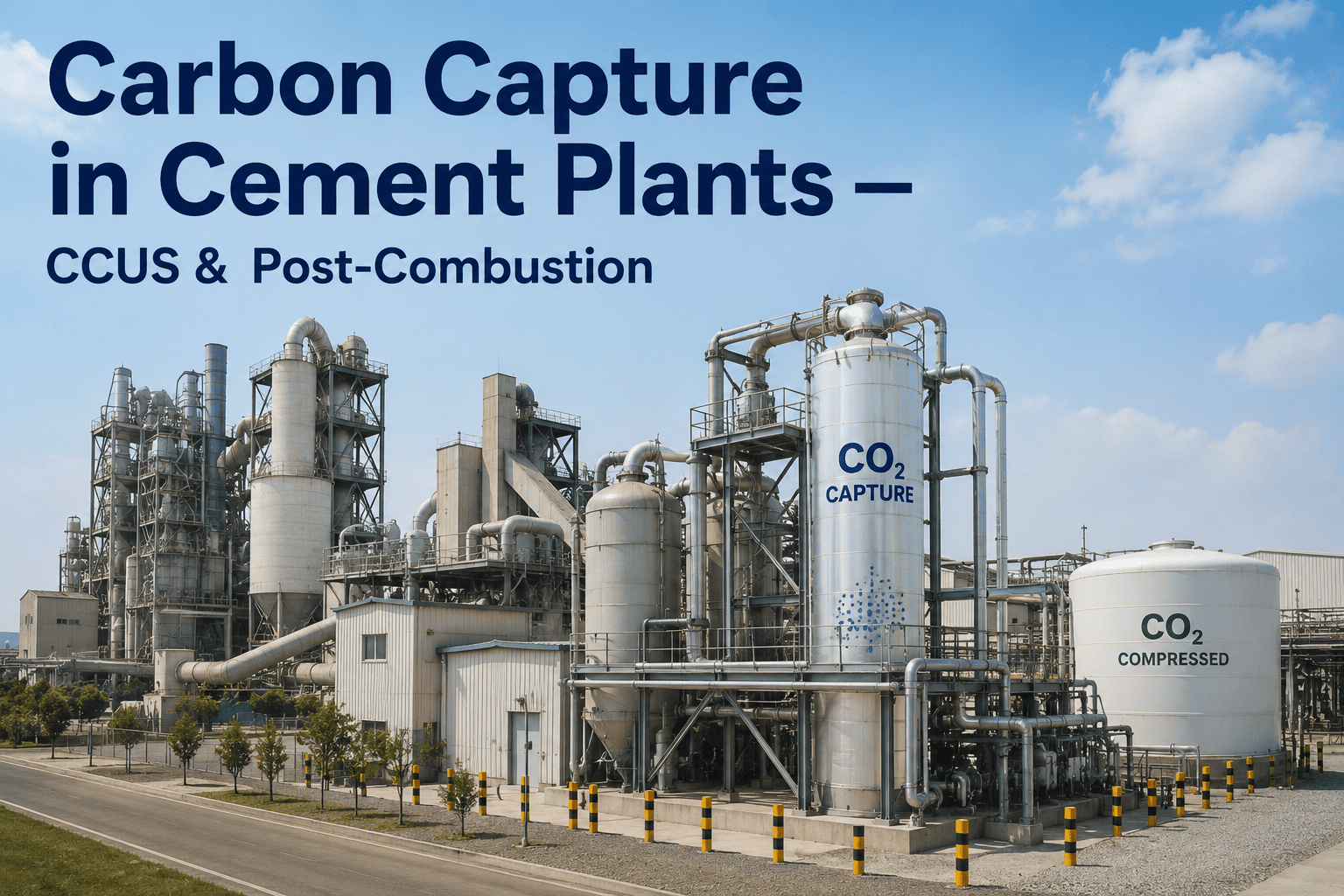
The sustainability director at a 2.2-million-ton cement plant on the U.S. Gulf Coast reviews the company's 2030 decarbonization roadmap and sees a number that stops him: 1.65 million tons of CO2 per year that the plant must capture or avoid to meet the corporate net-zero commitment — 780 kilograms of CO2 per ton of clinker at the plant's current emissions intensity, multiplied by the 2.1 million tons of clinker the kiln line produces annually. The plant has already implemented every operational efficiency measure available — waste heat recovery, low-temperature catalysis for NOx reduction, alternative fuel substitution at 38%, and SCM blending that has reduced the clinker factor to 74%. The remaining 62% of the plant's emissions are process CO2 from limestone calcination — emissions that cannot be eliminated by fuel switching or energy efficiency. The plant's engineering team has evaluated post-combustion carbon capture systems from three technology suppliers, reviewed the 45Q tax credit qualification requirements, and assessed the CO2 pipeline infrastructure within a 50-mile radius of the plant site. But the evaluation is being managed across three disconnected spreadsheets and a shared network drive — no single platform tracks the technology performance assumptions, the cost estimates, the regulatory milestones, and the emissions baseline simultaneously. iFactory's Emissions Tracking and Process Optimization modules give cement plant sustainability and engineering managers the digital infrastructure to model CCUS technology options against the plant's actual emissions profile, track capital and operating cost estimates against budget, manage the 45Q life-cycle documentation requirements, and monitor captured CO2 volume and utilization pathways in real time — replacing the spreadsheet-based feasibility study with a continuously updated CCUS project management platform. Book a Demo to see iFactory's CCUS project tracking platform configured for your plant's emissions profile and technology pathway.
From 780 kg to Net Zero — The CCUS Technology Pathway for Cement Plants
Process emissions from limestone calcination account for 60-65% of cement plant CO2 — emissions that no fuel switch or efficiency measure can eliminate. iFactory's digital CCUS platform tracks technology evaluation, cost estimation, 45Q compliance, and captured CO2 utilization in one system.
Carbon Capture Technologies for Cement — Performance, Cost, and Maturity by Technology Type
Four carbon capture technology families are commercially relevant for cement plant application — post-combustion amine scrubbing, oxy-fuel combustion, direct separation (calcium looping), and carbon mineralization (carbonation curing). Each technology has a distinct capture efficiency, energy penalty, capital cost profile, and technology readiness level for cement industry deployment. The table below presents the key parameters for each technology type at cement plant scale, based on current published performance data from GCCA-member plant pilots and commercial reference installations.
| Technology | Capture Mechanism | CO₂ Capture Rate | Energy Penalty | Capital Cost ($/t CO₂) | Operating Cost ($/t CO₂) | TRL Level | Commercial Reference |
|---|---|---|---|---|---|---|---|
| Post-Combustion — Amine Scrubbing | Chemical absorption using amine solvents in packed-bed absorber column with thermal solvent regeneration | 90-95% | 2.5-3.5 GJ/t CO₂ | $600-900 | $70-110 | TRL 8-9 — Commercial at Brevik CCS, Norway | Heidelberg Materials Brevik — 400,000 t CO₂/yr; operational 2024 |
| Oxy-Fuel Combustion | Combustion with pure oxygen instead of air — flue gas with 80-90% CO₂ concentration for cryogenic purification | 95-99% | 2.0-3.0 GJ/t CO₂ | $700-1,100 | $60-95 | TRL 7-8 — Demonstrated at pilot scale | Calix LEILAC pilot at Lixhe, Belgium (2019-2023) |
| Direct Separation — Calcium Looping | Circulating fluidized bed where CaO captures CO₂ in carbonator, calcined in oxy-fuel regenerator | 90-97% | 1.5-2.5 GJ/t CO₂ | $500-800 | $50-80 | TRL 6-7 — Demonstrated at 1-10 MW scale | CLEANKER project at Buzzi Unicem Vernasca, Italy |
| Carbon Mineralization | Reaction of captured CO₂ with Ca/Mg-rich wastes to form stable carbonates in concrete or aggregates | 50-85% | 0.8-1.5 GJ/t CO₂ | $300-600 | $35-65 | TRL 5-7 — Pilot reactors operating | CarbonCure, CarbonBuilt, CarbiCrete processes |
Cement CCUS Deployment — Current Commercial Projects and Cost Trajectory
The cement industry's CCUS deployment is accelerating, driven by the 45Q tax credit ($85 per ton for geologic storage, $60 per ton for qualified utilization), the EU Emissions Trading System carbon price exceeding $90 per ton, and the GCCA's Net Zero Roadmap requiring 280 million tons of CO2 capture capacity across the global cement fleet by 2030. The metrics below present the current deployment status, cost trajectory, and project economics for cement CCUS in the U.S. market.
Captured CO₂ Utilization — Market Pathways for Cement Plant CO₂
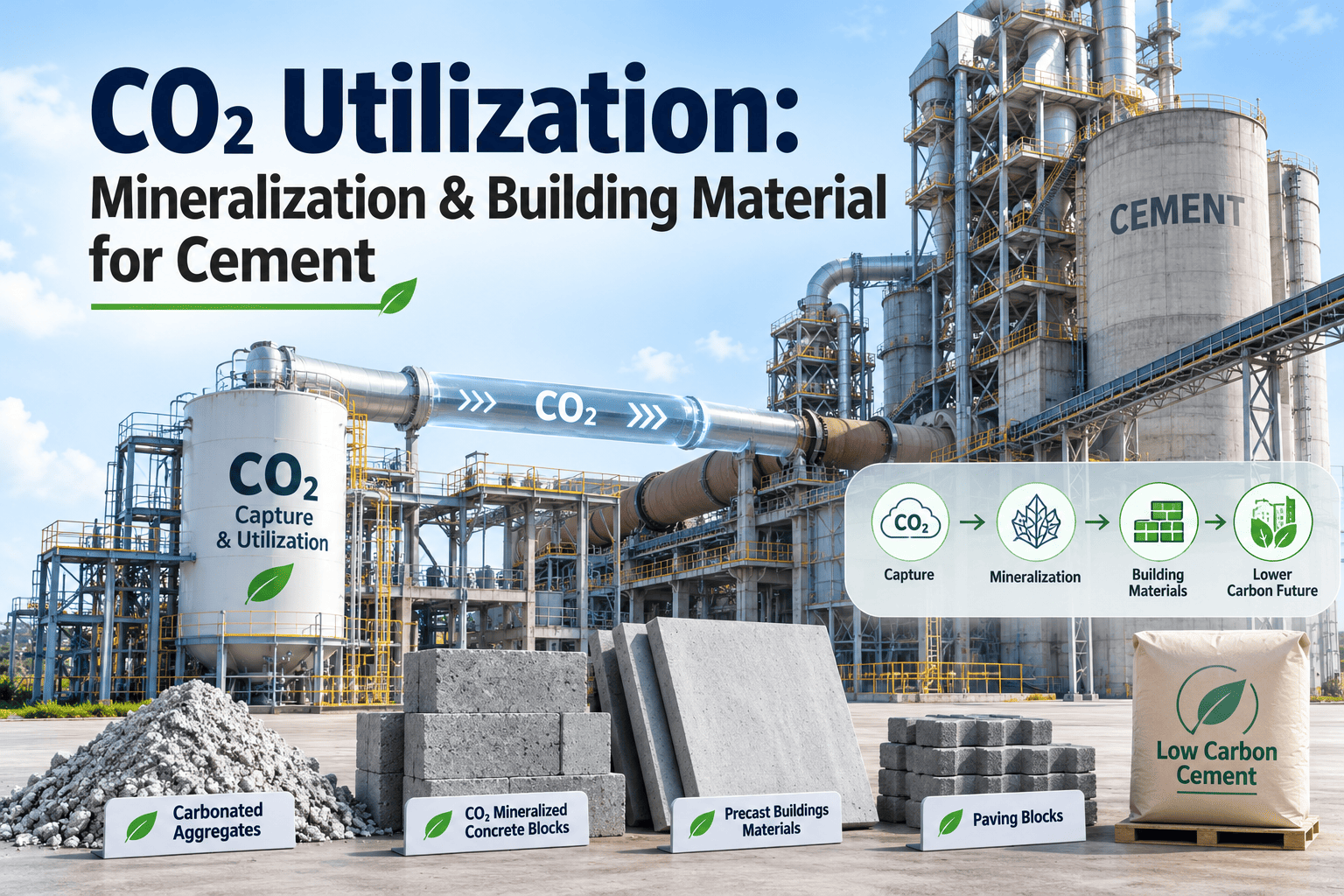
Captured CO₂ from cement plants can be utilized through six primary market pathways — geologic storage, enhanced oil recovery, concrete carbonation curing, synthetic fuels, building materials mineralization, and chemicals production. Each pathway has a distinct CO₂ demand volume, price point, technology maturity, and regulatory framework. The cards below present the key commercial characteristics of each utilization pathway, including the current market price for CO₂ offtake and the volume that a typical 2-million-ton cement plant could supply.
Geologic Storage — Saline Formation
CO₂ injected into deep saline aquifers at 800-3,000 meters depth for permanent mineral trapping. Largest potential volume — U.S. has over 2,000 gigatons of saline storage capacity. Offtake price: $85/ton (45Q credit + storage fee). Volume addressable: 1.2-1.6 million tons CO₂/yr.
Enhanced Oil Recovery — CO₂-EOR
CO₂ injected into depleting oil reservoirs to mobilize residual oil — producing 5-15 barrels of oil per ton of CO₂. Mature at scale — over 50 million tons CO₂ injected annually in the Permian Basin. Offtake price: $25-45/ton. Volume addressable: limited by EOR project proximity.
Concrete Carbonation Curing
CO₂ injected into fresh concrete during mixing or curing — mineralized as CaCO₃ permanently embedded in the product. Applicable to precast, ready-mix, and concrete masonry units. Offtake price: $40-80/ton industrial-grade. Volume addressable: 20,000-100,000 tons/yr per plant.
Synthetic Fuels — E-Fuels
CO₂ combined with green hydrogen (electrolysis with renewable electricity) to produce synthetic methane, methanol, or Fischer-Tropsch aviation fuel. Requires 50-70 kWh per gallon. Offtake price: $4-8/gallon synthetic diesel; $6-12/gallon SAF. Volume addressable: limited by hydrogen availability.
Building Materials Mineralization
CO₂ reacted with Ca/Mg-rich industrial wastes or minerals to produce carbonated aggregates, SCMs, or building blocks. Products replace mined limestone and virgin aggregate. Offtake price: $50-120/ton. Volume addressable: 50,000-500,000 tons CO₂/yr per facility.
Chemicals — Methanol and Urea
CO₂ as feedstock for methanol (CO₂ + H₂ → CH₃OH) or urea (CO₂ + NH₃ → NH₂CONH₂). Methanol market: 100M tons/yr; urea market: 180M tons/yr globally. Offtake price: $100-300/ton green methanol. Volume addressable: limited by green hydrogen production cost.
What Stands Between a Cement Plant and Commercial CCUS — The Three Critical Barriers
Every cement plant considering CCUS deployment faces the same three barriers — the capital cost of the capture system, the energy penalty of operation, and the CO₂ transport and storage infrastructure gap. These barriers are not theoretical. They are the engineering and economic constraints that every project team must address in the feasibility study and front-end engineering design phase. iFactory's CCUS project tracking module helps project teams manage all three barriers simultaneously — tracking cost estimates, energy integration studies, and infrastructure development milestones in a single platform.
Capital cost — $300 million to $600 million per plant
The installed capital cost of a post-combustion amine capture system at a 2-million-ton cement plant ranges from $300 million to $600 million depending on the capture technology, site conditions, balance-of-plant requirements, and CO₂ compression and dehydration equipment. For a plant with an annual EBITDA of $40-80 million, a $400 million capital investment requires a 5-10 year payback period — achievable only with 45Q tax credit monetization, DOE Industrial Demonstrations Program grant funding, or a carbon contract for difference that guarantees a minimum carbon price.
Energy penalty — 25-35% increase in plant power consumption
Amine-based post-combustion capture requires 2.5-3.5 GJ of thermal energy per ton of CO₂ captured — delivered as low-pressure steam for solvent regeneration. For a cement plant capturing 90% of its 1.65 million tons of annual CO₂ emissions, the steam requirement is equivalent to 50-70 MW of thermal energy, which typically requires a dedicated natural gas boiler or steam extraction turbine. The additional power consumption for CO₂ compression, solvent pumping, and cooling water circulation adds 15-25 MW of electrical load — increasing the plant's purchased power cost by $5-10 million per year at current industrial electricity rates.
CO₂ transport and storage infrastructure — the missing middle
The U.S. has 5,100 miles of CO₂ pipelines — concentrated in the Permian Basin, Gulf Coast, and Rocky Mountain regions for enhanced oil recovery. For a cement plant in the Midwest or Southeast, the nearest CO₂ pipeline connection may be 50 to 200 miles away, requiring a dedicated pipeline spur at $2-4 million per mile or truck/rail CO₂ transport at $15-30 per ton. Geologic storage sites require site characterization, permitting, and EPA Class VI injection well construction — a 3-5 year process before the first ton of CO₂ can be injected. iFactory tracks all infrastructure development milestones and regulatory application deadlines.
Cement Production Economics — Without CCUS vs With Post-Combustion Carbon Capture
The financial impact of installing carbon capture on a cement plant goes beyond the capital cost of the capture system. The comparison below presents the full cost of cement production for a 2-million-ton-per-year plant operating without carbon capture and with a post-combustion amine capture system achieving 90% CO₂ capture rate — including capital recovery, energy penalty, CO₂ transport and storage, and 45Q tax credit monetization at current market assumptions.
Without CCUS — Current Operations
- Cement production cost: $62-78 per ton (all-in, delivered to market)
- CO₂ emissions intensity: 780 kg per ton of cement
- Annual CO₂ emissions: 1.56 million tons
- Carbon compliance cost: $0 per ton (no federal carbon price in the U.S.)
- Voluntary carbon market: $5-15 per ton for verified emissions reductions
- Capital expenditure: none for carbon management
- Net cement production cost: $62-78 per ton
With CCUS — 90% Capture Rate
- Cement production cost: $92-118 per ton (all-in, includes CCUS capital and operating cost)
- CO₂ emissions intensity: 78 kg per ton of cement (90% reduction)
- Annual CO₂ captured: 1.40 million tons
- 45Q tax credit at $85/ton geologic storage: $119 million per year
- Net carbon revenue after storage cost: $85-100 million per year
- Capital investment: $350-500 million (depreciated over 20 years)
- Net cement production cost with 45Q monetization: $52-72 per ton
The CCUS Project Development Life Cycle — Feasibility to Commercial Operation
Developing a carbon capture project at a cement plant follows a structured life cycle of six phases, from initial feasibility assessment through commercial operation. Each phase has specific deliverables, decision gates, and regulatory milestones. iFactory's CCUS project tracking module manages the documentation, timeline, and budget for all six phases — providing the project team and corporate management with a single source of truth for project status and decision support.
Feasibility Study
Emissions baseline characterization, technology screening, preliminary cost estimate (-30%/+50%), site assessment, CO₂ transport and storage option identification, 45Q qualification review, and grant funding opportunity assessment. Duration: 6-12 months.
Front-End Engineering Design
Detailed engineering for selected capture technology, Class V cost estimate (-15%/+25%), environmental permit application preparation, CO₂ pipeline or truck route engineering, storage site characterization, and final investment decision package. Duration: 12-18 months.
Permitting and Regulatory
EPA Class VI injection well permit (if geologic storage), Clean Air Act Title V permit revision, NEPA environmental assessment, state CO₂ pipeline siting permits, and 45Q life-cycle documentation registration. Duration: 12-24 months (concurrent with FEED).
Engineering Procurement Construction
Detailed engineering, equipment procurement (capture columns, compressors, heat exchangers, cooling towers, CO₂ pipelines), site civil works, and system construction on a 5-10 acre plot adjacent to the kiln line. Duration: 24-36 months.
Commissioning and Startup
System commissioning, solvent loading and circulation, integrated performance testing at 50/75/100% capture rate, CO₂ quality verification, emissions monitoring system certification, and operator training. Duration: 6-12 months.
Commercial Operation
Continuous 90%+ capture operation, CO₂ transport to storage or utilization offtaker, 45Q tax credit documentation and verification, quarterly emissions reporting, annual MRV third-party audit, and ongoing optimization. Duration: 20-30 years.
What Cement Industry CCUS Project Managers Say About the Path to Commercial Carbon Capture
I have managed carbon capture feasibility studies and front-end engineering design projects at four cement plants across North America over the past eight years — two in the Midwest, one in the Southeast, and one on the Gulf Coast — and the most consistent pattern I have observed is that the technology selection is never the hardest part of the project. The hardest part is managing the data across the six phases of the project life cycle in a way that supports informed decision-making at every gate review. At the first plant where I led the CCUS feasibility study, we had 14 separate files on a shared drive — a technology screening spreadsheet from the engineering consultant, a cost estimate workbook from the EPC contractor, a 45Q qualification tracker from the tax advisor, an emissions baseline file from the environmental team, a storage site screening map from the geology consultant, and a grant funding calendar from the corporate development group. The project team was spending 12 to 15 hours per month on manual data reconciliation — copying cost estimates from one spreadsheet to another, checking whether the emissions baseline in the environmental impact statement matched the baseline in the 45Q application, and verifying that the project schedule in the FEED contract was consistent with the grant funding deadlines. At the fourth plant, we deployed iFactory's CCUS project tracking module and configured it with the project work breakdown structure, the cost estimate categories, the 45Q life-cycle milestones, and the regulatory application deadlines. The project team stopped doing manual data reconciliation. The feasibility study was completed three months ahead of the original schedule, the FEED cost estimate accuracy improved from +/-35% to +/-18%, and the 45Q application was submitted with complete documentation on the first submission — no requests for additional information from the IRS. The technology at that plant — post-combustion amine capture with geologic storage in a saline formation — was the same technology that the first plant had selected. What changed was the data infrastructure supporting the project team. That infrastructure is the difference between a CCUS project that takes eight years from feasibility to first operation and one that takes five years.
— CCUS Project Development Manager, U.S. Cement Manufacturing — 8 Years Carbon Capture Project Management — Professional Engineer (PE) — PMP Certified — GCCA CCUS Working Group MemberCommon Questions About Carbon Capture Utilization and Storage for Cement Plants
Carbon Capture Is the Only Technology That Addresses Process Emissions — and the Data Infrastructure Determines Whether a Project Succeeds or Stalls
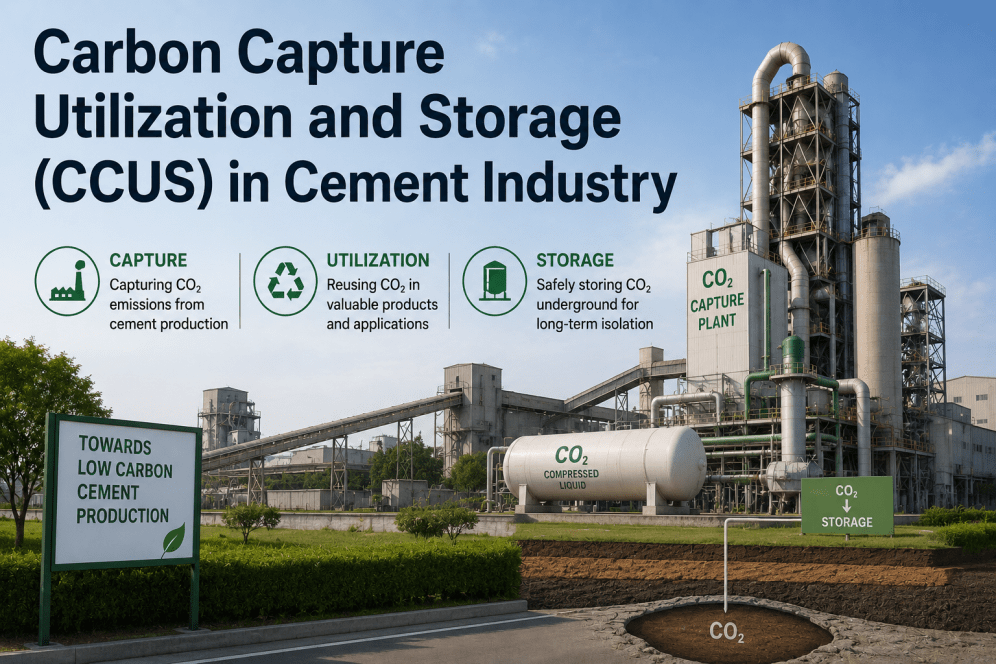
Process CO₂ from limestone calcination — 60-65% of a cement plant's total emissions — cannot be eliminated by fuel switching, energy efficiency, or SCM blending. Carbon capture utilization and storage is the only technology pathway that addresses these process emissions directly. The capital cost, energy penalty, and infrastructure barriers are real, but they are solvable — as the 18 commercial cement CCS projects currently in development across the global industry demonstrate. The variable that determines whether a CCUS project at a specific cement plant proceeds from feasibility to construction to commercial operation is not the technology choice. It is the quality of the data infrastructure supporting the project team — the ability to track cost estimates, emissions baselines, regulatory milestones, 45Q documentation, and infrastructure development in a single integrated platform that gives the project manager and the corporate investment committee the confidence to make informed decisions at every gate review.
iFactory's Emissions Tracking and Process Optimization modules provide cement plant sustainability and engineering managers with the digital infrastructure to model CCUS technology options, track capital and operating costs, manage 45Q life-cycle documentation, and monitor captured CO₂ volume and utilization pathways in real time — replacing the disconnected spreadsheet approach with a continuously updated CCUS project management platform that supports every phase from feasibility study to commercial operation. Book a Demo to see how iFactory's platform manages CCUS project tracking, emissions baseline monitoring, and 45Q compliance documentation for your plant's decarbonization pathway.
Your Carbon Capture Project Needs Better Data Infrastructure — Not a Different Technology
iFactory connects your emissions data, cost estimates, regulatory milestones, and 45Q documentation in a single platform — replacing spreadsheet-based CCUS project management. Book a demo and see the system configured for your plant's emissions profile and technology pathway.