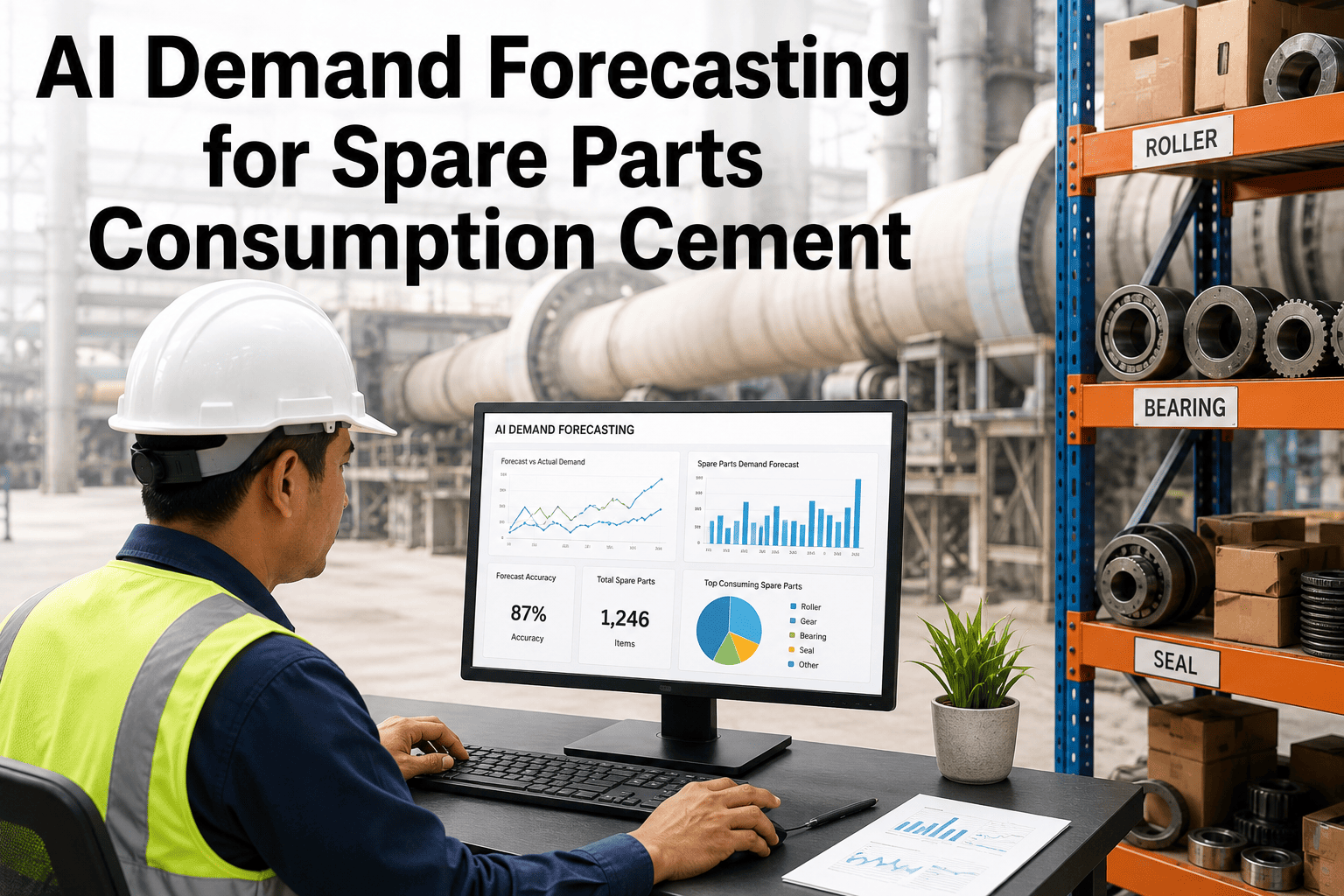
The cement industry operates on margins thin enough that a 5% demand miscalculation in either direction triggers a cascade of costly operational consequences. Overproduce, and your kilns burn fuel grinding clinker that sits in silos for months while carrying costs and working capital interest erode the margin on every tonne. Underproduce during a regional infrastructure spending surge, and you lose delivery contracts to competitors who can fulfill on time — contracts that rarely return once the customer relationship breaks. Traditional demand forecasting in cement relies on sales team estimates, regional historical shipment averages, and seasonal pattern assumptions that ignore the 47 or more variables actually driving cement consumption at any given time: regional construction permit velocity, government infrastructure budget release cycles, monsoon and freeze season patterns, housing starts data, competitor price movements, and macroeconomic indicators that precede construction activity by 12 to 18 months. A 2025 McKinsey analysis found that AI-driven demand forecasting reduces forecast error by 30 to 50% compared to traditional methods across heavy industries — translating directly into optimized kiln scheduling, lower inventory carrying costs, fewer emergency production restarts, and better maintenance alignment with actual demand cycles. iFactory's AI analytics platform delivers purpose-built cement demand forecasting that connects production scheduling, inventory management, and maintenance planning to a single unified demand intelligence model. To see iFactory's forecasting engine running on cement industry data in a live demonstration, schedule a forecasting platform walkthrough with our cement analytics team.
Why Traditional Cement Demand Forecasting Produces Expensive Errors
The Structural Limitations of Sales-Estimate and Historical-Average Forecasting in a Volatile Market
Most cement producers still forecast demand using one of three approaches, each with structural limitations that produce forecast errors large enough to materially damage profitability. The sales-team estimate approach aggregates bottom-up projections from regional sales managers who combine their account relationships, local market intuition, and previous quarter actuals — a process that systematically underweights leading indicators like construction permit velocity and infrastructure budget cycles that precede actual cement purchases by 8 to 18 months. The historical average approach identifies seasonal patterns from 3 to 5 years of shipment history and extrapolates them forward — a model that fails completely when regional infrastructure spending surges, housing market dynamics shift, or an unusual weather season compresses or extends the construction window. The consensus model aggregates both, producing a forecast that averages two structurally limited inputs and presents the result with false precision. None of these approaches ingests the external economic signals that AI models are specifically designed to process: construction permit data by postcode, housing starts by development type, government infrastructure spending commitments by project stage, competitor pricing and capacity changes, and regional industrial activity indices that predict cement consumption 6 to 12 months forward. iFactory's AI demand forecasting engine ingests all of these signals simultaneously, weights them by their demonstrated predictive value for your specific market geography, and produces probabilistic demand scenarios — P10, P50, and P90 — that give production planners the risk-adjusted demand picture they need to make optimal scheduling decisions under uncertainty. To see this forecasting engine applied to real cement market data, contact our cement analytics team to schedule a demonstration.
How iFactory's AI Demand Forecasting Engine Works for Cement
The Data Inputs, Model Architecture, and Operational Outputs That Drive Production Planning Precision
iFactory's cement demand forecasting model is built on an ensemble architecture that trains multiple algorithm families in parallel — gradient boosting models (XGBoost and LightGBM) for tabular historical demand data, LSTM recurrent neural networks for sequential consumption patterns, and SARIMA statistical models for seasonal decomposition and trend separation. An ensemble layer combines outputs from all three model families, weighted by recent accuracy performance for your specific market geography, to produce a single unified forecast that outperforms any individual algorithm consistently. The model is trained on a minimum of 3 to 5 years of weekly or daily shipment data combined with production logs from your SCADA and DCS systems, then enhanced with external demand signals sourced from public APIs and government databases: construction permit records, housing start data, GDP and industrial production indices, weather and seasonal pattern data, and infrastructure project pipeline information from public procurement records. The output is not a single point forecast — it is a probability distribution with P10, P50, and P90 demand scenarios that enable risk-adjusted production planning decisions: produce to the P50 most likely scenario while ensuring physical capacity and spare parts staging for P90 surge events. This probabilistic output structure is what separates iFactory's forecasting from spreadsheet-based methods that present a single number with no uncertainty quantification and leave production planners with no defensible basis for planning decisions under volatile market conditions.
Seasonal demand wave chart SVG5 Operational Domains Where AI Demand Forecasting Transforms Cement Plant Performance
How a Unified Demand Signal Connects Production, Inventory, Maintenance, and Logistics
Demand Forecast Accuracy: The Variables That Drive It and How AI Captures Them
Moving Beyond Shipment History to True Demand Signal Intelligence
Horizontal comparison chartThe Financial Case for AI Demand Forecasting in Cement Operations
Where Forecast Accuracy Translates Directly Into Recoverable Margin
The financial case for AI demand forecasting in cement operations is built from four quantifiable value streams that compound across an operating year. The first is kiln energy waste elimination: every tonne of clinker ground during a low-demand period that sits in silos represents energy already consumed with no corresponding revenue collected. At a typical mid-sized cement plant burning $18 to $24 per tonne in thermal energy, a 5% overproduction error on 500,000 annual tonnes of clinker represents $450,000 to $600,000 in wasted energy cost. The second is missed sales recovery: forecast errors that underproduce during demand surges result in customer orders that cannot be fulfilled on time, with the associated contract risk and relationship damage. The third is maintenance-demand conflict elimination: a single $200,000 to $500,000 kiln shutdown that overlaps with a peak demand week pays for multiple years of iFactory platform investment in a single avoided conflict. The fourth is working capital optimization: silo inventory levels aligned to accurate demand forecasts require less clinker buffer, freeing working capital equivalent to 4 to 8 weeks of clinker grinding cost at typical cement plant throughput rates. Together, these four value streams consistently produce a compelling ROI case for AI demand forecasting that finance directors at cement companies can model directly from their own operational cost data. iFactory's cement analytics team provides assistance in building this financial model using your plant's specific production and cost data — schedule a financial modelling session to quantify your opportunity.
Frequently Asked Questions
What is AI demand forecasting for cement and how is it different from traditional forecasting?
AI demand forecasting for cement uses machine learning models — including gradient boosting algorithms, LSTM neural networks, and seasonal statistical models — to analyze 47 or more demand-driving variables simultaneously, producing a probabilistic demand forecast with P10, P50, and P90 scenarios. Traditional cement demand forecasting relies on sales team estimates, historical shipment averages, and simple seasonal pattern assumptions that typically model only 3 to 5 variables and produce single-number forecasts without uncertainty quantification. AI demand forecasting reduces forecast error by 30 to 50% compared to traditional methods (McKinsey 2025), directly translating into optimized kiln scheduling, lower inventory carrying costs, and fewer emergency production events driven by demand miscalculation. iFactory's AI platform is the only cement industry forecasting solution that connects the demand forecast directly to production scheduling, CMMS maintenance planning, and spare parts pre-staging in a single integrated operational system.
What data does iFactory need to build a cement demand forecast?
The minimum viable dataset for iFactory's cement demand forecasting engine is 3 to 5 years of weekly or daily shipment data by product type and regional distribution point, combined with production logs from SCADA and DCS systems. External demand signals — construction permit data, housing starts, GDP indicators, weather patterns, and infrastructure project pipeline data — are sourced from public APIs and government databases by iFactory's platform, not requiring additional data collection work from your team. Most cement plants already have the internal shipment and production data in ERP and DCS systems; the typical data preparation effort involves extraction and standardization rather than new data creation. iFactory's implementation team handles data migration and model training, typically delivering the first operational forecast within 60 to 90 days of implementation start.
How does iFactory connect the demand forecast to maintenance scheduling at cement plants?
iFactory's demand forecasting engine feeds directly into the CMMS maintenance scheduling module, creating a demand-aligned maintenance calendar that identifies 4 to 12 week demand trough windows where planned shutdowns and non-critical PM tasks can be executed with minimum sales capacity impact. When the forecast predicts a high-demand period, the system automatically defers non-critical maintenance work orders and verifies critical spare parts availability before the production push begins. When it predicts a natural demand trough — winter slowdown, post-monsoon lull, government budget gap — it front-loads the maintenance schedule to maximize asset intervention during the natural low-demand window. Plants using demand-aligned maintenance scheduling report 15 to 20% higher kiln utilization during peak periods and complete elimination of the costly maintenance-demand scheduling conflicts that previously required senior management intervention to resolve.
What is a P10/P50/P90 demand forecast and why does it matter for cement production planning?
A P10/P50/P90 demand forecast presents three demand scenarios: P10 is the pessimistic scenario exceeded 90% of the time, P50 is the most likely demand outcome, and P90 is the optimistic scenario exceeded only 10% of the time. For cement production planning, this probabilistic structure enables risk-adjusted decisions: schedule production to the P50 most likely demand scenario while ensuring physical capacity, silo space, and spare parts staging for the P90 surge scenario. Single-number forecasts force planners to choose between the risk of overproduction (planning to a high estimate) and the risk of undersupply (planning to a low estimate). Probabilistic forecasts eliminate this false choice by quantifying the probability and consequence of each scenario, allowing optimal decisions under uncertainty — a capability that is structurally absent from traditional sales-estimate-based forecasting approaches.
How long does it take to see ROI from AI demand forecasting at a cement plant?
Cement plants typically see measurable ROI from iFactory's AI demand forecasting within the first full production season following deployment — 3 to 6 months for operations in markets with pronounced seasonal demand cycles. The fastest ROI appears in energy cost savings from eliminating overproduction during low-demand periods, followed by working capital improvement from reduced clinker buffer requirements. Medium-term ROI from maintenance-demand alignment — eliminating costly shutdown-peak conflicts — typically materializes within the first 2 to 3 maintenance scheduling cycles. Plants with annual production above 500,000 tonnes and historical forecast error rates above 12% consistently achieve payback within 12 months of full platform deployment, with documented ROI ranging from $1.5 million to $4 million annually depending on plant scale and previous forecast accuracy baseline.
Can iFactory's demand forecasting handle the extreme seasonal volatility typical of cement markets?
Yes. Seasonal volatility is precisely where AI ensemble forecasting outperforms traditional methods most decisively. iFactory's SARIMA model component is specifically designed for seasonal decomposition — separating trend, seasonal, and residual demand components to identify the recurring seasonal cycle accurately. The LSTM neural network component captures multi-year pattern evolution — recognizing when seasonal peaks are shifting earlier or later due to changing construction funding cycles. Real academic research published in 2025 on cement sales data from 2022 to 2024 demonstrated that SARIMA forecasting captured seasonal variation with demand ranging from 200,000 to 650,000 tonnes within the same year — variations that flat historical average models predicted as stable at 320,000 to 350,000 tonnes per month, representing forecast errors of up to 100% at peak and trough periods.
Does iFactory's forecasting integrate with cement ERP and production planning systems?
Yes. iFactory integrates with major cement plant ERP platforms including SAP, Oracle, and Microsoft Dynamics for historical sales data ingestion and production order output. SCADA and DCS system connectivity is provided via OPC-UA and Modbus protocols for production log data. The demand forecast output is pushed to your production scheduling system as a structured data feed that planners can act on directly within their existing workflow tools — iFactory does not require your scheduling team to work in a separate system. Purchase requisitions generated by the demand-triggered spare parts pre-staging function are pushed to the ERP procurement module for buyer review. Most integrations with existing cement plant systems are operational within 2 to 4 weeks of implementation start.
How does iFactory handle demand forecasting for multiple cement grades and product types?
iFactory generates individual demand forecasts for each cement grade and product type in your portfolio — OPC, PPC, SRC, white cement, and specialty blends — with separate models trained on the unique demand drivers for each product category. Different grades have different demand sensitivities: OPC demand correlates strongly with infrastructure project starts; PPC demand tracks residential construction permit velocity; SRC demand follows coastal and marine construction project cycles. iFactory's AI engine captures these grade-specific demand drivers independently, enabling production schedulers to optimize grinding circuit allocation across product grades based on a differentiated demand picture rather than a single aggregate volume forecast that cannot guide grade-level production decisions.