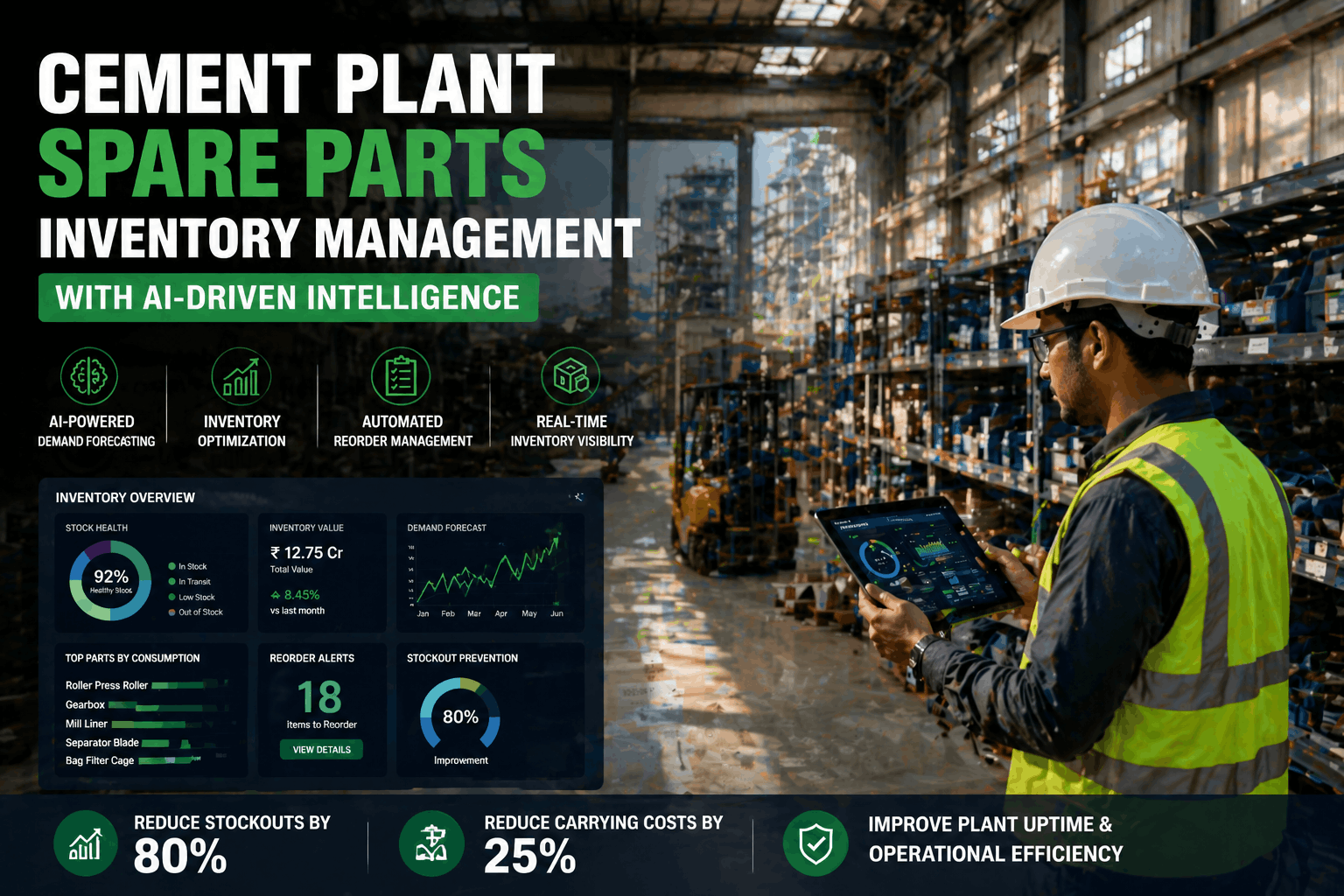
A cement plant in Kentucky lost $280,000 in a single scheduled shutdown because one $340 drone inspection component was not in stock — the 4-day vendor lead time pushed kiln inspection past the relining contractor's arrival window. That scenario is not an outlier. The average cement plant warehouse holds 8,000 to 15,000 unique spare parts, operates under extreme conditions that cause components to wear 30 to 50% faster than manufacturer specifications, and faces annual shutdown windows where months of normal parts consumption are compressed into days. Without a structured critical spares strategy, inventory accuracy degrades silently until the exact bearing, seal, or drive component needed for a critical repair is simply absent — and the $150,000-per-day production line is waiting. A 2025 industry analysis found that 68% of critical-part stockout events at cement plants occurred at plants where the same part had failed before, and where a CMMS corrective action recommending minimum stocking existed but had never been enforced by an automated system. iFactory's AI inventory platform closes this gap — connecting asset health monitoring directly to spare parts demand forecasting, criticality classification, and automated reorder triggers that fire weeks before a stockout can occur. To see how iFactory manages critical cement plant spare parts in a live environment, schedule a spare parts assessment with our cement operations team today.
Why Cement Plant Spare Parts Management Is Uniquely Difficult
The Four Conditions That Make Standard Inventory Approaches Fail in Cement Operations
Cement plant spare parts management operates under conditions that invalidate every assumption standard inventory software was built around. First, the abrasive operating environment — cement dust with a Mohs hardness of 3 to 4 infiltrates bearings, seals, and electrical enclosures continuously, causing components to wear 30 to 50% faster than OEM specifications written for clean industrial environments. Second, the thermal extreme of the kiln circuit — operating at 1,450°C with thermal gradients that cause identical components in different positions along the kiln to fail at completely different rates, making historical average consumption rates meaningless for planning individual part stocking levels. Third, the feast-and-famine demand cycle of the annual shutdown — a 15 to 21 day planned shutdown consumes months of normal spare parts inventory in days, then returns the plant to near-zero consumption until the next event. Fourth, the extreme lead time variance of OEM cement equipment parts — a standard bearing might be available in 3 days, while a kiln girth gear segment from a European manufacturer requires 16 to 24 weeks of manufacturing lead time. Static reorder-point systems designed for predictable, high-frequency industrial parts consumption cannot handle any of these conditions, let alone all four simultaneously. iFactory's AI inventory platform was built specifically for this complexity. Organizations ready to evaluate their current critical spares exposure can contact our cement inventory specialists for a structured assessment.
The ABC-XYZ Criticality Framework: How iFactory Classifies Cement Plant Spares
A Two-Dimensional Classification That Drives the Right Stocking Policy for Every Part Number
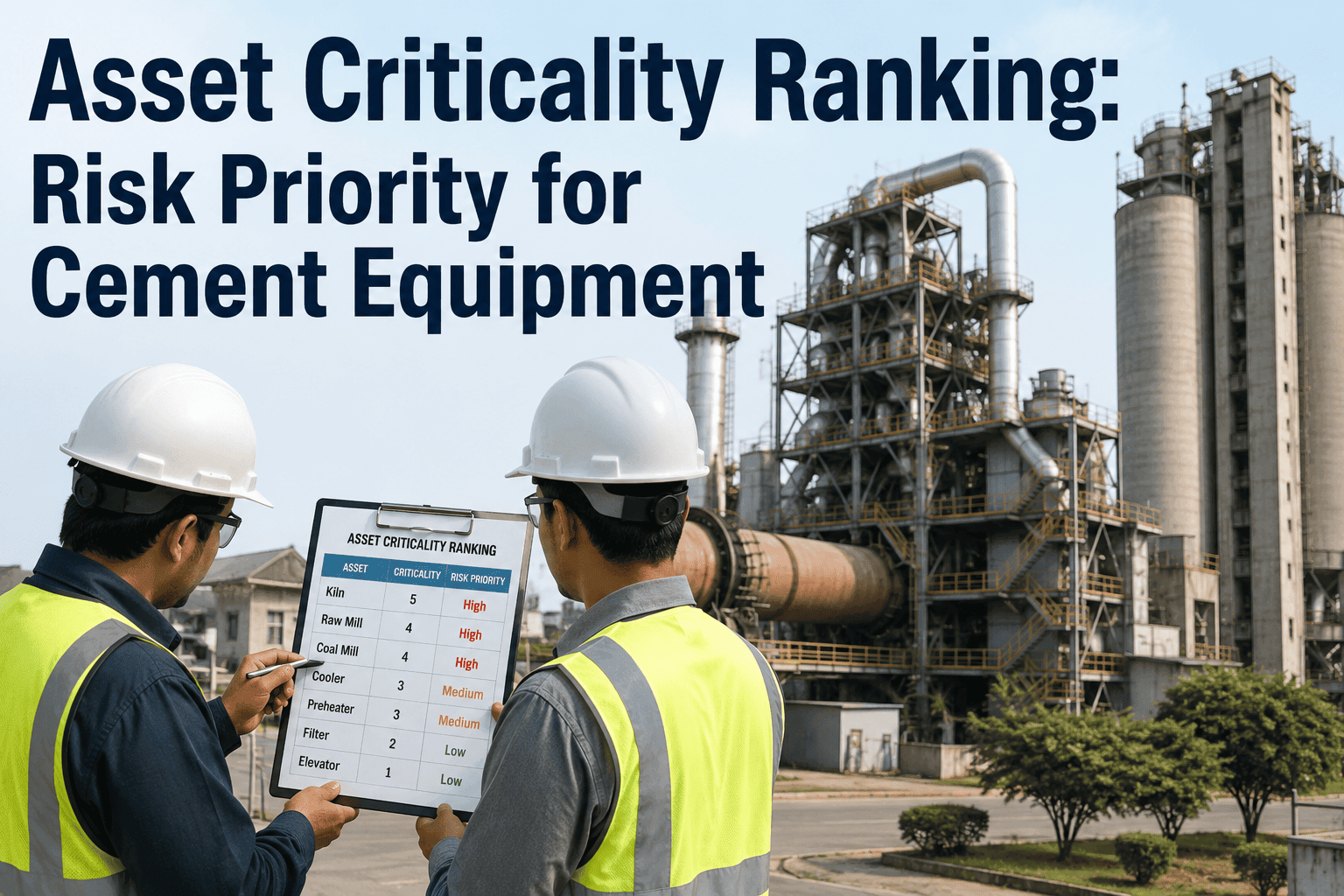
Not all 15,000 spare parts in a cement plant warehouse deserve the same management attention, procurement urgency, or safety stock investment. iFactory's critical spares classification system applies a two-dimensional ABC-XYZ framework that evaluates every part on both value impact and demand predictability — mapping each part to the stocking policy and reorder logic appropriate for its specific risk profile. In the ABC dimension, A-class parts are high-criticality components whose absence causes immediate and catastrophic production stoppage: kiln main bearings, girth gears, kiln drive gearboxes, and vertical roller mill grinding rolls. B-class parts cause significant production impact but allow limited operational workarounds or partial capacity continuation: mill separator bearings, fan drives, and kiln chain systems. C-class parts cause maintenance delays but do not directly halt production: standard fasteners, gaskets, and electrical consumables. The XYZ overlay adds demand predictability: X-parts have stable, predictable consumption that supports automated min-max reordering; Y-parts have seasonal or shutdown-driven demand spikes requiring proactive planning; Z-parts have intermittent, event-driven demand that requires probabilistic forecasting based on asset health signals rather than historical averages. iFactory automatically applies this two-dimensional classification to your entire parts catalogue and links each classification to the appropriate stocking rule — ensuring that A-Z kiln components receive safety stock buffers sized against AI failure probability forecasts, while C-X consumables are managed on automated min-max reorder without manual review overhead.
Pyramid / tier chart using SVG5 Ways iFactory's AI Platform Transforms Critical Spares Management for Cement Plants
From Static Min-Max to Dynamic, Asset-Health-Driven Inventory Intelligence
The Cost of Critical Spares Failure: Financial Exposure by Scenario
What a Single Missing Critical Spare Actually Costs a Cement Plant
| Failure Scenario | Critical Spare Missing | Estimated Lead Time | Production Loss Exposure |
|---|---|---|---|
| Kiln Main Bearing Failure | Main bearing assembly — no stock | 8–14 weeks OEM | $8.4M – $14.7M |
| Girth Gear Segment Fracture | Girth gear segment — no stock | 16–24 weeks manufacture | $16.8M – $25.2M |
| Mill Drive Gearbox Failure | Gearbox internals — partial stock | 6–10 weeks | $6.3M – $10.5M |
| ID Fan Shaft Bearing Failure | Fan bearing — no safety stock | 3–5 weeks | $3.2M – $5.3M |
| Shutdown Delayed by Missing Component | Specialty refractory anchor — 1 missing | 4 days vendor | $280K – $600K |
Insurance Spares vs. Strategic Spares vs. Operational Spares: Understanding the Policy Hierarchy
Why Each Tier Requires a Different Management Approach — and How iFactory Manages All Three
The most common critical spares management mistake at cement plants is applying a single uniform stocking policy to three fundamentally different spare parts categories. Insurance spares — girth gears, kiln shells, main bearings, large fan rotors — have catastrophic failure consequences, extreme OEM lead times (16 to 24 weeks or longer), and zero alternative available during the repair period. These parts require a one-for-one or consignment policy where at least one unit is always in plant regardless of carrying cost. The carrying cost of a single girth gear segment is trivial compared to the $16M to $25M production loss exposure of waiting 24 weeks for a replacement following an unexpected fracture. Strategic spares — separator assemblies, mill internals, major fan shaft assemblies — have significant but recoverable failure consequences and moderate lead times of 4 to 12 weeks. These require safety stock buffers sized against the AI failure probability forecast and the plant's maximum acceptable production interruption duration. Operational spares — standard bearings, seals, belts, electrical components — have predictable consumption patterns and short lead times, making automated min-max reordering with modest safety stock appropriate. iFactory manages all three tiers simultaneously within the same platform — applying the right stocking logic to the right tier automatically, based on the criticality classification and the real-time asset health intelligence feeding the system. To review your plant's current insurance and strategic spares coverage gaps, contact our cement specialists for a structured inventory audit.
Frequently Asked Questions
What is a critical spares management strategy for cement plants?
A critical spares management strategy for cement plants is a structured framework for classifying every spare part in the plant warehouse by its failure consequence severity and procurement lead time, then applying the appropriate stocking policy, reorder logic, and safety stock level to each classification tier. The strategy distinguishes insurance spares — components whose absence causes catastrophic multi-week production loss — from strategic and operational spares that require different stock policies. An effective critical spares strategy for cement plants must account for the extreme operating conditions that accelerate wear rates beyond OEM specifications, the demand surge profile of annual shutdowns, and the 16 to 24 week lead times of OEM cement equipment components that make early reorder triggering essential. iFactory's AI platform implements and maintains this strategy automatically, using asset health sensor data to drive dynamic reorder decisions that static min-max systems cannot achieve.
How does AI improve spare parts management in cement plant operations?
AI improves cement plant spare parts management by connecting physical asset health monitoring directly to inventory demand forecasting. iFactory's AI maintenance platform ingests vibration, thermal, acoustic, and oil analysis data from IoT sensors on kilns, mills, and other critical rotating equipment. When the AI detects a developing fault in a bearing or gearbox, it immediately evaluates the current stock level of the replacement components against the predicted failure timeline and OEM lead time, triggering a purchase requisition automatically if the part is not available with sufficient margin. This asset-condition-driven reorder logic eliminates the scenario where a predictable failure produces an unpredictable stockout — the primary cause of the most expensive unplanned shutdowns in cement manufacturing.
What are insurance spares in cement plant management?
Insurance spares in cement plant management are components whose failure would cause catastrophic, extended production stoppage and whose procurement lead time — typically 16 to 24 weeks or longer for OEM manufacture — means no recovery is possible through emergency procurement once failure occurs. Classic insurance spares in cement operations include kiln girth gear segments, kiln main bearing assemblies, large kiln fan rotors, and vertical roller mill grinding table segments. These components are held at a minimum of one unit in plant at all times regardless of carrying cost, because the cost of holding a spare is always trivially small compared to the production loss exposure of waiting for OEM manufacture following an unplanned failure event.
How does iFactory handle OEM part number normalization across multiple cement plants?
iFactory uses a data normalization engine to map disparate OEM part numbers from multiple equipment manufacturers — FLSmidth, ThyssenKrupp, KHD, Polysius, and others — into a single master catalog across your entire multi-plant operation. The system identifies components that are physically identical or interchangeable even when catalogued under different OEM part numbers at different plants, creates a unified cross-plant inventory view, and automatically identifies inter-plant transfer opportunities when one plant's emergency demand can be met from another plant's available stock. For cement groups with two or more plants, this normalization exercise consistently reveals hundreds of thousands to over a million dollars in transferable spare parts inventory that was previously invisible in siloed plant-level CMMS systems.
How does iFactory manage spare parts procurement for the annual cement plant shutdown?
iFactory's shutdown integration connects the maintenance work order planning system directly to the inventory engine. As shutdown work orders are defined — kiln refractory replacement, mill liner renewal, drive gearbox overhaul — the system automatically evaluates current stock levels against defined parts requirements, calculates OEM lead times against the shutdown start date, and generates purchase requisitions with sufficient advance notice to avoid premium freight and expedited sourcing costs. This automated shutdown pre-planning replaces the 3 to 4 weeks of manual parts list compilation that maintenance planners previously performed before each major shutdown event, and eliminates the emergency procurement scenarios that arise when a required part is discovered to be out of stock after the shutdown has already started and the kiln is already cold.
What causes phantom inventory at cement plant parts stores and how does iFactory fix it?
Phantom inventory at cement plants occurs when parts are consumed in repairs or borrowed for field use without a corresponding CMMS transaction, causing the system to show stock that does not physically exist. The problem compounds silently across thousands of part numbers until a critical repair requires a part the system shows as available but the shelf is empty. iFactory eliminates phantom inventory through mandatory barcode and QR code scan-out enforcement via mobile app — every part issue from stores requires a scan transaction linked to the associated work order before leaving the shelf. Physical inventory accuracy rates at cement plants using iFactory's scan-enforced issue process exceed 98% within 90 days, compared to documented accuracy rates of 60 to 75% at plants using paper pick lists or manual CMMS entry without scan enforcement.
How long does it take to deploy iFactory's spare parts management platform at a cement plant?
iFactory's cement plant spare parts implementation begins with a data onboarding phase — typically 2 to 3 weeks — in which the existing parts catalogue is imported, OEM part numbers normalized, and criticality classifications applied. IoT sensor connectivity to critical assets is established during weeks 2 to 4, providing the first asset health signals to the inventory forecasting engine. The dynamic reorder logic is configured and activated in weeks 4 to 6, with the first AI-driven purchase requisition recommendations reviewed by the procurement team before full automation is enabled. Most cement plants have the complete AI spare parts platform operational within 6 to 8 weeks of implementation start, with measurable inventory accuracy improvements visible within the first 90 days of operation.
How does iFactory integrate with existing cement plant ERP and CMMS systems for spare parts?
iFactory connects to major cement plant ERP platforms including SAP PM, Oracle EAM, and Microsoft Dynamics, as well as dedicated CMMS systems via standard APIs and OPC-UA data protocols. The integration is designed to complement and enhance existing ERP investments rather than replace them — iFactory adds AI demand forecasting, asset-condition-driven reorder triggering, and multi-site pooling intelligence on top of the transactional inventory records already maintained in your ERP system. Work order consumption data flows from CMMS to iFactory's inventory model automatically, and purchase requisitions generated by the AI reorder engine are pushed back to the ERP procurement workflow for buyer review and approval. Most ERP and CMMS integrations are fully operational within 2 to 4 weeks of deployment start.