Every rotary kiln running alternative fuels or chloride-bearing raw materials eventually hits the same wall: chlorine and alkalis don't exit with the clinker, they evaporate in the burning zone, travel back up with the gas stream, and condense on cooler material further up the preheater. Left unmanaged, this internal cycle builds coating, plugs cyclones, and forces a kiln stop that has nothing to do with the burner and everything to do with chemistry nobody was tracking. A bypass system breaks that cycle, but running one efficiently is a balancing act most plants still manage by feel — this is where continuous bypass analytics change the equation.
Cement Kiln Chemistry Management
Your Bypass Rate Is Either Costing You Fuel or Costing You a Kiln Stop
Run the bypass too low and volatile chlorides and alkalis build coating until the preheater plugs. Run it too high and you're throwing away heat and dust you didn't need to remove. Most plants have never measured exactly where that line sits.
Why Chlorine and Alkalis Won't Just Leave With the Clinker
Inside a rotary kiln, the process runs counter-current: raw meal moves toward the flame while hot gas moves the opposite direction, back up through the preheater. Chlorine, potassium, and sodium volatilize in the high-temperature burning zone, ride the gas stream upward, and condense back onto raw meal particles once the gas cools enough — typically somewhere in the lower cyclone stages. That condensed material falls back down into the kiln, re-volatilizes, and rises again. Without an exit point, this loop concentrates a little more chlorine and alkali on every pass, and the buildup shows up as sticky coating, cyclone blockages, and unplanned kiln stops that trace back to chemistry, not mechanics.
1
Volatilization
Chlorine, sodium, and potassium evaporate from the raw meal in the kiln's burning zone at peak temperature.
2
Gas Transport
Volatile compounds ride the kiln exhaust gas backward through the kiln and into the lower preheater cyclones.
3
Condensation
As gas cools in the lower cyclone stages, chlorides and alkalis condense onto incoming raw meal particles.
4
Re-Circulation
Condensed material falls back into the kiln and re-volatilizes, concentrating further with every pass unless removed.
What a Bypass System Actually Removes
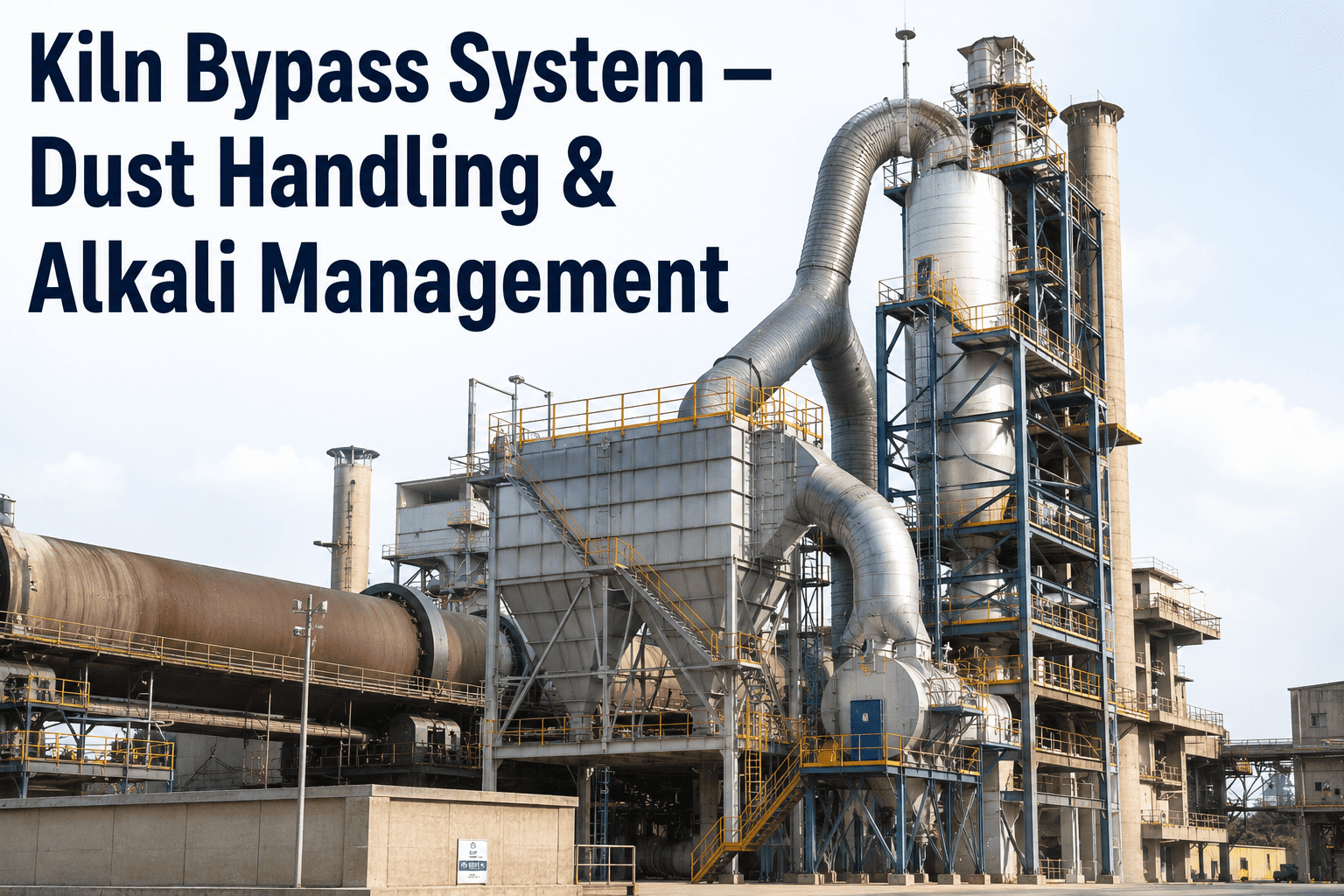
A bypass draws a controlled fraction of kiln inlet gas — typically 5 to 15 percent — before it enters the preheater, quenches it rapidly with cold air to condense the volatile compounds onto fine dust, and captures that dust in a dedicated filter before the gas rejoins the main system. That single extraction point is what gives the volatile cycle somewhere to exit instead of concentrating indefinitely.
Gas Bypass
Extracts kiln inlet gas directly, removing chlorine and a portion of sulfur before the gas reaches the preheater cyclones. The most common configuration in modern dry-process kilns.
Hot Meal Bypass
Diverts a portion of hot meal from the kiln riser duct rather than gas, reducing chloride carried forward into the kiln without pulling as much heat out of the system.
Dust Bypass
Targets heavy metals and fine particulate specifically, used where alternative fuel co-processing introduces contaminants beyond chlorine and alkali alone.
Finding the Right Bypass Rate Is a Moving Target
The correct bypass rate is not a fixed number — it depends on the chloride and alkali input from your specific raw materials and fuels on any given day, and that input shifts constantly with alternative fuel mix, raw material source, and even weather-driven moisture changes. Set the rate too low and hotmeal chloride and alkali levels creep upward until coating and blockage risk rises. Set it too high and the plant is pulling more heat and dust out of the system than the chemistry actually requires, which shows up directly as wasted fuel and unnecessary bypass dust disposal cost.
Bypass Rate Too Low
Chloride and alkali accumulate in the hotmeal cycle
Sticky coating builds in lower cyclone stages
Risk of cyclone blockage and unplanned kiln stop rises
Alternative fuel co-processing rate has to be capped to compensate
Bypass Rate Too High
Excess heat is extracted with the bypass gas, raising specific fuel consumption
More bypass dust generated than the chemistry requires
Higher disposal or processing cost for chloride-enriched dust
Unnecessary strain on bypass fan and quench air system
Bypass dust with over 0.1% chloride content measurably lowers 28-day cement strength if added back untreated — which is exactly why getting the rate right, continuously, matters as much for product quality as it does for fuel cost. See what your own kiln inlet gas data says about your current bypass efficiency.
Book a 30-minute demo and bring recent bypass and hotmeal chemistry logs.
Where Bypass Dust Goes After It's Captured
Bypass dust doesn't have to be a pure disposal cost. Because it concentrates chloride and alkali in a fine fraction, several paths exist for recovering value or reducing landfill volume — and the right path depends on the composition of your specific dust stream, which is exactly the kind of data that benefits from continuous tracking rather than periodic lab sampling.
Air Classification
Separates the fine, chloride-enriched fraction from a coarser fraction that can be returned to the raw mix, cutting landfill volume significantly.
Water Washing & Leaching
Recovers potassium chloride and other salts from the dust through washing and leaching, turning a disposal cost into a saleable byproduct stream.
Controlled Reintroduction
Low-chloride fractions can sometimes be blended back into cement in small quantities without measurably affecting compressive strength.
Frequently Asked Questions
How does AI actually improve bypass rate control compared to fixed setpoints?
Most kilns run bypass rate at a fixed percentage set months or years ago, adjusted only when an operator notices coating problems or excess dust cost. AI-based monitoring instead correlates kiln inlet gas chloride and alkali readings, hotmeal chemistry, and bypass dust composition continuously, recommending rate adjustments as raw material and fuel inputs actually shift. This keeps the bypass rate closer to the minimum needed to control the volatile cycle at all times, rather than a static number that's either overshooting or undershooting depending on the day.
See this correlation running against your own kiln data.
What data do you need to start optimizing our bypass system?
The core dataset includes kiln inlet gas analysis, hotmeal chloride and alkali lab results, bypass dust composition, bypass rate and gas offtake volume, and alternative fuel mix records if your kiln co-processes waste-derived fuels. Most cement plants already generate this data through routine process control and quality lab sampling; the gap is usually in connecting it into one continuously monitored view rather than reviewing each stream separately on its own schedule.
Ask our team what your current systems already capture.
Can better bypass control let us increase our alternative fuel co-processing rate?
In many cases, yes — chloride input from alternative fuels is often the limiting factor capping how much waste-derived fuel a kiln can safely co-process, since higher chloride input requires either a higher bypass rate or accepting more coating and blockage risk. Continuous bypass optimization gives plants better visibility into exactly how much headroom exists, letting fuel substitution decisions be made against real chemistry data rather than a conservative fixed limit set once and never revisited.
How much fuel is actually wasted by running the bypass rate too high?
Every percentage point of bypass gas removes heat along with it, since the extracted gas is quenched and vented rather than recovered through the normal preheater cascade. Plants running bypass rates above what their actual chloride and alkali input requires are effectively paying a continuous fuel penalty for chemistry control they don't need at that level. Because German cement plants typically operate in the 5 to 15 percent bypass range depending on raw material and fuel chemistry, a plant running consistently at the high end of that range without input data variability to justify it is a strong signal that rate optimization has room to recover fuel cost.
Bring your bypass rate history to a demo and we'll help you check.
Does bypass dust composition tell us anything about upstream raw material quality?
Yes — because bypass dust concentrates whatever volatile chlorine, sulfur, and alkali entered the kiln that day, tracking its composition over time effectively gives a real-time proxy for raw material and fuel chemistry variability that would otherwise only show up in periodic lab sampling. A sudden shift in bypass dust chloride content often flags a raw material source change or contaminated alternative fuel batch before it becomes visible anywhere else in the process, making it a useful early warning signal beyond bypass rate control alone.
Stop Guessing Where Your Bypass Rate Should Sit
See Your Kiln's Volatile Cycle Mapped From Real Data
Bring recent kiln inlet gas, hotmeal chemistry, and bypass dust records. We'll show you where your current bypass rate sits relative to what your chemistry actually requires — and what that gap is costing in fuel or blockage risk.